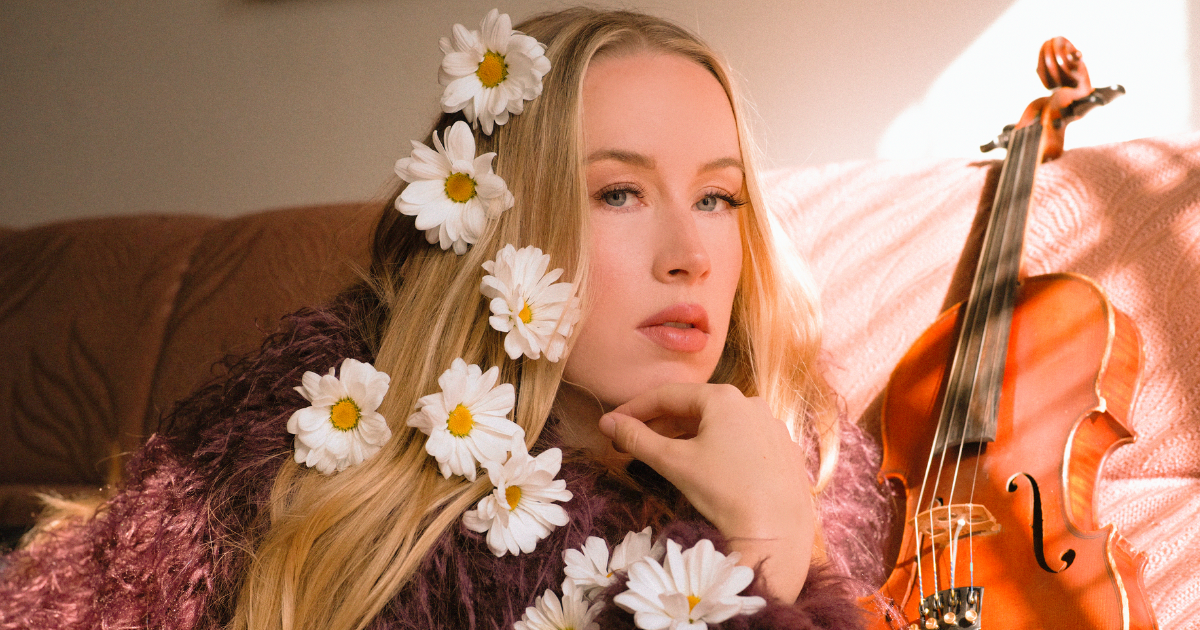

Playing the fiddle has been part of Bronwyn Keith-Hynes’ life since discovering the instrument when she was 3 years old. By age 10, she had become serious about music. She attended fiddle camps, joined her first band at 13, and took lessons, but always gravitated toward ear training.
This approach changed when she attended Berklee and enrolled in their American Roots Music program, where she met, studied, lived with and jammed with a collective of musicians, many of whom would later settle in Nashville as part of a new bluegrass generation. Those personal connections from Berklee led to her becoming an integral part of the bluegrass group Molly Tuttle & Golden Highway until the ensemble parted ways last year. (Read our BGS interview with her Golden Highway bandmates Molly Tuttle, Kyle Tuttle and Shelby Means.)
Now professionally just known as Bronwyn, the two-time IBMA Award-winning fiddle player has stepped out on her own as a full-time solo artist, front and center as a musician, vocalist, and bandleader. While her two prior albums established her first as a virtuoso player and then also as a talented vocalist, her new album Rattlin’ Bones takes her to the next level. Co-produced with Brent Truitt, the collection explores the musical territory within bluegrass while incorporating flavors from her Celtic and jazz roots.
On a July afternoon in Nashville, Bronwyn – our BGS Artist of the Month for September – discussed her dedication to practicing, the throughline between jazz and bluegrass jams, and who’s most likely behind the wheel of her tour van.
BGS: With Rattlin’ Bones ready for release, are you feeling a sense of relief that it’s done? Anticipation for the world to hear it? Satisfaction of goals accomplished? All of the above?
Everything. I’ve been playing some of these songs live [since the spring], I’ve been teasing some of them at some shows, and so I’m excited for people to hear the whole thing. I feel like I’ve been hanging on to this for a little while now.
Was the album complete when you began performing the songs?
No, it was still getting mixed. It all got recorded last year, and I feel like I’ve been building the plane as it’s taking off. Last year was my transition year. Golden Highway was wrapping up, and I was starting to do my own shows in the second half of the year. I was writing as much as I could for this record and recording as I wrote it. As soon as I wrote a couple songs I liked, I would go into the studio, record them, and then try them out after I recorded them or I came up with an arrangement. So it’s been this process over the last year.
Does playing them live sometimes change the arrangements?
Yes. Playing them in the studio is one thing, but as soon as you play it live, you’re like, “It has to be faster when we do it live,” or “This section should be longer,” or whatever. It’s a different experience when you’re listening to an album versus at a live show. So I think they’re all right for the studio, but then there are some moments … and that was part of the intention of coming up with these arrangements. I wanted places that could stretch and contract, based on the night and the audience. I wanted to deliberately have places that could breathe and we could do different things, because different things will feel good on different nights.
You mentioned stretching and changing the songs and the improvisational moments. Talk about that a little bit — working those out within the structure of the studio and keeping that balance of instrumental breaks and vocals.
That was definitely a consideration. We want the songs to be first and foremost. I feel like everything serves the song. If there needs to be a big solo to make the song feel complete, then that’s what should happen on the record. But it also comes down to who you have in the studio.
I was able to get some of the best musicians out there, and when you’ve got people like that, they all intuitively are able to create magic. We all know when it’s right, when the arrangement is right, and when the take is right. Brent is definitely the overarching ears, but oftentimes the whole band is going to come to a consensus on what the best take was. It’s a feeling. When you’ve got people like that in the studio, they just make the magic.
Your early love was ear training, rather than theory, but your formal education at Berklee was, in fact, theory. Did that require any undoing of what we’ll call “bad habits”?
It was a real challenge. I’ve always been an ear learner. That’s always been easy for me, and visually has always been harder. In the Berklee environment, there were ear-training classes, of course, but the majority of stuff was eye-based and that was really tough. I had to work extra hard to develop that at all, but learning theory does really help make stuff make sense and makes me able to make faster connections. Once you actually learn how those sound, then you have the complete picture, and so I was able to put together a lot of the pieces while I was at school, and connect some dots that I hadn’t really understood before.
Now I’m back to being an ear person. I never read music. I’ll look at a chart if I need to, but as soon as I can get it in my head, I’m able to play better than if I’m staring at the chart. In the studio you do have the charts, but it feels like everybody uses the charts as a very rough guide just to make sure they’re on track. But they’ve got it in their minds more intuitively, and so they are really playing by ear after the second take.
True or false: When you went to Berklee, you were on track to study jazz.
True. That was my idea — I thought I was going to be a Celtic jazz fiddler. I was going to blend the two somehow together. I got to Berklee and jazz was really hard. There was this whole American Roots Music program that had just started, and they’d brought all these great bluegrass players there that year. I met them all and was at jams with them and I got really inspired to play bluegrass.
Do you see a throughline in those two genres, which on the surface may seem completely different, but at the core are about improvisation and jamming?
Oh, totally. And they’re both authentic American forms of music, which is super cool. I think what made bluegrass easier to get into, rather than jazz, is because I’m coming from a fiddle background. I had this fiddle vocabulary. I had to learn the bluegrass idiom to some degree, but it all was a lot closer to what I was used to than learning a whole jazz language, so it felt like an easier way to express myself and be able to improvise in a genre that was closer to home.
Do you still feel some of that jazz influence in your playing?
I’m always going to be inspired by it. Honestly, the further I get with bluegrass, and the more comfortable I get with bluegrass, I feel like I can stretch out and try for some extended notes or weird-sounding stuff or some more jazz vocabulary. I feel like you never stop learning, and hopefully you never stop growing, as a musician, so that does feel like something I would love to get more and more into.
You are the outlier who loves to practice. What does your practice consist of? How do you keep it enjoyable as opposed to becoming a chore?
Oh, man. I wish I had more time to practice. I don’t have enough time these days and it’s a bummer, actually. There are times when it’s a chore, but that’s when there’s a certain thing I have to do, something I have to learn. Usually what makes it fun is visualizing where it’s going, visualizing that I’m going to play this onstage, and so I’m going to come up with all these cool ideas. Thinking about playing for a crowd or playing for somebody makes it fun. I love learning new stuff. The challenge of learning somebody’s solo or learning a new tune or song is fun.
A learning experience versus scales or finger exercises.
Definitely. But I go through periods of time recognizing some technique issue that needs to be resolved and trying to work on that in particular, and that is very satisfying too. It’s almost like going to the gym and working on abs, or arm day, and the satisfaction when you’re in it or when you’ve done it. You’re like, “I did something for myself today.”
Keeping with the gym analogy, how much of the live performance is muscle memory?
That’s what you’re relying on. That’s the thing that, first of all, helps you out in a high-pressure situation. Anytime I’m on a television show or something, I’ve made sure I’ve played that song so many times that if I’m going to have to play it one more time, hopefully there’s almost no way I can mess it up.
It also gives you this bedrock for improvisation and trying new things, because you have this thing that you can fall back on. You have this comfort with the song or with a certain solo, and then you’re like, “I know how this goes, so I can step away from it and always feel like I have something to come back to.”
What makes you a good bandleader? What did you learn as a band member that you apply to now being in charge?
I feel a lot of responsibility to the band on so many levels. I want to make sure there’s enough shows for them to make enough money, I want to make sure the travel is good, their accommodations are comfortable, that the schedule is clear, that they have enough time to have breakfast, all these little things. I think a good bandleader genuinely cares about their band and puts their band first in terms of comfort.
I do all the driving, and I try to make everybody’s life as comfortable as possible, because it’s a big sacrifice on their end. They’re going out for a whole year, or however long, to play my music, and it’s a real honor that such great musicians would do that, so I try to put them first as much as I can.
You do all the driving?
When we’re in a van, I do. Sometimes they help. They’re always offering to help, but there’s a stubborn part of me that feels like that’s not their job and they shouldn’t have to do that. It’s my burden to bear. Hopefully, at some point, I’ll be able to hire a tour manager to do that, but for now I try to do it. It’s just the five of us on the road, no extra help, so it’s all hands on deck and they are all super helpful. It really feels like a team effort, which is awesome.
Do you still teach?
I do occasionally. I’ve got a couple students, one kid and a couple adults, over Zoom, and occasionally I do group classes over Zoom, which has been really fun and a nice way to reach more people. I love teaching. I used to do a lot of it, and I feel like I have a lot to share and a lot of insight. I didn’t grow up playing bluegrass. I came to it when I was a late teenager and in college, so I feel like I had to analyze it more to make it make sense to me, and maybe some of the ways I approached it at that time have helped a lot of my students.
What do students want to learn and what do they need to learn?
Sometimes they want to learn flashy licks, and what they need is better timing and fundamentals. I think that’s the classic teacher-student push and pull — the student wants to learn something fun, and the teacher sees fundamental issues that are going to prevent them from moving forward until they deal with them. So it’s trying to balance that as a teacher and make sure the lesson is fun, but that they can still improve these fundamental things.
What do you hope people take from Rattlin’ Bones, and what do you hope to bring to the stage as a group when you perform this music?
I hope it’s a fun album for people to listen to. I hope it’s one they want to come back to. I hope it’s one they want to turn up loud and blast on a road trip. I wanted to make a fun album, and I wanted to make an album of songs that would be fun to play live. So I hope that translates into the show.
We have been playing some of these songs live, but I’m so excited for people to have heard the record and then recognize the songs when we play them. It’s always a rush when you’ve heard a song on the record and the band is playing the song you’ve been listening to live. I’m excited to have those moments.
Photo Credit: Alexa King Stone