
If you’ve heard the songs “Shady Grove” or “Black is the Color,” it’s likely because of Jean Ritchie. Now, thanks to a recording that had been lost for decades, Jean Ritchie’s voice can be heard in a new way. A rare, high-fidelity recording of one of Ritchie’s concerts from 1960 is now available, and it may contain some of her last renditions of songs whose places she solidified in the folk music canon.
Born in 1922, Ritchie was a prolific source singer who memorized over three hundred songs over the course of her life, mostly during her childhood in Viper, Kentucky. The term “source singer” refers to someone who learns songs orally and organically (as opposed to from a book or recording), and Jean Ritchie fits the bill; for example, she was one of the primary sources for Alan Lomax’s Folk Songs of North America. She was, however, far more than a source singer. She was a storyteller, folk song collector, musicologist, songwriter, and engaging performer, as the newly unearthed performance demonstrates.
In 1960, Ritchie was invited to perform at the University of Indiana by folklorist and musician Ellen Stekert. At the time, the Bloomington-based school had an illustrious graduate folklore studies program, meaning that many of the students in attendance had likely heard of Ritchie. Stekert organized for the concert to be recorded and then released it on her radio program on WFIU, The World of Folk Music. For the next sixty years, the reel-to-reel tapes gathered dust in Stekert’s impressive folk music archive.
In July, those recordings were rediscovered and released thanks in part to Ross Wylde, Stekert’s producer, who mixed and remastered the recordings. As a teenager, Wylde had started a YouTube channel called “Swingin’ Pig” (a reference to the bootleg label that released music from many popular musicians, including Bob Dylan). Originally, the channel focused on Dylan recordings, but Wylde has recently expanded his mission. The channel, which is the home of the newly unearthed Jean Ritchie concert, now has a description that reads, “Dedicated to the preservation and accessibility of rare music.”
Stekert, 91, was a contemporary of Ritchie’s, and has this to say about the iconic performer: “Jean Ritchie wasn’t just authentic; she was special, a singular artist who bridged two worlds and left them both infinitely richer. She was a brilliant ambassador who combined the traditional world she grew up in with an ever-changing commercial market.”
The stereotype of a source singer is someone who is poor, lives in a remote rural area, and has no knowledge of the music industry. While Ritchie may have grown up in a poor rural area, as Stekert’s words suggest, she was savvy when it came to the complexities of performing folk music for a modern audience. At one point during the 1960 concert, Ritchie discusses an appearance she had recently made at Cooper Union in New York City, where she had to follow the Tarriers, a group of folk singers who embellished folk songs with multiple key changes and elaborate harmonies. Ritchie said that, hearing the complexity of their arrangements, she was tempted to go back home to Kentucky, sit on the porch and “wait for you all to come down and collect me.” Ritchie recognized that in a musical world filled with groups like the Tarriers, her simple arrangements stuck out, and she navigated her unusual place in the musical world with a healthy dose of humor and self-awareness.
The 1960 concert is split into two parts. In the first half, Ritchie talks about her childhood and sings songs that she learned from her family. The Ritchies were hillside farmers in a town of about 350 people. As the youngest of fourteen children (and one of eleven girls, a fact that she comically bemoans before launching into a song nicknamed “The Ritchie Old Maid Song”), Ritchie believed that everyone lived like her. She thought that everyone sang the “old songs from the old countries” as their primary form of entertainment.
The Ritchie family repertoire was diverse. The first half of the concert features story ballads, lively party songs, and melancholy tunes. Ritchie introduces her audience to the concept of “Play Party Songs,” which had accompanying games that the singers would play. The games looked a lot like dancing… and that’s because the church forbade dancing but encouraged games. One of the songs, “The Little Devils,” was an “anti-work” song that the Ritchie children would use to trick their father into extending their break from shucking corn, knowing that he couldn’t resist a good song.
Ritchie’s biting wit shines in her rendition of “The Little Devils.” She asks for some audience participation and responds to the underwhelming result with “Pretty puny, but I guess you’ll catch on.”
The second half of the concert reflects the kind of programming contained in Ritchie’s Field Trip album. In 1952, Ritchie received a Fulbright scholarship to travel to the British Isles and discover whether or not people were still singing the songs that she had grown up with. With her husband, George Pickow, she collected English, Irish and Scottish ballads with strong connections to the Appalachian songs she had grown up with. In Field Trip, she paired the American versions of songs with the versions she had collected across the Atlantic.
For her University of Indiana audience, Ritchie demonstrated the similarities in tune or lyrics in song pairings such as “Old King Cole”/“As I Roved Out” and “I Know Where I’m Going”/“Lichtbob’s Lassie.” Her musical analysis is compelling, though she claims that she’s trying not to get too “scholarly” and claims, “I’m not really educating you; you can draw your own conclusions.”
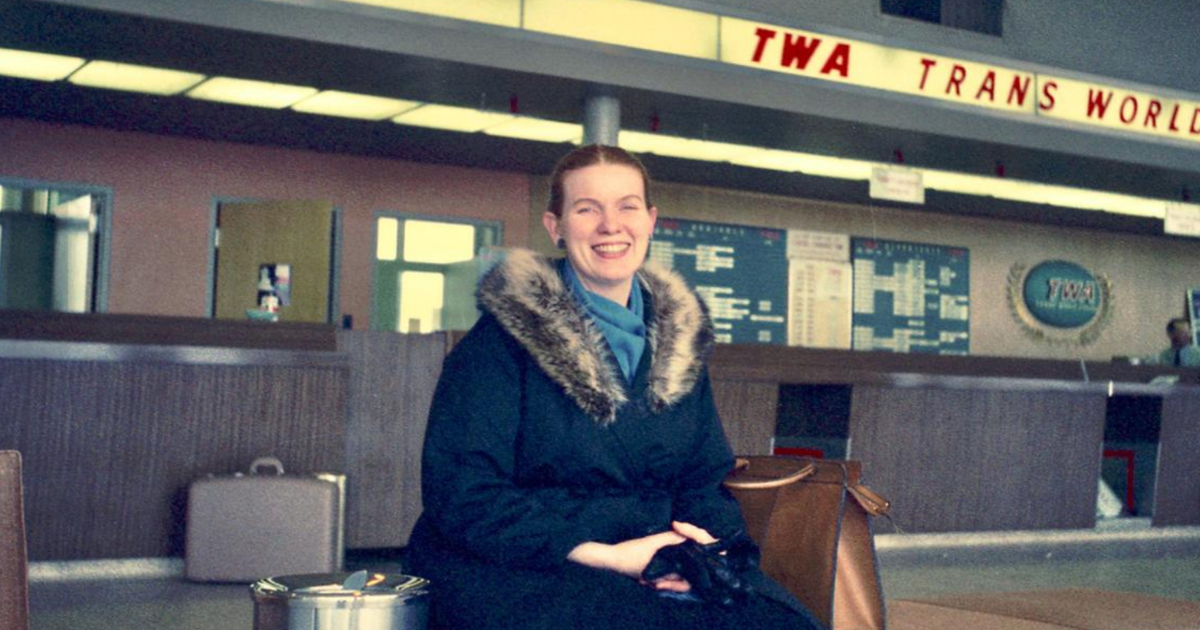
In addition to the 80-minute concert, Stekert has released rare photographs of Ritchie from her collection. The five images show Ritchie in the airport, wearing a thick coat with a fur collar (“Your cool weather’s got into my [dulcimer],” she accuses the audience at one point). The photographs, which are available to view or purchase, show different sides to Ritchie that are already evident from her performance. In one shot, she’s pensive. In a couple others, she seems to be a step away from laughter. In one enigmatic photo, it’s unclear if she’s winking, wincing, glaring, or playing around. This is the woman who went from hill farmer to Fulbright scholar. A woman who remembered hundreds of existing ballads and then contributed her own songs to an enduring tradition (for example, “The L&N Don’t Stop Here Anymore”). A woman who erased the line between rustic source singer and professional musician and influenced countless musicians, including Bob Dylan, Joan Baez, and Judy Collins.
This once-lost 1960 concert illuminates the reasons why Ritchie’s voice and work captivated the folk revival and makes it clear how much of an impact she’s had on traditional folk performance and scholarship today.
Photo Credit: Ellen Stekert