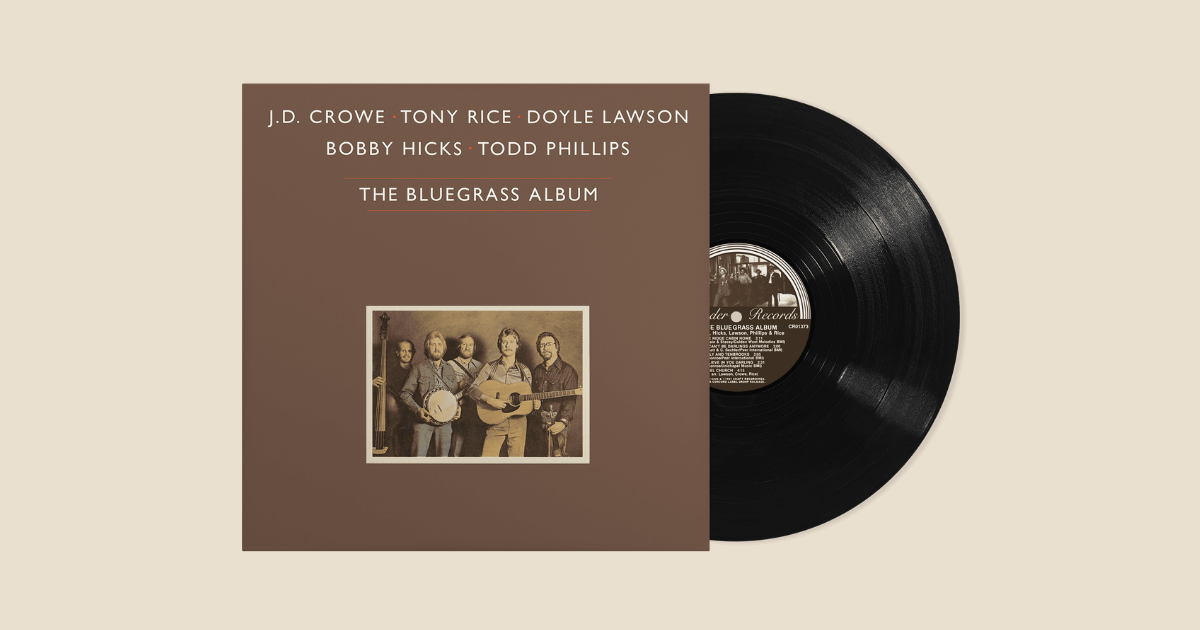

Tony Rice wanted to do a bluegrass album in 1981, but not just any bluegrass album.
It was time for another Tony Rice project for Rounder Records, though he had always made his bluegrass records along with those that featured his take on David Grisman’s genre-expanding musical experiment that Tony dubbed “Spacegrass,” such as Acoustics (1979), Mar West (1980) and Still Inside (1981).
By this time, Tony had also been part of many groundbreaking bluegrass recordings, including the legendary Rounder 0044, J.D. Crowe & The New South (1975), as well as solo albums such as Guitar (1974), California Autumn (1975), Tony Rice (1977) and the marvelous Manzanita (1979), which managed to become one of the best bluegrass recordings of all time without a banjo. In addition, he and Ricky Skaggs offered one of the best examples of early country duet styles on the inimitable Skaggs and Rice (1980).
The album Tony had in mind in 1981 would go on to be considered a masterpiece: The Bluegrass Album. It would also launch a franchise, with subsequent volumes in 1982, 1983, 1984, 1989, and 1996.
Tony didn’t yet have a name for the album but he wanted the new record to be a straight-ahead paean to the early bluegrass he was raised on, specifically the canon of Bill Monroe and Flatt & Scruggs. The reason, to him was clear: 1
“I remember thinking back then very well that bluegrass music was really in the toilet. And it was. It was at maybe its lowest point in its history. It was a rarity to even see a good bluegrass band that used an acoustic bass back then. Bluegrass bands were spread out all over the stage, individual microphones ten feet apart and it was just like a different world. It wasn’t there anymore. And The Bluegrass Album was kind of a deliberate attempt to get back to that.
“And it worked; it hit the bluegrass music world with ten times the impact that I thought it would in terms of satisfying or pacifying any bluegrass aficionado. Even the more contemporary players liked it. The traditionalists really liked it. All of a sudden here was this sound again, and it hadn’t been done since Flatt & Scruggs and Monroe and [Jimmy] Martin and Jim & Jesse at their best, and [The Osborne Brothers’] Sonny and Bob at their best. And here was the music resurrected again in its purest form, maybe even a little more precision than the originals.”
When it came time to choose who would play on the record, he thought of course of J.D. Crowe, whose playing by this time was deeply embedded in Tony’s sense of rhythm and timing. He also thought of Doyle Lawson and Bobby Hicks “…because I thought that they could do it better than anybody that I could think of. I knew I was going to be doing a bunch of Monroe and Flatt & Scruggs stuff, and I wanted to do a bluegrass album that was just as pure as it gets.
“The banjo player was logical, but I needed a mandolin player and tenor singer that could cover both of those sectors of bluegrass and do it well. Doyle was the only guy that could have done it, who could have played mandolin like that. On a Monroe tune, he could give it a Monroe flavor, and he could give it a Monroe tenor. On a Flatt & Scruggs tune, he could give it that Everett Lilly or Curly Seckler flavor, tenor too.
“And back then, Bobby Hicks was really riding the wave of a bluegrass fiddle renaissance. I mean, there was the smoothness of Kenny Baker and the unusualness of Vassar Clements, but there was a fiddle player in Hicks that was almost like every damn bluegrass fiddle player from Howdy Forrester, Chubby Wise, all the way down through the ranks, rolled up in one. And not only that, but he could play it so hard and so deliberate. And when it came time to back up something, he knew exactly what to do. And you can hear that shit. That’s the reason his backup on those mixes, if you listen to it, it’s really loud. His backup is in your face as much as the solos are—it was too pretty not to have it out there.”
Tony recalled that “Bobby and I ended up recording on a record of Ricky’s called Sweet Temptation. I heard Bobby playing that fiddle in the studio and we became real good friends.”
J.D. Crowe remembered that it was his idea to include Lawson: “Tony was talking to me about who to get for tenor. There was [Jimmy] Gaudreau, there was Ricky, there was Doyle. I said, ‘Well, for what this project is… And we’ve played with Ricky. So I think probably Doyle.’ Now I love Gaudreau’s singing, but for this record, Doyle was the one to have, for the mandolin playing, and the timing, and tenor pull, the phrasing. And I don’t think Tony had worked with Doyle at that time.” 2
On bass, Tony turned once again to his constant musical companion in this era, Todd Phillips, a fellow alum of the David Grisman Quintet. While Todd had played second mandolin in that group, he turned out to be an amazing bassist, and he played on both Guitar and Manzanita as well as on Tony’s Spacegrass recordings.
As the band listened to the results, Tony began to rethink how the project should be branded: “The first Album Band album was slated to be a Tony Rice bluegrass album and then after I got everybody together and started hearing playbacks, I thought, no, I’m not gonna do that. This sounds too much like some sort of a band. It came out under everybody’s name. I didn’t invent the name ‘The Bluegrass Album Band.’ I’ve always detested it. Milton Harkey is the inventor of that name.
“By the time the band had decided to go on a tour, it had to call itself something. Nobody knew what to call it. I didn’t know what to call it. And by then, the buying public in the bluegrass world had been buying three volumes of this stuff, and they were calling it The Bluegrass Album. Milton’s logic, I think, was, ‘Well, this is The Bluegrass Album Band. This is not just the album, this is going to be the band.’”
The group’s early albums were recorded in Berkeley, California, at 1750 Arch Street, the studio where Tony had recorded most of the Grisman records as well as Tony Rice (his first Rounder solo record), Manzanita and his first Spacegrass recordings. The session was cut with no headphones and no overdubs.
Tony remembered: “The first three volumes there were no overdubs. The idea was that when you edit, you’ve still got the entire ensemble playing together rather than piecing it together one guy at a time or making tracks and going back to overdub vocals. No matter how much you edit, you’ve still got the band playing live.
“There were two rooms at Arch Street. There was a big, elegant room upstairs with a control room that was in this mansion of a house and the guy who owned it was the first violinist for the San Francisco symphony. He was getting old and he built this room after he retired so that he could play his violin and hear it. And that was the main room at Arch Street, but they also had an isolated, conventional studio downstairs that was adjoining the control room.
“So the first two volumes of the Album Band were done in the upstairs room, and you could hear a pin drop. When you get guys gathered around, you could just hear every little nuance working together. We were individually miked and then Billy (Wolf, the engineer) hung a Neumann quadraphonic mic over the top of the whole ensemble for the purpose of capturing the room sound.”
To Tony it was more important to capture the spirit and energy of the traditional bluegrass from the 1950s: “I will accept mistakes to be able to have it live if it’s got the spirit. Listen to those Album Band records—they’re loaded with mistakes: off-pitch harmony vocals and weird tuning discrepancies here and there; missed fiddle notes. But who gives a shit? It’s almost like the discrepancies have a value of their own.”
Although Tony had a definite idea of the kinds of material he wanted to record, he admitted, “It was kind of a collaborative thing, you know. I came up with a list of tunes before we went into the studio, a list of 20 tunes to pick from. And Doyle would bring out a couple other things, and then when we got in the studio, a lot of times we’d do just whatever came to mind.”
Doyle Lawson remembered in more detail how part of the material was chosen: “Most of the time, J.D. and I would fly out together, and we’d usually meet in Atlanta and fly from there to California. And we’d write down a list of songs. I’d say ‘What about this?’ And he’d say, ‘Yeah. What about this?’ And we’d make us a list. We’d have eight, ten or twelve, whatever. We’d have a whole slew of them. And then when we got out there, Tony would have his list. We’d go through and kind of pick ‘em out—‘Who knows this one?’ ‘Yeah, I do!’ We might run through them one time or so just to figure out what we were going to do, who was going to do what where.” 3
But these were not mechanical recreations of the originals. At various times, the players would be adamant about not playing breaks or certain signature phrases because they didn’t appear in the originals, yet they also needed to play to the strengths of this extraordinary set of musicians. For one, there were no guitar breaks in the originals, but then again, in the ‘40s and ‘50s, they didn’t have Tony Rice.
Tony remembered: “I think it was Doyle who talked me into playing any guitar solo I played on the first couple volumes. I didn’t want to do any. But it was Doyle who kept kind of prodding, ‘Well, I don’t want to play a mandolin solo there. People are going to expect you to play a little bit.’”
Tony’s break on Flatt & Scruggs’ “Blue Ridge Cabin Home” has become such a classic that you will undoubtedly hear it in jam sessions today. Blue Highway banjoist Jason Burleson remembers hearing “Blue Ridge Cabin Home” and Tony’s break for the first time: “It was the first time I ever heard Tony play a solo. I had no idea it was a guitar. I distinctly remember thinking, ‘Wow that’s a cool mandolin break,’ until it got to the end and there was a G Run, and I thought, ‘There’s no way that was a guitar.’ I must have set the needle back 50 times trying to comprehend what I just heard. I really didn’t know that was even possible to do on a guitar.
“At that point I’d been playing a couple of years and all I ever saw a guitar player do was a G Run. I became instantly obsessed with that solo and his solo on ‘Molly and Tenbrooks’ on the same album, and ended up buying every record I could find with Tony’s name on it. At every festival, I went in search of anyone who could maybe show me a little bit of how to do that. I remember being really skeptical that anyone could actually play and sing that well. I thought it surely must be some kind of studio trick. Then of course I saw the Album Band in Denton [North Carolina] and it was even better than the record.”
“Blue Ridge Cabin Home” is the obvious choice to begin this collection. The power and precision of both the playing and singing here make it a standout track, one that the group, once it began touring, kicked off almost every show with. When they performed at the very first International Bluegrass Music Association (IBMA) awards show in Owensboro, Kentucky, in September 1990, they became the only group in the history of the awards to earn an encore. From Crowe’s power pinch, fans knew they were in for a thrill.
Crowe recalled that the group didn’t need to spend a lot of rehearsal time on the material because they all knew it so well: “Just our phrasing, that was the only thing. And that wasn’t hard either, because we had all done ‘em so much and done ‘em together. Especially me and Tony. And of course, Hicks, he learned off the same thing we did. So it just fell together.”
To Doyle, who was busy at the time touring and building repertoire with his own new band Quicksilver, it “…was a joy just getting to be there and not have to do anything except play mandolin and sing tenor. For me, I was in seventh heaven.”
Perhaps the moment that best defines the power and drive of this record, and indeed, the whole series, is J.D. Crowe’s half break near the end of “Molly and Tenbrooks.” His slide seems impossibly long and his syncopated, bluesy phrasing syncs with Tony’s guitar to create one of the great moments in the history of the genre, even if it is only a few seconds long.
Once again, engineer Kevin Gray of Cohearant Audio has outdone himself for a new reissue on Craft Recordings with a stellar all-analog remastering with lacquers cut from the original stereo master tapes. With the album now available for the first time ever on vinyl, the first hi-res remastering is brilliant, bright and powerful—a must-have for any of the countless fans of these classic recordings as well as a new generation just discovering the magic of Tony Rice and his entourage’s Golden Age recordings.
Like so many of those other Tony Rice records, The Bluegrass Album’s versions of these classic songs became the standards that subsequent generations would learn and continue to emulate. Indeed, within a couple decades of its release in 1981, groups in parking lot and campground sessions were describing the songs from this record and subsequent BGAB projects as “old Bluegrass Album Band songs…”
And this continues today. It’s a measure of the legacy of this record and those that followed in the series. Tony certainly succeeded in bringing “the real stuff” back front and center in the music. The audience for this kind of music had never really gone away, but it was the 1980s that saw the first real neo-traditionalist flowering in the genre’s history, with groups like The Johnson Mountain Boys and Nashville Bluegrass Band hitting their stride. The first tap into that free-flowing keg of tradition was The Bluegrass Album.
1 Author interview with Tony Rice, 2006; other Rice interview material from Still Inside: The Tony Rice Story (Word of Mouth Press, 2010).
2 J.D. Crowe interview with Author, 2005.
3 Doyle Lawson interview with Author, 2008.