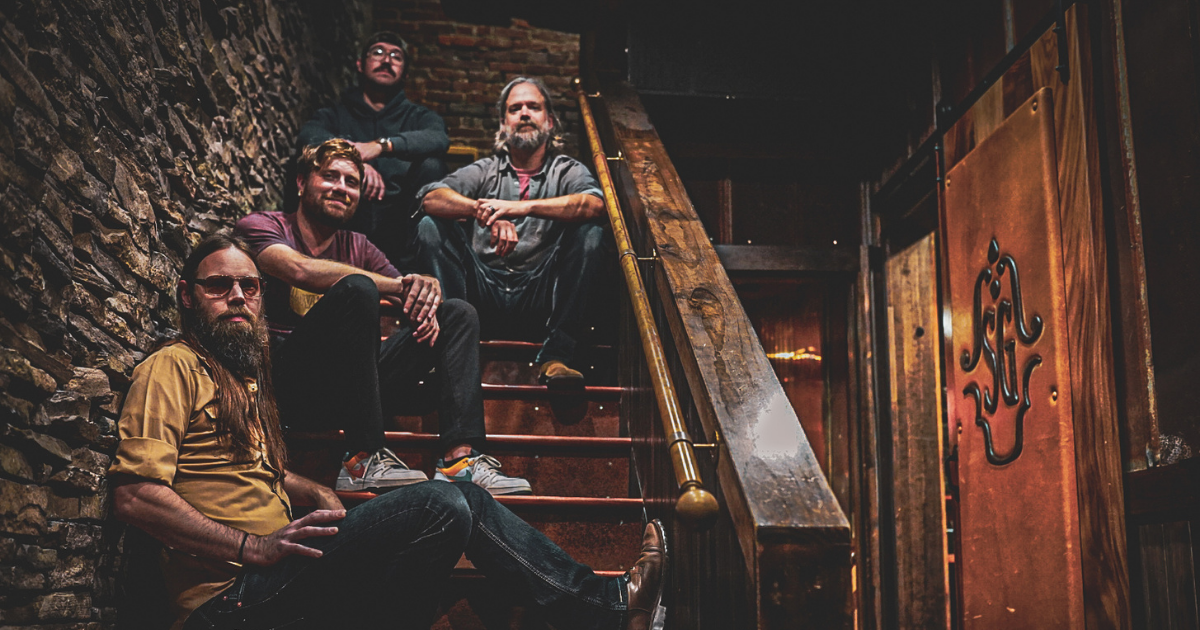

Arkansauce has been feeding fans nonstop with its string-fueled southern twang since 2011, when Zac Archuleta and Ethan Bush, who grew up across the street from each other in Johnson County, Arkansas, reconnected in their early twenties in Fayetteville, and started playing music together.
With Archuleta on guitar and Bush on mandolin, the group’s current lineup solidified in 2014 when Tom Anderson (bass) and Adams Collins (banjo, marimba) filled in during a set at the Riverstomp Music Festival just outside of Tahlequah, Oklahoma. The group hasn’t looked back, slinging a blend of bluegrass with a little jam, pop and rock that listeners can’t stop chirping about.
While the band’s sauce remains as good as ever on its new record, Horizon Never Dies, the project marks their first time recording outside the Natural State, with Arkansauce instead trekking to Nashville to record at Southern Ground Nashville with producer-engineer Dan Davis.
“We did tour a few other studios there in Nashville, but we ended up settling on that one because it had a really nice vibe where we felt like we could really do some work,” Andersen tells BGS. “The other motivation was that we knew we wanted some guests, and we knew that it’d be easy to pull people together in Nashville versus here in Fayetteville.”
Joining them were the likes of John Mailander (Billy Strings, Bruce Hornsby), Tommy Maher (Fireside Collective) and drummer Jesus Agreda. Together they hit their stride across a dozen tracks that celebrate southern staples like soda pop and katydids, put a microscope over their lives on the road, and distill a few dramatic moments – like hiking the Pacific Coast Trail and being stranded by a snowstorm in New Mexico – in what is easily their most vibrant and ambitious piece of work to date.
BGS: Between your last record and this one, some of y’all have been busy getting married and starting families. How has altered your creative process and outlook on the music you’re making together?
Ethan Bush: Our banjo player Adams got married in between the last album and this one and had a daughter just last summer, and then I’ve got a four-year-old now too. We’ve never been the band to kick out an album year after year, so all of that hasn’t done anything to slow us down in terms of recording. We usually have a pretty good gap in between projects, and we’re all just kind of still.
We’ve all been settling into our lives. Because as we became a band, we were all just getting to Fayetteville. We’ve been doing this for 11 or 12 years now, so we’ve all had a lot of time to grow and experience new seasons of life in between releasing albums, which is fun. It helps give us a lot of inspiration and drive when it comes to writing new music.
Tell me about the song, “Horizon Never Dies.” I understand it stems from journal entries written by a friend when they were hiking the Pacific Coast Trail (PCT)?
Bush: That was a friend of ours, Jasmyn Barca, who’s a pretty accomplished outdoorsman, and was around the time she started focusing on these long trail hikes. She would get little brief moments of service while she was on the PCT and sent me a message one day saying that they all had a handful of songs downloaded to their phones, but they were only listening to the same four or five ones over and over again as they were doing their morning push, and began fantasizing about having their own little theme song that applied directly to their experiences that they could listen to. She floated the idea to me and was like, “Do you think that’d be something you’d be into trying to write?”
This also happened during the first year of the pandemic, too, so I was really excited to have a project to work on with some outside influence and inspiration like that. Once I said yes, she started sending me notes from her journal every couple weeks whenever she got a chance. Then I would sit down and work them like a puzzle and try to see what I could come up with. I was doing a lot of long walks with my kid in the stroller at the time, and I would walk with him and try to write. I had a lot of lyrical ideas, but none of them really felt like a captivating hook, but as soon as the chorus came to me it all fell together. I recorded a simple version with just me and my mandolin and sent it to her and she was super excited.
Archuleta: I feel like that song and the album as a whole are just accumulations of everything we’ve learned from being on the road together. It’s a lot about balancing tour life with your family life back home in pursuit of your dreams, and for us that horizon will never die. We’re always driving, always chasing the next show and going down the road. Like Robert Earl Keen says, “The road goes on forever…”
“…And the party never ends!”
On the topic of touring, I wanted to ask about “Rearview” and “Weather.” Are those touching on how it’s easy to avoid your problems, fears and insecurities when you’re in a new town every night?
Archuleta: As far as “Rear View,” that’s exactly what it’s about. For us, being on stage and being on the road is its own form of meditation. You don’t have time to think about those things because you’re too busy piecing together the other parts of your journey in the moment that you push those thoughts to the rear view.
The song also ties back into one I wrote for our previous album called “Early Bird” that was a pretty heavy song about losing people and death. It came about during the pandemic when I was trying to write something inspiring about what was happening, but it wound up coming out pretty heavy. For that reason, we don’t play it a lot because we don’t want to bum people out, since it is so melancholy. Because of that, on this album I wanted to write something a little more positive, happy, lighthearted and fun that had a cool instrumental melody to contrast what happens on “Early Bird.”
Andersen: The inspiration for “Weather” was a bit different. A lot of my songwriting ends up being tapestry-like, and that song was no exception. There were a couple of wells of inspiration that were very random with it, the first being a podcast I listened to with my wife. We went on a trip right before [Colorado music festival] Rhythms on the Rio and there was a moment where the host mentioned the expression that changing your weather is like changing your attitude towards the situation you’re in, and I really liked that. At the time, that shift into [¾ time] was heavily inspired by learning Tony Rice’s “Old Gray Coat” — I just loved how hard it hit in that tempo without having a full-on waltz feel.
The last song I wanted to ask about is “Lift Your Voice,” which stems from a time y’all got stranded in traffic during a snowstorm in New Mexico of all places?
Bush: We were on the interstate coming into either Albuquerque or Santa Fe and the bottom dropped out. The interstate was grinding to a standstill and I was getting ready to drink a Five-Hour Energy and take over driving duties, but we wound up not switching because we couldn’t find a place to safely pull over. As a result, I tried to channel that caffeine buzz into something, so I pulled out my mandolin and started noodling. Song ideas always come to me in different ways, but one of the common ways is I’ll practice without any real structure and stumble upon a lick that I really, really like. That moment was when the opening riff for “Lift Your Voice” came about, which features a rhythm that’s a bit unique for us.
I didn’t have any huge lyrical idea or any end game for that song until we were sitting at our friend’s house during that snowstorm after having a gig canceled and trying to figure out what was going to happen with the rest of the run. I started toying around with some lyrics and chord progressions for it, and since I didn’t really have a strong idea of where I was going with it, that’s what I began deriving the lyrics for the chorus from. It has more of a poppy, Arcade Fire-style chorus with long and big harmonies and a big multi-vocal finish that make it a fun song if nothing else just for the sake of being a fun song.
Y’all have been a band for a dozen years now. What’s the biggest advice or lessons you’ve learned over that time about keeping things together while cramped in a van and out on the road together?
Bush: For the first three to five years we were doing it, I kept expecting some gigantic tipping point for us where every gig was going to get better and everything was going to be easier and that our exposure would snowball and that kind of thing, but that never really happened for us. We’ve been grinding it out steadily and growing the whole time and are very thankful for all that we’ve done.
What it made me realize was that some of the connections we’ve made throughout the years that kind of lead to bigger things came from shows and experiences that I really wouldn’t have expected. The lesson there is just to approach every opportunity you have with that thought in your mind that I might meet somebody here that is a really big, interesting part of my career later down the road and to always play like that and enter spaces with an open mind, ready to meet new people.
Archuleta: As far as relationships in the band, I learned fast that it’s not much different than a marriage. It’s just the four of us, so we have to compromise and support each other, but we also need to know when to push back on stuff too. It’s very democratic. When I hopped in a van with these guys all those years ago I never thought we’d be playing together for this long. I always hoped that, but I never really sat and thought about what that would look like to hang out with the same people every day, have a business with them, still be friends and carry all those relationships at once.
Andersen: Once we settled into this group of us four, it’s been a fun ride. The first several years were a never-ending party, but we slowly realized that this is not just a party, it’s our life and our career. We used to celebrate each great show as much as we could, but now we’ve got entire tours to get through so we’re gonna hang out for a bit before going to bed early so we can get up and drive. It’s been like one big trust fall with these three other guys and feeling like I can count on them for anything. In the same sense, I want to be the kind of dependable guy that they can count on on the other side of it, too.

Read more about Jamgrass. This content brought to you in partnership with Preston Thompson Guitars.
Photo Credit: Jacob Thayer