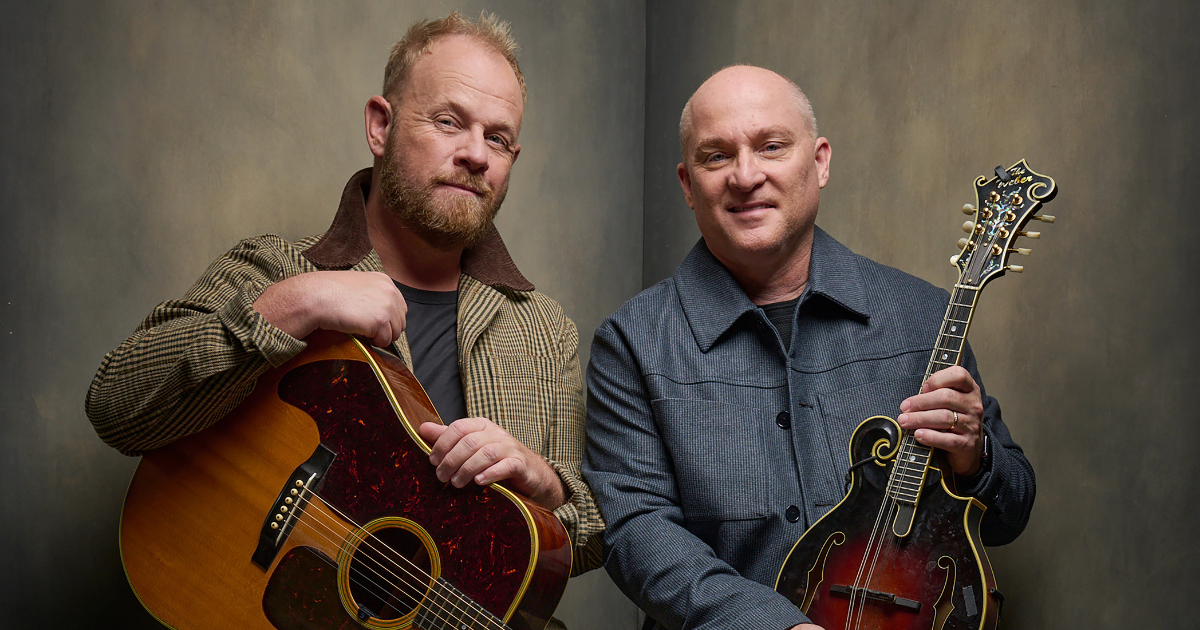

Since they were boys, Jamie Dailey and Darrin Vincent have been surrounded by music. As a child, Dailey sang with his father, who was in a gospel group. Vincent performed at a young age with his family’s bluegrass gospel band, the Sally Mountain Show (which included his older sister, Rhonda Vincent). In 1990, he joined the John Hartford Band and then, in 1996, the multi-instrumentalist and singer signed up with Ricky Skaggs & Kentucky Thunder for nearly a decade. In 1999, Dailey started his successful nine-year run in the esteemed bluegrass group Doyle Lawson & Quicksilver as a tenor and baritone vocalist, and played acoustic bass before moving into rhythm guitar.
Dailey & Vincent met at the IBMA’s annual business conference and festival in 2001 and became quick friends. One day, after having breakfast at a Cracker Barrel Old Country Store, they went to Dailey’s car to listen to a tape of a song he had written. When they sang along to it, the two realized that their voices blended together in an uncanny way. It took several years for them to leave their respective groups and officially become a duo.
Along the way, they contributed the track “Beautiful Star of Bethlehem” to a Christmas compilation and that tune hit No. 1 on the Prime Cuts of Bluegrass charts. Dailey & Vincent then scored a deal with Rounder Records based on a demo they submitted. Since 2007, they have released 11 albums (including A Beautiful Life, released in June), won multiple SPBGMA and IBMA awards, and received several GRAMMY nominations. They also host a TV series, and have attracted a devoted following for their mix of traditional and contemporary musical styles that draws upon bluegrass, country, and gospel.
From September 17 to 19, the two are again hosting their annual Dailey & Vincent Music Fest. Held in Hiawassee, Georgia, up in the Blue Ridge Mountains, the festival’s lineup this year includes friends and family like Ricky Skaggs, Rhonda Vincent, and Doyle Lawson & Quicksilver, as well as Lonesome River Band, Seldom Scene, Gene Watson, and Wyatt Ellis – with Dailey & Vincent performing different sets each day.
To celebrate A Beautiful Life, we’ve named Dailey & Vincent our BGS Artist of the Month in August. Enjoy our exclusive AOTM interview with the duo below and don’t miss our Essential Dailey & Vincent Playlist, too. Plus, keep an eye on our website and social media for even more D&V content all month long.
When you all were creating your new album, A Beautiful Life, did you go in with an intention to make a certain type of album? Because your records frequently have had some type of theme or concept – like your prior release, 2022’s Let’s Sing Some Country.
Jamie Dailey: For me, it was not a themed record at all. I think Darrin and I both feel the same way. We just wanted the best songs that we could get our hands on to record. By being with Morris Higham [Management] and our manager Robert Filhart having the tie-in to the publishing companies to help us with songs, that gave us a whole new breath of life to be able to get a hold of some really great songs. And so that’s kind of how we were looking at it. We were not thinking about a theme at all.
Darrin Vincent: We’re able to create the bluegrass and the country music feel on the same record. But it’s mostly acoustically based. One of the coolest things about those elements was our management saying, “Go out and create the best songs and the best record you guys can. Don’t worry about [the album being] branded at anything or themed at anything. Just go make yourself a record.” And that’s kind of our mindset, and what we did with that encouragement.
How did you find these songs come together?
JD: Our manager, Rob Filhart … took us to Music Row and set us in publishing offices with speakers on both sides of our heads and a person across from us. They would play song after song after song, and you would listen to one and you’d be like, “No, that’s not it.” They’d play another one. “No, that’s not it.” And then a song came on and it was, “Wake up in the morning to a big orange sun/ Calling in sick, gonna have a little fun…” I thought, “Wait, wait, wait, what is that?” I want to keep listening. And it was “A Beautiful Life.”
One of the reasons that we love the song is that both of us have lived that lyric. Growing up, we have lived that lyric and still live a lot of it today. So that song touched our hearts and touched who we are as human beings. And we thought, “Man, we’ve got to record that song.”
We kept listening to more and more songs. Then they played us the song that was written by Don Schlitz and Josh Kear called “I Grew Up in Heaven.” Once again, we’re sitting there and I’m like, “I grew up in a beautiful rural area with the hills and the mountains and lakes and the rivers and bluffs and wildlife.” And I’m like, “Oh my goodness, I’ve lived this lyric” – and so has Darrin, you know? We fell in love with that. So, we thought, “Well, that’s going to be a good song.”
DV: We actually recorded 16 of the songs and those 12 [on the album] seemed to fit together the best. We got four other songs we haven’t even finished yet, but they’re great songs as well. We need to probably look at those at some point, but these really fit together well. I’m so thankful for them.
“Ruby” makes for a tremendous lead-off track. How did that get in the album?
JD: We got a call from the Grand Ole Opry, and they were going to recreate a show from 1974. They said, “We want you guys to come in and sing an Osborne Brothers song and a Jim & Jesse song and recreate a night that they were on this stage. You have to say what they said that night and you have to sing one of their songs.” They gave us choices. Darrin picked the song “Paradise” from Jim & Jesse. And I picked the song “Ruby.” I didn’t really want to sing “Ruby,” because it’s really high. It’s really fast and it’s really hard. I’m going to be honest, I was extremely intimidated by the song.
We sang the song on the stage of the Ryman Auditorium during the Grand Ole Opry. And the crowd went bonkers. I mean, bonkers from the front to the middle of the back! We thought, “What is going on?” And I simply think it was because they enjoyed watching me trying to kill myself singing. But when we came off stage we said, “Man, what a reaction! You know, it really doesn’t lend itself to the record, but people loved it so much. It might be a great opener to the record – loose and fast and high and all the things.” So, we decided to do it and lo and behold, it went No. 1 [for multiple weeks on the Bluegrass Today charts].
DV: My favorite thing is to watch Jamie kick off “Ruby” and see the people’s reaction to that. They’re just absolutely floored and that the reaction is so cool. I don’t think they’ve ever seen anything like it. It’s awesome.
The album has a good number of songs, like “A Beautiful Life,” that have a soulful, soul-feeding quality. Not just in a religious way, necessarily. Like “God’s Country,” you might think it is a religious song but it’s just about praising – praising where you come from.
JD: Yeah, and the place that I come from, everybody has different beliefs here. They have different political backgrounds. The song is for everybody. It’s not just for one set group of people. It’s for everybody because I love everybody. I mean, if you’re a nice person and try hard and treat people right, then I love you. I don’t have an issue with anybody.
When you started off as a duo, your first show was the Grand Ole Opry, right?
JD: We’ve played the Opry a lot. Darrin had played it longer than I had. But we both played the Opry a lot in other bands we’d been in. And then as Dailey & Vincent, we started our career off there. Darrin can tell you about us turning down dates just so we could play something like the Opry.
DV: Yeah, we had a manager by the name of Don Light who really, really put us under his wing and really gave us great advice. Advice we’re still using today after all these years. After we quit [working with] Ricky and Doyle, or we turned in our notice … we were getting all these offers of really good money to go out and play. Don Light said, “Boys, there’s only one first. I really believe your first [performance] needs to be at the Grand Ole Opry.” He said, “I know you all could use the money and it’s nice to have money,” but he said, “It’s more important for the longevity of you guys to make that Grand Ole Opry your first performance.”
Jamie and I agreed to it, we said no to everybody, and just kind of hung on to that. The thing of it is we weren’t promised [the Opry gig]. Pete Fisher [Opry VP/GM at the time] did not promise, “Yes, you guys can make your debut at the Grand Ole Opry.”
JD: It was a gamble.
DV: He and I took a gamble. We said no to everybody and, man, are we ever glad we did! ‘Cause we can honestly say our very first paid performances were the Grand Ole Opry. The Ryman, no less, of all stages. The birth of bluegrass music [was there], started with Bill Monroe. Isn’t that something? That’s really something!
JD: And we had to eat beanie weenies for about four months, but, you know, we’re alive now. We made it.
You both have been performing music since you were children, and been professionals for a long time. Besides having a lifelong love of music, it seems like you have a respect for the profession of being a musician.
DV: We’ve been recording records for a long time and have been on wonderful projects. Jamie grew up with his dad playing music and I did the same thing with my mom and dad. I think that my very first recording was at age five. So, we’ve been doing this a long time. I tell people this is not a hobby. It’s our job and our life and our livelihood, and man, it’s our DNA. It’s the way we grew up, and being members of the Grand Ole Opry and just being able to carry on that legacy of our family tree is really, really important. … It’s what we’ve done all of our lives. My wife, as a child, wanted to be a teacher and be in education. For us, this is our job, yes – but it’s more than that. It’s our life. I mean, this music, this record, is our life.
I think there’s some people that do it for a hobby, and that’s wonderful. But for us, our job is to get music, songs that will help people. I mean, we’re basically therapists as well. I can’t tell you the number of people that come through our line that are going through chemotherapy or some kind of issue in their life. This music is therapeutic – especially “A Beautiful Life.” I’ve had so many people come up to me and say, “That just makes me happy listening to those lyrics.” I feel like we’re sometimes musical doctors as well.
Harmony singing has always been important to you, and to the history of bluegrass. Jamie, I know the Statler Brothers were a huge influence on you. How do you see the state of harmony vocals in bluegrass music today? Is there a resurgence or are you just like holding the torch?
JD: Okay, we may have two different answers… How I’m going to answer this, I want everyone to know, I don’t mean this negative at all. This is just something that I’m seeing – and I could be wrong, okay? I’ll be the first to admit it. I am seeing more great pickers and a lot of picking now than I am, per se, a lot of great, top-notch vocal art. Now, yes, there are lots of people out there doing it, but it used to be that I saw more of that than I did a lot of the hot picking. It seems to me that’s what I’m seeing now. Folks, I could be wrong. Okay? If I am, please point me in direction so I can learn. But that’s what I’m seeing and what I’m hearing. So I found that to be interesting. Darrin, how do you feel?
DV: Yeah, you know, [Jamie] and I are always going to do four-part harmony, if possible. I never ever did four-part harmony with my family group all those years. With Ricky [Skaggs], we would have “Remember the Cross,” the Bill Monroe song, with the bassist in Ricky’s band doing the Bill Monroe quartet kind of thing. Of course, now Jamie, being with Doyle in those nine years, that was absolutely Doyle Lawson’s sound, the four-part harmony gospel. We have since moved back to three-part harmony, and we’ve been having Kyle [Ramey], our banjo player, do the bass part. I think Jamie and I will always do duets, trios, all the different types of songs, because that’s our DNA, that’s part of bluegrass’s DNA as well, all the way back to Flatt & Scruggs and Bill Monroe. It’s just something that’s part of bluegrass. I think that people need to hear that and we certainly feature that on our TV show. It’s very important and it’s just a cool thing to hear.
It also feels like you two are at an interesting traditionalist/non-traditionalist intersection, where you respect and follow some traditional leads, but also listen to your own inner voices of what you want to sound like.
JD: That has been a craw with some people on the traditional side. You know, “What are you guys? You used to be bluegrass, but we can’t really call you bluegrass. But you’re not really country, so we can’t call you that. What are you?” And all we know to tell them is: Dailey & Vincent! We sing and play the songs that we like and love. We play and sing the styles that we like and love. And we play and sing the way that we play and sing. We don’t know what that is, other than it’s just us. It’s how we think. How we breathe. It’s just who we are. And that’s not a good answer for a lot of people. They don’t like that answer, but honestly, we really don’t know how else to answer it.
You’ve finished your tenth season of your TV show. How has the TV show fit in with or affected your overall music career? Like, has it improved your live show?
JD: One of the things that I am so thankful for about the television show is, of course, we get to sing our bluegrass songs, whether they’re covers or originals that we’ve written. We get to sing a lot of the country songs that we like – original or covers. But something I have loved, it has given me the ability to sing songs like Bryan Adams’ “Heaven.” I’ve been able to sing Christopher Cross’s “Sailing.” I’ve been able to sing Sting’s “Fields of Gold.” All these old pop songs.
It’s given me an avenue to get that side of my fanboy out on all these pop songs and get to sing them and put them out. It’s interesting. When we have put them on social media, I have been very clear in my wording of, “Hey, one of the reasons we love to get to do our television show is we get to sing songs we’ve always wanted to sing, but that we never really could put on a record or necessarily really sing on a stage somewhere.” So, that has been one of the most fun parts for me. Darrin, how about you?
DV: I’ve loved being able to sing different songs and create different musical settings for different songs. Even songs that we did bluegrass, we go back into country now and just flip it around. It’s just wonderful being on the creating side of the musical side of that with these songs.
For me personally, I love all that and creating, but I’ve always been behind the vocalists in my group. It was my dad and my sister Rhonda. When I went with John Hartford, it was John. He was the frontman. He was the voice. Ricky, he was the voice. Jamie’s a great MC and a great frontman. But in our group now, I have to walk out and do more lead vocals and do more talking. And being a part of the Grand Ole Opry and this TV show has really set me to be out front, to be more of a talker. I’m more of a thinker on that side of it. Jamie is great off the cuff. I have to think about what I say and then I have to try to make it feel correct. I struggle with that.
JD: [Laughing] I probably should think about what I said!
DV: I’m not ashamed of this. I spent my whole entire life in special ed. Education was very hard for me. Being in the background is more where I like to be. I love being on the backside of things and I don’t need the spotlight. But since it’s Dailey & Vincent, Jamie and I both go out there, but those [TV show] settings have helped me to try to be more outgoing. I love that Jamie’s very outgoing. He’s such a great speaker and it has really encouraged me to try to do better at that. He’s absolutely the best, but I feel like I have grown because of those platforms to be able to speak better. My thought process goes a little quicker now and I feel more comfortable with it, and I’m sure grateful for that.
Photo Credit: Gregg Roth