For their fifth studio album, Brothers Osborne are returning home.
John and TJ Osborne’s coastal hometown of Deale, Maryland, serves as the inspiration for their latest project, Watertown. Ten years after the release of their debut album, Pawn Shop, the Grammy-winning duo found themselves drawn back to their roots – reflecting on the people and places that shaped them.
The brothers also once again find themselves among the nominees for Vocal Duo of the Year at this month’s CMA Awards. This marks their 12th consecutive nomination in the category; they have taken home the award six times to date.
John Osborne spoke with Good Country via Zoom from Nashville to discuss the songs that guided the new project, their mutual collaborations with Cody Johnson, and his favorite spots to visit back home in Deale.
GC: This album is named Watertown in reference to your hometown of Deale, Maryland. What was behind the decision to return home, in a sense, for this new project?
Osborne: When we started writing for this, we were without real honest intention. We might just be at that point in our lives where we’re starting to feel the gravity of our hometown and a bit of retrospection. And I wrote a song called “Family Business.” I really liked the title. It is very autobiographical. Everything is very literal in this song, all of the events and the family members and the characters.
I also liked the idea because my brother and I grew up plumbing with our dad who owned his own plumbing business – a family business – called Osborne Plumbing & Heating. And then here we are, decades later, still in a family business together. A lot of things started kind of writing towards that. That became the centerpiece of the album in a way. Not that it’s a concept record per se, but we wrote with that song in mind.
Then I wrote another song called “Watertown,” and these are the two songs on the album I wrote by myself – just because I wanted to write something that was autobiographical. It’s hard to have a co-writer there helping you write if they don’t know the ins and outs and the details of your life. And that one seemed to be a bit more center bullseye than “Family Business” even. It informed a lot of the decisions around the record – the aesthetic, the atmosphere, the mood – and it seems to encapsulate how we feel in 2026 about who we are and where we came from.
The album kicks off with “Born and Raised Hell” featuring Cody Johnson. You haven’t done a ton of collaborations, other than “Loving Me Back” with Lee Ann Womack on Pawn Shop. How did this collab with Cody come about?
The collaboration thing, it really just has to make sense at the end of the day. And other than Lee Ann, we had never really done that before. We were recording “Born and Raised Hell” and TJ was like, “Man, I feel like Cody Johnson could sing well on this song,” and it just sounded right. Like, I could hear his voice on it, and it made sense. And Cody came in and absolutely crushed it.
The funny thing is, we actually collaborated on his record, on a song called “Fool Proof.” Unbeknownst to each other, I was going to text him the very next day, and he had texted us, saying, “Hey guys, I have this song that I think you guys would sound great on.” And then I replied, and I was like, “Funny thing, we have a song that we want you to perform on, and I was going to text you.” He listened to it, and he’s like, “Screw it, let’s just do both. I mean, who’s to say we can’t?” So that’s what we did.
The song “Bottle It Up” feels, in some ways, to be a spiritual successor to your breakout single, “Rum.” In fact, several of these new songs seem like they could go hand-in-hand with your early work. Was that intentional when you were tapping into the Watertown aesthetic?
I think it happened subconsciously, because we were writing with our hometown as the lens. Our first album referenced our hometown a lot and we went back to Deale to shoot our video for “Rum.” It was such an important moment, not only in our career, but in our lives – where that album has taken us, but also what got us to that album. And so with that in mind, it did inform how we were writing.
This is the first album where we actually took outside songs [by other songwriters]. And a lot of that had to do with the fact that we have so little time. My wife [Lucie Silvas] and I had twins a few years ago and TJ is very, very busy. We found ourselves needing a little help in that department because of just lack of time. I’ve also been producing projects and stuff like that, so I’m running a little thin.
We listened to tons and tons of songs. “Bottle It Up” is one of the first songs that TJ was like, “I think I found a cool one.” He played it, and I was like, “Damn, that sounds exactly like the songs we were writing during our Pawn Shop era.” And it sounds like the brother to “Rum,” like a song that 100 percent we would have written… even today, but definitely then. It was a great companion to that song, which we still love, and we still play today. And a lot of people are shocked that we didn’t write it, because it sounds very much like a Brothers Osborne song. Which is why we cut it because it made perfect sense.
Another one that feels like it has the classic trademarks of a Brothers Osborne song is “R.I.P.” This song has an energy that feels like it’s gonna be a lot of fun to play live. How much does thinking ahead to the live show factor into your decisions when you’re in the writing room and studio?
Thinking about the live show creeps in all the time. I remember when we wrote “It Ain’t My Fault,” and the first line of the chorus is “I’ve got my hands up.” And we were like, well, we don’t know what will happen with the song, but it directs the crowd, and the crowd’s going to love that line, and it’s going to make them put their hands up. And by God, it did. The first time we played it, before people had ever heard it, it made them put their hands up and clap. And so those things do creep in a lot. And we know our crowd, and our crowd appreciates musicality – and long guitar solos, thank God, or else I’d be out of a job. [Laughs]
Looking back at the milestones over the last decade, how are you feeling about where you’ve been and where you still hope to go?
So, my default setting is, “It’s all going to fall apart at any moment.” I think that stems from coming from a very lower middle class background. Not that it was an awful upbringing whatsoever, but I always have scarcity in mind. But in a way, that creates this hunger and the desire and the drive in me, and I like it. I work better under pressure. I always have. Keeping a little bit of pressure on is good for me and it’s how I function.
But the difference between then and now is I am able to stop and take a step back and assess where I am. And that just comes with maturity. I get to look back and go, “Here are all the things that we’ve done.” Sometimes, I get caught in the hamster wheel of life: “We gotta do this. This has gotta be better. We need more of this. We need to make sure this is happening.” I can step off the hamster wheel now and go, “Wait, hang on, hang on.”
I have a wildly beautiful life – success beyond anything that I ever even dreamed of or imagined. I just wanted to move to Nashville and play guitar for Alan Jackson. That was my dream. [Laughs] Just like every other kid that was obsessed with Brent Mason. So, that’s where I’m at. But again, I still like the pressure, and I like a little bit of a chip on the shoulder, because that’s how I work my best.
Finally, to bring it full circle back to your hometown – for people who haven’t been to Deale, what are some of your favorite things to do there that are not music-related and not seeing family?
Absolutely. So, in Deale, Maryland, there are more boats than people. If you like to fish, there’s no better place to do fishing, because you can fish right off the pier with just a cooler of beer and wet a line and let time slip away, and maybe catch a few, or you can ride out into the bay and catch some great, beautiful rockfish. It’s one of my favorite things in the world.
And later, once the sun starts to go down, there are a couple of just great small bars there, Happy Harbor being one of them, which is just right there off of the road. It looks like it’s about to fall right into the creek. I don’t think anything is level in that place whatsoever, and it’s just awesome. And there’s The Boathouse and Skipper’s Pier, and that’s where time kind of stops and slows down and the night ends. That’s where you’re going to see all of the people, and all of the locals, and all of the good and bad types of trouble that are in that town. And you can just rinse and repeat, you know?
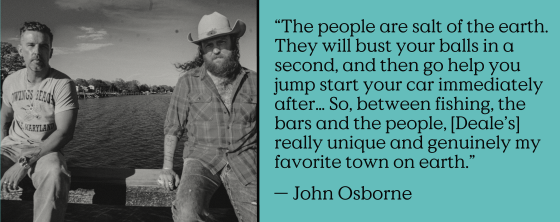
What makes Deale so special – and it took me a long time, it took me traveling the world to realize this – is the people. The people are salt of the earth. They will bust your balls in a second, and then go help you jump start your car immediately after. They will do anything. That’s the type of people they are, you know? They are all different walks of life. They’re all red, or blue, or purple and some work in government, and some do plumbing, and everyone loves and appreciates each other. The community is unlike any place I’ve ever seen. So, between fishing, the bars and the people, it’s really unique and genuinely my favorite town on earth.
Photo Credit: Larry Niehues