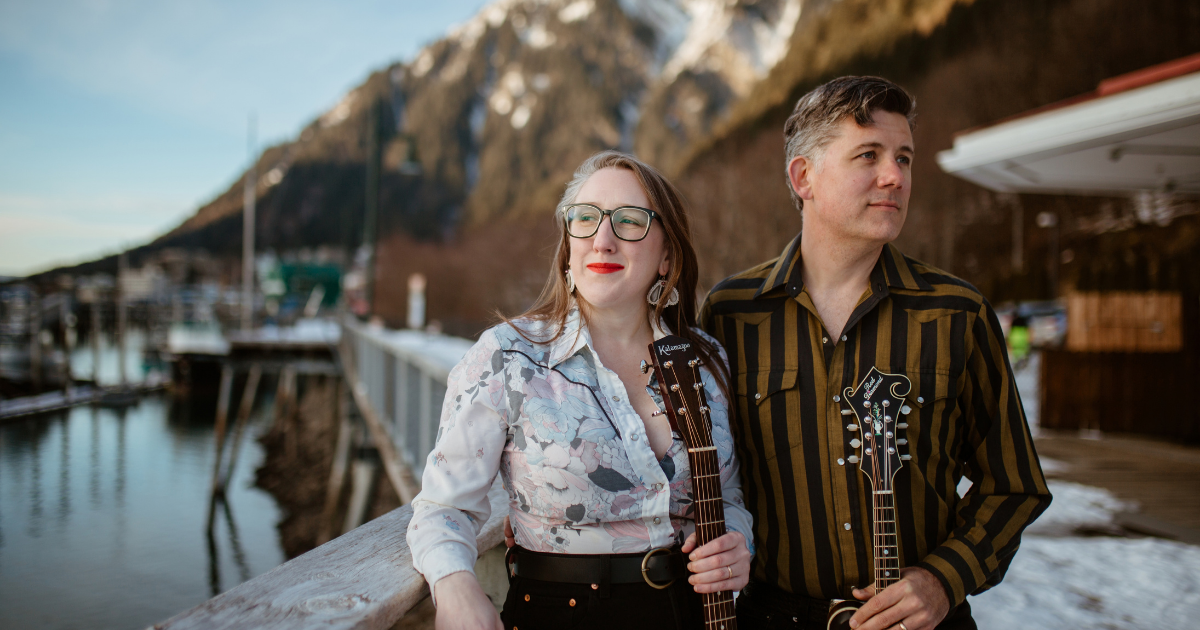

Artist: The Heists (Andrew and Erin Heist)
Hometown: Juneau, Alaska
New Album: Break & Mend EP
What’s the most difficult creative transformation you’ve ever undertaken?
Coming from a strong background in bluegrass, where you are performing a music that’s rooted in a specific tradition and most often written by someone else, I primarily expressed my individuality through the musical and stylistic choices I would make while improvising solos or singing a harmony part. Transitioning to performing original songs has been an enormous adjustment. There’s immense vulnerability in taking the leap to share songs that are incredibly personal on stage. It’s a completely different ballgame when you’re putting yourself and your songs out there in this way.
Erin apparently coped with the isolation of the pandemic by becoming a crazy prolific songwriter. She was churning out great songs, one after the other, and instantly sharing them with the world. I was like, “Don’t you need to fret over it and overanalyze it and then be overcome with crushing self-doubt and hide it away in obscurity?” Nope. It was so inspiring to see her fearlessness as she worked out what being a songwriter meant to her. Around this time we were beginning to collaborate with and be inspired by Josh Fortenbery and Taylor Vidic, two mega-talented Juneau neighbor-musicians who were also writing and performing their own songs. The incredibly supportive environment that formed there really helped me get out of my own head and begin to share my own songs. It has been the most important and challenging musical moment for me since I started playing. — Andrew
I didn’t start playing guitar or singing until I was in my mid-20s. And as someone who has had a big issue with drawing attention to myself, the whole process of becoming a performing musician coincided with transforming from primarily an introvert to primarily an extrovert. The first time I sang in front of Andrew, I kind of whisper-sang a Cat Power song. Which now, thinking back, it is WILD that I thought that’s how I sang. Our voices are so deeply personal and I imagine that I’ll spend the rest of my life learning about my voice and finding new ways to sing. — Erin
What rituals do you have, either in the studio or before a show?
For the studio, I think the big goal is to be at the right level of ready. Part of what I really love about the recording process are the little twists and turns and surprises that happen along the way. When you have the right people in the room, like we did for Break & Mend, the result feels magical. There’s a conversation that happens in the moment. Patrick M’Gonigle has been a longtime pal, but this was the first time we’ve worked with him as a producer. Patrick is just a monster musician and a great hang, and with his immense experience, knowledge, and innate feel for the kind of music we play, he really helped us double down on those impossible-to-define moments that can only happen between musicians that are live in the room together. — Erin
This has evolved over the years. When I was in my twenties, getting ready for a show meant soundcheck at 5 while having a couple beers. Head out to another place to grab another drink or three, grab dinner somewhere with a couple glasses of wine then show up at 10 p.m. for a four-hour bar gig. It was a (somewhat lengthy) moment in time and it was a lot of fun, but not sustainable.
Thankfully now, things are different. We get to play shows where people are coming to really listen to the music and I want to fully show up for them. Being rushed is one of my least favorite feelings and really takes me out of the frame of mind I want to be in to perform. I like to do all of the boring drudgery of gathering gear early in the day to free up time later to leisurely run a few songs and feel warmed up. I’m definitely not someone who leans toward over-rehearsing, but over the years I’ve felt the sting of being unprepared on stage enough times that I want to avoid it at all costs. Having the setlist done ahead of time and knowing that we’re rehearsed and ready gives me a foundation of calmness to start from. It actually makes me more inclined to make a few in-the-moment changes during the performance that can be really fun. That base of preparation for me actually frees up my ability to be spontaneous on stage and some really magical moments have come out of it. — Andrew
What is a genre, album, artist, musician, or song that you adore that would surprise people?
In Alaska I’m probably best known from lots of years playing hard-driving mandolin and singing in several iterations of a traditional bluegrass band. Recently that has expanded to performing our own songs with The Heists as well as backing up a variety of musical pals, most of which lands in the folk, country, acoustic Americana vein. I think people might be surprised to learn that when left to my own devices I very, very often listen to jazz and hard bop from the mid-twentieth century. Miles Davis, Bill Evans, Bird & Diz, Coltrane, Horace Silver, Dave Brubeck, Mingus, Monk.
I grew up listening to the grunge and punk of the mid-’90s and then drifted into the Grateful Dead universe, and right before I left Philadelphia I started going to a club called Ortlieb’s to see live jazz several nights a week. When I went out west to college I was able to borrow dozens of jazz CDs from the library and burn my own personal jazz collection. I love lyrics in music, but there’s something really important to me in just listening to pure music without words. The improvisation in jazz is just magic to me. To this day, any time I have a decent chunk of time at home by myself I always carve out a night to listen to Keith Jarrett’s fully improvised The Köln Concert in its entirety. — Andrew
I absolutely love going to punk shows. I don’t actually listen to any recorded punk, but man, when I get to go to a show, especially a small show in a local scene, that is the best. Last year one of my favorite shows I went to was in Tokyo with my brother and we ended up in a tiny black basement punk show with non-stop crowdsurfing and a goofy mosh pit. — Erin
If you didn’t work in music, what would you do instead?
I’m a big foraging nerd and I love food. Which means that in an alternate life I used to write a column for our local paper and had a foraging food blog. I love spending a quiet few hours poking around the woods. If I’m mushroom hunting I have to set a timer for a few hours because otherwise I could spend from dawn to dusk looking for “just a few more.” Part of what I love about writing recipes for foraged food is that there are always new puzzles to solve, new textures and tastes to pair. I’m a lazy cook and forager, so I only want to pick delicious things that are relatively easy to pick and clean. And then to figure out a new recipe, share it with folks, and help people get out onto the land, I love that. Foraging means that you pay attention to the way that a season moves through your home, how the light moves through the forest, the texture of the earth. If I wasn’t giving my creative energy to music I would finish that cookbook I’ve got started and probably start a series of wood walks and cooking classes. — Erin
This might be a bit of a cop out, but I’d work with musical instruments. Repairing, restoring, making them. From the time I started playing guitar in middle school, I’ve been captivated by the instruments that make the music possible. It probably started by looking at the ads in my Guitar World magazines and then I got a book called The Guitar Handbook (Ralph Denyer) that was full of pictures of all kinds of guitars throughout the prior 100+ years and I was hooked. I ended up on the paper mailing lists for Mandolin Brothers in Staten Island and Gruhn Guitars in Nashville. I would read these photocopied newsletters, with hundreds of descriptions and grainy, black-and-white pictures of guitars and other instruments cover to cover, over and over again, even though I couldn’t afford to buy a single one.
When I was 18 I bought a Roger Siminoff book and a very inexpensive tabletop band saw and attempted to build an F-style mandolin in the basement of my childhood home. While that attempt never reached completion, I became intimately familiar with the inner workings of acoustic stringed instruments and have tinkered with them to varying degrees ever since. — Andrew
What has been the best advice you’ve received in your career so far?
Throughout my life I have been very fortunate to be surrounded by dozens of successful, amazing artists from all kinds of disciplines who have been role models in some way or another. I’m not sure it specifically counts as ‘advice’ but I have continually been awed at the amount of work and determination that all of these people have put towards their art. While many of them were decidedly some of the most un-serious people I have ever known, when it came to their art they gave it absolutely everything. I’ve tried to instill a bit of this in myself when it comes to working on my own playing and writing. — Andrew
Growing up we had a very close family friend who was a stride piano player and a helicopter pilot. He’d come up to Juneau and live with us for a month while he was flying for one of the big lumber outfits. Michael was the first person in my life who I ever saw improvise music. He was a bit of a wild man, a Vietnam vet who had traveled the world and had a wicked sense of humor and a giant heart. I had started to learn how to play piano and desperately wanted to travel around the globe. Michael told me that learning to play music was one of the best things I could do because if I could play music, then I’d always have a way to thank people. I think about that lesson almost every time I play. That playing music for folks is a form of giving a gift, of thanking them for their presence, connection, silly jokes, amazing dance moves, and joy. — Erin
Photo Credit: Sydney Akagi