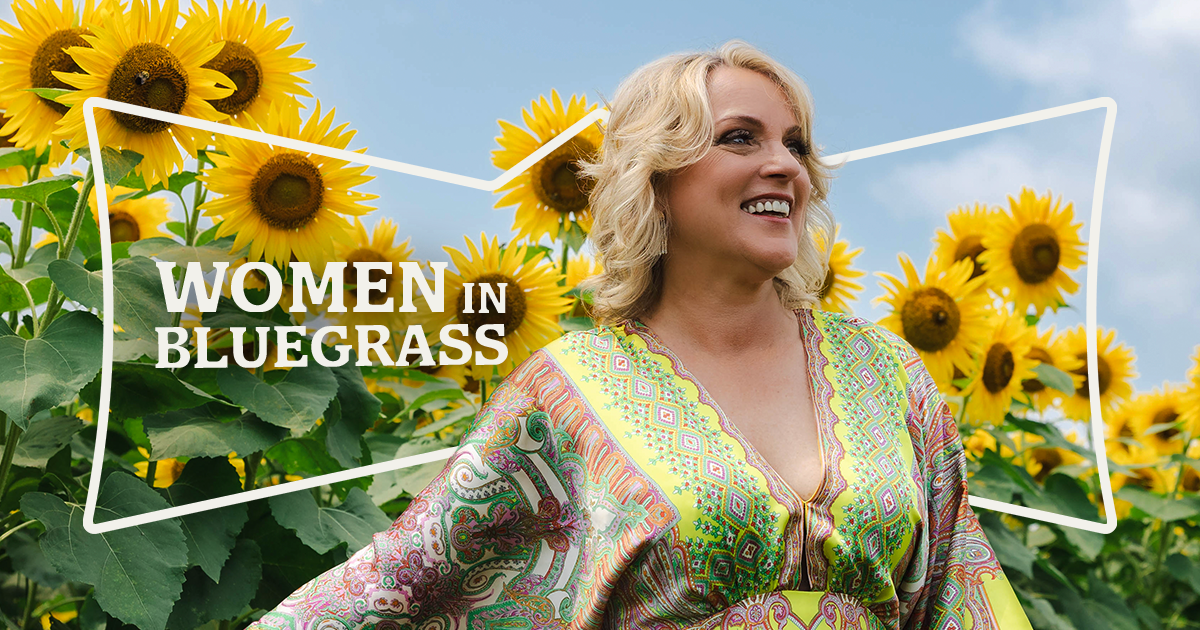

The undisputed Queen of Bluegrass, Rhonda Vincent, returns with a studio album of original and newly recorded material that demonstrates the unwavering command of her craft, while shining a light on a new cast of musicians who helped shape this project into something she didn’t foresee.
Talking with Vincent on the phone between her shows at Dollywood, we learn about the process behind writing and tracking A Possibility, a project that sidesteps her usual rituals. Partnering with co-producer Adam Haynes, who also plays fiddle in her touring band, Vincent says, “I loved working with him. There’s a calmness about him, and that calmness carried over into the creative process. Going into this album, I didn’t expect him to become a co-producer, but that’s what happened.”
Combining their respective stashes of vintage microphones and recording equipment, then outfitting a new space with pleasant furnishings, Vincent and Haynes created a studio atmosphere that felt as much like home: “One day I hauled in a couple of recliners because I realized we had all this amazing equipment, but nowhere comfortable to sit.” Haynes also encouraged her to reach out to Dan Tyminski, who sings on the album’s title track.
In her earnest, Midwestern way, Vincent may describe her own creative process as “willy-nilly,” yet it’s clear that every choice is thoughtfully made in the interest of making honest, sustainable work that speaks for itself, with the ability to move audiences near and far. A Possibility is no exception.
BGS: What was the process of cutting this record? I’m also wondering if you have a certain “religion,” so to speak, that you live by in terms of when, where and how you cut records.
Vincent: If you follow me around for very long, you’ll see that my process is pretty sporadic. I’m actually very organized. I know where everything is, and I have a plan in my head, but from the outside it probably looks chaotic. A lot of it starts with an idea, then I just start building from there. Most people come off the road and spend two or three months writing. I’m usually on the road, working, performing, and trying to fit everything in around that schedule; so, my process is probably more chaotic than most. That’s just the way I’ve always worked.
This project was different, though. We probably started thinking about it in January. We had just come off 84 Christmas shows in 30 days, which took us right up to January 4. Knowing we wanted to start a new record, we gave ourselves a little bit of breathing room. We jumped back on the road quickly, but there was a gentler start to this project than usual.
Is there a certain way you like to write songs—on mandolin, guitar, or does it move around?
Yeah, I don’t really consider myself the kind of person who sits down and decides to write a song. Most of my songs come from inspiration. “A Possibility,” the title track, happened when we were getting ready to leave on the bus. I was carrying the trash down to the corner and walking back when I looked up at the sky. It was unbelievably clear, full of bright stars. I just started singing and thinking, “I wonder if this star talks to that star.” By the time I got back on the bus, I was still singing, and that eventually became “A Possibility.” I guess I’m more of an inspiration writer than anything else.
I sent Dan a message [about singing with me] and didn’t hear anything back. A little later we were playing the same festival. I saw him sitting outside his bus in a lawn chair, so I walked over. Honestly, I was thinking maybe he didn’t like the song because I hadn’t heard a word. Before I could even ask, he looked at me and said, “People are sick of your song on the bus because I’ve listened to it over and over and over and I’ve been singing along to it. I can’t wait to record it”. I thought, ‘Well, that’s a pretty good sign.'”
Then there’s “Vesper Thompson,” which is about my great-grandfather. The story behind that song is true. He had two children with his first wife, and then she left. In researching the family history, I went back and found the actual records, and Aladyne was the woman’s real name. My great-grandfather worked in a coal mine in Novinger, Missouri, not Queen City. Adam helped me write the song, and he used Queen City because it’s closer to where I’m from and it fit the rhyme.
As the story goes, the mine owner sent his daughter, Aladyne, to stay with him. I’d never even heard the name Aladyne before. What I didn’t include in the song is that she eventually became pregnant. The two of them went on to have six more children together, and one of those children was my Grandpa Charlie, my mother’s father. He passed away when I was eight years old. I remember going to his house, and what stands out most in my mind is this big ashtray and his pipe. I can still picture him sitting in the front window, smoking his pipe.
When he died, my mom took me up to the casket at his funeral. It affected me deeply. I remember thinking afterward, “I don’t ever want to make my kids go through this.” She also took Polaroid pictures of him in the casket, and I had nightmares about those photos for the longest time. Even so, those memories stayed with me, and somehow all those years later, I ended up writing a song about him.
I love “Would You Like to Buy Some Flowers” with Sierra Ferrell, and the Carter Family nature of its arrangement. Did you record that together in the studio?
No, we recorded the track and sent it to her. Along with it, I included a note that basically said, “Whatever you’re thinking, just go for it.” I assumed she’d approach it the traditional way. I thought I would sing the first verse, she’d take the second verse, and we’d sing the chorus together. But she took it in a completely different direction. I sang the first chorus, then she came in on the verse, and after that we started singing together. When I heard what she had done, I thought, “Wow, I never would have come up with that.”
That’s one of the things I loved about working with all these different people on the album. Everybody brought their own ideas and their own perspective to the music. A lot of the time, they came up with things I never would have thought of myself, and the songs ended up being better because of it.
Have you started performing the new songs?
Yes we are. The first one we performed was “Even If I Tried” at Bill Anderson’s 65th Opry anniversary celebration. Bill Anderson, Bobby Tomberlin, and Will Jones wrote that song, and to get a brand-new, unheard song from Bill Anderson was incredible. He’s been writing hit songs for decades and is a member of the Songwriters Hall of Fame, so I could hardly believe I was getting a song from him.
We debuted it on the Opry almost as soon as it was finished. The harmonies had been recorded the night before. Jamie Johnson from The Grascals sang on it, and I think it was the very day of the performance that I called Ben Isaacs because we needed a third harmony part. I said, ‘Ben, could you put a harmony on this?’ It turned out he was on the Opry that night too. He came in that afternoon, sang the part, and then we walked onto the Opry stage and performed the song that night before it had even been released. That’s the way a lot of things happen for me, kind of willy-nilly, but somehow, they always come together.
Right now, we’re at Dollywood for five days, and this is our fifth day here. We’ve done ten shows this week, and by now I think we’ve performed almost every song on the album at least a few times. We’re just working them into the sets here and there and seeing how audiences respond.
Yesterday we performed “Far Away From Home.” I’ve been using my phone to pull up lyrics when we’re introducing some of the newer songs, but this time my phone wouldn’t bring them up. We ended up going ahead and doing the song anyway, and we got through it without needing the lyrics. I was happy about that! As of today, I believe it’s been the No. 1 song on Bluegrass Today for its second consecutive week.
Congratulations! How did “Even If I Tried” arrive to you? Did they have a demo or were you left to construct some of it yourself?
Well, that’s the crazy thing. Bobby Tomberlin texted me that song at 11:30 one night. I was half asleep, and normally I would’ve waited until the next morning to listen to it, but something made me hit play right then. He said, “Bill and I have written a new song,” and that immediately got my attention. I listened to it, and the whole thing was about smoking, drinking, and cussing. Well, I don’t smoke, drink, or cuss. So, I texted Bobby right back. I said, “I love the song, Bobby, but can you make this a little more relatable to me?” I told him, “I don’t smoke, drink, or cuss, and it feels very male-oriented.”
They got together the very next day and customized it for me. They changed the lyrics and worked in things like exercise and shopping instead. So, I ended up with what was basically a custom-written song from Bill Anderson, which is pretty cool.
It certainly sounds like they were thinking of you when they wrote it.
Bill told me he thought of us when he wrote it, but I had no idea the kind of impact it was going to have. Before it was released, we performed it at Gettysburg in August. After the show, a man came up to me crying uncontrollably. At first, I didn’t know what he wanted because he couldn’t even compose himself enough to speak. When he finally did, he said, “That song. I have to have that song.”
I told him, “Well, it’s not out yet.” He said, “You have to teach me the chords. I have to have the words.” Then he told me his wife had battled cancer four different times. He said, “I have to sing it to her and tell her it’s for her.” I still get chills just talking about that encounter.
Photo Credit: Linden Stackley