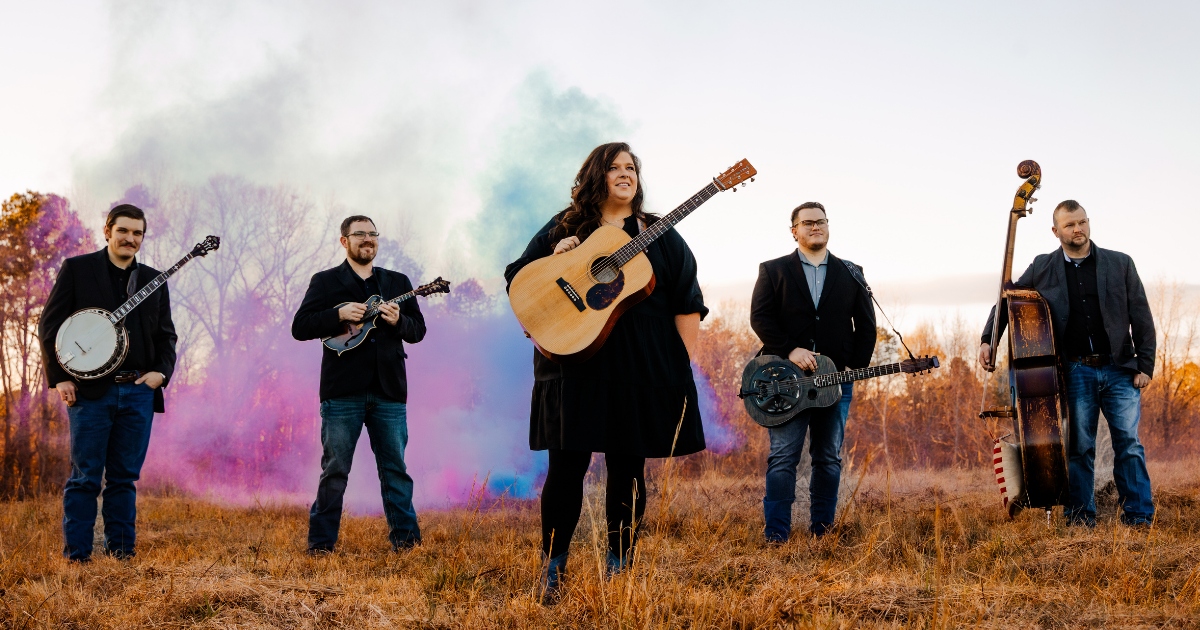

When I call Katelyn Ingardia – songwriter, band leader, and lead singer of bluegrass band Backline – to chat about the South Carolina band’s new album, Turning New Ground, she’s at home in Easley, an adorable rural town steeped in bluegrass and nestled in the foothills of upstate S.C. Other current members of the band – Jacob Carroll (banjo), Alex Hampton (Dobro), David Heavner (mandolin), and Chris Williamson (bass) – make their homes sprinkled not far away throughout north Georgia, South Carolina, and North Carolina.
Together, the ensemble sounds exactly like their southern Appalachian homeplaces. Traditional bluegrass – “mash,” old-timey mountain sounds, hard-driving rhythms, familiar idioms – coupled with a crisp modern flair, story-rich songwriting, and forward-looking production and arrangements.
It may seem their music is a far, far cry from the songs that would have emanated from the nearby textile mills found along the “fall line” and up into the Appalachian foothills, but the band’s name isn’t the only touchstone that hearkens to this era in bluegrass history. In our conversation, Ingardia draws a direct line from the semi-rural, suburban industrialization of the area in which they live to their own music, today. And you can hear the grit, authenticity, and power they channel from their regions and ancestors on Turning New Ground.
There’s plenty of life and rejuvenation breathed into this collection by the group – and their producer, Jeff Partin – after a decade of performing and recording. The energy is subdued and passionate all at once, bluegrass with momentum and feel that isn’t ever hobbled by its need to prove anything. You can relax and be soothed by these songs, or be driven to dancing, hooting, and hollering, too. And the songwriting – much executed by Ingardia herself – helps mightily to sell this subtle balance of new and old, soft and strong, driving and laid back that you can sense throughout the LP.
In the year 2026, bluegrass is still being born from the Piedmont, the foothills, the fall line – from textile mills and corn fields and twisty backroads and little villages between Georgia and the Carolinas. And while it might not exactly sound like what you’d expect to arrive from such a lineage, the music of Backline still – always – sounds exactly like home.
I figure we start with the new album, right? Turning New Ground is your fifth album since you were founded in 2016. In the liner notes, you mention that the project really is “turning new ground” in many ways, and you say that you hope folks can hear that on the record. Why is it important for you to bring in freshness? And I wonder, if you were to sit down with someone uninitiated, what would you point out on this album as being that “new ground” y’all are turning over? Is it the songwriting? Is it the production? Is it the song curation?
Katelyn Ingardia: When we were talking about new ground, we actually had a couple years of a lot of rebuilding. The first few years we had really good success. We were moving quickly to hitting those “dream stages,” I call them. Those bucket-list stages and festivals. Then, of course, the whole world got turned upside down there for a little stint [with the pandemic]. When we came back from that, we had a lot of member changes – I think it was 2022 when I took over as full bandleader.
We had some great label options on the table at that time that were saying, “We wanna sign y’all,” but I didn’t feel like musically we were at the place where we were giving something back to the industry that we wanted to present. We actually had those hard conversations. It’s like, “I just don’t feel in my gut this is where we need to be to give our best,” you know?
Once we found the sound that we wanted – a modern sound, but a traditional flair – when David came aboard, and Jacob and Alex, who are the guys in the band now, it was like all the pieces started to fall together.
I had released [my solo project] Getaway during this rebuild craziness and worked with Jeff Partin as a producer on that record. That was a huge change, ’cause we’d never had a produced record before. I loved the dynamic of the songs working with Jeff and Aaron Ramsey. I just got to talking to Jeff and I was like, “Man, I’d love for you to come aboard and be the producer for Backline’s next record. This is the kind of vibe I wanna be in. This is the kind of music that I would love to make.” It’s complex, but still genuine. And still, hopefully, relatable for a listener. From there, we just started gathering material and seeing how this album could come together.
I’ve always been really picky with albums. I love a cohesive album. I love something that has a little bit of everything, but it’s supposed to be together. Jeff saw that and understood where we were coming from. When we went into the studio for this record, our banjo player [Jacob Carroll] had only been with us for two months. That’s kinda where the “turning new ground” part came from. And the new sound, it was a lot of the production and having that outside source that gets you out of your ruts and your habits, you know?
One of the things I love most about this record is that it’s so chill. You guys are in the pocket – and you’re driving and you’re really aggressive at times, too, but you’re also subdued and telling sensitive stories at other times. It’s not a quiet album, but it’s subdued in its power. Do you think that’s something Jeff brought to the table? How do you think you struck that energetic balance? It’s a really dynamic album.
Well, I love happy accidents, but I think it’s a combination of the lyrics in the songs with Jeff’s producing – and how he writes and how he thinks musically – that brought a lot of those songs together. If I sent you the roughs of how I played them with the guitar and how I wrote them, they’re not far off from the melodies. So then I send them to Jeff and Jeff takes them, adds a flair and a flavor. He’s like, “You know, that chord works, but what if we tried this minor chord here?” Those discussions I think just elevate it.
I think sometimes songwriters can run into the problem of being a stickler about how they want it and how they wrote it. So, going into this, it’s like giving someone your baby. I really tried to be laid-back on that and just say, “I want the songs to be what they’re supposed to be.” I want them to feel like they’re supposed to feel and just to come together organically. That was the attack on the Getaway record, and this record, and the future album to come. We wanted it to come organically and to just flow.
We go into the studio, we chart them and build them in the studio. It’s not like we’ve been rehearsing for months at a time. It’s very organic, which I think entails a lot of the freshness you were asking about. But then, like you were saying, the calmness – I don’t really know. I think it’s just a combo of the material, the people working together, and that organic build in the studio that brings that.
You’re an excellent songwriter, and you’ve written about six out of these 10 tracks. What is your songwriting process like? You talked a little bit ago about collecting material for the album. It sounds like you are following the songs organically as the inspiration comes. But do you sit down every day to write? What does a songwriting session look like for you?
I think it’s kind of different. I know there’s some songwriters that thrive off of sitting every day and writing, just throughout the day, a couple of hours a day, or something like that. I lean more to the inspiration side of things.
I also love diving into different genres of music and different artists. For instance, “Dark Rolling Deep,” I was on a Lord Huron kick. Have you ever heard of them? They’re out of Canada. I was on a huge Lord Huron kick at that point, listening to different songs and tracks, and it inspired me melodically. I was like, “Man, I love that sound. I wonder if there’s a bluegrass song out there that has that feel?”
From there, I had a picture – I’m very visually-minded, so a lot of times I’ll have a picture pop up in my head, almost like a movie. It’s weird. I was like, “It would be really cool to write a song about wooden ships.” That led me to going and studying what was so unique about that time, and sailors. And that led me to folklore and superstitions. They had a ton of superstitions. From there, it led me into this whole path of building the story that I saw in my mind. Stuff like that happens a lot.
I also get hook lines in my head, I’ll jot them down and then come back to them. Then in co-writing, just in the last two years I’ve been able to do a lot more industry co-writes and stuff like that. That’s been a learning curve for me, ’cause I’ve done co-writes before, but not with industry professionals. And to learn from them– like Rick Lang, he was one of the first ones that ever invited me to come and sit down with him.
I love “Dark Rolling Deep,” too, because I grew up being a masher and playing really hard-driving bluegrass and I love that y’all can still do that – you still have those moments of “SON!” on this record – but you have such a range of material and such a range of textures and styles. You have moments that are almost orchestrated in the arrangements, like this one, and some much more simple and straightforward songs, too. You straddle a lot of bluegrass styles, from traditional to “mash” to newgrass.
I appreciate you saying that. That’s a huge part, and it’s a huge part of what we wanna do. It goes back to that thought of the organic growth and flow of the record, but also talking about Alison [Krauss’s] records or even Lee Ann [Womack’s] records. There was never a song on those albums that I remember wanting to turn off, you know what I mean?
Exactly. No skips.
There was always a song that was coming up, and it didn’t matter what week or what year [I played it], I would have a new favorite song from the same album. For me, as not only a songwriter but an artist, that’s what I want, you know? I want there to be so much material and so much diversity on the record that it’s all supposed to be together, but there’s something there for everybody. Or there’s something there for me on a different day.
Another song that jumped out at me – this is probably my favorite on the record – is “Just Country.” About nostalgia, belonging, home. It’s archetypical bluegrass, obviously, but it also makes me think about how bluegrass always falls under the country umbrella, whether we lose sight of that or not. Can you talk a little bit about what “being country” means to you and how you wrote that one?
Well, this one’s a really special one to me, because I did write it about home. I grew up in a small town and I think, for me, it stemmed off of that small-town life. The more we travel, the more you realize that no matter where you are, there’s a small-town life out there being lived. Then also the line, “No matter where the journey takes me, I can always come back home,” it could also mean in memory, too. Because “back home” changes so much.
I live about an hour from where I grew up. My parents, my grandparents, my sister, all of them still live there. I go back pretty frequently and there’s always a notice of change. There’s always a new traffic light or where we used to hang out after school and get glass-bottled Nehis is shut down and now it’s apartments. It’s all those things. I remember driving home one day and I started thinking about all the special things that I remember about that place that I love. It shaped me and it created different memories and different aspects of my life. I got home and started writing down all those little things that stood out to me. You’re looking around, you’re driving through, you’re seeing all the things.
That was kind of the picture that I wanted to paint in that song. I think this song alludes to that. Home is gonna change, it’s gonna evolve. When you go back and you ride through it, it’s probably gonna be different, but your memories and those special things to you will always be there, and you are home. That’s your home – and you’re a home for someone else, you know? It has such a deep definition.
Home shows up all across this record. “Living on the Backline,” “Not All Roads,” “Just Country.” Do you think your sound, like the literal sound of the bluegrass you make, is that how bluegrass sounds at home to you? Does it sound like upstate South Carolina? Or the Carolinas in general? To me it does, but I wonder what you think. You’re talking about home, you’re singing about home, but I think you guys “sound like home,” too. And I wondered what you felt about that.
We’re definitely tied to our roots. I mean, Backline, the name and “Living on the Backline,” that’s all tied to textile mills and the history of that culture. Our name we got because we wanted something to tie to home. Originally the band was started out of Spartanburg, South Carolina, ’cause all the members are from there. And now we’re regional, we’ve kind of spread out and members are from Georgia, North Carolina, South Carolina.
But “Living on the Backline,” my grandparents worked at a textile mill. They had mills in Georgia and a lot of Chris’s family came from that kind of life. Up in Fort Mill, Asheville, those areas in North Carolina, Jacob and David can relate to that and that kind of life. It’s all leading back to what’s real and telling those stories that make it relatable. Because, like I said, they’re small towns and there’s history that people are proud of from where they live. They live in these places and they wanna tell you the stories about their town, because it’s a part of them. I love that you picked that up. I don’t know if we sound like everybody, but I think we’ve pulled so much from these areas.
You know, there was a place in Chesnee, South Carolina, called The Homespun and my dad would take us down there every Friday night and we’d play bluegrass. Everybody would sit in a big circle. There were places up in Georgia, like the Chicken Shack that Chris grew up in, and all those people would come and play bluegrass and jam, and that’s how he learned, you know? I think a lot of the places where we lived, this South Carolina, North Carolina music – I mean, the Feed and Seed in Fletcher, North Carolina, up near Asheville, they have a big jam and they’ve had bluegrass music for years.
I think all of that pours into us, and we take pieces of it with us. And to take those things and then share them across the country in our music, and for it to be real to someone – that’s the goal.
Photo Credit: Cherry Rose Photography