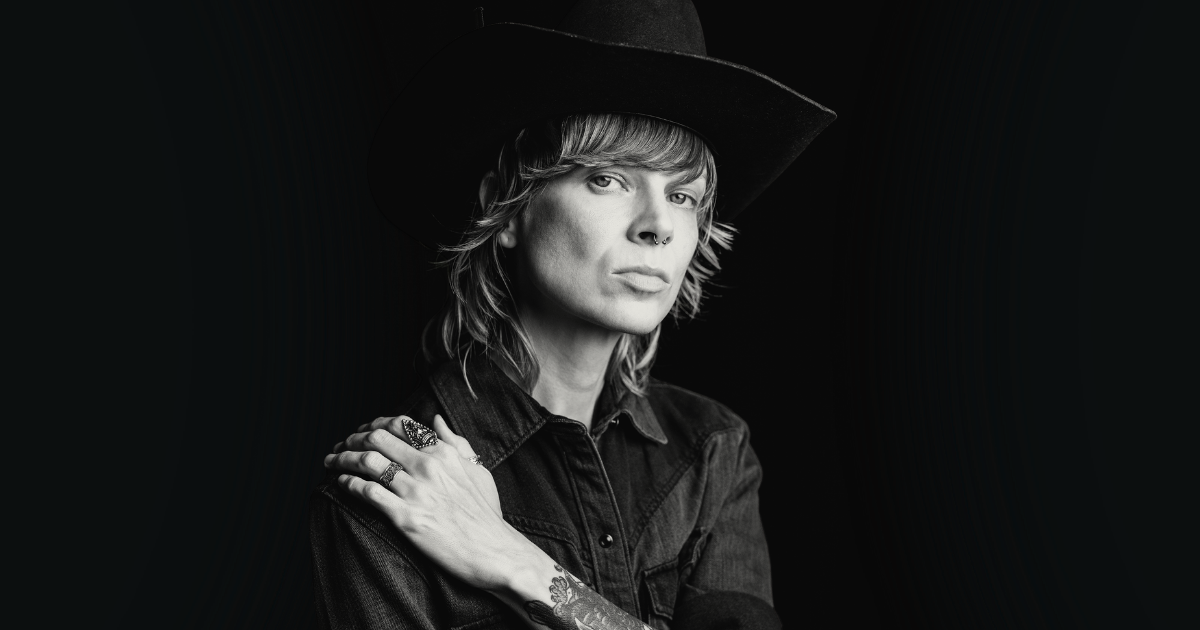
After more than a decade fronting various alt-country bands – most notably the Disarmers – River Shook is now breaking out on their own.
The new chapter officially launched June 26 with the release of Shook’s self-titled debut. It’s stripped back instrumentally, but still features the same blunt songwriting and gritty vocals that longtime fans of the singer have come to know and love. As such, its 10 songs take listeners on a rollercoaster of emotions balancing equal parts sorrow and joy, ultimately reminding that we’re all stronger than we give ourselves credit for.
“This album is extremely dichotomous,” says Shook. “One constant is a theme of being able to hold two very contrasting emotions at the same time, which can be hard for many people and takes a level of self-awareness that I think we should all aspire to.”
Bringing the record to life was Shook’s bandmate and life partner, Blake Tallent, and together they produced the project inside their North Carolina home. That decision came after unsuccessfully shopping demos to record labels, then leaning on the guidance of friend and esteemed producer Brad Cook (Bon Iver, Waxahatchee, Mavis Staples), who stressed to them the need to build everything around the vocals.
“When he said that, my brain immediately went back to the times where we’ve made Disarmers records where I felt like vocally I was competing with the band and had to force my singing overtop of everything else,” explains Shook. “But with this album we wanted to figure out the vocals and build everything else around them. When we started recording we acted as if it was a demo, just me with an acoustic guitar, a mic and a click track in my ears. There’s still the rock ‘n’ roll people know me for, but it’s a lot more nuanced because we really wanted to make the vocals the North Star of this project. When I listen back to it now, I’m amazed at how natural my voice sounds – there’s no straining to break through the noise like before.”
Ahead of the album’s release, Shook caught up with Good Country to talk about disbanding the Disarmers, recording the new project exclusively at home with Tallent, why they opt to be so up front with pain in their songwriting, and more.
When did you first start planning for this solo project, and why was it important for you to effectively “kill off” the Disarmers before doing so?
River Shook: The Disarmers were together for about 10 years, but the last couple years of it we were dealing with the situation where we had all of these tours booked and my guitarist at the time, Eric Peterson, had to take a leave of absence because he was having some arm issues that were preventing him from being able to play. That started this weird cycle of having to bring in sub musicians and soon after everything fell apart. Our bassist ended up leaving followed by our drummer, leaving us in this mode of band-aid fixes since we had so many shows already on the books. We were so busy that we didn’t have time to even really be intentional about who we were bringing in, it was just a matter of “can they play the instrument well and are they available?” – there wasn’t any time to reflect.
I was also getting really burned out, and on top of that I’m a very introverted person, so it was really hard for me to get used to new people. Couple that with the fact that sometimes we would have people in the band that we just weren’t meshing with made it start to feel weird. I was constantly trying to hold together this thing that was determined to fall apart. Then in December of 2024 my other longest-running band member, Jack Foster – who had drummed with me for three or four years at that point – called me shortly after Thanksgiving and told me he could no longer commit to the band. Instead of the knee-jerk reaction that we’d all been having every time a band member left, I just decided to let go and move on. It wound up being a massive weight off my shoulders.
At the same time, I knew I [was] not quitting music, because it’s such a huge part of who I am, I just realized it was time for that chapter to come to a close. Immediately I began thinking about what’s next, not in a hectic or frantic way, but in a way that felt extremely liberating and inspiring. [I was] immediately inspired – like, I can take this wherever I want to.
You talking about feeling liberated has me thinking of the album’s opening track “Free At Last.” Was that your way of declaring you’ve broken free of what has weighed you down?
That’s absolutely what it felt like. That song is actually a reference to sort of a parallel storyline that was occurring at the time. I had to cut my parents off for a while, which is very hard to write a song about. Most people can’t relate to that, but I felt like if I can write this song about a divorce, that is something that so many people can understand. That – coupled with the fact that the Disarmers ending was very much a divorce in its own way – made this a song that I wanted to use to remind people that getting out of your shit is really hard to do. However, the freedom to do and pursue what we want on the other side is absolutely worth going through that heartache.
Speaking of your parents, you also sing about your up-and-down relationship with them on the record’s closing track, “Loving Me Is Like Rolling A Big Old Rock.” What was it like rehashing some of those memories and examining how your relationship has evolved with them over time?
I was working through a lot of stuff with all the songs on this record and trying to be more honest with myself about my childhood and my teen years, which were rough. I know my parents meant well and were coming from a good place, but it was a very controlling and authoritarian household where I experienced a lot of religious and gender-based trauma. In their minds I was born a girl, so I was only supposed to exist to be a wife, mother, and housekeeper. They’ve since come a long way with their beliefs and don’t think like that anymore, which I’m grateful for, but the damage had already been done.
More recently I was at a point where I [was] grappling with all this stuff as an adult and going to therapy to try to come to terms with it all. Therapy is a great tool, but it can only get you so far. There’s so much work that you have to do yourself and that’s part of what writing this record was, it was me therapizing myself. It was me having very honest and frank discussions with myself about what happened and what I need to do to have a healthier perspective of all of the bad things that I’ve dealt with.
So “Loving Me Is Like Rolling A Big Old Rock” is supposed to feel kind of mischievous and fun because it is touching on such heavy topics that unfortunately I think a lot of people can relate to. When most people become parents for the first time they’re not prepared, because their parents weren’t prepared to be parents either – it’s a tale as old as time.
You and your partner Blake Tallent produced this album yourselves inside your home studio in North Carolina. What led to that approach, and is it something you’d ever done before?
The first four Disarmers records were studio albums, but with my side project, Mightmare featured the only other record that I’ve made at home, although that was a completely different situation. That entire record was me, a MacBook with GarageBand, and a Scarlett Focusrite [interface] – it was very DIY. When I wrapped up the Disarmers, I had demos that our manager was shopping around. We were getting some interest but nothing more, and it got to a point where the timeline that I had with our touring schedule required that we release this in spring of 2026. That’s when we started making the record at home between just the two of us.
Blake is a killer multi-instrumentalist, so much so that it blows my mind. He lived in Nashville for a long time and still has a house on the east side. When he lived there he was producing records, playing instruments, and even mixing – he’s a fucking weapon! Our original goal with this record was to have a whole band on it and to capture it at Sonic Ranch, since that place has been on my bucket list for several years. When the things that you want don’t work out, you can get lost in the defeat and your emotions or you can notice it as an opportunity to do something else, and that’s how we chose to approach it. I’m so grateful that [Blake] was fully on board.
The Disarmers had a couple fly-out dates at the end of June 2025 and by July 1 we were hunkered down in the house and started making the record using Pro Tools. Blake taught me the basics of Pro Tools so that while he’s playing drums or bass, I can be running the session and he doesn’t have to multitask. It was also nice not running into that “too many cooks in the kitchen” issue, because both of our creative visions were 100% aligned. I can’t think of a single disagreement we had in the studio, which simply does not happen. Having a creative partner who’s also your life partner and being in alignment together on a project of this magnitude was incredible, and I think because of that our synchronicity really shines through on this record. It sounds very cohesive without any kind of dissonance or struggle.
How long has Blake been playing with you?
He joined the band as a sub in June of 2022, then we were seeing each other by August and fell in love on our first European tour together, completely unexpectedly. The story of how we met is told in “Running to Georgia.” It was a combination of crazy coincidences and planets aligning for us to have even met in the first place.
That’s funny, because the first time I listened to that song I assumed it was about you trying to get away from someone. How exactly did y’all find each other?
The Disarmers were playing the El Rocko Lounge in Savannah in October of 2021. When I walked in the venue I saw him across the room and immediately thought, “That’s my person!” It wasn’t like it was love at first sight or a sexual thing, it was just this acknowledgment and recognition. Then he walked over to me and held his hand out and said, “Hey, I’m your sound tech” and I was so embarrassed. [Laughs] I thought I’d made a terrible mistake, but then I ended up going out to a bar after the show to meet another friend who happened to be in town on tour and Blake was there. We wound up having this great night of hanging out with friends and talking, but the next day I was so depressed because I thought I’m never gonna see this person again.
Then a few months later we needed a guitar sub and my manager emailed me out of nowhere saying there’s this guy named Blake Tallent who knows all the songs and is available for all the dates, and my jaw hit the floor. It was destiny.
That’s lovely. I’m so glad you found your person!
The next song I wanted to ask you about is “Wildlands,” which was your first single as a solo artist but isn’t included on this album. Why is that?
“Wildlands” was a separate thing. When we made the record, the only instruments that Blake didn’t play were banjo and pedal steel. But immediately after we made it, he got a pedal steel and stated that he wanted to do it himself next time – which he did when we eventually recorded this song. At the time we were talking with a label and everyone involved was 99% certain that we were going to sign with them, but it ended up being an absolute fiasco. Initially we planned for the song to be a single leading up to the album singles, but when this label deal fell through I realized we had no option other than to self-release unless we wanted to move the album to the fall. At that point I’d already put a band together and promised people jobs so that wasn’t going to happen, but I still really wanted to get the song out since I knew fans were hungry to hear what this new project is gonna feel and sound like.
In that sense it was like revenge putting this out. I didn’t know if we were going to find another label or distribution partner – or what-the fuck-ever – but [“Wildlands” was] going to be a standalone thing, which I think was very symbolic. In the end, that single is 100% independent – I own the masters, the publishing, and the songwriting. We were very fortunate to find a distribution partner for the record, but I think that song is really special and has its own thing going on.
In lieu of not landing a record deal you released the album under your own imprint, Blackberry River. Mind telling me about the origins of its name?
I’ve been working on a memoir … When you’re having to really rethink your childhood and the things that occupied your time– one big thing for me was summer, because winters in Western New York are absolutely brutal. It’s like six months of winter and gray sky, so spring and summer have always been my favorite seasons. My favorite thing about summer was our backyard, which was pretty big and had these amazing blackberry bushes that my older sister and I would go out to with baskets to fill up while also eating them right off the bush. The wild nature of blackberries – not as a thing that’s an agricultural commodity, but something that is just literally wild and free – is something I relate to so deeply. So Blackberry River is just a nod to my 8-, 10-year-old self that was barefoot running through the yard with purple blackberry hands. [Laughs]
What has bringing this record to life taught you about yourself?
I learned that less is more sometimes and that I can be a very hyper-focused type of person, which sometimes means I need to step back and take in the bigger picture. I’m just now developing the ability to step back and see things more as a whole than as individual parts. Doing that gave me a lot more perspective on how to make this album really shine.
Photo Credit: Jillian Clark