
Robert S. Cantwell died on July 3, and for people who write about country or folk – and for people who play these musics – this was a major loss. Cantwell grew up on the South Side of Chicago and went to school at the legendary Grinnell College in Iowa. He spent his time at Grinnell learning how to play the banjo, though frequently he would be fined by the college for playing after hours. Committing to a lifetime of writing, he wrote mostly about country and folk music, but in ways that were difficult, all-encompassing, eccentric, and curious. He never really believed in the purity of form, but also was careful about what popular music meant. For decades, mostly in North Carolina, he was writing and teaching about music where legend was more often printed than the truth. Cantwell knew the truth was polyvalent. And slippery.
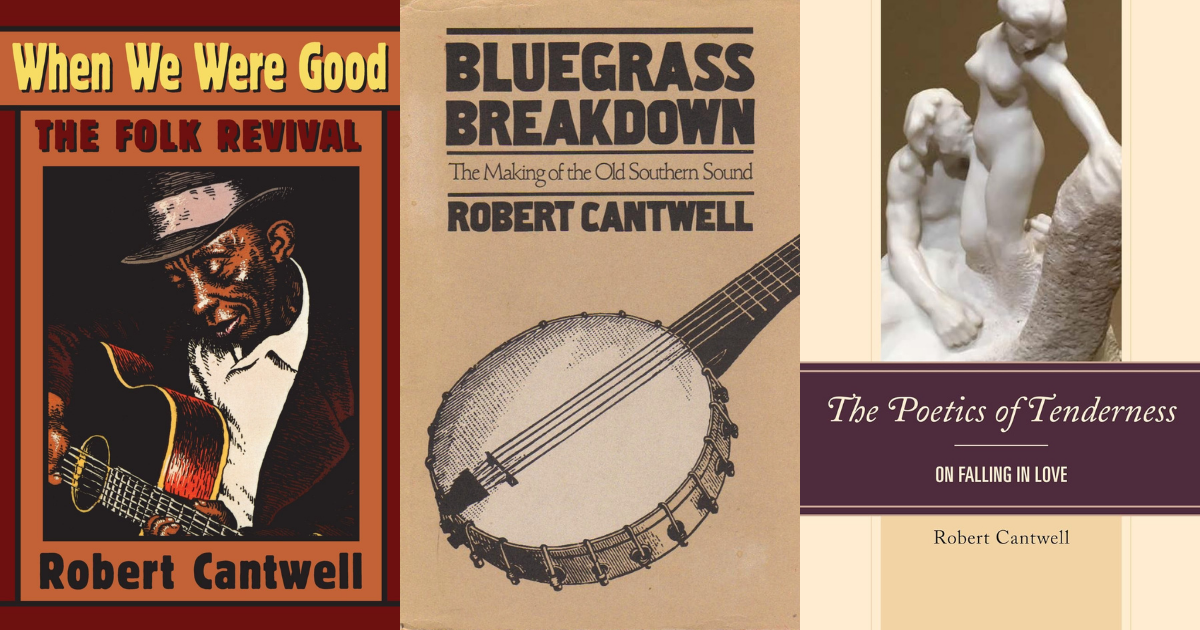
He writes carefully in one section of Bluegrass Breakdown about what church music means, tracing the sanctification of hillbilly music all the way through Appalachia to Calvinist psalters in Scottish churches. At the same time, he was one the earliest white critics to note that the history of the banjo came from West Africa, but the theft of the banjo, as an instrument and a music, was abetted by vaudeville and burlesque, places where blackface was rampant. These two examples note the public and social problems of the music, but also note that the public performances of these spaces was as much in an oral as written tradition, and that bluegrass requires a performance orientation.
This move towards understanding performance as central to the genre also allowed for a chapter in Bluegrass Breakdown about Bill Monroe at the Grand Ole Opry, an exquisitely reported backstage report. That chapter is so well observed, not through the top-down hierarchy of an academic who needs to pretend that he knows all, but through noting carefully what he does know (the origins of Bill Monroe’s “High Lonesome Sound”), what he doesn’t know (who Jean Shepard was outside of her stage clothes), or what cannot be known entirely (the social pressure of the Opry as a site of country music.)
Cantwell’s observations come out of concerns, a careful listening, which suggest that genre is less important than a loving discussion of what music is, as it is listened to now, and how it has been listened to historically. Cantwell can follow that backstage passage, with its shade of ’70s-style New Journalism, with a discussion of what Monroe was actually playing – and I mean this culturally, but also via actual notation. But he follows that with an annihilating anecdote against an anonymous scholar who argued that bluegrass must result from written sources. He further argues that it is one kind of music, one kind of genre – though not one that is central to the conversation – acknowledging the legitimacy of the form, but asking why the performer would only allow one kind of knowledge.
Cantwell was included in fellow critic Eric Weisbard’s magisterial volume on music criticism, Songbooks: The Literature of American Popular Music, a book that features almost every important book of music criticism. Weisbard writes about Cantwell’s Bluegrass Breakdown: “Folklore almost dissolved in Cantwell’s antidisciplinary, antigenre, anti (as prose) generic accounting,” then spends the rest of the entry almost walking back what could be considered an accusation – recognizing that if bluegrass was supposed to be a melting-pot genre, then writing about bluegrass should be equally anti-genre. Bluegrass at its best is both pure and filthy; singing about plain truths in flashy suits. Work that happened within written or oral traditions requires a systematic dismantling of the genre, reworking it with new disciplines and stranger understandings.
This is where I say that Cantwell argues – and he does that sometimes – but he also tells stories, and pays attention, and works out some problems about the rise of bluegrass. He considers Bill Monroe central, but uses Monroe as a larger example that the genre is a commercial construction, one that has an origin in a wide variety of oral and written traditions. Bluegrass – and I think by extension folk and country music – is a bastard child with many parents, and Cantwell at his best elucidates all of them.
His other work is equally dense. He traces the entire history of the 1960s folk revival in the ironic and telling When We Were Good, which deconstructs genre as aptly as Bluegrass Breakdown does. His last book, The Poetics of Tenderness, is about how much he loves his wife, but also about how to read with an all-consuming love–and according to its press copy it quotes “Andreas Capellanus, Plato, Schopenhauer, Freud, William James, Hardy, Dreiser and Fitzgerald, D.H. Lawrence and Tom Stoppard, among others.” That might be the central gift of understanding Cantwell, understanding that to love something is to consume it – with tenderness and with ravenous hunger.
In his death, we not only lose a singular voice in American popular music criticism, but we also experience a loss in how exactly to write about genre, and about bluegrass. We lose someone who dedicated care to research, but also with the patience and space to consider work over centuries. In the systematic dismantling of humanities, and in the academic gatekeeping which forbids working-class people from writing about working-class music, Cantwell’s death seems deeply symbolic – of how rare writing this patient and erudite is now.