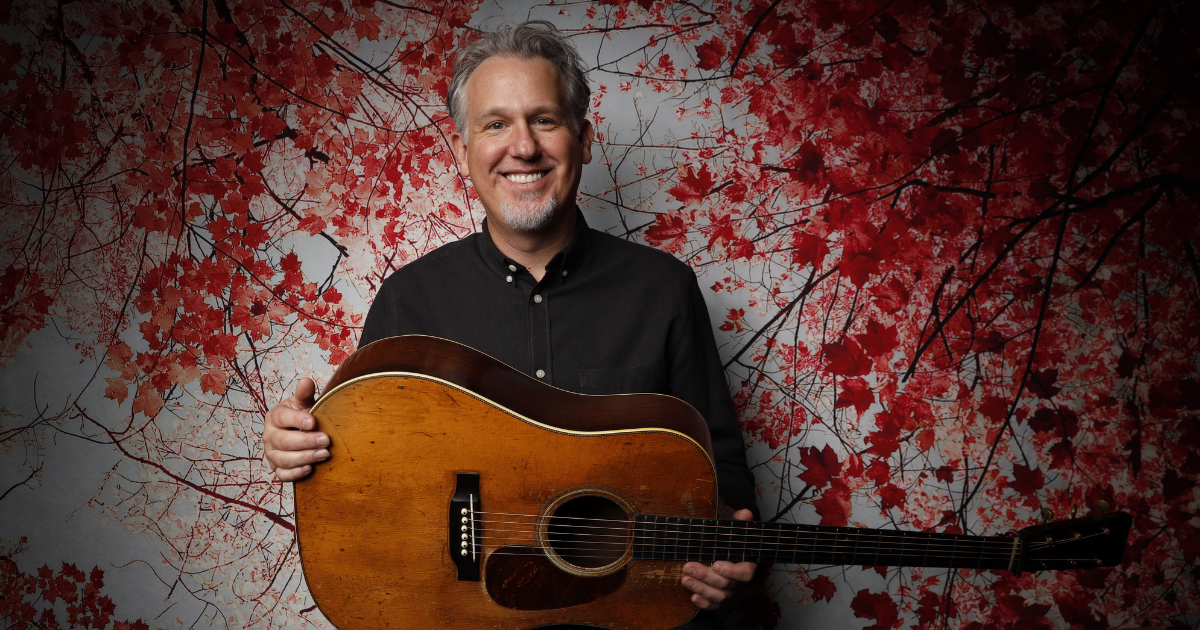

A summer conversation with Bryan Sutton finds the musician roughly twenty years after the release of his first record of guitar duets, Not Too Far From the Tree, which featured musicians he considered both friends and heroes—folks like Norman Blake, Doc Watson, Tony Rice, George Shuffler, and Earl Scruggs.
In this interview, we revisit those days when he’d drive around the South to meet these musical legends at their homes—often with his dad in tow—sharing meals and setting up a rack-mounted ADAT digital mobile recording unit, not unlike the early years of country music where field scouts and song collectors alike would visit fields, hollers and cities in search of material. We also explore how he parlayed that same work ethic into his newest collection of duo material, which pairs archival tracks with brand-new performances, offering snapshots with singular musicians in a relaxed setting, presenting their playing down to the core of their stylistic identities.
It is no news that Sutton has built a formidable reputation since moving to Nashville from North Carolina in the early ‘90s. Since then he’s navigated seamlessly between Top 40 country sessions, cutting-edge bluegrass bands, teaching, and recording his own solo albums. On From Roots to Branches Vol. 1 (released via Mountain Home Music Company), Sutton subtly shifts the focus from older generations to his peers and younger musicians, while continuing the conversation he began in 2006 to modestly present the music he loves best.
The track list includes unexpected contributions from guitarists like Joe Bonamassa (“Blue Night”) and Tommy Emmanuel (“Don’t Let Your Deal Go Down”), alongside bluegrass mainstays such as Billy Strings (“The Devil Went Down to Deep Gap”), Sierra Hull (“Grandfather’s Clock”), Kenny Smith (“Three Star Hornpipe”), Jake Stargel (“Crazy Creek”) and others. In his own words, this record presents “musical guitar conversations” that are both archival and representative of his collaborators’ creative voices: “We’re all in a room together. Being in the moment with whoever it is, wherever it is, and not letting the gear and recording tech get in the way.”
BGS: I’m curious how this record came together—whether you were looking for specific material and filling holes as you went along, or if folks came to you with tunes they wanted to play.
Sutton: The spirit of what I tried to maintain from the first one is, at its heart, the guitar duet concept—being way more conversational musically. A lot of times back then and now, not 100 percent of the time, but enough times, we show up not sure what we want to record. It’s kind of like a jam in that way, real organic, because I didn’t want to overthink it producer-wise. Sometimes I needed to, but as much as I could, I just tried to say, “This is what we would do in a jam. What’s a tune you like? Let’s just play it.”
That’s really what I wanted it to be: collecting musical guitar conversations. The big question was where we stop, because it could just go on forever and ever. And that’s a cool thing. I like knowing that I could keep doing this kind of thing. That was sort of the spirit of all those things coming together. I had these tunes from Doc and Tony left over that I thought could connect the whole bigger guitar duet thing—that project mindset, being able to release stuff from the first batch with some new songs. That was the focus going in.
Then it was just trying to call people up and ask, “When are you coming through town? Are you going to have a day here?” A lot of it was between Thanksgiving and Christmas, around those winter months when people aren’t traveling, and just random times. I did nearly all of it at my house in the home studio so I could tear down and set up quickly, and folks were willing to drive there.
Most of it was cut in the same room with the same mics, which was another concept from the first one in my little rig. Joe Bonamassa and I recorded ours at Curb Studio in Nashville, and I did one with Brad Paisley down at his house. Even though I was in a lot of different places, from North Carolina to Colorado and here (in Nashville), I used the same mics and gear. So, I was able to preserve as much of that as possible, too.
Where were those initial sessions recorded—specifically the ones with Doc, Norman, and Tony? I assume the tracks with Doc and Tony on the new record were captured in the same location as the first record.
The Doc tunes were recorded in a hotel room at the Radisson in Longmont, Colorado, probably late July 2005. Tony met me at the Crossroads studio in Asheville, North Carolina, for his. And Norman—I drove to his house down in Rising Fawn, Georgia. So yeah, I had a little rack-mounted rig and a box of mics, and we’d set up, push play, record, and get what we got.
When I first came across that record, I didn’t consider the idea of you doing it in a mobile way.
Yeah. Well, again, I was thinking about Tony Rice, Earl Scruggs, and Doc Watson: “Can you come to Nashville? Can you totally arrange your life around coming to record one song with me?”
And then you get to hear them in their natural environments, or in the case of Tony, somewhere he probably worked a lot.
Right. That was the cool part. I went to Norman’s house, George Shuffler’s house, and Jack Lawrence’s house. That was great. I don’t know that I was that intentional on that front, other than feeling like I didn’t want to make these people drive anywhere.
Where was George Shuffler, just out of curiosity?
Valdese, North Carolina. It was great. His wife had made a cake. There are a few other songs from that batch that are still unreleased—maybe we’ll put them out in some other format. I always loved George. He was always really kind to me, gregarious, wanted to hug you, and called everybody “honey.” I loved it. Again, that was a neat thing: I had my dad with me driving around. We did that on the same day—drove around Asheville, then to Valdese, and then down around Charlotte to get Jack Lawrence at his house. So, it was a neat little trip to get all this stuff. In the old days, for sure.
I loved George. I remember asking him – because again, I had no idea what we would record until we got in there – “What was the first song you played? What’s your favorite song?” I think it was “A Little Rosewood Casket” or something like that, and he started tearing up when he was playing.
Since you made those first recordings, has your concept of the duo shifted in any way? Perhaps a renewed perspective?
Honestly, not a renewed perspective, but a continued love of it. The duo setting, either on stage or off, has represented some of the deeper musical moments for me. It is more intimate, and you hear more of everything. Especially with guitar, where you have a wide range sonically and volume-wise, you feel like you don’t need much more. Part of that perspective has always been the commitment to it: not saying “this is reduced or minimalistic compared to a bigger production,” but rather “these are two really capable musicians playing capable instruments and owning it.”
That’s the power of old brother duets—maximizing the setting. There’s magic within a trio sharing the workload, too, but the duo is the perfect little balance. I’m a Libra, so maybe that shows up (laughs). A lot of times I feel like I play more authentically in a duo. In a band, I feel like I have to spread myself thinner. I really relish the opportunity to fully support somebody and feel fully supported trading solos or looking at each other and singing.
One thing I have always appreciated about your guitar playing is your ability to orchestrate in a way where the listener knows what’s next and things are demarcated clearly, whether through ornaments, rhythmic emphasis, or improvisation as a facet of form. All of that is represented on this project in spades. I’m wondering if there are recordings or experiences that got you thinking that way.
From early days with Ricky Skaggs’ band, making records with him… he came out of that Brian Ahern, West Coast country ’70s style with a lot of emphasis on the orchestration of acoustic guitars. We still do this in sessions today: orchestrating sections with two different guitars where one comes and goes, a higher guitar plays along with a lower guitar in a louder section or transitioning into an arpeggiated part versus a big strum. It speaks to dynamic orchestration and arranging awareness. What is the emotional impact the listener feels because of this extra stuff coming in, or because we stripped everything down to help the emotion of the song?
Jerry Douglas was the first person I heard use the term “song shape.” The idea is that you can see a song building and growing from beginning to end like a first act, second act, and third act. Those things developed through experience, paying attention, and learning as I went. Session work is about crafting a performance and its arcs—the transition from a verse to a chorus, setting up the next move, and knowing when to empty out space or lay out. It’s a bit of maturity that’s been part of my learning. I want to keep getting better at it.
For you, what’s the balance between having a distinct voice in a given tradition, then sublimating it to make others sound like themselves, such as in studio sessions?
That’s a good question. I had an opportunity early on to be a bluegrass guitar player around Ricky Skaggs, Hot Rize, Jerry Douglas, and Béla Fleck. That music was part of my core. If you heard me at 14, certain things in the pocket, tone, or inside awareness would still connect to how I play today. But part of me has a “both things can be true” mentality. I can play sessions, write, sing, tour with Béla Fleck, or make solo records. I love listening to rock music, traditional country, or Ray Edenton’s rhythm guitar on a Loretta Lynn record. If someone is curious about that path, you’re agreeing to be all things—going from playing on a Top 40 country record to making an acoustic duet record.
I like moving around. I don’t want to be in the same band forever or do the same thing forever. Playing non-bluegrass music informs what I do in bluegrass, especially rhythmically with different drummers. There was an era in Nashville where touring could kill your session career because people assumed you were always on the road. When I was weighing doing live gigs versus sessions, producer Paul Worley told me: “You’re only as creative in here as you go out there and fill yourself up to be.” That was a great perspective on maintaining balance.
In the present, with you teaching more recently, I’m curious if there is anything that is particularly exciting for you.
After years of pursuing a career, I’m trying to slow down, take more time for myself, tour less, and pay attention to things that truly matter. I’m doing things I wouldn’t have thought I’d be doing 20 years ago—teaching online, running camps, and asking what needs to define me as a human on this planet. But yeah, just trying to be a little more reflective, a little more intentional, a little more healthfully detached from musical things—maybe it’s not all about D-28s and G-runs (laughs).
Photo Credit: Ali Hasbach