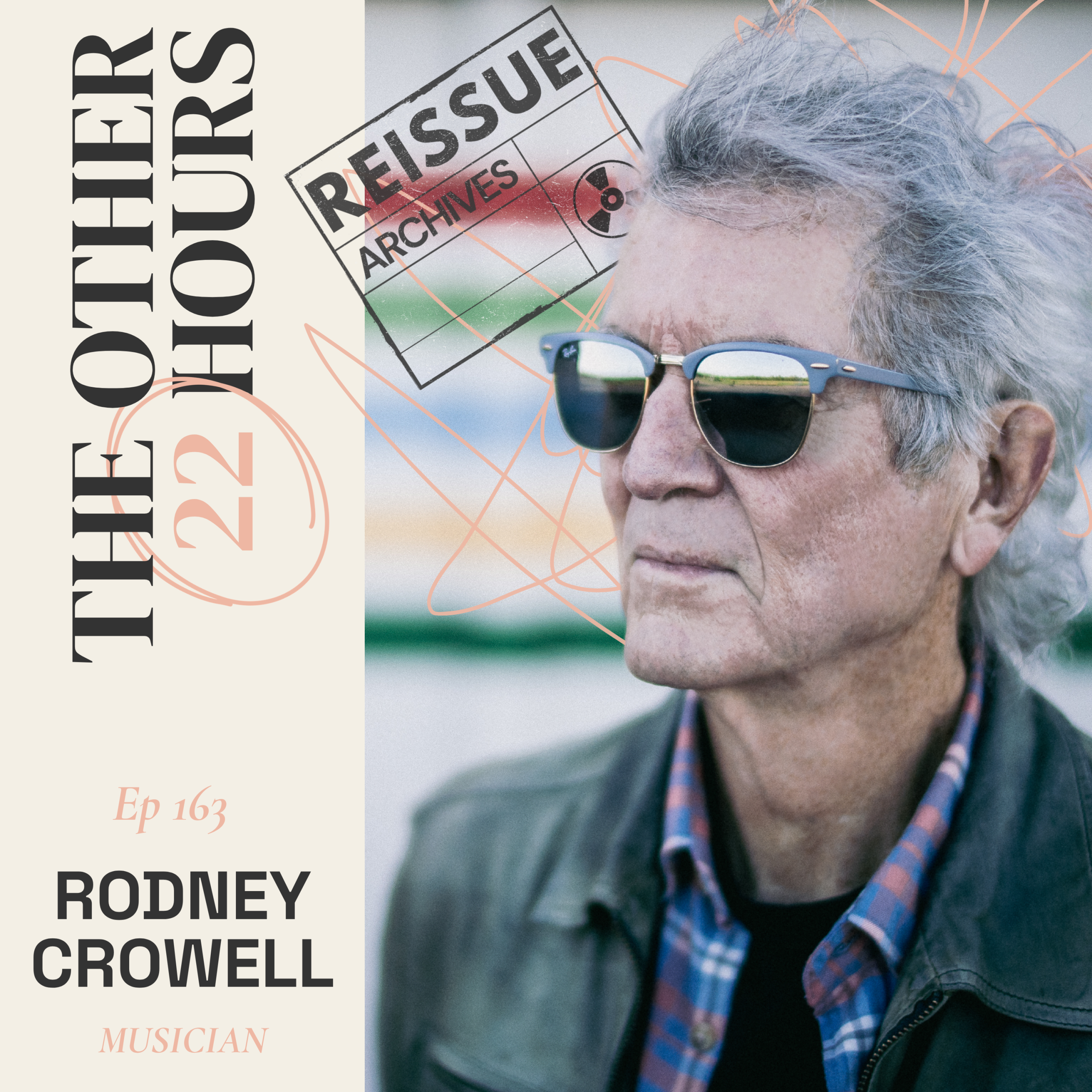

Some records arrive exactly when they’re meant to. Others wait patiently in the dark, gathering meaning with every passing year. For Rodney Crowell, Then Again belongs to the latter category.
Recorded in 2006 but quietly shelved for nearly two decades, the album was never abandoned because Crowell doubted the songs. Instead, time itself became part of the recording’s story. When he eventually rediscovered the tapes, he wasn’t simply listening with older ears. He was listening with a different heart.
“I heard a record I wasn’t tired or bored of,” Crowell said with characteristic candor. “I was no longer tired and bored with myself. That’s what 20 years will do for you.”
It is a remark that says as much about life as it does music.
At 75, Crowell has little interest in nostalgia. He speaks instead about perspective – about learning to regard the younger man he once was with affection instead of criticism. The years have softened neither his standards nor his curiosity, but they have granted him something perhaps more valuable: compassion for himself. Then Again sounds less like an archival release than a conversation between two Rodneys separated by 20 years yet bound by the same restless artistic spirit.
That spirit was forged long before Nashville embraced him as one of America’s premier songwriters.
Crowell’s education began in southeast Texas, where songs traveled not through record collections but from one human voice to another. His father, who grew up on a sharecropper farm in western Kentucky, possessed an extraordinary gift for remembering music.
“He had a butterfly net to catch songs,” Crowell recalled. “Once he had them, he knew them.”
As a boy, Rodney sprawled across the floor while his father sang old Appalachian ballads, heartbreaking country laments, and weathered tales passed along through generations. There were no carefully cataloged albums lining the walls, no elaborate stereo system. The music lived in memory, carried from person to person through an oral tradition stretching back decades. Those songs became Crowell’s first inheritance. When he left home at fifteen to join a band, his father’s advice proved surprisingly prophetic.
“Tell them you write your own songs.”
Rodney didn’t write songs yet. He promptly claimed an Otis Redding classic as his own before the rest of the band recognized the bluff. The deception didn’t last, but the challenge did. His father had planted an idea that would eventually shape American songwriting.
Those early years unfolded across Legion halls, rodeo dances, Gulf Coast clubs, and small-town gathering places east of Houston. The humid Texas evenings smelled of beer, cigarette smoke, and dusty dance floors. Bands moved effortlessly between Beatles tunes, country standards, and surf instrumentals, playing whatever kept couples moving beneath strings of lights hung over community halls. The venues have mostly disappeared.
“I went looking,” Crowell said of one former dance hall. “The location was there, but the building wasn’t.”
Like so much of America, those landmarks surrendered to suburban expansion, leaving only memory behind. Memory also carried Crowell to Nashville, where another education awaited. He arrived knowing few original songs but possessing something the city’s finest writers admired: an encyclopedic knowledge of old country music learned from his father. Around late-night gatherings with Guy Clark, Townes Van Zandt and Mickey Newbury, Crowell discovered that his familiarity with forgotten ballads earned him a place among extraordinary company.
Guy Clark became a mentor as much as a friend. Crowell remembers first hearing Clark’s name from an unlikely source before unexpectedly finding the legendary songwriter asleep on the bed he had been renting. Their friendship blossomed into an apprenticeship unlike any classroom could offer.
“Guy was a curator of early Nashville songwriting,” Crowell said.
Clark introduced him not merely to songs but to standards. He played Bob Dylan recordings. He encouraged deeper language. He challenged Crowell to pursue authenticity rather than cleverness.
“Your language has got to be that real.”
Townes Van Zandt provided another kind of lesson. Late one night, around one in the morning, Van Zandt quietly announced he had written something new. Then he played “Pancho and Lefty.” Crowell sat stunned. Inside, he remembers thinking, “This is what you’ve got to do.”
Van Zandt possessed a competitive streak, unveiling masterpieces that simultaneously inspired and humbled everyone fortunate enough to hear them first. Clark, by contrast, nurtured younger writers with generosity. Mickey Newbury demonstrated that lyrical sophistication could coexist with a soaring tenor voice, freeing Crowell from believing every great songwriter needed the baritone gravity of Cash, Kristofferson, or Billy Joe Shaver.
Together they became an informal graduate school of American songwriting. Years later, Crowell would write songs that entered the same conversation. Yet success brought its own hazards.
When a remarkable run of No. 1 country hits made him one of Nashville’s hottest writers in the late 1980s, Crowell sensed something unsettling happening. Walking into rooms, he realized people no longer saw Rodney Crowell, the songwriter. They saw Rodney Crowell, the hitmaker. He began constructing, almost unconsciously, a version of himself shaped by other people’s expectations.
His ego, he says now, became a dangerous collaborator. “If you let your ego get involved, you can get hurt,” he reflected. “It would rather sabotage the art.”
Rather than feeding celebrity, Crowell deliberately resisted it, sometimes awkwardly. During promotional radio appearances, while enthusiastic hosts tried to sell records to morning commuters, he answered questions with monosyllables, refusing to play the role expected of him. Looking back, he laughs at his own stubbornness while recognizing the lesson beneath it: fame is fleeting, but authenticity demands constant vigilance.
That understanding would prove invaluable during another extraordinary chapter of his life – one lived within the orbit of perhaps the most recognizable voice in American music. As Johnny Cash’s son-in-law, Crowell could easily have embraced proximity to legend. Instead, he did everything possible to establish himself as his own man.
“I ain’t coming around here because you’re Johnny Cash,” he remembered thinking. “I’m around here because I love your daughter.” Cash understood. More remarkably, he respected it.
Years later, after his marriage to Rosanne Cash had ended, Crowell discovered just how deeply those family bonds still ran. When Johnny and June learned that Crowell had begun dating Claudia, the woman who would become his wife of more than three decades, they invited the couple to dinner. Driving home, Claudia couldn’t understand why Johnny and June had worked so hard to make her feel welcome.
“I said, ‘Because they love me.'”
It remains one of Crowell’s favorite memories – not because it involved two American icons, but because it revealed the generosity beneath their fame.
Cash also delighted in gently puncturing Crowell’s youthful swagger. Looking back now, Crowell smiles at the younger version of himself who insisted on proving his independence every chance he got. Rather than embarrassment, he feels something closer to tenderness.
“I’ve developed a compassion…for that me,” he said. “Good go, young Rodney. You were just trying to establish who you were.”
It is difficult to imagine a better description of Then Again itself. The album captures an artist still determined to prove himself, while the older Crowell who finally released it understands that proving oneself eventually gives way to understanding oneself. Time didn’t erase the younger man’s ambitions; it simply placed them within a larger frame.
That perspective echoes throughout one of the album’s most affecting songs, “If I Could Speak to Leonard.”
Written years before Leonard Cohen died in 2016, the song has become something more profound with time. What began as an expression of admiration now sounds almost like a farewell whispered across generations of songwriters. Crowell insists it was never intended as an imagined conversation.
“It was a love song,” he said simply. “It’s expressing my love for his work.”
For Crowell, Cohen represented far more than literary songwriting. He offered a blueprint for aging with artistic purpose. While many performers spend their later years revisiting past triumphs, Crowell watched Cohen continue reaching toward new creative heights. Albums like Old Ideas and You Want It Darker became, in his words, breadcrumbs showing how an artist could continue growing even as the body inevitably slowed.
“I want to continue to create art at a high level as I wane,” Crowell said. “I don’t want the art to wane with my physicality.”
That aspiration permeates Then Again. Although recorded years ago, the album feels uncannily current because Crowell himself has finally caught up with it. Songs once left behind now carry fresh emotional resonance, illuminated by experience rather than youthful urgency. The years have also sharpened his awareness of time itself.
“I’m 75,” he reflected. “Time is more precious. I don’t have much time to waste.”
There is no trace of resignation in those words. Instead, they carry the quiet urgency of a man determined to spend his remaining years loving his family well, encouraging younger writers, and pursuing songs that continue asking difficult questions.
He speaks often of longing – not for youth, but for continued artistic growth. That philosophy shapes the songwriting workshops he still conducts, where he finds himself most energized by young writers willing to rethink a lyric or reshape a narrative. Their openness reminds him that songwriting remains an act of discovery rather than certainty.
For Crowell, certainty is often the enemy. The same conviction explains his skepticism toward artificial intelligence creating music. Songs, he believes, are more than carefully arranged words and melodies. They carry the fingerprints of the people who lived them.
As a child listening to worn Hank Williams records spinning across the living room floor, Crowell wasn’t merely hearing music. He was beginning a relationship with another human being. That relationship later extended to Buck Owens, Chuck Berry, Johnny Cash, Bob Dylan, Merle Haggard, and eventually Leonard Cohen. Great songs invited listeners into another person’s emotional world, something Crowell doubts machines can genuinely replicate.
“I want to wrap my arms around the artist,” he explained.
It is an observation that also reveals why Then Again feels so personal. These are songs created by a younger Rodney Crowell but embraced by an older one, each version reaching across time toward the other. Crowell often compares an album to an art gallery.
“When you walk into the room that is this record,” he said, “there are ten or eleven paintings hanging on the wall in the form of music.”
It is a beautiful metaphor because it captures the experience of listening to a complete album. Each song occupies its own space while contributing to something larger. Rather than rushing past individual tracks, listeners wander from one canvas to another, discovering unexpected connections along the way.
That idea feels increasingly radical in an era dominated by playlists, algorithms and abbreviated attention spans. Crowell remains committed to albums as immersive experiences, invitations to linger rather than scroll. Perhaps that explains why Then Again never sounds like an artifact rescued from storage. Instead, it resembles a gallery whose doors have finally opened. The paintings were always there.
Only, the artist needed twenty years before he could walk through the room without judging every brushstroke. For Rodney Crowell, that may be the greatest gift age has offered. Not perfection. Not certainty. Simply enough grace to recognize the younger man who created these songs and enough wisdom to appreciate what he had accomplished before he knew it himself.
Some records capture a particular moment. Then Again captures two. In an industry that often celebrates novelty over endurance, Crowell has offered something rarer: proof that good songs, like honest friendships and enduring love, are not diminished by time.
If anything, they become more fully themselves. And perhaps so do we.
Photo Credit: Claudia Church