Where does one begin to draft a list of exceptional guitarists, historic and modern, for readers of the Bluegrass Situation? It goes without saying that BGS is consistently enchanted by Molly Tuttle, who’s won two Grammys for her bluegrass albums, as well as Cody Kilby, the reigning IBMA Guitarist of the Year, and the late Tony Rice, arguably the greatest bluegrass guitarist of all time. To shine a light on other notable guitarists working in the acoustic-roots worlds, I’ve chosen folks who are eternal to the music, while at times subversive, occupying roles that aren’t always at the center of the stage. I’ve also done my best to present musicians working within traditions that both inform—and are informed by—bluegrass music at large.
Historic Guitarists
Riley Puckett
I argue that Riley Puckett is of the most influential, yet overlooked, pioneering country guitarists and singers of all time. Starting on the airwaves of Atlanta, Georgia, in 1924, Riley outsold many of his contemporaries, while influencing players as wide-ranging as Jimmie Rodgers and Doc Watson after his untimely death in 1946. Also of note is the fact that he miraculously played everything with a lone index finger (check out his song “Fuzzy Rag” to see this at play with a particularly virtuosic number).
“Moonshine Kate” Carson
The youngest daughter of Fiddlin’ John Carson and one of the very first hillbilly recording stars of the 1920s, Rosa Lee “Moonshine Kate” Carson was highly capable as both a guitarist and singer. She can be heard accompanying her father on many of his sides, playing a hand-painted department store guitar to render plaintive runs and steadfast rhythm. She also recorded several solo sides, and I recommend checking out “The Drinker’s Child” from 1925 as a starting point. There are also interviews given by Carson in the 1970s and ‘80s, providing a much-needed perspective from country music’s early recording era.
Uncle Eck Dunford
These days, Uncle Eck Dunford is a name quietly associated with the Bristol Sessions, having recorded with Ernest Stoneman during country music’s “Big Bang” in 1927. A skilled fiddler, guitarist and singer from around Grayson County, Virginia, Dunford recorded a handful of solo numbers, including the first commercial version of “Skip to My Lou, My Darling.” In many ways, the active nature of Uncle Eck’s runs on the guitar is representative of the Galax, Virginia, region at large, signposting to other members from that community, including Kelly Lundy, the son of fiddler Emmett Lundy. I credit Kelly as being one of the first recorded flatpickers in my method book, Guitars Have Feelings Too.
Mother Maybelle Carter
Mother Maybelle needs no introduction, yet any list of bluegrass and country-adjacent guitarists would be incomplete without her. Not only did Maybelle formalize many of the conventions that support acoustic guitar playing across all genres, but her voice also set the standard for everyone who came after her. I find it quite paradoxical that she defined the role of the country guitarist on a Gibson L-5 archtop, though the Martin flattop became the gold standard; with that said, we find one of her archtop compatriots, David Rawlings, on this list of stylists.
Don Reno
Don Reno is known far and wide as a three-finger banjoist who made bluegrass history with his musical collaborator, Red Smiley. What I didn’t know until recently—thanks to Bob Dylan’s Instagram—is that Bill Monroe originally intended to hire Reno, though he was enlisted in the service at the time, and thus Scruggs stepped into this role. It’s important to note that Don Reno was originally a guitarist from his early days in North Carolina (even mentoring a young Hank Garland), putting down the instrument several times before committing to the banjo full-time. There are a few great videos of Reno playing guitar, in addition to a field recording from a duo guitar concert with Doc Watson held at Bean Blossom in 1969. His solo record, The Golden Guitar of Don Reno, is also a must.
Bill Napier
Bill Napier is a subtle, yet fundamental musician of bluegrass music history. After joining the Stanley Brothers in the 1950s and playing with them for a few years, he began recording with singer Charlie Moore. In a manner perhaps most comparable to the great George Shuffler (another guitarist for the Stanleys), Napier’s approach is highly textural, melody rich, rhythmic and highly creative without excessive fretboard excursions. He was also an accomplished mandolinist and banjoist, highlighting the inherent quality of flapicking guitar which borrows from other instruments. His record Folk ‘n Hill with Moore is a gem, and guitarist James Stiltner has a few archival recordings posted on his YouTube channel.
Elizabeth Cotten
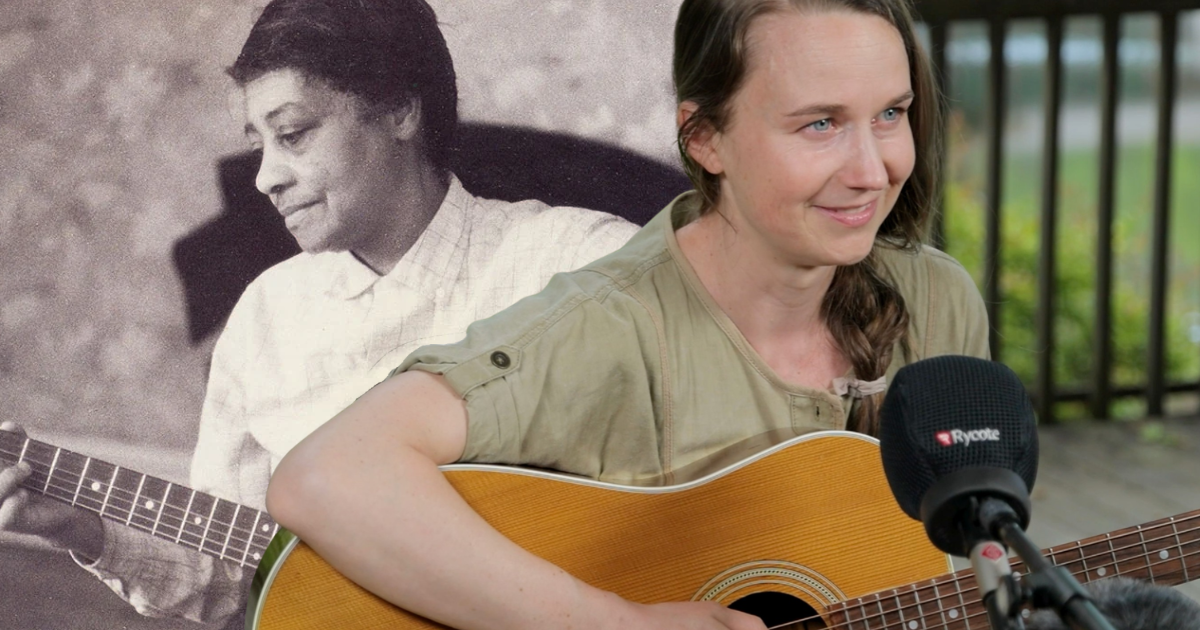
Elizabeth Cotten is easily one of the most important—and original—guitarists of all time. After first picking up her brother’s banjo off the wall as a child, she eventually purchased her first guitar, a Stella-branded instrument she affectionately called “Stella.” While working various domestic jobs, sxhe taught herself to play in a self-guided, methodical way by resting the guitar on her lap and playing each string fret-by-fret before learning to chord in small clusters. Remarkably, she developed a style that was backwards by all conventional standards, with a right-handed guitar flipped upside down without restringing it. To date, no other notable player has approached her arrangements in this exact manner, meaning that even the most faithful covers remain merely approximations of her original performances.
Dudley Hill
I first learned of Dudley Hill from my friend and guitarist, Alan Barnosky. Hill was a fixture in the PCNW acoustic scene, forming the celebrated band Pearl Django and mentoring a young Mark O’Connor on guitar. Though he was a highly accomplished jazz guitarist, he released a solo flatpicking record in 1976 called From a Northern Family. On it, Hill tackles familiar chestnuts, including “Sally Ann” and “Spotted Pony,” utilizing open tunings in a way that is quite far ahead of its time. His time-feel, touch and concept of the instrument are deeply inspiring each time I return to this great record.
Lesley Riddle
A distinguished musician and song collector from Western North Carolina, Riddle is a crucial figure in the founding of country music. Marking a common, yet underreported exchange where African American musicians worked alongside white musicians in a highly segregated nation and industry, A.P. Carter often enlisted Riddle on song-collecting trips in the 1920s, and Mother Maybelle cited him as a strong influence on her guitar style. In a manner not dissimilar to Elizabeth Cotten, he was recorded later in life by Mike Seeger who took an interest in his work. Unfortunately, Riddle never recorded with the Carters, or on his own during the early era of country music’s blossoming years, though the recordings presented on Step By Step (made by Mike Seeger from 1965-1978) showcase Riddle’s incredible depth as both an instrumentalist and singer.
Modern Guitarists
Jordan Tice
A deeply gifted songwriter, founding member of the string band Hawktail, and wildly diverse fingerstyle and flatpicking guitarist, Tice is the complete package. His songs champion what he loves while breaking new ground through fearless dedication to his craft. Digging his heels in as a solo artist in recent years, Jordan is soon to release a stunning record of original material with a top-tier band.
Joseph Terrell
A founding member of the seminal bluegrass-pop group Mipso, this North Carolinian songsmith has a keen ability to channel his eclectic and dialed-in reference points toward focused, truth-telling music. As of late, Terrell has been releasing a chain of singles that comment on the intense strife of the present moment, marking a wonderful turn as a solo artist working within timeless song forms, enlisting his wit and poise. On his solo record, Good For Nothing Howl, the artist builds sonic worlds with a refreshingly creative interpretation of the guitar’s abilities as an orchestrating instrument.
Gillian Welch
Gillian Welch is celebrated as one of the most singular voices and songwriters of our generation, and rightly so. I’d also like to make a case for her guitar playing to be heralded alongside her other gifts. Using a 1956 Gibson J-50 for her rhythmic work, Welch’s steadfast fingerpicking and strumming found the basis of the duo she hones with her musical partner, David Rawlings. Her right hand commands the Gibson’s entire dynamic range at a moment’s notice, and her control of feel, pulse and groove yield a lifetime’s worth of study.
Jake Xerxes Fussell
Jake is one of the few living musicians whose understanding of folk music forms is so rich that he can bend them entirely while keeping their essence intact. A student of the multi-talented Art Rosenbaum and the son of two folklorists, Fussell brandishes a Fender Telecaster and Deluxe Reverb amplifier to render timeworn folk songs through kaleidoscopic forms and colorfully new melodies, not unlike the work of Mississippi Fred McDowell who subtly challenged the familiar with a bold creative streak. He released his new record, The Old Beloved Path, on Fat Possum in September of this year.
Robert Bowlin
I was lucky enough to discover Bowlin’s 2007 solo record Six String Soliloquy when I was in my late teens. On it, Robert delivers a mostly original track list with the utmost attention to detail; everything about it is pristine while remaining raw, containing all the ingredients that are contained within my very favorite music. In addition to his total mastery of the guitar as a concert instrument, Bowlin is also a trained classical pianist, mandolinist and fiddler, having played with Bill Monroe, The Osborne Brothers and Tom T. Hall on various instruments. I cannot think of any other person who speaks so fluently across genres of music, and between so many instruments.
David Rawlings
It is no news that David Rawlings is one of the most heralded guitarists of folk music history. I’d like to add to this by saying that he largely invented the role of the improvising guitarist in this idiom, drawing a throughline from Jimmie Rodgers to Neil Young with a rambunctious yet studied approach to the instrument. Utilizing a small, Epiphone Olympic archtop to wage his work, Rawlings’ voice is etched onto the walls music somewhere between Bill Monroe and Jimi Hendrix, while being the consummate accompanist all at once.
Yasmin Williams
Fingerstyle guitarist and composer Yasmin Williams stands in a lane all her own. Using extended techniques and tunings to flesh out compositions that are at once rooted in tradition while being distinctly modern, she subverts expectations of what a guitar should sound like and how it should be perceived. Williams has graced stages and collaborated with artists as varied as Tommy Emmanuel, Tatiana Hargreaves, Alison de Groot, and Indigo Girls, and is unapologetically outspoken about the problematic roots of American guitar in a noted New York Times article (“The Face of Solo Guitar Is Changing. It’s About Time”), creating new and much-needed inroads to history. Her most recent record, Acadia (Nonesuch Records), finds the artist collaborating with musicians from across genres, demonstrating the increasingly varied perspectives her compositions support.
Jake Eddy
From Parkersburg, West Virginia, Jake Eddy is a lifelong instrumentalist at the forefront of the flatpicking guitar idiom. Citing influences ranging from Clarence White to Norman Blake, Eddy channels his virtuosity into a decidedly homespun, self-contained approach to bluegrass guitar that holds melody, rhythm, and texture at the forefront. When he’s not performing with his own band, touring with Noam Pikelny & Friends, or playing on recording sessions, the young Renaissance man runs Home Run Vintage Guitars in his hometown. There, he specializes in top-tier bluegrass flat-top guitars while also championing distinctive, lesser-known instruments from the golden era of American guitar manufacturing.
Courtney Hartman
In addition to being a consummate guitarist of the highest order, Courtney Hartman is a gifted songwriter who can gracefully transmute the complexities of modern life into deeply personal songs. On With You, Hartman collaborates with a host of songwriters to bring to life songs written during a particularly challenging chapter of her life. While working with her husband to restore their 1930s homestead in Eau Claire, Wisconsin, Hartman learned that they were expecting a child. During the same period, she was also navigating the loss of her booking agent and a totaled car, all while helping her husband recover from a serious accident. Her approach to the instrument is founded on a reverence for tradition and a life spent on the road (including seven years with Grammy-nominated Della Mae), supporting ensembles and her own voice, utilizing a subtle approach to flatpicking that is at once driving and heartbreakingly subtle.
Dan Knishkowy (Adeline Hotel)
Dan Knishkowy—of the musical project Adeline Hotel—is a tried-and-true songwriter and guitarist who works as both a solo artist and collaborator to many others in the New York indie scene. Using a slew of open tunings to support his beautifully hushed voice, Knishkowy’s songs are expansive and very much his own, paying reverence to the British folk scene’s hallmarks, while reimagining them. Tied to sources as varied as Bert Jansch, Richard Thompson and his contemporary Nathan Salsburg, Dan’s work becomes more rewarding with each listen (check out his latest album, Watch The Sunflowers).
Nathan Salsburg
Nathan Salsburg defies tradition while upholding it, occupying a singular space within multiple disciplines and traditions at once (he was also the longtime curator and archivist for the Alan Lomax collection). As a solo artist, his work explores faith (such as Psalms), alternative forms through sampling (the Landwerk series), while Salsburg’s first three records cement him as one of the great stylists of guitar soli. Utilizing open tunings funded by a much-refined technique and commitment to melody, Nathan’s records are expansive, exciting, thoughtful and reverent at every turn.
Ben Garnett
The composer-guitarist Ben Garnett boldly confronts the question of what it means to be an improviser, flatpicking bluegrass guitarist, and stringband leader all at once. Through his solo projects released on Padiddle Records, Garnett navigates expansive terrains that are at once reflective of his UNT (University of North Texas) jazz training and his singular voice as a vernacular guitarist, carving a path as a forward-thinking creative whose holistic conception of work leads the way.
Dylan Day
Dylan Day earns his keep as a studio musician in pop music’s capital of Los Angeles, though his disposition toward bedrock American music is unapologetically eternal. Informed by source musicians like Skip James and Reverend Thomas Whitfield, Day parlays his unparalleled bottleneck slide work into a language that adorns records from Selena Gomez, Ed Sheeran, Jenny Lewis and Beck. He recently released his debut record, The Unanswered Prayer, on Far Cry Records, which represents a heroic twenty-nine-minute solo performance on an old Gibson LG-2, recorded live to tape on a piano bench, belying what we all thought was possible on the instrument.
Alan Barnosky
Central North Carolina’s Alan Barnosky is a top-tier musician and flatpicker who draws a wide span in terms of who he cites as his aesthetic reference points. A longtime writer for Acoustic Guitar Magazine, he produces lessons which cover many of the lesser-known figures from bluegrass music’s history—such as Bill Napier and Dudley Hill from this article—with incredible clarity and depth. He has released two solo projects, Lonesome Road and Old Freight, and performs alongside many acts on guitar and bass, including Counterclockwise String Band, The East Side Ramblers, and Chatham Rabbits.
Photo Credit: Elizabeth Cotten via Smithsonian Folkways Recordings; Courtney Hartman by I Know We Should, Brad Wagner and Juan Soria.