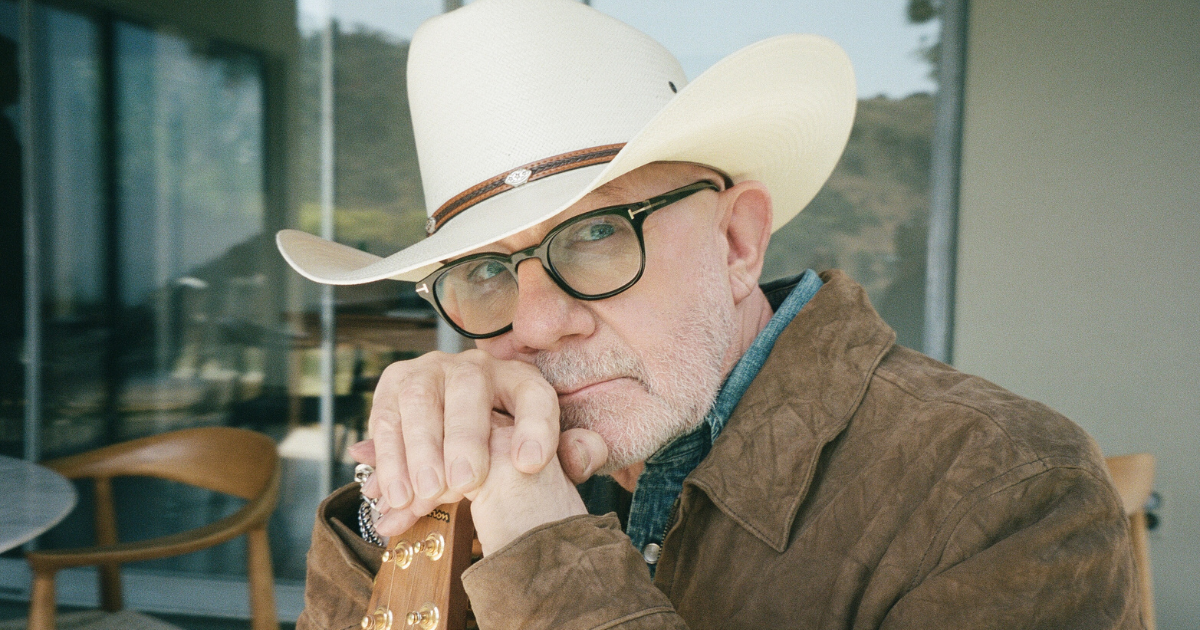

After nearly sixty years of co-writing some of the biggest pop hits of all time, Bernie Taupin still has a lot to say, and in the case of his newest effort, The Sea Has No Mercy, the stories are so intensely personal that, for the first time, he couldn’t imagine sharing the pen.
“There is no way on earth I could have farmed these lyrics out to all my friends, who are very proficient songwriters, because I wouldn’t have been able to get the cohesiveness and personality I needed on these songs. So, these songs had to be on hundred percent me,” he says.
“Outside of the fact of this album being, as I’ve said time and again, a late-in-life manifesto, they are so personal that I had to wait till I was satisfied with my own songwriting process, and melodically happy with what I was coming up with. I never wanted it to be terribly intricate. I’m a great subscriber to ‘three chords and the truth,’ which I think much of this album is.”
On The Sea Has No Mercy, Taupin repeatedly tips his hat to his musical heroes, such as Tom Waits, Leonard Cohen, Bob Dylan and John Prine, all worthy of a place on a lyricist’s Mount Rushmore. Whether he knows it or not, Taupin himself belongs carved in stone alongside them for his contributions to the great global songbook through his indelible compositions with Elton John.
On a Zoom with BGS, Taupin discussed making this record with his dear friend, producer Frank Liddell, alongside Nashville powerhouses Glenn Worf on bass, Michael Rojas on drums, and Adam Wright on guitar, all of whom Taupin considers musical geniuses. He also speaks about the legacy and lessons he wants to leave with his daughters, leaning into “atmospheric folk,” and his fear and reverence for the open sea.
BGS: I’d love to talk to you about your songwriting process and especially how it differs when you’re writing by yourself. I’ve read that this album is very autobiographical, built on your entire life. With lyrics as personal as these, is your process different?
Bernie Taupin: Well, OK, there are several answers to your question there. Obviously, my songwriting process has changed tremendously over the years, because when I first started writing songs, I literally didn’t know how to write songs. I was basically pretending I knew how, and I hoped I’d find somebody who could show me the right path. And luckily I hooked up with the right guy.
But you have to also remember that I’ve been doing this for close to sixty years now, coming up next year. The process over time, through the decades, you become more proficient.
When I first started out, I knew nothing about it; I was just a green kid. I was a hillbilly from the north of England, and I really got into this game simply out of frustration. So I was writing stream of consciousness that I thought somebody, hopefully, would be able to make sense of, because I had no idea how to write a song. I didn’t know anything about bridges and choruses or anything of that nature. But as time went on, I kept my mouth shut and just became very proficient at sucking in all the energy that happened in studios. I watched other people writing and learned how to really construct songs.
You go full circle to now, and I am pretty much proficient on every level of writing songs, whether people appreciate them or not. So it’s been a long, long time coming, to quote Sam Cooke. You get to this point in time where I’m writing, as you say, extremely personal songs for this record.
And, you know, you can see the blueprint of the fingers that are all over this record are the people that haven’t relied on intricate melodies, people like Leonard Cohen, Tom Waits, Bob Dylan. I mean, Bob Dylan is the originator of the simple sort of three-chord song, but nobody more than Leonard Cohen, who is one of my huge inspirations. I knew I didn’t have to be complicated because the lyrics are intricate enough, so I didn’t want to mess it up with intricate melodies, if you will.
These songs, in my opinion, ask the listener to pause, to consider dynamics, to sit in moments of silence. I’m thinking particularly of the fade-out in “Old Church Road.” There are moments of quiet transition, and I love that. I’m wondering if that was intentional, asking the listener to go down that path with you.
One of the intentions of making this record was, I wanted to have an ethereal quality without sounding new age. I never wanted it to be what I call a four-on-the-floor record, where you can really recognize a band’s involvement. I didn’t want it to sound like a band. I wanted real, authentic instruments on an analog level, but I also wanted continuity that matched the songs. Frank knew what I wanted from the production, and I absolutely was emphatic about the fact that this should all transcend in a way that brought the listener in.
I’m a very, very simplistic guitar player. You’re never going to see me playing guitar on stage because I’ve got too many proficient guys around me who can convey it much better than I can. I use the guitar for architecture in the beginning, to give me a sense of melody.
And with this record, I have to say, this is probably not an easy album for mainstream listeners. I’m not sure how my own fan base, or Elton’s and my fan base, will accept this record. As a genre, it’s kind of indescribable. We’ve come up with the term “atmospheric folk,” but I don’t like slapping labels on music. As long as it’s good and it connects, that’s all you need to do.
You have a couple of all-star guests on this record like Lee Ann Womack and Brandi Carlile. Can you tell me about those collaborations?
The idea of Lee Ann was a no-brainer, because she was in the house. As you know, she’s married to Frank Liddell, and we cut this record at their house. Also, by the way, their daughter Anna Lise recorded and mixed the record. It was a family affair.
Lee Ann was in the house, and the first day we started recording, she was upstairs and she came down, and I guess said to Frank that something special was going on here. I think that Lee Ann, along with Emmylou Harris, are the two best female voices in country music, hands down, no question. It was a no-brainer that we had her on the record.
I have such a great relationship with Brandi and said to her, “ I’ve got this one song which is probably the most mainstream song on the record. Would you be interested in singing on it?” And she said, “Well, I’d be offended if you didn’t.” And she did an amazing job.
Frank Liddell was the perfect choice for producing this record. And this band, I mean nobody’s better than Glenn Worf.
No, no, nobody. I mean, I got so, so lucky with these guys and that’s because of Frank. Frank brought them all in, and he said these are the guys for you. We had so much fun. It was so inspirational to be around. … I sang them the songs off the top of my head. They came up with the arrangements. I rechristened them the Tennessee Stonecutters. They (played) with me at the Opry. I said I wouldn’t do it unless they were with me and they were up for it.
Is the anticipation of releasing these songs to the public different from past projects you’ve released, since it is so personal?
Yeah, absolutely, because I think all of the records I’ve made in previous decades, they’ve all been products of their time. Looking back at some of them, I’m not sure whether I was feeling a little pressured to do it or not. I’m not going to dismiss them in any way, but I certainly know that with this record, I’ve come full circle.
This is a hundred percent Bernie Taupin, no doubt about it, with the fingerprints of the artists that I respect, people like John Prine. John Prine’s all over “Elephant Boy.” That’s a song that I thought, Yeah, John Prine could have sung this.
Speaking of “Elephant Boy,” I love hearing a calliope. It reminds me of being in New Orleans. Tell me a little bit more about this song. It’s a different texture than the rest of the record. What were the inspirations for this one?
No, I understand exactly what you’re saying. The reason I wanted to make that particular track in that vein was to put a sense of humor in it, and have something that was a little bit more upbeat. Not necessarily more cheerful than the rest of the record, but it has a certain comedic element to it. At the same time, it’s still making its point in the real world. The bottom line about that song is that I’m certainly lucky. I’m saying if I hadn’t been born me, I might have been something else. But luckily I didn’t get to be a freak in a circus show.
And I used “Elephant Boy” rather than “Elephant Man,” only because “boy” sounded and sung better than “man,” quite honestly. As songwriters, we do change things. Bob Dylan changed John Wesley Harding, you know, from John Wesley Hardin. I don’t know if he did it on purpose or if he made a mistake. Who knows, but we’re allowed to do those things. That’s our sort of lot in life to change things around if we want.
I had fun with that song because I just like the way it rolled. I got to mention things in it that would probably make people sit up and think. And it’s all about the way that I see and think about the world.
Tell me about your relationship with the sea.
I think you are fascinated by the things that you fear, and I hate the open sea. I appreciate it, I understand it, but I understand its power. It is the most powerful natural force on Earth, and it terrifies me. That’s why I put it on the album cover. You gotta face your fears.
I think the ocean is such a great metaphor for song. I used it in that song [“The Sea Has No Mercy”] and as the album’s title track because I thought it was a good way to use it as a metaphor for turmoil, division, and relationships. It is just continually churning, and you never know what to expect from it. That’s how I viewed my life back in those days. I’m a bit more complacent about things now. Back then, I lived in a world of turmoil, of pitfalls and highs and lows, and that’s like the ocean.
On the opening of the final track, “One Hundred Ways,” you’re clearing your throat, you’re counting in. The production choice to keep that in feels purposeful, to put the listener in the room with you. It almost feels like you’re on the cutting room floor with the four of you. Was that a conversation that happened?
Yes, you absolutely nailed it. That was exactly the point. I wanted to kind of get everybody’s attention and bring ’em in and say, “OK, I got one more thing to say here.” You know, “One Hundred Ways” isn’t a full-on song; it’s an afterthought. That song, it just rolled off the top of my head in about 10 minutes. Everything flowed so instantly and instantaneously.
This song is for both of my daughters. One of them, Georgey, happens to sing like an angel. I could never have had another female voice sing that, because it would have taken it out of the room. It had to be one of my kids saying, “We’ll take the ball and run with it. Just leave us the map.”
I don’t find that morbid at all. It’s just telling your kids you want to leave them the best of what they’ve learned from you. We live in a very troubled world, but the beauty of the world is still there around us. The trees are still going to grow; there will still be seed in the earth below. You’ve got to focus on the beauty of life rather than the negativity of it, and remember that, and take it with you. And when you think about me, think about the best things that I provided for you and gave to you and instilled in you as a young woman.
I’m not looking to disappear. I’m not like Captain Hook; I’m not listening out for the alarm clock in the belly of the crocodile, by any means. I still got a lot to do. I want to make another record with Frank, maybe starting sometime next year. I’ve already written about eight songs. We are in the process of putting that together, and I can’t wait to get back with those guys.
Photo Credit: Jill Augusto