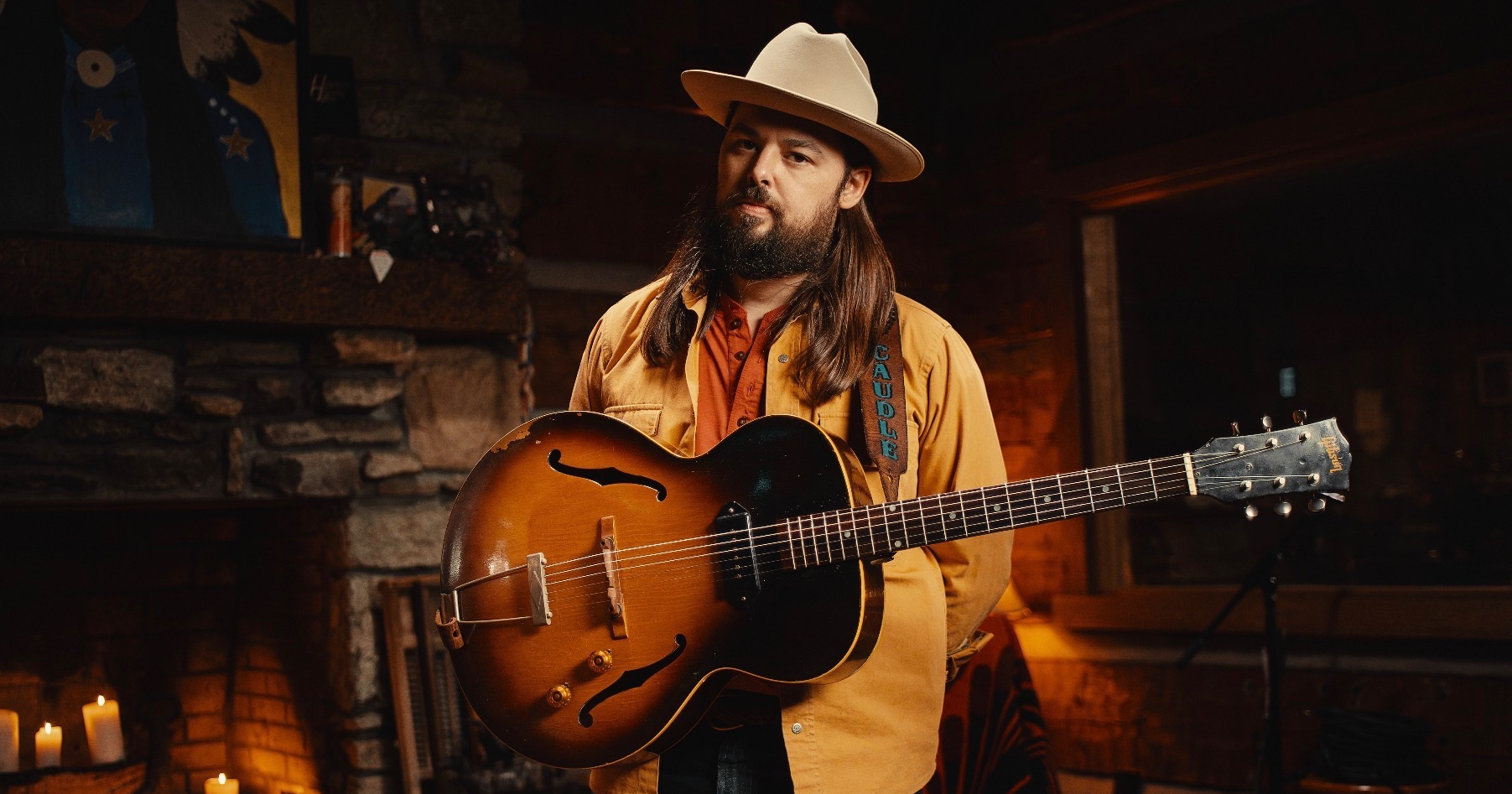

For nearly two decades North Carolina folk singer Caleb Caudle has traveled the country bringing his music to fans wherever they’ll listen, but on his forthcoming eighth studio record he adds a new role to his repertoire – producer.
Released June 5 via his newly launched imprint Hand Plow Records, Heavy Thrill looks to be his most ambitious work yet, as it melds his personal evolution and artistic journey into one singular vision. Whether he’s ruminating on a bumpy road to self-improvement on “Slow Growth,” analyzing self-doubt with “Anxious,” or examining how people deal with adversity on “Path of Desire,” Caudle’s words tell the story of his individual journey through a world that’s changing too fast for him to keep up with.
Although the bulk of the record was recorded at Johnny Cash’s former retreat-turned-studio, the Cash Cabin, Caudle actually recorded his bits for the album at a friend’s studio in the Pocono Mountains – before returning to Tennessee to wrap things up at the same place he captured his projects Better Hurry Up (2020) and Forsythia (2022). He says that the familiar setting not only helped him hone in as a producer, but also helped him to tap into the building’s history as continues chipping away at perfecting his retro modern sound.
“I feel like I’ve started to develop my own sound over the past 20 years that marries traditional elements with more modern sounds,” Caudle tells BGS.
“Because of that I’ve never been afraid to try new things. In many ways I think of what people like Sturgill Simpson, Tyler Childers, or myself are making as modern country music, but in a different timeline where people aren’t as focused on songs about pickup trucks and shaking your ass,” he continues, laughing.
Caudle spoke with BGS about learning from other producers, fatherhood, artificial intelligence, and more.
This is your eighth studio record, but your first time self-producing one of those projects. What motivated you to finally take the plunge?
Caleb Caudle: It’s been one of my end goals for a really long time. I’ve always wanted to produce my own records, but I wanted to go and work with people first that I could learn from. Each has brought different things to the table I’ve picked up on. I’ve also always been involved in the process and have a good idea for how I wanted things to sound. Then after talking with some of my past producers and telling them my plan they all gave me their votes of confidence.
Once I jumped in I wound up doing a lot more pre-production than I’d ever done in the past. I also had great mixing and mastering engineers – Jacquire King and Pete Lyman – who were my safety net in case anything went off track. It turned out to be a really fun experience that even has me thinking about producing records for other folks someday.
While producing the record was new for you, the place you did most of it at – the Cash Cabin – was not. Tell me about what drew you back there to record for the third time?
That place is like my second home now. I’ve done several video sessions there and written with John Carter Cash a bunch. This time around I also kept the band leaner there than I had ever done before. It was just five people total, with no features or guest vocalists like some of my past records have had. I instead wanted to make something that was more self-contained. I knew I could make a record the other way, so I wanted to see what it’d feel like if I took some of those pieces out and really relied on my own instincts above everything else.
It’s also a place with so much history that I’m able to tap into even though I’m writing mostly about my own modern-day experiences. At the end of the day, I love Ralph Stanley just as much as I do Big Thief. They all come from a place that’s honest to that person, which is what I’m after, too. I love what indie rock bands like Bonny Light Horseman do with melodies, but I also love Flatt & Scruggs. It’s all music to me – I’m just trying to take bits and pieces from all of it that I feel would suit my sound.
With that in mind, I also think it’s important to listen to music outside or your own genre. Sometimes when I’m struggling with songwriting I’ll start listening to a ton of jazz to provide that spark that gets me writing again. Other times I’ll go a month listening to music with no lyrics before I grab the pen again. Whether it’s a playwright, actor, poet or songwriter, I always find myself drawn to folks that are passionate about what they’re doing.
Tell me about the writing process for this record… Did anything stand out compared to previous writing sessions? And how many leftover songs did you pen for it that didn’t make the cut?
I’ve had extras every time I’ve made a record. For me, there’s the obvious ones that are going to make the record that everyone feels good about, then there’s another batch of songs that I wouldn’t call “filler,” [that] are less immediate. We do our best to decipher which of those are the missing puzzle pieces for the story we’re trying to build. It’s like having brother and sister songs on the record where something on Side A reminds you of a tune on Side B – it’s all very cohesive. Trimming the fat is such a big part of songwriting for me. As a writer you want to focus on giving people what they need and not all the fluff surrounding it.
Since writing and recording these songs you and your wife learned you’re expecting your first child this summer. How has that knowledge shifted the perspective you have of these songs?
While I didn’t know I was going to be a dad before I wrote it, it almost feels like a record that’s preparing me for that whole process. It’s a really measured and honest look at where my life is right now. There’s a lot of mass confusion in our world currently with artificial intelligence and inflation that feels out of my control. That’s the macro side of it, but I’m also looking at things on a micro level by taking care of the earth and those around me.
With this new label I’ve set up, with every 100 records I sell I’m providing 1,000 meals to the Second Harvest Food Bank of Northwest North Carolina. I want to do all I can to help the people around me in a meaningful way. I’m not saying to disregard the big stuff by any means, because I do believe it’s important to be tapped into what’s going on in the world, but for me personally I feel like my time is best placed in my own community with the people of Appalachia around me.
You just mentioned your label, Hand Plow Records. Tell me more about launching that and the intentionality behind its name?
I live across the street from my great uncle who has a single-horse hand plow that belonged to his great-grandfather and goes back multiple generations. My parents used to plow tobacco near Winston-Salem and sold it to RJ Reynolds, so it’s something I’ve always been around. It also seems like really hard work, which has me drawing lots of parallels between what I do as a musician and the farming they did. I weather storms the same way they did, by putting in the work, planting seeds and constantly nurturing them while they blossom and grow. Farmers are critical to our way of life, so I wanted to use the name to honor them for their hard work and sacrifice.
Is “Slow Growth” reflective of that hard work and change, whether it be on a farm, internally, or in society at large?
That’s a song about honing your craft and trying to become a better person each day. I’m not out here looking for shortcuts, even though so much of society right now is about “how I can get things done the quickest,” especially with AI – which in music feels like cutting corners on something I’ve dedicated 20 years of my life to. I don’t know that anything meaningful will ever come of that process, because lessons learned are the whole point. I don’t think I’d be writing the songs that I’m writing now had I not written the songs that I had before them.
AI feels like a very cheapened version of real life, and I’m not interested in that. It’s a huge threat to the existence of art and creativity – both things that can’t be faked or fast-tracked. It’s a slow process where you have to put the work in every day. There’s days where I pick up and play for two hours but don’t write a single word, but it still feels important. It feels like part of this bigger process where I’ve dedicated my life to this thing, so the fact that someone could use AI to generate a song that sounds like me is scary. It can give them an approximation of what I may sound like, but it’s not getting at where I’m at currently. It’s replicating what’s already been made, but I’m out here trying to tell new stories. It’s the opposite of progress.
Another song that reminds me of stepping away from technology and plugging into the moment is “Sequoia Polaroids.” Tell me about what inspired that one.
I’m constantly trying to pay attention to the small details. [My wife] Lauren and I were on a solo tour opening for Ray Wylie Hubbard in California a while back and we made a trip out to Sequoia National Park. That song is almost like a page from that day. We wound up taking a bunch of Polaroids and throwing them on the dash of the car. The song is about being present in those moments and spaces that feel ancient and vulnerable.
Places like Sequoia are majestic and big and we have an opportunity as humans to help preserve or destroy them. Those spaces are so important to me, so it was really cool to get a song out of that day. The trees out there shrink you in a way that’s very humbling – it’s a beautiful thing.
Nature is a great way to get in tune with yourself, just how vinyl is a great way to interact with music on a deeper level. On that note, I know the physical version of Heavy Thrill incorporates some cool imagery taken from its title track. How did that come to be?
I’ve got to shout out Skillet Gilmore, who did the art. He’s an incredible artist in Raleigh that I love working with. The ants carrying the peach pit [that appears on the center of Heavy Thrill on vinyl] come from a lyric in the title track about how an army of ants can lift up a peach. [That] is symbolic of our chaotic world and how we’ve got to work together to get things done, setting aside our differences along the way in order to find some common ground. When we do that you’ll realize we all have a lot more in common than we think and that our goal should be to help everyone be happy and thrive. A rising tide lifts all ships, so it’s important to work together and show empathy to your fellow humans, because you never know what sort of hard times they’re going through. It’s like Mr. Rogers once said: “Look for the helpers.”
One of my favorite parts of the record is the instrumental transition two thirds of the way through “No Show,” which feels like a new composition entirely. How did it come about?
That instrumental piece is something I’ve been playing at sound checks for a couple years called “June Bug Crawl.” I included it on the record because I was always a fan of when folks like Doc Watson included instrumentals on their records. I thought the song was really cool even though it’s in a different key than “No Show” is, but I still wanted them to live together on the record. I give a lot of credit to my buddy Philippe Bronchtein, who played pedal steel and keys on the record. He’s very good with the more electronic side of things. We basically had to get the instrumentals into a different moment to execute that transitional moment. It was executed flawlessly and really works well given the context of the song and record.
On a more reflective note, what has bringing Heavy Thrill to life taught you about yourself?
It’s taught me to trust myself. This is the first time I’ve seen an album all the way through calling the shots myself. I’ve spent 20 years doing this and developed good instincts over that time, so it’s important to believe in those and remain confident in what I’m doing.
Photo Credit: Joseph Cash