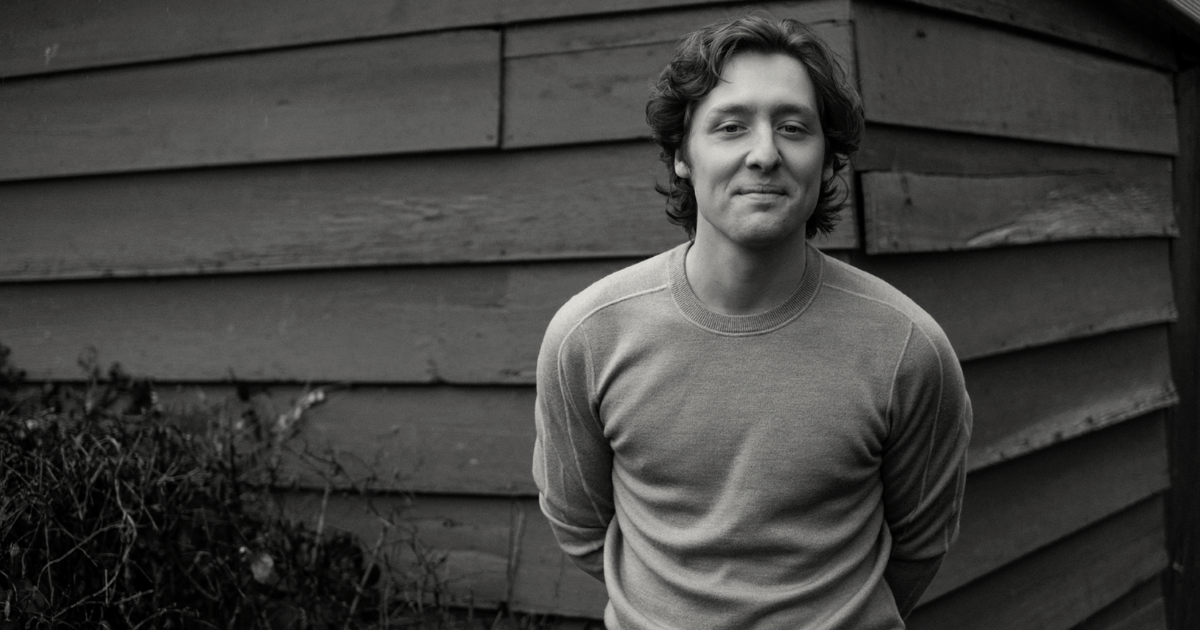
When it comes to aspiring Nashville musicians, some newcomers immediately stand out. Others blend in. For Jack McKeon, he’s able to do both – in the best possible way. His new, eight-song collection, Every Once in a While, showcases a warm baritone, thoughtful songwriting, and an impressive studio band. Yet he’s also equally adept at being a sideman and songwriting partner, and he’s just starting to step out as a producer for other people’s albums.
Two of McKeon’s biggest songwriting influences are Guy Clark and Wilco’s Jeff Tweedy, and fans of those artists will find a lot to like in Every Once in a While. Leading off the project, the title track explores the emotions behind trying to make it in the music business, though the lyrics can be applied to just about anyone who’s chasing a dream. On a quiet Monday morning, Good Country caught up with the Chatham, New York, native before a full day ahead in Music City.
BGS: The song “Every Once in a While” is about putting the work in, working toward your goal. For you, that’s a music career. When did you get interested in songwriting?
JM: Writing has always been something I’m interested in. My parents were writers. My mom was really big on writing and reading, and those are still two things I do every single day. Songwriting began to take over my life a little bit more probably nine or ten years ago. It was a medium that started to click for me in that moment and I leaned into it. And of course, I’ve always been surrounded by music. I played music for a long time before I ever wrote music.
So, all of those things were coming together to culminate in songwriting, but it did take a while to get there. I was not one of those people who was writing songs at six years old. I was writing other stuff for a long time, but coming to songwriting later in my writing life definitely helped me in terms of perspective. At its best, songwriting can beckon outside of just the songwriting medium. I’d like to think that all of the reading and writing I did in other styles helped me get there.
When I was listening to the song “Pontiac Blue,” I thought your studio band on that track sounded great. It’s got such a cool groove to it. What was your approach to figuring out who would be playing on these sessions?
I went into these sessions for Every Once in a While pretty different than my first record, Talking to Strangers. We did the first record, which was 10 songs, in two-and-a-half days. I hired one band, and folks from the band also sang on it. It was like, “We’re making this thing,” and I moved really quickly for creative reasons, and also for budget reasons.
I’m proud of that record but when I went into making this one, I wanted to move a little bit more slowly, and be more intentional. We tracked six of the songs more sparsely. It was myself on acoustic guitar, Josh Hunt on drums, Vicky Vaughn on upright bass, Casey Campbell on mandolin, and Seth Taylor in an acoustic utility role. He’d double a lot of my acoustic guitar parts, he added some banjo, things like that. Which already is a lot, but I knew I was going to add more, and I wanted to be pretty intentional on how I built the tracks out.
That showed itself in the choices on harmony singers, choices on fiddle players. On “Pontiac Blue,” that’s Deanie Richardson playing fiddle. I knew I wanted that country rockin’ thing. Deanie’s resume and Deanie’s playing speaks to that tenfold, with her playing with people like Patty Loveless, Vince Gill, all those ’90s legends. That song definitely conjures up that era.
I didn’t know that it was Deanie on the fiddle. Her playing style really shines through. You have a first-rate group of musicians on this record.
I am very lucky. It’s some serious players hanging out. That community is so cool. It’s rare you get people in the studio who haven’t worked together already, and who don’t already have a rapport. A lot of that rapport goes back much further than me. Like in those sessions, Casey brought in a CD that Seth made when he was like 14, which was really funny. He was passing it around because Deanie produced some project of a bunch of teenage bluegrass phenoms from Middle Tennessee 20 years ago, and Casey was in it, and Seth was supposed to be. It’s history that goes way beyond me, so the vibe is there, the relationships are there, and of course those people are such incredible musicians that you don’t even need those relationships for them to kill it. But it does help. The comfort level was there.
When you came to Nashville, how did you go about finding your community?
I got really lucky in a handful of ways. My writing community came out of an event that used to happen in Nashville every Tuesday night called Revival. That was a great writers’ round, but more than that, it was an important community gathering space for writers, and it was the only writers’ round weekly event of its kind that actually melded people doing the Music Row thing and people doing something left of center. Call it Americana, call it whatever you want. I was meeting great collaborators, great friends. A lot of the writing friends that I’m still so close with, I met at that round, hanging out with them every Tuesday. It ended eight or nine months into my time in Nashville, so I was only there for the tail end of it.
View this post on Instagram
Before that I was writing a music blog, now long-scrubbed from the internet, and interviewed a guy named Gabe Lee, a fabulous songwriter here in Nashville, probably in October 2020. We just hit it off. I was writing songs and mainly working day jobs, saving money to go somewhere. I was still living at home, and the way he spoke about his Nashville community really stuck with me. So I hit him back up in early 2021, and I was like, “Dude, I’d love to come visit if you were legit about that.” And he was like, “Yeah, come down.”
I ended up getting off the plane and Ubered to lunch with him and another songwriter named Vinnie Paolizzi. He’s a great friend of mine as well. They showed me around Nashville. Met a handful of people that are still some of my best friends. I got back from Nashville on a Sunday, signed a lease online that night, walked into my job on Monday and quit, and moved to Nashville three weeks later. So when it happened, it happened fast. I think that was the kick in the pants that I needed because it happened too fast for me to think about it or second-guess it. I just dove in and I got really lucky.
That was how I found my first writing community. Then the bluegrass, or bluegrass-adjacent, community came later. I mean, I was a bluegrass fan and knew of all these people, but I was so intimidated from the outside looking in. And so that happened slowly and a little bit later. But the biggest inroads I’ve made in the bluegrass community have happened just from bluegrass musicians either playing on my records or playing live with me, or just being kind enough to listen to my stuff and liking my writing or appreciating my writing and wanting to do something different themselves. It’s been cool to find a place in that community as a writer as well as just a community member.
View this post on Instagram
What are you enjoying the most about this time in your music career?
Basically I simplified my relationship to music at the beginning of this year, which is like, “I want to make music as much as possible, and I want to make records as often as possible.” From the sheer fact of budgets and my own creative output, that cannot mean a Jack McKeon record every single time. Once you simplify that way, it’s like, “Yeah, I do want to go play guitar with you,” or “I’ll play mandolin with you on this,” or “Yeah, I can put a band together for your session, or write charts out for your session, or come sing harmonies. Let’s write a song together.” Once I simplified what I was looking for, I started finding so many more outlets and opportunities, and this record landed in the middle of that.
This might not be the most savvy answer as someone who just put a record out, but I’m in such a time of creating and collaborating with other people that it’s informing and changing my own music in real time. I’m playing with other artists a lot right now in sideman roles, and beginning to dip my toe into producing for other artists. I’m feeling very creatively validated right now. I’m starting to see a vision where the music that I make and the albums that I release are only a part of a greater whole, which is my life as a songwriter, my life as a player, my life maybe as a producer of kinds, and so that’s really got me fired up.
Photo Credit: Scott Simontacchi