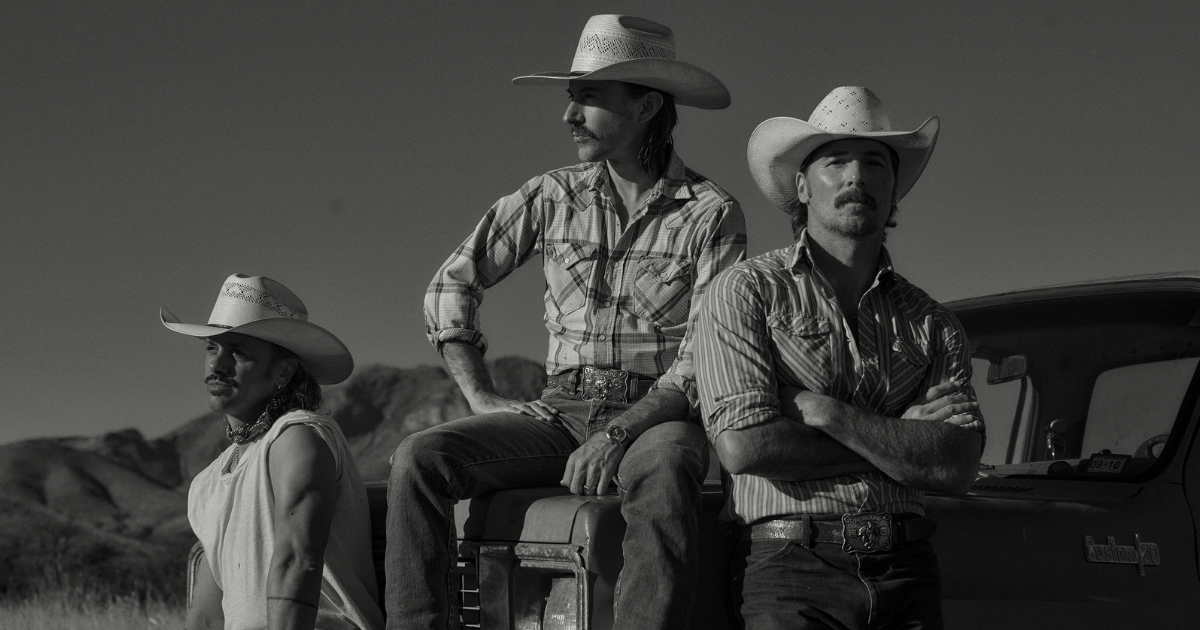
Ever since they injected vintage swagger and rhinestoned style back into the country mainstream with 2017’s “Drinkin’ Problem,” Midland’s Mark Wystrach (lead vocals), Cameron Duddy (bass/vocals), and Jess Carson (guitar/vocals) have been on a journey.
The GRAMMY-nominated trio have welcomed new stages of life alongside new physical stages, rising from roadside honky-tonks into the legendary clubs they still consider home, and on to the biggest venues in the world. Their climb mirrored their evolving country influences, which began with a love for the treble-and-twang sound of the 1960s and progressed on through the ’70s, ’80s, and beyond, helping lay a revivalist foundation for this current new generation of neo-traditionalist artists. Despite all these changes, they never lost sight of their own brotherhood – or their bar-band roots. Their new album Stages is the proof.
Working primarily with producer Trent Willmon for the first time (Jamie Moore also contributed), Stages finds Midland looking back to their road-dogging Texas beginnings, while bringing their throwback renaissance toward the rich tones of the ’90s era. As a former artist with a late-’90s/early-2000s Texas pedigree, Willmon knows that form well, and it fits Midland like a tailored Manuel suit. Over 10 new tracks, timeless barstool themes unfold under gentle, genuine twang and three-part harmony, taking the masters of modern retro to a new peak.
Good Country spoke with Jess Carson about the current stage of Midland’s story and where the classic-country resurgence may go next. We also touched on the band’s ideal venue, covering bluegrass tunes, and the best course of action when encountering a song written by Dean Dillon.
Midland has always struck me as being about more than just throwback nostalgia. There’s a theme and message behind your work, so what’s the title Stages mean to you?
Jess Carson: I think there’s definitely a part of it that is self-referential for us. I think it’s there in the title, it kind of references our own journey all the way back to The Sonic Ranch, which we ended up releasing later, but was the first time we got together– shoot, 12 years ago. It’s been a long road and journey and we’ve been through a lot of stages. And we’re also very much a road band, so there’s that play on words that’s so popular in country music.
Different physical stages too, right?
Yeah. Which is really where we’ve grown up. From playing in dive bars around the Austin, Hill Country area to … I mean, our last show was at [Arlington, Texas, stadium] Globe Life Field.
That’s amazing. There’s a lot of growth there. You guys have gone through a lot together.
We have, yeah. We’ve done a lot of growing up – but are still pretty immature, probably.
“Young at heart” is a better way to put it, maybe.
Well, part of being a musician is that Peter Pan thing. It’s hard to imagine Keith Richards on the phone trying to figure out some bank charge or something.
I’m interested in the physical stages idea, because your band has stayed really committed to and supportive of smaller stages [like the Palomino Club in LA, which Midland reopened for one night in 2019 to record a 2020 live album], even as you’ve leveled up to the biggest venues in the world. I just wonder why you love the small stages so much?
I think as a musician, you’re always going to love that. It’s the most intimate. It’s where you start out – for us and country music. The kind of dive bar honky-tonk thing is always going to be the most intimate and at least for us, it’s where things feel the most at home. These places around here [in Austin], The Broken Spoke and Gruene Hall, Luckenbach, and places like that. That’s where it feels like the music is at home and it’s the easiest place to catch a vibe. If you play at Global Life Field, for example, you can see the people right in front of you. But you can’t see the people way up in the upper deck.
Where did you want to take the sound this time? Over your career you’ve always blended Texas, Nashville, and California country influences very freely.
I don’t know. All of our albums are really a mix of what we’re listening to at the time, what we’re inspired by. For some reason I was reading this Tom Waits interview recently and he said that he’s in the salvage business. More than being a musician, he’s salvaging all these different bits of inspiration. I can identify with that. Going through the stages of our history and our catalog, I think in the beginning we were maybe inspired by stuff that was even older than where we are now. Maybe our stuff sounds more ’90s now than when we started, when there was a lot more, like, ’60s influence.
It’s just whatever place we’re in. I don’t know how thought out it is. I don’t know how thought out anything we have ever done is. [Laughs]
Maybe that’s the secret. How do you feel about where the country mainstream is right now? I would imagine you’re really enjoying this, because you have a lot of like-minded artists out there with you.
Yeah, I think we played a big part in opening the door for what’s going on right now.
Absolutely.
There was a handful of people. Cody Johnson is one that was really doing that sound in 2014 and is massive now, and Jon Pardi. And then I think we inspired a lot of acts. That’s a big part of our legacy. We were in that class of people who kicked the door down and got steel guitar on the radio again, or at least back on the radio during a time when the mainstream was really thriving. So yeah, I’d say more than ever since we’ve been doing it, it’s like classic country is having this moment. Like, that’s being valued now. You know what I mean?
Totally. I wonder though, do you feel like maybe it’s time for a second wave of this renaissance that you guys helped kick off? Now you can have steel guitar on the radio. Songs with a honky-tonk edge are taken seriously commercially. But could we go further? I mean, do we need some Eddy Arnold-style crooning?
Ooh, that’s a good question. I mean, I don’t know. The older stuff feels more difficult.
You’re saying it could go too far.
It’s like, the stuff that’s ’90s influenced right now, it feels very effortless. Who’s going to say they don’t love Alan Jackson or George Strait, Keith Whitley, Clint Black, Shania Twain?
The ’50s stuff, I love all of that. “Make the World Go Away” and all that kind of stuff, I love it. For whatever reason, it’s harder to make that not feel like cosplay. But, that would be super cool if there was somebody who felt like they came out of this time warp and it felt authentic, because that’s some of my favorite songwriting. Willie Nelson’s songwriting from back then. Tin-Pan-Alley-meets-Nashville/American-songbook type songwriting. It’s the coolest in my opinion. But I think maybe it is harder to do that and have it not feel like a shtick in 2026.
Tell me a little bit more about the album here. Was there a moment when Stages started coming into focus for you creatively, and when was that?
Well, we work on albums through the tour cycle. We don’t really take time off to work on the album, so they definitely have their own way that they take form over time. … This one was the way we’ve done the other albums, where we’ll go to Nashville and spend two days here or four days there. I think the first song we did was “Drunk Enough” and that was like – I don’t even know, over a year ago?
“Drunk Enough” almost felt like a follow-up to “Drinkin’ Problem.” Like, it’s a little farther on in the story. You’re still having fun in the “Drinkin’ Problem” time period, but then things progress and it gets a little sadder.
Well, actually I think “Drunk Enough” is, to me, as close as we probably can get to doing that old American-songbook type sound. With the chord changes and the melody, I think there’s a lot of that old inspiration. If there’s something that could be tied to Eddy Arnold, it would probably be that one from the album.
Can you tell me a little about where “Marlboro Man” is coming from? It seems like there’s a cost that comes to living the way you guys do. Have you felt that?
Definitely. We didn’t write that one, but when we heard it, it was like, “Yeah, we can identify with the aging cowboy.” Or just the guy that’s acknowledging the sacrifices and what it takes to get to this place. All three of us can certainly identify with that character.
It was really fun to go down to Southern Arizona and shoot that music video and also tap into the visuals, the images in that song and the cinematic quality of it, too. But yeah, that’s an old Dean Dillon song that he wrote a while ago. I don’t even know, maybe 10 years ago.
Well, his are all timeless immediately.
Yeah. If you can get an old Dean Dillon song, take it.
Another I want to ask you about is “Drinkin’ Dark Whiskey.” BGS [the parent outlet of Good Country] is a bluegrass outlet at its core, and I remember that song from the SteelDrivers back when [Chris] Stapleton and Mike Henderson were there. What made you want to record that and turn it into something new?
That was one the label sent over and they just felt like it would be great to get an uptempo [track] on [the album]. I think our albums, you want to hit these different cornerstones and especially to be able to integrate into the live set. We’re always going to want to have a “Mr. Lonely,” or we’ve been playing “Boot Scootin’ Boogie” in the set since we re-did that with Brooks & Dunn [for Reboot].
Certainly from the SteelDrivers and Gary Allan, the song had a life before us getting to it. But I think we’re able to put our own spin on it and we’re already playing that one live. It’s just a fun one in the set.
What about “Up In Texas.” You co-wrote this, and it features Clint Black. You mentioned some of the famous Texas dancehalls earlier in the chat here, and this song is kind of a tribute to all the cool things that make Texas what it is, right? Do you still have a lot of love for Texas?
Oh yeah. I’ve been here for, gosh, close to 20 years, and it’s where I’m going to stay. It’s where the band was formed. Mark’s in Colorado now. Cameron and I are still here in Texas. We’ve always been a Texas band. We never did move to Nashville. We probably would’ve gotten a lot farther if we had. But I very much see ourselves as a Texas honky-tonk band still. And there’s been so many songs written about Texas.
Totally.
It’s like that old saying, “How do you tell if somebody’s from Texas? Just wait 10 seconds and they’ll tell you.” People here are so proud of Texas. But you got to do it. The thing is, you can tell if it’s forced. You can tell if you’re pandering.
When we did “Up In Texas,” Josh Osborne came in with that line, “Out of 10, it’s 11/ I bet even in heaven/ They say ‘Up In Texas.’” That was one of those ones that when he said that, it gave me goosebumps. Lines like that don’t come along that often. I love that payoff so much.
Let me get your take on what you think is next. Not just for your band, but what’s next for your kind of music? For country that still feels rooted in the past, but also has a progressive soul. Life has changed for everybody and now you’ve got AI coming online. Where’s your music headed?
We’re hoping to get some AI robots that can just take over touring for us. [Laughs] We’re trying to build something in the garage right now. No, man, who can even say they know where this is all going to land with AI stuff?
I saw an Instagram post yesterday of this guy, it was a Bronc rider and it was a video of his ride, and somebody commented, “AI ain’t taking this guy’s job.” I think in music we hope that there will always be this kind of soul that you can’t replicate. … I don’t know that I have too much wisdom. We don’t have any interest in using [AI] for songwriting or anything like that. I think that’s pretty obvious. … I think we are purists in that way and the stuff that we love was done very organically, and we’re going to just continue to do what we do.
Photo Credit: Harper Smith