
When the world locked down during COVID in 2020, Steve Wariner was determined to use his time productively by dedicating himself to his two passions: guitar and art. That meant a lot of writing, practicing, and painting – and expanding his skills by exploring new areas.
“I told myself that I’m going learn some things, I’m going to go to work,” he says. “Of course I started writing. I’m always writing songs, so the music part of what I do will never go away. I write all the time, and I’m lucky to write with some wonderful co-writers. I wrote with a lot of people by Zoom. That was a weird thing. I did a bunch of that.
“I painted every day and built up a pretty good body of work. I started diving into oils, which I never did much before. I didn’t like how long it takes to dry, and using chemicals with it – turpentine, linseed oil, so forth. But the reasons I was hesitant are the exact reasons I love it now. You can go back and paint a week later, it’s still wet, and you can add things to it.”
He worked diligently with no specific goal in mind, other than broadening his horizons and satisfying his need to create. “I really paint for myself,” he says. “It’s like my songs. I just write, and if they get heard, if they get out there in the world, that’s great. If not, that’s cool too. I write for me, mainly, and same way with painting. I’m lucky that people every now and then hear my songs and cut them, and every now and then I sell paintings.
“I sold a couple pieces last year. And of course, this year at the show we’ve sold some. But it’s not something I’m aspiring to do all the time or make a living doing it. It’s something I do because it’s therapy and something I love. It’s joyful to get out and paint. You get in the zone, too. It’s real easy to get lost in it.
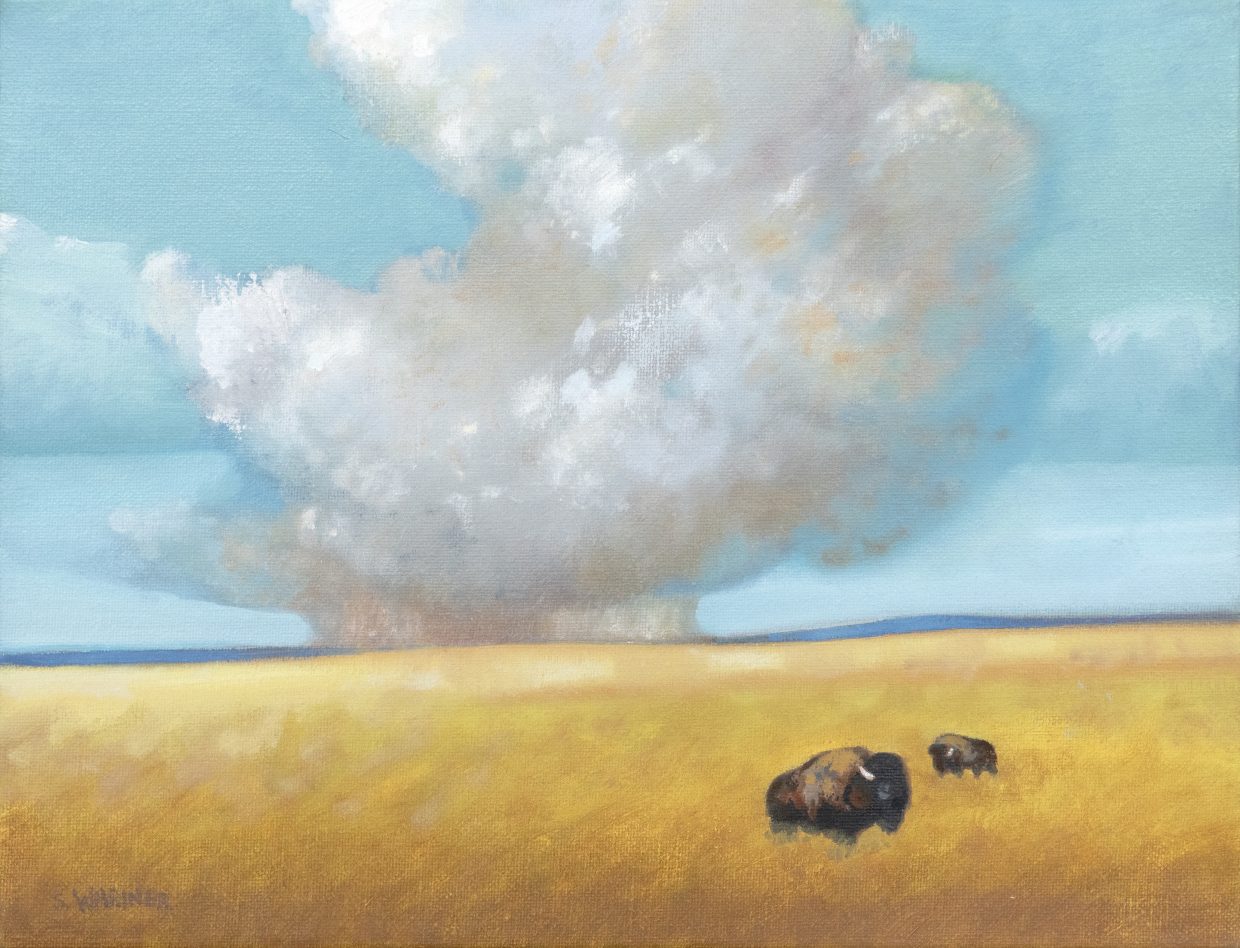
What he didn’t expect was that his time and effort would lead to the aforementioned “show.” Through mutual friends, the staff of the Monthaven Arts & Cultural Center, in Hendersonville, Tennessee, found out about his work and requested a viewing. The result is the Flip Side, a collection of 60 pieces in various mediums. The show opened on June 21 and runs through July 26. On June 25, Wariner performed an intimate concert as part of The Monthaven’s Heritage Music Series, making him the first artist/musician to simultaneously exhibit art and perform onstage.
Music has always been Wariner’s first love. His tremendously successful career is filled with dozens of Top 10 and Number 1 hits and a multitude of industry awards and recognitions. He has also painted throughout most of his life, and sold his first piece, a pencil drawing of a country store, when he was a high school sophomore – his art teacher purchased it for twenty dollars.
He is no stranger to exhibiting his work, and sometimes donating it to the best possible causes. In 2014, he created a fiberglass Basset Hound statue for Old Friends Senior Dog Sanctuary’s fundraising auction. In 2016, he participated in an artists’ exhibit at the Tennessee State Museum.
Between then and now, he has shown his paintings in California and sold numerous pieces, but “never anything on this scale,” he says about The Flip Side. “When this started out, we were talking about 35 to 40 pieces of art, and I thought that was pretty overwhelming. I’ve got tons of art, but Ruth Chase, the curator, and Cheryl Strichik, the executive director of Monthaven, looked at about 89 pieces of my work, total, and wanted to run with 60 pieces for the show.
“It is daunting, the work that goes into doing this. People don’t see that work and I never realized it either, to be quite honest. It’s time-consuming, and it takes a lot to frame and wire and get everything ready. Even placing it on the walls, matching it up, is an art. When you walk into the museum, it’s really nice; it’s got a nice flow to it, how they put it together. I’m really pleased.”
Let’s try something different with this interview, drawing parallels between painting and playing guitar. Let’s start with the tools: selecting the medium, brushes, paper, and so forth and selecting guitars, amps, pedals. The signal chain for each craft.
Steve Wariner: My first thought was watercolors would be like the acoustic guitars. In my guitar collection I have some old Martins and an old Epiphone Broadway that’s more of a jazz kind of guitar. Watercolor is very loose and free and unforgiving. If you mess up with watercolor, you start over because there’s no fixing it, unlike other mediums. I think that’s why a lot of times watercolor is harder than anything.
I think people take acoustic guitar for granted sometimes. If you’re not in that bluegrass or Americana world, where it’s very acoustic-driven, a lot of people think, “Oh, yeah, that’s acoustic.” No. It’s an art unto itself. People that play acoustic really well, the great players like Tony Rice, Mac McAnally, Bryan Sutton, they make it look easy, but it’s not. And that’s watercolor.
An oil painting, let’s say a beautiful English landscape, is like a vintage D’Angelico or Gretsch or some kind of beautiful archtop electric guitar that’s smooth and nice and elegant. That’s what I would equate with an oil painting. If you switch over to an abstract painting, something that’s more hard, that’s very expressive and can be loud, that would be the rock guitars, a Les Paul into a Marshall amp, or a Fender Strat, something very expressive, with a Nobels pedal or any kind of overdrive. That’s the abstract painting.
There are so many parallels with music and art. You start with a blank sheet of paper and you start writing, you start making something out of nothing. You start writing a song and you put a few words on there. On the blank canvas, you start putting a few colors on it and then, “Oh, this looks good with that.” With writing a song, you go, “Oh, that sounds good with that. If I say this, maybe I should…” It’s same with painting. It builds up as you go along.
With music and art, it’s not about what you hear or see. It’s about what you feel. A lot of people don’t understand why they love a painting, and it doesn’t matter; they just love it. A lot of the reasons why are the colors, the values, the way it’s put together, the composition, the harmony of it. In music you talk about tone, harmony, values, space. You hear a song and you love it right away. The song just hits you and it connects with you.
We always hear that tone is in the hands, it’s in the individual player, which is a parallel to painting and the individual painter.
Two people can pick up the same guitar and it sounds different. Two artists will look at the same thing, their paintings look different, and both are beautiful. I really do believe … a little bit of my faith has to come through because I think it’s a God-given talent in a way. You can hone it, like music, and when you love it so much, you’re going to do it. You’re driven to do it. But part of it is a God-given thing. I think you’re just born with it. You can hone it. It can be taught. But a lot of it is natural ability, too, I believe, and it’s something you’ve just got to do.
Does mood affect the choice of medium and, if so, how does that parallel mood and choice of guitar?
It is the mood. Some days I feel like doing a watercolor, and some days I say, “I’ve got a giant canvas out there and I want to just put some paint on it. I don’t know how I’m going to do it, or what or where it’s going to take me, but I’m going to put my old overalls on and paint.”
That’s me with the guitar, too. Some days I go out to my recording studio and, for example, I’ll say, “I feel like doing a Hawaiian song today,” and I’ll get out my Rickenbacker lap steel and start. It’s where the mood takes you. That’s what you feel like doing, and you can dive in and be creative.
You mentioned that with watercolor, you can’t make mistakes. Watercolor is to painting what tape is to recording?
That’s exactly correct. Chet Atkins used to talk about direct-to-disc recording, which means they would have one shot at it. It’s basically being cut into a disc when they record it, and you didn’t want to be the one making a mistake, because if somebody messed up, that’s it. That’s a watercolor painting.
The musicianship in that era was so strong. Their ear training was great because they had to figure everything out. Technology today makes it easy. You can tune it, fix it, slide it, do all these things. Don’t get me wrong – there are some great players today. But tape makes you really on point because if you mess up, it’s over with.
That’s the way it is with watercolor. If you mess up, you have to start over, and that’s what I like about it – the danger thing. I’ve done it before, where you have a beautiful thing going and you have to start over. With oils it’s still wet, so you can wipe it away and go over it, or when it’s dry, just paint over it.
Oil is Pro Tools. You can fix it in the mix.
Totally. Absolutely. The “undo” button makes you bold!
Do you sometimes sketch first, or do you go directly to paint?
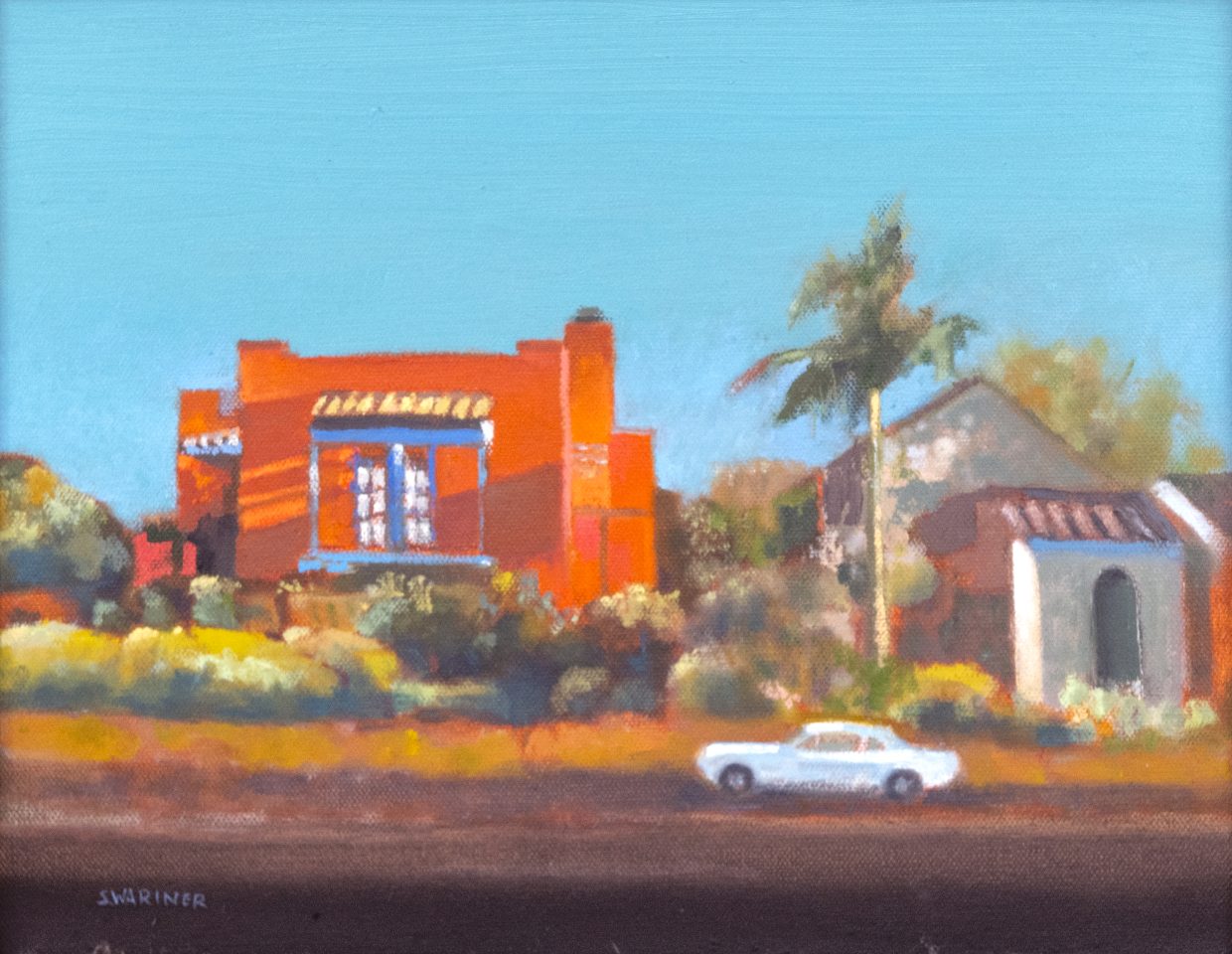
I do both. I keep sketchbooks and I sketch. My wife Caryn and I have a little RV and sometimes we go on road trips. I don’t want to carry all my stuff, so a lot of times I’ll just sketch, make notes on colors, and go back to it later. I also use my phone and iPad sometimes.
Sketching is the demo process, the pre-production.
That’s correct. There’s the demo in my sketchbook, now let’s make a record. Let’s get out the big canvas and make the painting.
Does your music or your guitar playing ever inspire a painting, and conversely, do you sometimes paint something, “hear” it on the canvas, and then it becomes a riff or a melody?
The answer is yes, to the first. I have thought of some guitar pieces, compositions. Both are compositions, but I have thought of that. Sometimes I paint with a certain mood or riff or song in mind, and if I have a name for the music piece, I call it that.
I have a piece in the show called “The Ocean’s A Little Bit Bigger Tonight.” It’s the name of the painting. It sold the other night. It’s a large abstract landscape, but it was inspired by a song I wrote with Bill Anderson called “Two Teardrops.” The first line of the chorus is, “Oh, the ocean’s a little bit bigger tonight, two more teardrops somebody cried…” That song is about the circle of life, and that’s the painting. As I was painting it, I kept thinking you could see the ocean way back in the back. It’s very abstract, but it has a lot of textures.
Bill came to the opening of my show and I showed him that painting. I said, “Bill, it’s like you when we first started writing this,” because he had part of it started and he was saying, “Wariner, you’re going to think I’ve either lost my mind or I’m a genius, I don’t know which, but it’s about two teardrops talking to each other.” The painting is that way. I told Bill, “You may think I’ve lost my mind with this abstract painting, but to me, that’s what it represented: two teardrops.”
Could abstract art be parallel to instrumental music? It’s open to interpretation from the viewer or listener, versus a painting of a specific subject being more like lyrics – even though those things can certainly mean different things to different people, too.
That’s a good way to look at it. It could be instrumental music, or more to me, I think freestyling. When you look at a jazz or bluegrass band, they get to the back half of the song and they’re just passing it around. Everybody’s playing – “Now you play eight bars, now you play eight,” or whatever. They’re freestyling. To me, that’s more what it is. It’s whatever you feel, it’s whatever you are interpreting, and I always loved that.
My first thought is Sam Bush. I love playing with him because with those songs where you do freestyle, I can’t wait for him to get ahold of his eight bars when it’s his turn, because he’s into it all the way. A lot of times that’s what I think an abstract might be, something like that. I like jazz, too, and some of those players get lost in their own world. They’re painting, they’re really layering and throwing some colors on there. It’s about the freedom.
You had to select 60 pieces for this exhibit. Is that parallel to putting together a song list for a show or sequencing an album?
Yes. It came down to that. It was interesting for me and very liberating, because I wasn’t in on making the set list necessarily. My suggestions were there, but that would be the difference. When I play, I make the set list, but they had the curator Ruth Chase, who’s wonderful, and she’s an artist in her own right. She had some great suggestions and great ideas, so she helped me put together the set list.
The curator is the co-producer.
Exactly, and the director is the engineer. She puts the whole thing together. It really is a team, the players.
In addition to your exhibit, something else that’s in the news is 75 years of Telecasters. Would you agree that it’s still the guitar that defines and is associated with country music?
That’s true. Number one, it’s so versatile. Maybe distinct is a better word. The West Coast guys, Roy Nichols, Buck Owens, Merle Haggard … they were certainly using them in Nashville, too, but the Bakersfield records really made the Telecaster, in my mind. It’s an iconic instrument.
James Burton turned me on to the Telecaster, no question. I saw him bending strings when I was a kid. I didn’t know how he was doing it, but I wanted to do it. It was like a magic trick I had to learn. Later we became great friends and we still communicate. He’s the king of the Telecaster, in my opinion. Roy Nichols was a big influence too.
We know you have quite a guitar collection. When did you get your first Tele?
I didn’t own a guitar until I was a sophomore in high school. I learned to play on my dad’s Jazzmaster, which he bought brand new in, I think, 1962. I still have it. Every time I played it, I dreamed and acted like it was a Telecaster. In my mind, it was a Telecaster, even though it didn’t sound or twang like a Telecaster.
When I was a sophomore, I had saved up about 400 bucks and I bought a Telecaster sight-unseen from a catalog. I ordered it from a store in Fort Worth, Texas. It was a ’71 or something like that. They sent it to me and I drove like a maniac to what is now Indianapolis International Airport to pick it up. I had an old 1964 Volkswagen and I blew the engine up going to get that guitar. I left it on the side of the road on [Interstate] 465, called my dad at work, and he came and got me and took me to pick up my guitar. We left my car sitting there for five days. I got my Telecaster and I was absolutely thrilled. That was my first guitar, and it’s now on display in a case at the Musicians Hall of Fame.
With all this talk of guitars and painting and writing, are we going to enjoy new music from you anytime soon?
I’ve got a stockpile of songs that I’ve been writing and going, “Ooh, I like this. I’ll put that over here.” I’ve got probably thirty songs or so that I just love, new ones I’ve written and that I’ve not really pitched around. I don’t have any plans right now. I don’t play them for anybody. I just sit on them. But I’ve thought about getting back in, getting some players together, having some fun, and see what comes out.
In the press release about the exhibit, there’s a quote: “Painting has always been a kind of therapy. It’s my sanctuary and escape.” How do painting and guitar fulfill and heal you therapeutically?
I think any artist will attest that you’ve got to find a place that you can go and just get away, get in a zone. It’s the free time that you’re not thinking about [anything else]. Music does the same thing. If I’m writing a song, I’m concentrating on what the song says. I have to force myself not to write about what I’m trying to escape from. But that’s good, too, to actually talk about it sometimes.
Painting is a place where I can turn my phone off. I’m listening to music in my headphones and I’m painting. I don’t know what time it is and I don’t care. I just go and go. No phones, no bother, nobody worrying you, nothing going on. It’s an escape and it’s great. It’s a really safe, free place.
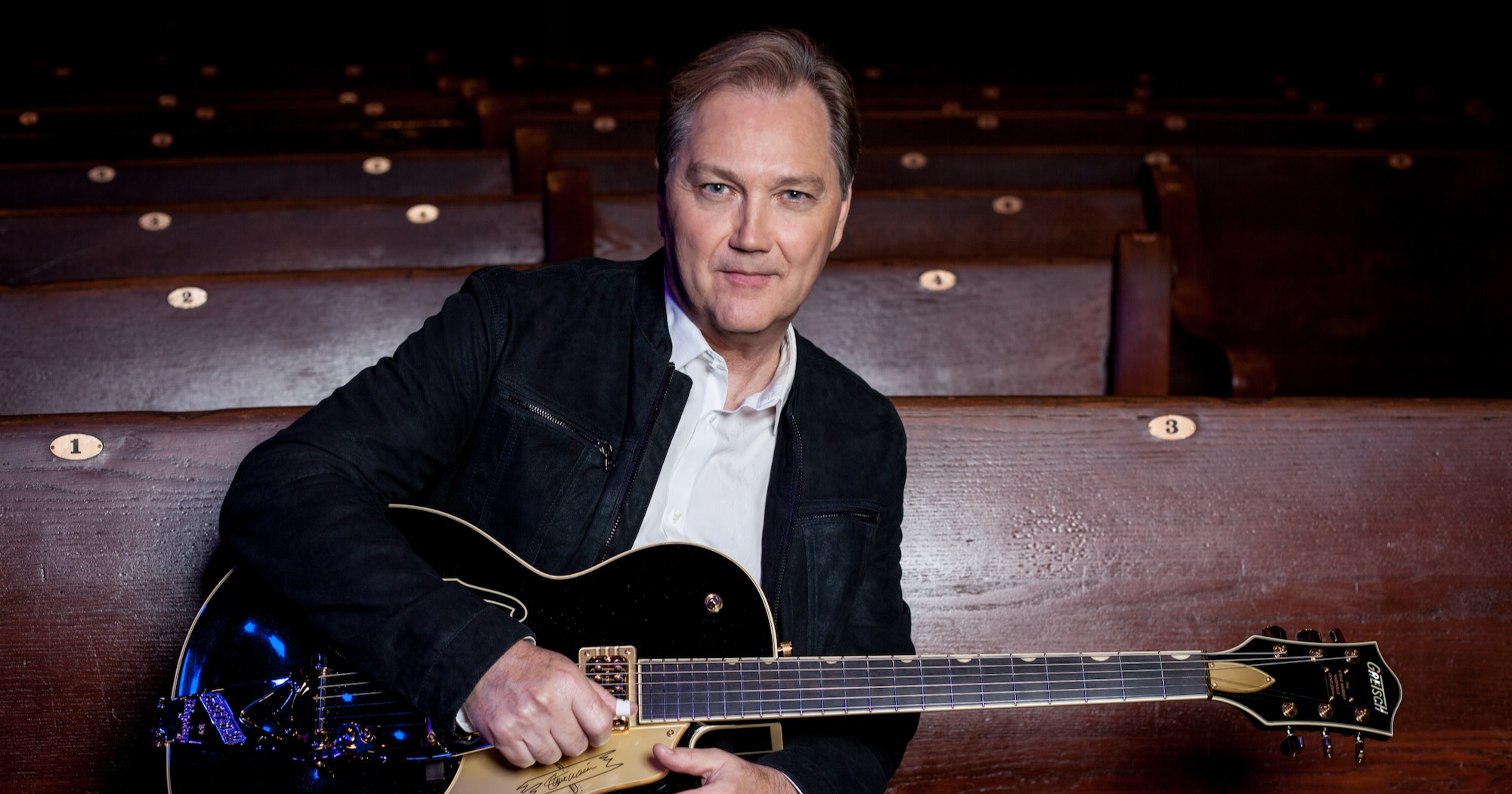
Photo Credit: David Abbott.
Reproductions of Steve Wariner’s visual art appear with permission, titles as marked. Images courtesy of the artist.