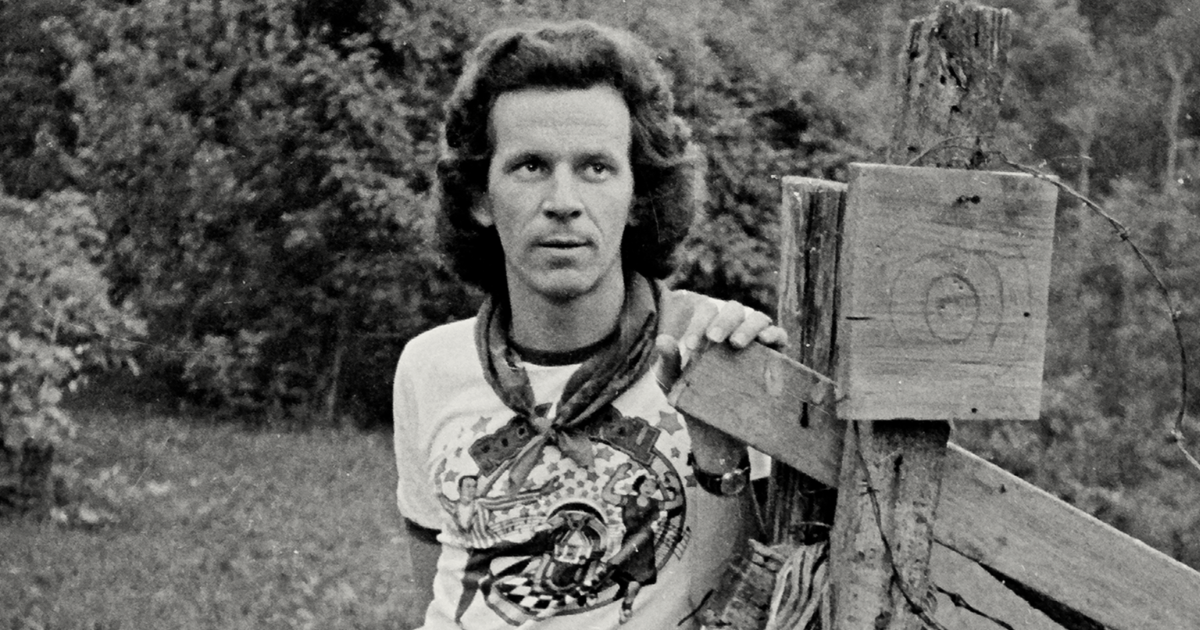
Nearly a quarter-century removed from the King of Honky Tonk’s tragic death, Gary Stewart’s early recordings have been revived in the first of a series of long-awaited compilation records.
One Track Mind, released on July 17, examines the country singer’s formative years from 1967-72, before Stewart signed with RCA Records and achieved national stardom. The 20-track compilation (or 16 on vinyl) was produced by the Delmore Recording Society’s Mark Linn, who helped to bring similar archived recordings by Kris Kristofferson to life on 2010’s Please Don’t Tell Me How The Story Ends: The Publishing Demos.
Linn has worked closely with Stewart’s music before. In 2010, Delmore Recording Society reissued Grandma’s Roadhouse, a 1970 album by Riley, the short-lived band led by Riley Watkins that also featured Stewart and his frequent co-writer, Bill Eldridge. Then in 2018 a 7″ single titled Mowtown (which is how Stewart spelled the record company’s name on his Musician’s Union paperwork) offered two of the demos that Stewart recorded in 1970, when he was hired to record country versions of songs in the Motown catalog, which were intended to be pitched to Nashville artists and producers.
The journey for getting One Track Mind across the finish line began shortly after Stewart’s 2003 death from a self-inflicted gunshot wound. Linn scoured the publishing houses lining Nashville’s Music Row for old Gary Stewart material. He soon came across a collection of demos transferred from reel-to-reel tape in the possession of the singer’s longtime friend, Tommy Schwartz, and started getting to work. But according to Linn, the condition these recordings were in when found — some were pieced together with a band and others were rough demos — made the process of restoring them more challenging than most.
“When I do these projects my goal is to have them play out like an album as opposed to a compilation,” he explains. “Then with Gary you’re also trying to tell the story of his early days along with exposing some of the influences he was exploring at the time that fans never got to hear. A couple examples of that come on ‘Beautiful River’ where he’s on a guitar inside his trailer, and on a stripped-back version of ‘The Snuff Queen (Acetate),’ a song that Nat Stuckey later released as a full-band single with Kapp in 1970. It was easier said than done, but I’m really happy with how cohesive it turned out sounding.”
For Linn the adventure down the rabbit hole of Stewart’s demos and deep cuts reignited his love for the singer that first began burning almost two decades prior.
“Once I caught the Gary Stewart bug in the late ’80s and started going back to explore his entire catalog, I became obsessed and needed to hear more,” Linn recalls. “The best part about what we just released is that I firmly believe that some of his best material are his demos and unreleased tunes, so introducing that to more of his fans has been a joy. Within the music industry he still doesn’t quite have the respect he deserves, but his memory is kept alive by the diehards and some of these newer fans and musicians that are covering his songs.”
Stewart was born in 1944 in Dunham, Kentucky, but moved to Fort Pierce, Florida, with his family at the age of 12, after his father was injured in a coal mining accident. Stewart started his music career playing country and rock in the bars around Fort Pierce. Mel Tillis happened to hear him singing in a honky-tonk and encouraged him to try getting some attention for his songs in Nashville. Stewart took that advice and placed his material with country artists such as Jim Ed Brown, Stonewall Jackson, Cal Smith, and Billy Walker, while also recording for the Cory and Kapp labels.
With One Track Mind, fans get a glimpse of the singer during that era, as he’s still cutting his teeth. Yet he’s already got the energy and spark that fans would soon fall in love with when he landed at No. 1 in 1975 with “She’s Actin’ Single (I’m Drinkin’ Doubles).” Standouts on the new compilation include the cheeky and lighthearted “Living the Life of a Dog” and a rough demo of “Williamson County” with soaring vocals that’s like night and day in comparison to the twangy version on his classic 1975 album, Out of Hand.
“It’s not like each one of these songs is a masterpiece, but there is something uniquely ‘Gary Stewart’ about all of them,” Linn believes. “He’s still searching for his voice but has already developed a good bit of the signature Gary Stewart sound we’ve all come to know and love. With all this new attention on him, hopefully it puts some pressure on RCA to put out some of his unreleased music, because his legacy deserves more. There’s still so many more sides of Gary to explore, especially of his formative songwriting days.”
Someone else in agreement about wanting to hear more material posthumously from Stewart is his daughter, Shannon Stewart Ashburn. In addition to being hopeful about RCA making moves into her father’s catalog, Ashburn says that Linn has already begun work restoring demos from the late ’70s and early ’80s for another compilation record. However, she stressed that the biggest goal she has for her father and his legacy is to see him get inducted into the County Music Hall of Fame.
“It’s just a matter of time. I won’t stop until I get him in there because he deserves to be in the Country Music Hall of Fame,” assures Ashburn, who got to induct her father into the Kentucky Music Hall of Fame in 2024. “Drinking songs are at the heart of what country music is and as the King of the Honky Tonks he was full of them.”
She continues, “At the same time, I’m just a girl from Fort Pierce working two jobs. I don’t know the first thing about the music business, I’m just trying to do everything I can to keep my dad’s name alive. Between this album and the recent biography by Jimmy McDonough a lot more doors have started opening up — it’s been like witnessing the rebirth of Gary Stewart.”
After fighting for this recognition for decades, Ashburn admits that she feels more momentum toward a Hall of Fame nod actually happening now than ever before, due not only to the new album and aforementioned biography, but also the countless artists from Cody Johnson to Ella Langley, Charley Crockett and Zach Top who’ve been incorporating his songs into their live shows. This momentum has resulted in Ashburn becoming incredibly close with her father’s fans, going so far as to call them family and crediting them for keeping Stewart’s legacy alive.
“I feel like we were all robbed — not just me when my mom and dad died 18 days apart, but also the fans,” confides Ashburn. “Because of that they’ve become like family to me. If it wasn’t for them my father wouldn’t be where he’s at now with his rebirth. They’ve given me a whole new perspective on my dad and helped me realize just how strong a person I am.”
She adds, “When I was 18, 19, 20 I wanted to be on the run and go out, but now I’m making up for all that by listening to the fans and all of Dad’s music and it’s left me amazed. At the end of the day I’m a big Gary Stewart fan, too, not just because he’s my father, but because of all the different places he can take you with his songwriting and music.”
On top of getting her father into the County Music Hall of Fame, Ashburn stated that another of her goals is to see some of these artists covering her father’s songs put their own spin on them for an album or one-off single, similar to what Texas band Mike & The Moonpies (now called Silverada) did in 2020 with Touch of You: The Lost Songs of Gary Stewart.
Per that band’s frontman Mike Harmeier, the idea for the album materialized from multiple factors — a love of all things Gary Stewart, being sent a bunch of his old material to dig through, and having an abundance of time to work on it due to COVID. The band’s 10-song album features one track, “The Bottom of the Pile,” which is also included on One Track Mind. Others like “Smooth Shot of Whiskey” and “That’s Life” very well could wind up on future compilations dropped by the Stewart estate.
“The coolest thing I got out of making that record is now I get to hear everyone’s stories about Gary all the time,” says Harmeier. “We played a show in Fort Pierce a few years ago and got to meet some of his old friends and family. I remember them bringing us a bunch of food that Gary would typically eat before his shows and got to take in the whole experience. It was fun working on the songs, but it’s things like that which have cemented the moment in my memory.”
Through his father’s massive collection of music from the King of the Honky Tonks, Harmeier discovered Stewart as a child. Once Harmeier began playing music and formed Mike & the Moonpies in 2007, Stewart’s songs quickly took over their marathon four-hour dance hall sets. “[Gary] is quintessential jukebox material. His songs are gonna keep folks on the dance floor, so we played them often.”
“It really affected me later on because his music has so many ties to these bars I’ve grown up playing that have hardwood floors and wood paneling everywhere,” describes Harmeier. “It’s a big nostalgia trip for us as a band whenever we cover his music because nothing sets the tone of a barroom more than Gary. As a songwriter I chased those cliché bar songs for a while, and it was all influenced by him.”
As for One Track Mind, Harmeier says he’s partial to “The Bottom of the Pile” and some of the album’s other material that Stewart penned with his longtime songwriting partner Bill Eldridge. Another of his favorites, “Touch of You,” is about the late Mary Lou Stewart, and written by her husband, Gary, and their daughter, Shannon. Mary Lou Stewart, who was married to Gary for 41 years, died of pneumonia in November 2003.
With all of the converging styles on the album from singer-songwriter-oriented ballads to hard-driving honky-tonk numbers and Motown classics, the project shows not only the sheer talent within, but also the diversity of Stewart’s music. To the powers that be, those multitudes made it difficult for the industry at large to pigeonhole him, but the clamoring from fans the past 20 years has made his legacy impossible to ignore. Hopefully that means a Country Music Hall of Fame induction is just around the corner too.
“Gary was shunned for being too rock and roll for country and too country for rock and roll, which is the same boat our band is in right now,” Harmeier says. “But with the current state of the industry and convergence of genres, it comes as no surprise to me that people are diving back into his songs now, especially these new ones. They’re pure Gary.”
Photo Credit: Tim C. Cox