
In the nine years since Tift Merritt released Stitch of the World, she settled back into her hometown of Raleigh, North Carolina, where she is raising her daughter, Jean. Along the way, she stepped away from touring and began serving as a Practitioner-in-Residence at Duke University in Durham and renovating The Gables, an 18-room travelers’ retreat in Raleigh, set to open in July.
Merritt’s new album Sugar (released June 26 via One Riot Records), her first album of all new material in nearly a decade, was born out of the quiet moments of creativity off the road. Community, motherhood, and the wisdom that comes with age are prevalent throughout the stellar record, which was produced by singer-songwriter Lawrence Rothman, a longtime fan of Merritt’s singular lyricism.
“Before I made this record I was looking at the world and thinking, ‘I don’t know what to do except try to put some love out there.’ And for me, singing is the most honest, immediate way to offer love,” Merritt said in a press statement.
Merritt shares her joy through songs like “Finest Feelings,” about the possibility of new love, “Sugar,” an ode to the simple pleasure of using your voice to sing, and “Everyday Singing,” which features a women’s choir largely made up of educators and scientists who’d lost their funding due to cuts to federal research grants.
Merritt and Rothman met with BGS via Zoom to discuss creating Sugar, their immediate bond, finding sweetness in starting over, and the beauty of the second half of a brilliant career.
How did you first meet?
Tift Merritt: I first met Lawrence in France
Lawrence Rothman: The most exotic of locations.
TM: I was like, “Who’s this really nice, really well-dressed person?” I don’t generally do a lot of co-writing. I mean, writing is a really way down sort of personal thing for me usually. But this was in France and I was immediately put into a session with Lawrence and they were so fun, dancing and singing… I just figured that I would be the older person at this thing that nobody had ever listened to. I was like, “Lawrence is really nice and likes me.” They were so enthusiastic and so full of love. I was like, “I think that’s what I need if I’m going to come back out of my little hiding place.”
LR: We had a wonderful time our first time creating together, because we were parked in this beautiful hotel in the middle of the South of France. And we were all sort of disconnected from life and we were able to freely create. And Tift did a performance at the end of the stay there. We were there for five days and she did a performance with herself and a guitar and a looping pedal. There was a song that she played and I was just blown away by it. I asked her afterwards, because I didn’t recognize it, and it was a newer song.
That song – I believe it was “Pilgrim” – that you played on the looper pedal? That song just haunted me. It was in my head for weeks. I was hoping that I could get in the studio with her and record just that looping pedal song, at least, if not a whole album. Then she invited me to do a whole record and obviously that was a complete honor.
I’m a person who loves lyrics first, really. I’m kind of the opposite of your average Beatles fan. Melody is cute and fine and everything, but lyrics are, for me, what separates an amateur from an icon. Tift’s lyrics throughout her entire career have always blown me away. She’s, for me, a poet – a poet and a singer – but you never know what the next thing is going to sound like. When Tift started showing me this record in its very infant form – voice memos and things like that – and sent me the lyric sheet, I was blown away by how much her writing has progressed, too. I don’t even think about her past music now. For me, it’s almost like it’s a new era. It’s almost like part two of her career.
This person that she is today and the lyrics that she’s writing today and the story she’s telling today, I can’t wait to hear three albums of that. Maybe it’s the age that I’m at, maybe it’s just the life that I’ve lived now, but it just resonates to me in a way that I don’t find in a lot of singer-songwriters today. The stories that she’s telling. I don’t see it from the perspective of an older person. I see it in a lot of younger people and they tell it in a way that, I guess, is relatable if you’re 22 and going through something like that. But I want to hear what’s the heartbreak in midlife and what does that feel like? And what does it feel like to be alone without a lover and be over 40? And what does it feel like to raise a child over 40 as an only mother?
TM: I appreciate that so much. I just want to add, I think one of the things that’s really special to me about Lawrence and what we’ve captured is that I feel like Lawrence really understands that vulnerability is very rock and roll and sexy. Whereas in a lot of people’s hands, writing as vulnerably as possible or as honestly as possible or in an unguarded way, women end up being framed as fragile flowers and that they really understand that the vulnerability is very rock and roll.
Did you discover any similarities in how you both create?
TM: There was one thing I wanted to coda the last conversation with, which is that Lawrence has really made me feel like I was at the beginning. I did not feel like I was at the beginning, and [that’s] where you should be as an artist, [where] you feel like you’re just getting started. You just got to the good stuff, and I feel that way again. So thank you for that, Lawrence.
Similarities in terms of working, I just find that Lawrence is a very soulful, kind, warm person, and that we could talk about writing, first of all. Then in the studio, we really work the same way, which is fast. You can’t talk about what being in a band is like until you’re in a band. I think we’re both very free in the way that we love music and we just want to get in there to that place, so that was such a joy for me. Sometimes people make things much slower and piecemealing… and I just want to put it all out there right now with my voice. We had this amazing crew of musicians that were right there with us. I mean, I don’t think there was more than one song we did more than four takes of.
LR: I would say 80 percent of it, the take that you’re hearing is the take that Tift sang with the band. Either she’s at the guitar or at the piano singing, the band’s cutting it, and that’s the performance. The live energy of a snapshot of a performance at a specific time in somebody’s life are the records that I love. It’s hard for people to do those. You have to be in a mature, artistic state of mind to be able to be that vulnerable and also be that brave with going like, “You know what? We’re not going to patch it up. It’s just like this is the soul of what it is.”
I feel like over time when you listen back to records like that, you end up enjoying them a lot more. And with Tift’s record, I was so happy that we were both aligned with that. It was like, we’re going to go in there and we’re going to track this thing live. We’re really going to capture a moment in time that’s honest, that has all the imperfections and the realness of age, of soul, and heart and love and heartbreak–
TM: And process.
LR: And process.
TM: Why are we practicing? We’re practicing for these moments. It was very charged for me to be back in the studio and surprised by… I mean, I just felt so safe and so encouraged. I mean, Lawrence, the warmth was really a huge piece for me. I felt so safe and I felt like I could just throw myself in. A couple of times I thought my heart was just going to bust out of my chest singing like that. That’s what you want to be feeling.
LR: Tift and I – what’s great is when you meet a new friend and you have so much in common. We love Terrence Malick. We love the visual of what Terrence did visually. We love the same types of poetry, and the Stones, and Dusty Springfield. So it’s great because sometimes you’re working with somebody and you might have the same musical taste, but you don’t have the same visual taste. So there were a lot of things that we had in common. We even liked the same hotels and landscapes. We got to visit – whose grave did we go to behind the studio? George Jones. His grave was about 10 steps from the studio door. We had to go check that out.
TM: That was good juju. Lawrence.
I’m just loving your jacket. We’ve got to go shopping. I want to go shopping with you.
LR: We’re definitely going to do that.
Tift, I know you’ve spoken about this album being an offering of love and being a way of putting love and joy out into the world. How has creating this album helped you find joy in difficult times?
TM: I think at a certain point, I’d really made peace with being off the road, because my creativity was finding lots of other things to do, but– just looking at the world, the impulse to have a creative response is something that I feel almost with a sense of responsibility. As we all have, I’ve tried many different things in response to now, and I just kind of got to a point where I was like, “The only thing I can do is put love in the world and live my values and put as much love in the world as I know as possible.” Singing is the most direct way I know to do that. So, in one sense, it was very much a reason why to come back to the studio. I like that “why” for making art and for singing.
I think it’s very important to write about the messiness of being a human, the inefficiency of being a human. To inhabit that and live into that as much as possible right now seems also a political thing. I think writing personally is also a political thing. Living your life to your values and to the fullest and feeling as much as possible is a political thing too. So as much as I think this record is a creative response to the world we live in now, part of that creative response is intensely personal and intensely joyful and how thrilled I am to be here and to be alive in my good life, right? That’s an act of resistance in and of itself. Hopefully singing love into the world is too.
LR: One of my favorite songs on the record, “Mad Mad World,” I think sums up a lot of what Tift just said. A lot of the songs on the record address the anxieties, the heartbreaks, the loneliness of the culture of 2026: a lot of lonely people, a lot of isolation, a lot of disconnection. It’s hard to stay positive and stay alive in this era. Nothing that any of our grandparents saw in their lifetime – I mean, they went through World Wars and things like that, but we might as well be going through a World War right now. I mean, the amount of disconnection and non-loving vibes that are in the world is at a height. To have a record like Tift’s where it’s like, “Okay, I’m not alone. There’s other people that feel this.” I’m always connected to records as my way of dealing with sadness or loneliness or problems that I’m going through. My shrink is a good album. I get more out of that than actually going to a shrink.
I love the song “Everyday Singing.” I’d love to hear from each of you about creating that one.
TM: I’ll give you a little bit of the backstory about that song. That song is based on some letters that a woman named Rosetta Rietz – who was a Bohemian, downtown New Yorker, second wave feminist – wrote to her friend Dachine Rainer, who was an anarchist poet who had left New York City and upstate New York when her marriage fell apart and moved to London. I do an archival project with Duke University in a collective where we are looking at [Rosetta’s] papers from lots of different directions. She basically dedicated a good portion of her life to tracking down the erased foremothers of jazz and blues. And in this moment of second wave feminism in the ’70s, she’s looking at everything going like, “Why is that a male domain?” And she looks at jazz and she gets really angry that it’s a male domain and she goes, “I’m going to go find the women.”
And she did, and she joined these sort of circles of record collectors, which were all white jazz critics, and she was like, “Do you have anything by women?” and they didn’t want it, because they thought that the first period of recorded music from 1920 to 1927 – which Rosetta called the women’s reign – because 87 percent of the records that were released were by Black women. I know this because she counted them. They thought that was vaudeville. They thought it wasn’t “Integrity Blues”… They thought “Oh, these multitasking women, that’s not real blues, and we want the Robert Johnsons.” They weren’t making the jump from 33 and a third to LP – that’s a whole other story that I didn’t mean to ramble on about.
But in her letters back and forth with Dachine Rainer over a period of 20 years, she’s talking about being a single mom, she’s talking about being broke, she’s talking about making her own way. They’re talking about their ex-husbands, who are all depressed because they’re anti-nuke. They’re in the anti-nuke movement. They’re talking about Reagan and fascism and fascism moving around the world, because it’s happening in America. Then they’re like, “You’re divorced, you’re a phoenix and you’re going to rise from the ashes.”
I was like “Oh my God, this is like me and my friends.” It was so comforting. A lot of the verses are really taken from these conversations, inspired by the conversations that they were having. Then, of course, the idea of everyday singing, which is what my daughter and I do every day. The singing that comes from our houses and from living lives and showing up with love every day, that kind of singing is definitely a kind of resistance, and nobody can take it away. I just believe 100 percent that it’s the most important thing we can do.
LR: Wow, that was amazing. I knew some of that, but it’s nice to hear it again. For me, “Everyday Singing,” as far as my experience with it in the studio, was one of the [most] exciting songs I’ve ever tracked in my life. Because I love a challenge and I love when I’m thrown into the fire and I got to just be a grown up and make it work.
That day, our great drummer who we were using had a personal thing and could not come to the studio. So at the last minute, we were scrambling to find a drummer the morning of, and everybody was booked. We found an amazing person, but he was new to the group. We had already gotten into a roll and the way he played was very different than the previous drummer, and the way he played was very different than any drummer I’ve ever recorded. So it was a bit of an adjustment to my brain as far as like, “Hey, we have to deliver this song right now.”
The higher angels that put us in this situation to figure it out and to make some great art, and we did. It’s some of my favorite drumming on the whole record, actually. The sound of the drum set is actually a lot different, too. From the sound to the playing of it, it is just … I love it. It’s one of my favorite songs on the record too, and favorite production. Tift added the group vocals from remote from where she lives and we flew that into the final mix. Everything about it was not what I’m used to. I loved the challenge of how we did it. Sonically, it sounds like one of my favorite pieces on the whole record.
TM: I had this idea that it needed women’s voices on it. I said to some folks I work with, “Do you think that we could get educators and women who have lost their science funding and women who need to get together to do this?” and my friend said, “Oh yeah.” I mean, everybody who I asked came. There’s a friend of mine named Peter Askim, who is a conductor who lives across the street, and he came and he conducted it and we recorded it in The Gables. All of the women beforehand were really nervous and they were like, “We don’t know how to sing.” I was like, “No, no. You know how to sing.” We just had this amazing party. There was so much love in the room and everybody was laughing and dancing around and it was a wonderful night. I get a little teary every time I hear it.
Tift, one thing that struck me about this album is how you weave artifacts and history into your songs. I would love to hear from you about how your work in archives has inspired this album.
TM: My process really underwent a change when I started working more with material culture and archives. I mean, you don’t plan these things, it’s not transactional. I didn’t know that it was going to hang around with me, but I started collecting objects from site-specific places and really and truly listening to them like, “If you had a song, what would it be?”
There’s this real world context that material culture has. It has provenance, it has ingredients, and usually those things are really rich in language, and this context that they have brings a landscape of its own. Then the juxtaposition of that with more of what I call lyrical presences, but the more spiritual reality of the thing. That tension is a really interesting place to enter a song. It’s also just a really rich way to get out of yourself. I think there’s a real value of writing from a deeply personal perspective, but we are also deeply personally involved with the world as a collective and as a larger place. Spending time with objects is a really fun, rich way to get out of your own naval gaze.
Lawrence, does that resonate with you in how you write songs?
LR: Gosh, I’m such a researcher with things and really obsessed with people like Mark Twain and William Burroughs. I’ll go to people’s childhood homes and immerse myself in tactile things about the great writers that I love or the great songwriters or singers. So I can relate to that a lot, maybe more so than I would care to admit.
TM: Well, you and I have a … researcher bent in us that we share.
Do you have a favorite song or lyric on the album?
LR: Mine’s easy. Mine’s just the entire lyric, every line in “Finest Feelings.” I get very obsessed with certain things and that song is like my 2026 obsession. I forget that it’s even Tift and I. It’s just a song that I listen to – I’m going to cover it at my concerts. I mean, to me, it’s like when I heard Jeff Buckley for the first time. So every lyric in that song for me.
TM: Well, that’s so kind.
I have a hard time choosing, because I am really proud of the writing here and I think I’m proud of it as a writer, but I’m proud of it personally too. I uncovered some new spaces in me in writing this. I feel like just the song “Sugar” itself is earning my own respect from myself in a way… or holding my own space or power in a way that I probably could not have as a younger woman.
Do you have a favorite memory from recording the record?
TM: I think “Look What Love Just Did” was my favorite, because I tend to say, “Okay, let’s do the hard one.” We had saved [that song] for the end and it surprised me that it became this swagger. I was having so much fun. I didn’t see it coming. We were just dancing and throwing it out there and just feeling so free. So that was such joy.
LR: I think maybe my number one favorite moment was when Tift had her father come in [to the studio] and he’s got a big personality – the type of personality that I love. The first day [he was] telling stories and laughing, but there was a point on – maybe it was day two – we were playing back mixes and he was standing there and it almost looked like he was about to cry, but not in a dramatic way. I could just tell he was getting a little bit choked up. He was hearing his daughter’s music. I think he was a little overwhelmed, maybe he didn’t expect what he heard.
It was a really honest, amazing moment for me, because I come from a family where my parents are very involved with the music. They want to know what’s going on. They want to listen to it. They want to be in the studio like how Tift’s father was, but I never let them in the studio. After that moment, I was like, “You know what? Maybe I should allow them to come sometime,” because there was just sheer joy that you could tell was going through this man. It was just a beautiful moment. It was one of the most beautiful moments I’ve ever had in the studio, really.
TM: My dad taught me to play guitar and he has lots of opinions, as dads do. I remember thinking, a couple of days in, “I don’t want to jinx anything, but I better call my dad, because I don’t go in the studio that often and he needs to see this.” It’s really special.
Is there anything I didn’t ask that either of you’d want to add?
TM: When do we get to go back in the studio?
LR: Yeah, that’s what I can’t wait for. Like I said, a lot of great artists get part one of their career and part two, and Tift now has part two – like Leonard Cohen, like Nick Cave, like Lucinda Williams. I mean, the list goes on and on. Leonard Cohen, Nick Cave and Lucinda’s records that they made after they were 50 are my favorite ones. Leonard didn’t have his first hit, “Hallelujah,” ‘til he was 50 years old.
I love second-act careers because all that life that was lived, now you can hear it through a whole set of new songs and records. I just need people that I can relate to. I don’t know if it’s my age that I’m at – I love all sorts of music, but I just need to be able to have a group of records that I can listen to that are new, that I feel like I can find myself in. I feel like there’s a lot of other people that will feel the same way I’m feeling. So we need the Tifts of the world to keep putting out music.
I can’t wait to get [back] in the studio.
TM: I know. I’m trying to open a hotel right now. So I’m like, “Oh shit, I’m really going to have to write myself. I’m going to really have to write after this one.” When am I going to see you, Lawrence?
LR: God, I don’t know. I hope soon. … We gotta go shopping and have fun.
TM: I know! I need a suit. I need your help.
LR: C’mon. Let’s do it.
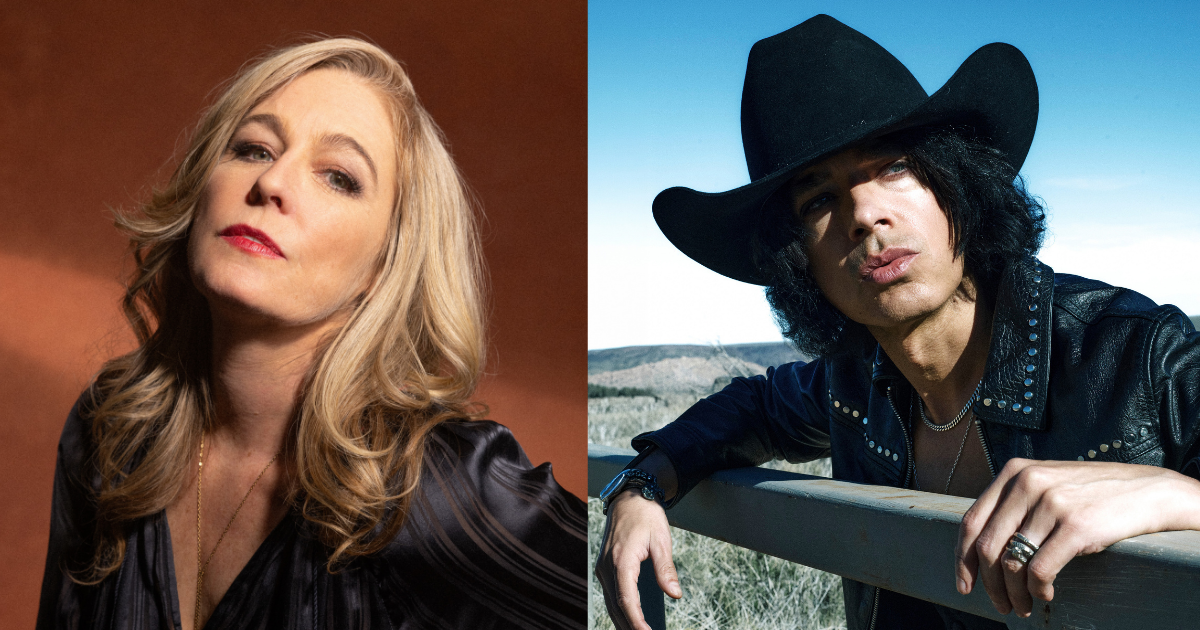
Photo Credit: Tift Merritt by Ebru Yildiz; Lawrence Rothman by Mary Rozzi.