
According to 20th century genius Louis Armstrong, “Man, all music is folk music. You ain’t never heard no horse sing a song, have you?”
Yet it is not universally accepted that hip-hop is folk music. The almost perfectly named folkhop derives from bhangra, not any rap/folk fusion – although DJs are involved. During the 1960s folk revival featured some cherished artists like Richie Havens addressed civil rights and the contemporary scene. As well as Bob Dylan presaging spoken word and folk with “Subterranean Homesick Blues,” while wise men in Black communities were signifyin’ on the streets. The 2000s saw acts Gangstagrass and Nappy Roots pioneer mixing bluegrass or other down-home sounds and themes with hip-hop.
This lineage notably continues in the current decade with Cleo Reed, whose music has been referred to as folk rap, and Greensboro, North Carolina artist/activist Justin “Demeanor” Harrington who combines 1990s hip-hop production and banjo samples, proclaiming, “I learned that it’s not that folk is separate from rap; folk music just means the music of the people. Rap is one of the illest folk music that’s ever existed.”
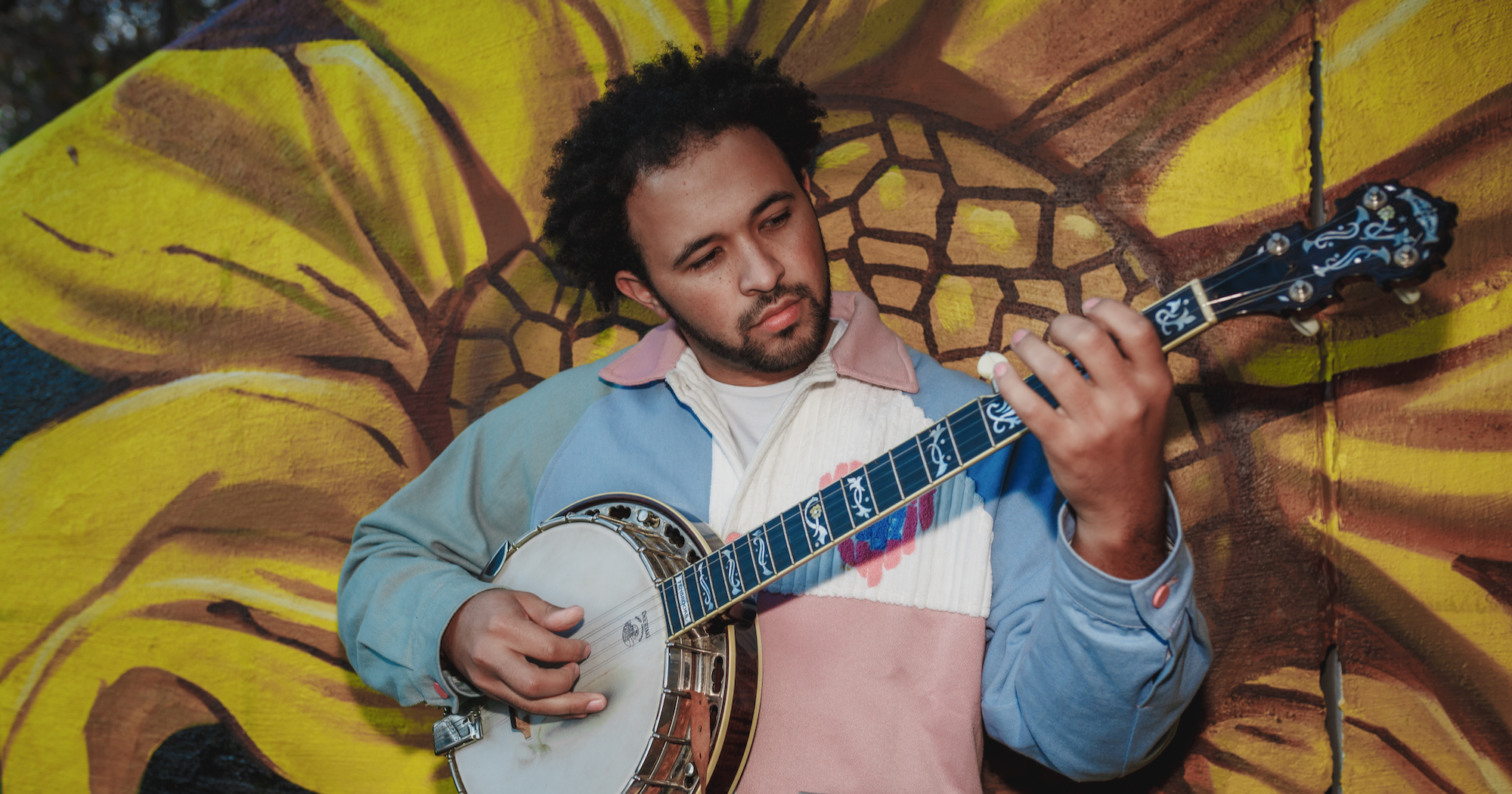
On his new album Heart On The Table, Tray Wellington – also from North Carolina – honors kinship to Harrington in pursuing hip-hop/folk fusion by featuring him on the fourth track “DEMEANOR // I’M WITH IT.” Wellington’s 2022 debut album Black Banjo infused traditional bluegrass with jazz styles while amplifying the Black Southeastern sources of roots music. He had already been lauded with the International Bluegrass Music Association Momentum Award in 2019 for Instrumentalist of the Year, before going on to earn the Steve Martin Banjo Prize in 2024 for innovation in bluegrass and on the five-string. In recent years, Wellington has also served in Black banjo supergroup and string band New Dangerfield (now on indefinite hiatus) alongside prominent roots artists Kaia Kater, Jake Blount, and Nelson Williams, taking the roots festival orbit by storm.
Wellington is a standout in the Black banjo movement of the past 20 years that seeks to reclaim the African-derived instrument and the lost world of Black American roots music created in the South at the crossroads of Scottish, Irish, and Indigenous styles. He has long been taking runs at bluegrass boundaries, covering songs like his reworking of Kid Cudi’s “Pursuit of Happiness.” New songs “INTERLUDE,” which features Sierra Hull, and title track “<3 On The Table,” featuring A.G. Sully, are the greatest on the new album.
BGS spoke to Wellington about his challenging journey.
What is it about North Carolina? Why do so many legendary musicians – from George Clinton and Chuck Brown to Elizabeth Cotten and Roberta Flack – hail from there?
Tray Wellington: You know, I think North Carolina, as a state, it’s just really cool, because it has so many different cultural identities. I think there’s so many different regions of the state that have their own unique musical identity, as well as personal identity and cultural identity. I think, because of that, where you have such a wide array of people in this one state, it just creates a bunch of natural vibrancy, you know, for the arts. And I think a lot of people just grasp onto that, and it just produces a lot of really amazing artists, because like, John Coltrane’s from there.
I used to live in Charlotte; moved there right after the original Black Banjo Gathering in Boone and met and got to know the embryonic Carolina Chocolate Drops and the legendary Joe Thompson. Where are you from in NC?
I’m originally from Ashe County, North Carolina, which is really close to Boone – 15 minutes away.
How did your journey with the banjo begin?
I was originally playing electric guitar for about a year, and when I was going through my grandpa’s CD collection one day I found a CD of Doc Watson. I remember when I found this CD, I remember listening to it. Doc Watson is a musician from Deep Gap, North Carolina. I was listening to this CD and I just got super invested in the sound of it, and just the overall vibe of the music. There was at the time a club at my middle school called the Mountain Music Club. I joined the Mountain Music Club to learn guitar, so I started doing some flatpicking there and in that class was when I heard banjo in person for the first time. It drew me in and I was like, “Whoa! What is this?” I just kind of became enamored with it.
I always loved banjo because I grew up watching Hee Haw. I’m likely much older than you.
What was it like winning the Steve Martin Banjo Prize?
That was super cool, I was super honored. I remember when I was like 14, 15 years old, when I was looking at my life goals, you know, one of the things I remember hearing about is the Steve Martin Prize. So, it happening was like a childhood dream come true, and I just think it was one of those moments that it’s so cool to be recognized by all these heroes of mine for my work. At first, I did the classic Southern thing like, “I don’t deserve it.” But I think I bring a unique perspective to the instrument and I was honored to have been recognized in that way.
To talk about the new album, Heart On The Table, what made you pursue bridging the gap between hip-hop and bluegrass?
Yeah, I think for me my biggest thing was when I was talking about storytelling. I looked at what my favorite storytelling was, it was hip-hop music. When I was first kind of conceptualizing this album, I didn’t even know what it was gonna be at first. I made all these tracks at home, because I’ve been doing hip-hop production for a few years now, too, and then also playing banjo. I remember I was making all these tracks with hip-hop stuff and I wasn’t putting banjo on it. I was hanging out with one of my friends and he was like, “Why don’t you add banjo to that?” And I was like, “What do you mean?” I had never thought of that. I never thought about mixing it. And then when I started doing it, I slowly started coming up with this collection of songs. “False Idols” was the first song on the album and I remember that was one of the early songs I did in that style. I found a way to make the banjo fit perfectly in there.
You’ve obviously been working with Kaia Kater, but how did you select the other artists feature on the new album?
Yeah, there’s a couple different ways. Some of them were old friends of mine, like Elora Dash, who was on “False Idols,” for instance. She was my vocal teacher in Raleigh when I was there and I’ve known her for a long time. I really, really respect her music. And then Demeanor, who’s on track [4]. I’ve worked with him before, we’ve done tracks. We have a release event together, we’ve done a few tracks together at his studio in Greensboro, and I was like, “He has to be on it.” And Lizzie No was a first-time collaborator for me.
The most riveting song of the collection is the title track featuring A.G. Sully. With its jazzy blend it reminds me of my brotha Gil Scott-Heron. What is the source of the song?
That was another song that I had made before we even recorded the album. And we didn’t know it was going to be the title track, actually. Then, when we were thinking about the new band, we were like, “How do we put this together?” I actually rewrote my verses for it after we re-recorded it, because I was like, “I need something that fits this vibe better.”
I remember the first thing I heard:
Is your heart on the table?
Did it fall?
How could I let you know?
Who could have seen the call?
Nothing to do at all.
It just kind of came to me naturally, and I remember I wrote it all down. When A.G. got it, I sent her all the lyrics and I was like, “I think this is kind of the vibe.” And she knocked it out of the park on the hook.
Since the Library of Congress Black Banjo Renaissance event featuring Demeanor is happening in July in D.C., do you see your work and his as parallel?
Yeah, I mean, for me, I have a lot of respect for what the brother does and I think we have two different approaches to [fusing folk and rap]. It was one of those things where definitely he’s an inspiration to me and we’ve been friends for a while now. I wouldn’t say we, either one of us, necessarily did it first or maybe around the same time, [we] just kind of naturally did it. I know he really likes my stuff, too, so it’s cool.
I am in the Black Banjo Reclamation Project NYC chapter. What would you like those folks coming up to know?
I would just say, don’t limit yourself. I think it’s the main thing I always tell people, because I think sometimes we can get caught up in people trying to sway our narrative. And as a community, the most important thing we can do is cultivate individuality. Ultimately, that should be the main message on the flight.
How do you challenge the consistent limitations for Black roots artists? Since we’re coming out of Black Music Month [June] and I noted that the War & Treaty were on the BET Awards as this lone roots outlier…
You look at the country music artists, for instance. You look at Morgan Wallen. He says the N-word, gets canceled, and then ends up becoming one of the best-selling artists of all time, because he said the N-word. And because all of his fans rallied around him and were defending him. Then he immediately took it back and said, “Well actually, I can be this controversial, because my fans will still buy my music.” White artists are gonna get away with a lot more.
I feel like the judgment is so much higher, you know? I feel like if you’re a Black artist and you release one bad song, people are gonna be [upset]. But a white artist could release a whole album of bad songs and people would still listen and not be as critical. I think sometimes, too, there can be an expectation of Black artists to always have to discuss certain issues. When ultimately you can talk about anything, and you should be allowed to talk about anything, and if you’re not touching on this one thing right now, it doesn’t mean you don’t like it. You know what I’m trying to say? Does that make sense?
A big thing I try to challenge is we shouldn’t have to always talk about racial issues in the world on every single song to be able to get traction, but sometimes that’s how it feels like it is.
What do you think accounts for the attraction of new Black players to roots music now?
I think one of the cool things we’ve seen in the last couple years is there’s been a big resurgence of it, and I think the Beyoncé album, surprisingly, was a big thing. There’s a whole lot of debate around that, because ultimately people can argue if it was country or not – that’s not my place to say. I remember there was a really good article that said don’t forget all the other people who have been putting in work for 20-plus years to try to get people [interested in Black roots music].
And all these artists who have been doing the work for the past 20 years should get that same recognition, Black people in roots music. That one of the biggest artists in the world that can highlight this thing that for so long made a lot of people feel like, “I don’t belong in this.” If they can help people jump over that barrier and see that all people do belong in this; it’s done a lot for the movement, that I’ve seen.

Photo courtesy of the artist.
This content brought to you in partnership with Preston Thompson Guitars.