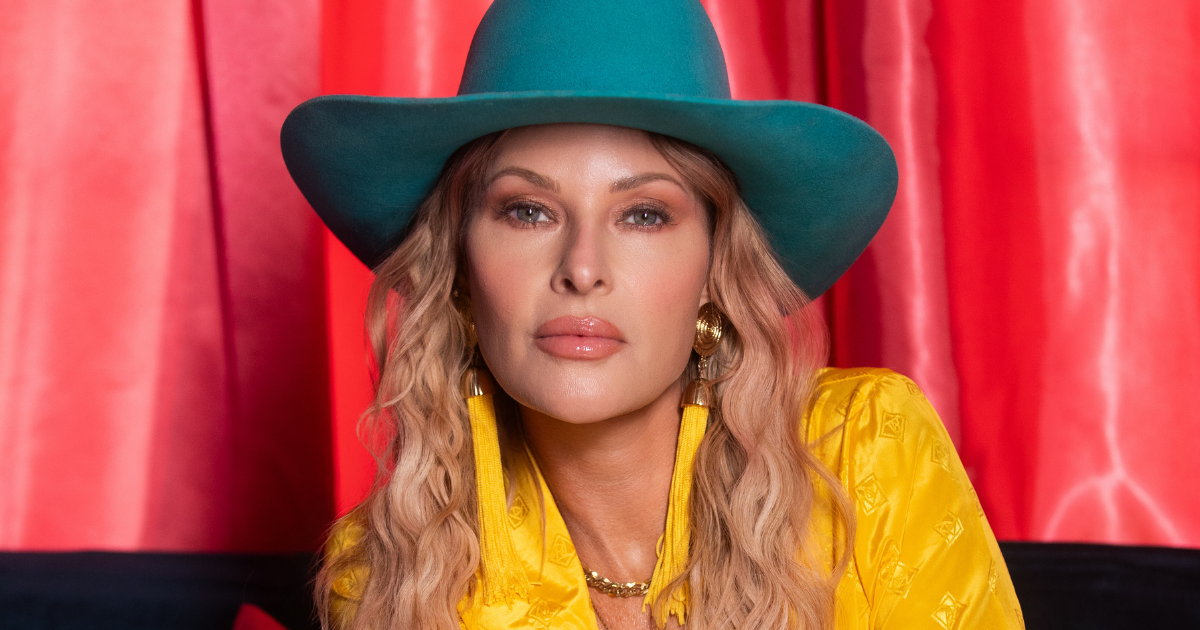
Elizabeth Cook writes from a place of lived experience — love, loss, family, friendship, loyalty, grief, mental health, even moments of history and headlines that speak to her heart and soul — and she does so with raw authenticity. It’s a transparency that fans have come to expect over the course of her many albums, interviews, and live performances.
Great Television, her latest release, was six years in the waiting and making. Produced by Shooter Jennings, it does not disappoint. Cook delivers an emotional walk through a range of deeply personal topics. She also dives into storytelling with “Girls of Atomic City,” a tribute to the women who worked on the Manhattan Project, and “Thiokol Tripwire,” recounting a 1971 explosion at a Georgia chemical plant that cost the lives of many Black women the plant employed.
All of this is presented through the overarching lens of media and how it affects our lives. It’s a topic she knows well from her decades spent in and out of public adulation and scrutiny. That theme is also present in a new, independent film she’s starring in, The Easy Kind, which is loosely based on her life and career.
“I’m just grateful that I’ve made it this far and am able to have tools to manage the emotional weight of the things,” she says in a call from a hotel room in New Orleans, where she is promoting the film. “Part of it, too, is I don’t run from it. I have to accept at some point that I am going to carry sad-girl energy. It’s just my calling. But I’m going to do it with heart and humor and enjoyment and pleasure wherever I can find it.”
BGS: Tell us about your day so far.
Cook: I slept till 10 o’clock — and I didn’t go to bed till probably 3 o’clock. It’s not because I’m at the hotel bar or anything, even though I was for a minute. But I come in and I do elaborate late-night journaling, organizing, self-care routines, foam rollers. So I slept till 10, got up, and hit the ground running. I’m answering emails, texts, handling technical problems with SiriusXM, my radio show there.
I walked to a grocery store yesterday and bought a bunch of fresh produce and stuff to eat. Not lettuce! I like eating in restaurants, but I don’t like to eat in a restaurant twice a day, day after day. I find that wrecks how I feel. So I buy a bunch of raw produce and eat it in my room. I’m walking into the hotel with bags of carrots, celery, peppers, apples, cucumbers, plums, whatever’s in season. So just snacking on that, and getting ready to fix my hair. That all feels like a wild answer to your question. But if I could show you my hotel room right now, it’s like a cyclone has come through.
A lot of homework goes into what you do. You research, study, and work on the accuracy of location, history, and facts in your songs. Is that an ongoing process — the research, the ideas, and the editing — as you strive to tell these stories with authenticity?
For sure. These late-night sessions that I have with myself, and these late-night parties — it’s a party of one. It’s my passion. It’s not work. It feels like I’m playing hooky from life when I do it, but it is, at the end of the day, my actual work, so I am fortunate to be able to indulge in it and justify it.
I am telling stories because I love stories, so I love to take them in. I love to discover people’s paths and experiences, and because of whatever my chemical and emotional makeup is, I attach to it somehow in a way that makes my heart speed up and gives me a rush and excitement.
Crafting that into song has a few different layers to the process and you listed them all. There’s the researching, going down the rabbit hole. There’s extracting language from the story that I can use lyrically. There’s trying to put an emotional application to that. And then there’s trying to put a musical grid to that, which has an emotional and technical tentacle to it. So it’s really fun. It’s like a Rubik’s Cube.
There’s not much coverage of your guitar playing, which is a significant part of what you do. Talk about that — your guitars, how the songs develop around your guitar playing, or how the guitar parts develop around the songs.
I develop the guitar around the songs. It’s an instrument in the truest sense of the word. It’s meant to help me further my point, the point of the song, and the feel I want it to have, which can be reinvented a million ways. But in the moment, you’ve got to pick one. You’ve got to pick which pants you’re wearing.
In the studio, my rhythm section, Phil Anthony on bass and John Venezia on drums, are pretty insistent that I play the acoustic guitar when we track, which means I then have to go back and do it again. When I do it as we’re tracking, I’m singing and playing at the same time, so there’s bleed, and they need everything isolated for mixing. So I do it with them, then I go back and redo both my parts. But I’m leading the charge, and I strum in a way that wraps around my phrasing. I stay out of the way when I’m singing something, and I maybe add a few more notes in terms of strumming or whatever in between lines that propel the song.
That really matters in rhythm playing. I think rhythm playing is under-analyzed in tracking. I love it. It’s percussive, and I love percussion. I love beats and I love rhythm. I love playing rhythm around the lines of the song. As far as my instruments, I played my Martin DM on the record, and currently on the road I have a Gibson J-45 Honky Tonk Deuce that was gifted to me from Dwight Yoakam.
What’s the story behind your Martin?
It’s the first guitar I ever bought for myself that was my own, that wasn’t my mom’s. It’s the only Martin I have. I would like to have more. I really love Martin guitars. I got it when I signed my first publishing deal. My publisher saw something in me as a writer that I did not realize I necessarily had to cultivate. I was an accountant and I was in a miserable corporate job. I bailed when I got this offer to write songs. It felt like a fluke out of nowhere. It was all like a wild, random idea to me, but this publisher was very clear in what he saw.
When I got my first publishing advance check, we went to Gruhn Guitars, when it was still on Broadway, and I bought that guitar for $600, I think. Now it has signatures all over it from Harlan Howard, Little Jimmy Dickens, John Conlee, Steve Earle, Carlene Carter, Gillian Welch, Mike Campbell, Kevn Kinney, on and on. Every time I play it on the Opry, I get people to sign it. Harlan’s signature is starting to wear off, and I’ve got to figure out how to coat it with something that doesn’t hurt the resonation of the guitar, but still be able to preserve his signature where it is.
This is not the first time you’ve taken six years between albums. However, the last time, we were not in quite the world of fleeting TikTok fame and five-second attention spans, and you are not one of those people. With that, was there some apprehension about the time away and coming back in?
Yeah. I’m definitely a deep Southerner that’s going to stay somewhat on island time, and so I can’t concern myself with those things. I’m making my work. I’m doing the part of it I can control, and then trying to spread the word about it at whatever is available at the time, whatever medium that is.
We were talking at dinner last night about the resurgence of CDs and how I do believe that there will be and actually is somewhat of a backlash to this moment and to the rapid pace and wireless nature of things. I think people want to be reconnected with a cable, slow down, and reclaim authority over your attention span and what you take in and what is meaningful to you. I like the idea of my offerings and art that I put out in the world being something that people can use to do that.
In “Sunset Promenade,” there are the lines “Turns out all the things in my head are a prison/And I just want a friend I can stand and do my time with.” You have those friends, but when you were struggling, did anyone walk out? That’s a common thing to experience: you struggle and everybody disappears.
Yeah, for sure. It’s the thinning of the herd. You find out who your friends are, and it’s no shade to some people. They’re not meant to be in that role for you, and you’re not meant to be in that role for them, which is fine. I’ve had relationships where I realized, “This is a one-way street, and this is taking advantage of me while not serving me.” Not that everything has to be on an even keel and transactional, but it’s more about discovering someone’s character and who they’re going to show up to be.
“Sunset Promenade” was the last song I wrote for the album. I was looking over the scope of the body of the entire album, and the work and the songs that were going to be on it. It was something I wanted to say that wasn’t there yet, which was like a song of love and gratitude to the people that are standing with you, and that I believe will be standing with me through it all, because it’s at the core of their makeup, and they are designed to be in that role for me.
Easier said than done. What got you to that place of understanding?
The culmination of it all, which takes time. Perseverance and patience with the process of time, reflecting, shows me that this is the work I’ve done, these are the songs I’ve written, these are the experiences I’ve had, these are the things I’ve shared with the public. It’s perspective, and it takes time and experience to have that.
And then a lot of great support. I’ve been really blessed with loving family and friends that are as crazy and wrecked as I am, but also on the battlefield, doing the damned thing. We’re all out there in arms together, we hold each other up, and we take each other’s calls in times of crisis and need, no matter where we are or what we’re doing. That network is really important to me. So I think it’s been a blessing of all those things and an acceptance of “This is what life is.”
Photo Credit: Stephen Dillon