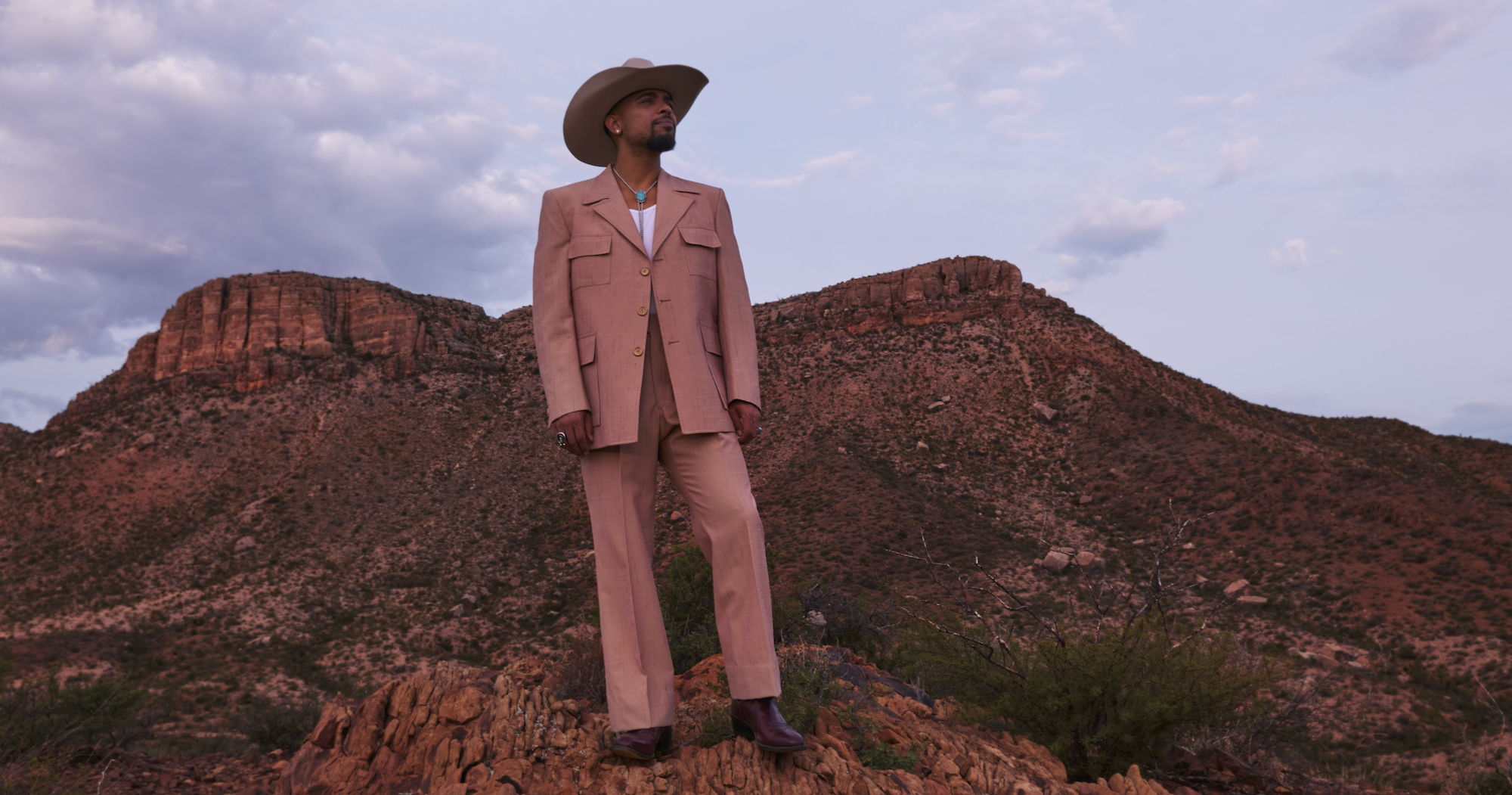

Devon Gilfillian is one of the most accomplished rock and soul artists in Nashville who many roots music listeners still may not know about. A self-described melting pot of music, the Philadelphia native is deeply inspired by the too-often-unheralded impact of Black music in Nashville and its influences on country and rock ‘n’ roll. Gilfillian’s hero, Jimi Hendrix, expanded the genres – and Hendrix’s connections to Nashville aren’t lost on him.
The amiable, passionate Gilfillian released Time Will Tell, his third major-label album, on June 26. Largely recorded at historic RCA Studio A in Nashville, the new album is inspired in part by the eclectic soundtracks of Quentin Tarantino’s movies, the oft-sampled David Axelrod music of the 1960s, the Shaft soundtrack by Isaac Hayes, and Bobby Womack’s “Across 110th Street.”
On “Hold On (Hourglass),” the project’s first single, Gilfillian sings over a galloping beat, spaghetti western guitar, and a choir about the passage of time and the uncertainty ahead. “I like that kind of swaying, or that western sound that is coming from a kind of cinematic place,” Gilfillian said from his home in Nashville. “I wanted to mix that country-western sound into that cinematic kind of world.”
In that post-genre spirit, Gilfillian co-produced his new album with longtime drummer Jonathan Smalt. The duo had major-league assists from Neil H Pogue (Tyler, The Creator and OutKast, among others) who contributed to the mix, along with sound engineers Michael Harris and Reid Leslie.
“Time” is a gorgeous opener with a rich palette of piano and strings. “Time, all we have is time, to heal it,” Gilfillian softly sings. “Cry, I don’t wanna cry, but I gotta cry, to feel it.” He then goes full Hendrix on “Black Dog Rabbit Hole,” his hardest rocking song to date, with lots of fuzz guitar and considerable sonic depth and instrumentation. “Let’s Stop Fucking Around” is old-school soul with harmony background vocals, and the funk-pop of “IRL” makes you want to dance as Gilfillian proclaims that he wants something real.
Gilfillian’s major label debut, Black Hole Rainbow, landed in 2020 after the pandemic took hold. Thoughtful, upbeat, catchy rock and neo-soul with Gilfillian’s emphatic delivery, the album was produced by Shawn Everett, a GRAMMY winner who’d worked with Alabama Shakes on Sound and Color and with Kacey Musgraves on Golden Hour, among other projects. Then, Gilfillian released his own impressive version of Marvin Gaye’s classic album What’s Going On during the pandemic shutdown to “lift up the Black voices in Nashville” with guests like Jason Eskridge, Ruby Amanfu, Joy Oladokun, Kyshona, and Jasmine Cephas Jones from Hamilton.
On his 2023 follow-up album, Love You Anyway, Gilfillian leaned a tad more toward traditional R&B and hip-hop, delivering the single “All I Really Wanna Do” in a falsetto voice a la 1970s Curtis Mayfield. Another highlight was “Let the Water Flow,” a gospel-style ballad about the murder of Ahmaud Arbery in Georgia and the attempts to overturn the 2020 election results.
Gilfillian’s new album is more personal than political, and BGS spoke with him about it recently.
This album has a bigger sound than your others. Did working at Studio A have anything to do with that? What was it like working in that room?
Devon Gilfillian: It’s magic. It’s truly magic. I was literally there just today for another interview. Just getting to go there and be in that room [was cool] because it was a year ago this week that we were there making the album. We laid down all the rhythm, the drums, bass, guitar, keys, and some of the time I sang at RCA in the studio. Most of the vocals were [done] in post-production, but I wanted to really bake-in the chemistry of that room and the band onto tape. That’s the main reason why I wanted to go to RCA.
Your music is always a bit eclectic, but the new album’s ode to the American west, most notably on the first single, “Hold On (Hourglass),” seems to go further than before.
Truly. My friend and amigo Mr. Ran Jackson, who I wrote the song with and who helped produce it, we were rapping about that and he nailed it. I came in and he had this track, he had the guitar, the chord progressions like ding-dinga-ding-dinga-ding, and I was just like, “Oh shit, let’s go. Let’s take this world [we created] and use that.” And I just poured out what was happening in my emotional world, which was my relationship that was not working out. That’s how that song started.
Your style really is almost genre-less.
Jimi Hendrix is my like North Star, right? And Jimi, he’s all the fuck over the place. He was playing with Little Richard, playing with the Isley Brothers. You know, he was learning by listening to Elmore James and listening to the blues. Then he goes over to the U.K. and he’s playing with Mitch Mitchell and Noel Redding [in the Jimi Hendrix Experience], and they’re like these folky, psychedelic, rock cats. They’re mixing in folk and psychedelic rock and then the blues and R&B, you know like fucking Isley Brothers, and all these things coming together.
When I listen to Jimi, I hear all of it. I’m not scared to take little bits and pieces of what I love and combine it with other parts and other pieces of other genres and, you know, see if it makes something tasty.
Hendrix spent time in Nashville, as you know, and in Atlanta as a backing musician at the Royal Peacock Lounge, from where he hit the road with musicians like Little Richard on bus tours of shows in the South. It’s so interesting to see how he was influenced by playing in the South.
He was stationed in Clarksville, [Tennessee, in the Army] right, for a little bit? I remember when I was in high school, I was obsessed with Jimi. It was like, “How did he do it? I want to know everything.” But I didn’t really know how connected he was to Nashville ‘til I went to the Jefferson Street [Sound] Museum. He was coming here and really learning from these cats, learning from people playing the blues and country and all this stuff… in like this fucking popping-ass, thriving Black, R&B, blues scene.
You’ve been in Nashville now for about 11 years. Is this sound just part of your soaking up the music in your adopted hometown?
The reason I fell in love with country music was because of a specific album that was made at RCA Studio A, and that was Sturgill Simpson’s Metamodern Sounds in Country Music. Back in 2016, I had a residency at [Nashville venue] the Family Wash, and I was in love with this record of Sturgill’s that everybody loves. I was like, “Oh shit. Little Joe came in.” [Simpson’s guitarist, Laur Joamets.] He’s one of the best guitar players I’ve ever heard. He was like, “Hey, you’re pretty good. I like your band. I want to play with you.” So that was amazing. Little Joe started sitting in with us and played with us for so many gigs. That was how the buzz started building. It was so full circle that, you know, the inspiration [came from him].
I fell in love with Waylon [Jennings] because of Sturgill.
You had a lot of guest singers and friends from Nashville singing on What’s Going On. What approach did you take for the new album?
A lot of the crew that was on the What’s Going On album were the band on this album. Both my keyboard players, Josh Blaylock and Ryan Connors, and then also Nate Felty and Jon Smalt, of course, on drums. It’s all my people, you know. These are all my favorite musicians to make music with. We also pulled in Jordan Lehning, who’s an incredible string arranger, and he brought in Lockeland Strings and had them play on this album. That’s really the thing that injected so much beauty into this album. The strings are just so gorgeous.
Michael Harris, who engineered, he was our main tape operator [at Studio A]. He’s one of my favorites in this town or in the world. He’s a fucking genius, and he worked on Black Hole Rainbow. He was flying in from L.A. and I had him crash at my place while we made this album. I really did get to do it with all of my favorite people.
When we spoke in 2021, you were getting into activism. You donated the proceeds from your What’s Going On album to voting rights and other political groups. Where are you as an activist now? How much of it do you leave to your music?
I still use my voice to spread as much knowledge as I can about the shit that’s going on. For this album, I definitely wanted the music to just be a reflection of my life over the past two years, and of course, politics are always going to be part of that. These songs are just diary entries that I’ve picked from the past couple years. I just looked at the common thread between all these songs, and I was trying to make this relationship work. And it did end, but that’s OK, because there’s still love there and I’m grateful for that love.
Also, my dad had a heart attack [during the making of the album]. I had the realization that my parents are mortals. They can go at any minute, and you know, what are you going to do if that happens? You better fucking hold on to this life that you’ve been given, and to the people that are around you that you love, and you know, just be grateful for them and be as present as you can.
I understand this album is more personal, but have you had to adjust your messages at times to some extent, based on your live audiences? I know you’ve opened for mainstream country acts.
I’ve got to be conscious of where I’m at and the audience that I’m in front of. You know, I try to keep it as real as possible. Whatever’s on my heart, that kind of just comes out. But no, I definitely don’t feel like I can just speak freely anywhere, especially if it’s like in a “red” place, opening for an act that for sure has a pretty conservative fan base.
“Time” is a real stunner on the new album. Tell me about the arrangement, mainly with piano and strings, and how that song felt from the beginning.
It’s definitely about the end of my relationship. I wrote that song with Tabitha Meeks, an incredible piano player [and] singer-songwriter herself. She came over and we wrote one song, and then she started playing, basically “Time,” like the chord progression, and I sang, “Time, oh time,” and she’s like, “Wow, that’s so beautiful.” We didn’t have time to finish it, ironically, that day, but we were like we have to finish this song. A month later, we came back together… It was while my girlfriend at the time was living with me. She left the house and I was like, “Alright, let’s get this recorded.”
It must be a gift when it just comes to you like that.
I’m so grateful for how that one came. It really did just fall out, and it doesn’t happen that way all the time, right? I would say most of the time it does not. 100 to 99 percent of the time it does not happen that way.
“Glad to Be Here” seems to be about being present and was written after your father’s illness. You sing that it has “been such a long, long time since I’ve felt ease, letting my worries fall like leaves/ And I’m so glad, glad to be here.” Do that song and “Shines in You” come from a similar place?
“Glad to Be Here,” yeah, exactly. “Shines in You” is really about my ex-wife, and how that was the love part of it, you know. She is a beautiful person and there was a lot of love there and still is. There was a lot of love, but we couldn’t pour into each other the right way.
That and “Let’s Stop Fucking Around,” you know, they’re the ones that are like, I love you, I love you. Let’s do this, let’s make this happen. But then “Time” and especially “You Can Hate Me Now,” those are at the end of the relationship and the realization that it’s not going to work.
“Keep on Movin’” has some tight drums and horns. It’s still guitar-driven, but I hear the Neville Brothers, New Orleans, and Philadelphia soul in there.
There’s some Fela Kuti in there, you know, very Afrobeat, and my buddy [and co-writer] Ray Mason, my God. I tell you, he funked them horn lines up! He played in this band, Antibalas. I think they’re based kind of all over, but mostly New York. An incredible Afrobeat band. Antibalas was the band for the FELA! Broadway show. They did the whole Broadway thing.
We set up like a whole drum circle. Eric Slick was playing drums. He plays with [Philadelphia band] Dr. Dog and he’s a great artist. Our buddy Nate Felty, he was playing percussion and Jon Smalt was playing on a drum kit, as well. So, we have like two drum kits and percussion and other people playing some auxiliary stuff, all out in the big room [of Studio A]. We wanted it to feel like, you know, just like a party.
You work with some great talent. Who else was instrumental in helping you make this album?
Ran Jackson was absolutely such a huge force in this album, and he helped me produce “Hold On (Hourglass),” “Moonflower,” “Let’s Stop Fucking Around.” And Jon Smalt, I couldn’t have done this without him and his taste and drum sounds – and he’s a great producer himself. As far as arrangements of songs and knowing dynamics and all that stuff, he’s so good at that.
Michael Harris, who engineered, he’s incredible. We couldn’t have gotten the tape sounds that we got without him. Reid Leslie was our assistant engineer, but truly he was like the main cat in pre-production, during production at RCA, and post-production. We did post-production at Reid’s place. Those are, I feel like, the dream team. And then Neil Pogue, he mixed it, and I just love that man. That was cool to get to know him. Oh man, what a legend.
This album has some sad moments, but ultimately, it’s hopeful. With everything going on in your life and the world at large, what gives you hope?
I’m just a hopeless optimist, you know. I try to bring the good vibes. I’m always paying attention to everybody that’s in the room and making sure that everybody’s comfortable. But you know, hope just always ends up in there. If it is a sad song, I don’t want [the listener] to be left completely crushed. That’s just me. I really am grateful for that [optimism], because there are days that I get freakin’ depressed and smoke all the weed and just numb it all out and whatever. For the most part, I can wake up and smack myself in the face and go, “Wow, this life I have is fucking beautiful. I need to soak this shit in right now.”
Does the artistic community that you’re part of in Nashville help keep you going?
I feel like I stumbled upon like, a Laurel Canyon. The communities here in Nashville, my brain couldn’t have conceived how cool, how dope this city is in that way. How being a musician, you can have a normal life here in Nashville and have a beautiful community – and it’s just so convenient, too. It’s not L.A., New York, these big music cities. It’s hard to hang out with each other in those cities, because you’re an hour, you’re 45 minutes away, even though you’re three miles away.
Even with all the traffic [here], it’s not that hard. If you know what’s up, you can zigzag around. So, it’s the most convenient music city in this country. I think it’s the best music city in this country. You can put your team together, the business is here, and most people here, they leave their ego at the door. Because they know that everybody’s talented. It’s just about what you do that I don’t do.
Photo Credit: Travys Owen