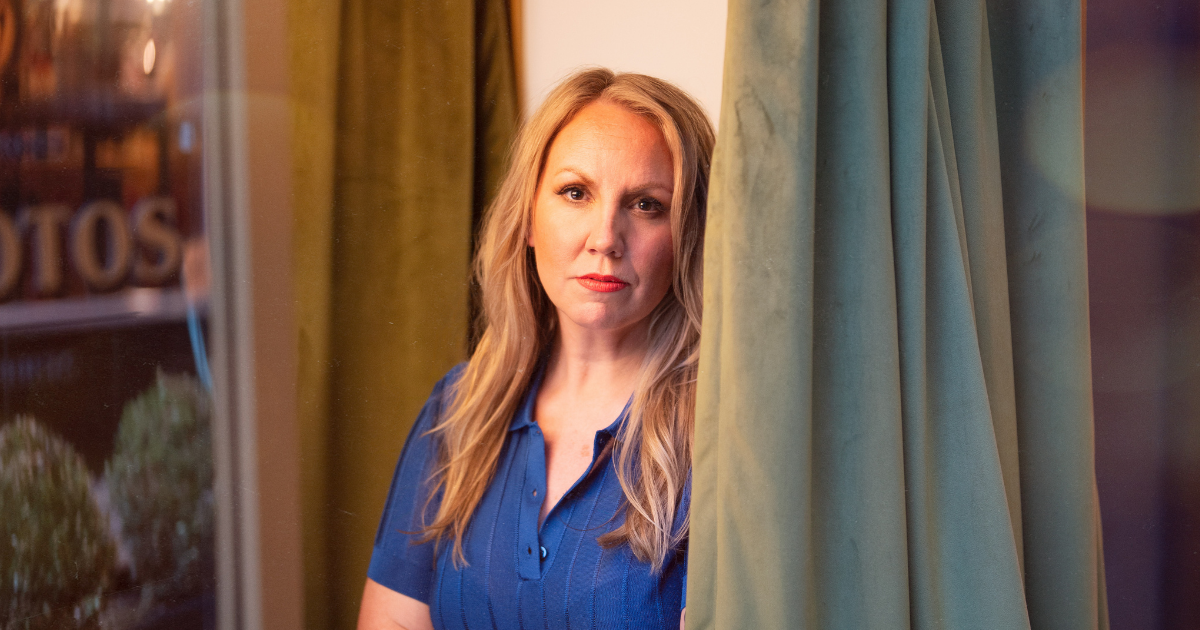

In her endearing delivery that retains a touch of her South Georgia accent, Mary Bragg has sung songs about growing up, falling in love, coming out, finding strength as a woman, and building bridges back to her family.
Now, on her sixth full-length album, Secrets to Strangers, Bragg shows us even more of herself in songs that sparkle with a rock-and-soul edge, exploring these themes more fully and deeply than ever before. She’s telling real stories and sounding unmistakably like herself, and these rootsy, melodic songs are especially warm, meaningful, and memorable.
Recording in Muscle Shoals and Florence, Alabama, the standout studio band lends these new songs a taste of soul, with John Paul White on acoustic guitar and vocals, Ben Tanner on organ, piano and percussion, Zac Cockrell on bass, and Chad Gamble on drums. White and Tanner also co-produced the project, and its tasteful vocal and musical effects leave enough room to put Bragg’s singing and White’s occasional harmonies first. This personal story-sharing on Secrets to Strangers makes listeners feel like we’re no strangers at all.
BGS: How did you decide to share such personal songs on the new album?
Bragg: I haven’t always consciously run away from things on records past, but the more I write, the more interested I am in getting to the heart of something and staying there instead of tiptoeing around it. If I’m in a bad place, pretty much all I have to do is pick up a guitar and begin to play, sing, or write. It’s like when you’re in therapy and you come across something that suddenly is incredibly important or some sort of revelation, there’s only one way forward, which is through it instead of running away from it.
Did you ever imagine you could be this open in your music and storytelling?
I knew I had it in me, but the only way to really get there was to just live more life and dig your heels into that authenticity and vulnerability with yourself and with other people. When the writing of this record was coming together, there were definitely a series of moments where I felt like it was flowing through me and I was just this vessel that needed to not get in the way.
You made Secrets to Strangers in the Shoals area of Alabama. How did you migrate there and find your producers, Ben Tanner and John Paul White?
It was born out of my interest in the records that they’ve made before, for people like Dylan LeBlanc and the Secret Sisters, and Ben’s work with Alabama Shakes, and of course John’s work with The Civil Wars and his solo records. I’m a huge fan of theirs and have been for a long time. I ran into my friend Traci at a show in Atlanta when my good friend Kyshona opened for Jason Isbell. She said to me, “Mary, you should come to the Shoals and make a record.” And I’m a firm believer that these things happen in the time that they are meant to happen.
It was immediately a good fit. I was so… relieved is not the right word, because it wasn’t like I was worried about it, but there was a sense of relief that I didn’t know I needed to feel — simply because of who they (Ben and John) are as people and as record producers. They’re so exceptionally professional and creatively devoted, that being met with a couple of people whose obsession with music is as serious as mine, it was the best thing ever. I was like, “Oh, good. I can relax now.”
You recorded many of the songs at FAME Studios in Muscle Shoals, where Aretha Franklin, Wilson Pickett and Etta James made some of their classics. Was it intimidating to record there?
Well, sure. Incredibly moving, really overwhelming to step in that space. The room has been preserved in such a way that you really feel like you’re taking a step back in time. It presents as an invitation, whether you’re the artist or the songwriter or the guitar player, to bring your best self to the song, to the room, to each other. Everyone that was in the room would probably agree that we wanted to bring our best, to give ourselves over to what this record wanted to become.
The Shoals Music Makers program was a large part of the reason we were able to make the record we did. They offer a rebate that allows you to have more time and flexibility in the studio to stretch out and explore, in ways you otherwise might not have been able to without the constraints of a fully self-funded project.
“The Game” on the new album — what a poignant and powerful song. I haven’t heard it described in song before how it feels to make the choice between keeping the peace in a family or showing more of yourself.
It’s a song that, honestly, I didn’t think I would ever write. I didn’t think it was something that I could write about, and I didn’t think it was something I wanted to write about. It’s too painful. But it’s one of those serendipitous songs, again, when something shows up and you’re met with an invitation to meet yourself in the truth. Here you are, in this opportunity, to either tell the story or run away from it.
Maya de Vitry is just an incredible writer. It was our first time writing with each other. She’s so spectacular and her heart is so big and willing, and I just love her work. We’ve known each other for a long time, and sometimes when you first start having a conversation, you might not realize what you’re talking about is going to be the song that you write that day.
She reminded me recently that we wrote it in the weeks leading up to my wedding, and she asked me if our families were coming. Then it’s like I blacked out and blurted everything out in one fell swoop, because I told her the entire story in that moment. And three hours later, pretty much the whole song was written.
She encouraged me to allow for it to be as brutally honest as it is. Like, am I really going to say, “how to talk about the future without speaking my name’? That just makes me want to vomit every time I say or sing that, and the reality is anytime you encounter that overwhelming feeling about something in a lyric, it’s usually because it has to go in the song. If it feels that gutting to you, then it’s probably something that other people might need to hear.
I just started playing it (“The Game”) out (on the road) a few weeks ago, and it’s already been a beautiful thing to see — it has been beautiful and upsetting how many people have a similar story. Maya has also been playing it on her tour, and she’s out there telling my story. She had a middle-aged couple walk up to her and say that they used to be those parents who didn’t approve of their child’s love, and then they had a change of heart and it was moving to them, as well. So that’s my hope, that people in my shoes will feel less alone, and people in the other pair of shoes might be compelled to consider another option.
What did y’all consider in producing and arranging “Way Back When” with a full orchestra and working with arranger Don Hart?
That was one of the songs that all three of us (Bragg and her producers) really felt strongly about recording at FAME, and we wanted it to be as live as possible, as an homage to the way records used to be made in that room. Ben especially was hearing strings on that from day one, and said, “I know the guy we need to call to do the arrangements: Don Hart.”
And, man, it was wild. We had the strings recorded by an orchestra in Macedonia remotely, and we all got to witness it over Zoom in real time. Tears were streaming down my face. I could imagine the swells and dynamic motion in the arrangements, but hearing it come to life through forty actual human beings was overwhelming. It was just the right representation of what that song was meant to become, and we couldn’t have done it without Don Hart.
I love the “record” imagery on the songs “Hi-Fi” and “B-Side” on this album. The latter song seems to be about finding some peace and living with yourself.
It’s a commentary on a frustrating moment when you wished for things to be a little simpler, for the clarity and quietude of a B-side. It’s also visually a direct representation of what I would do growing up, because I had this tiny window in my closet growing up. I would sneak out of it onto the roof and just lay there and stare up at the sky. I don’t think my parents knew about it until they first heard this song. It was one of my favorite things to do. And these “record” metaphors were not meant to be a through-line. That’s an interesting part of going through the experience of making a record, because the record does begin to reveal itself to you.
You wrote “I Like It Here” with Maia Sharp, and it seems to be about wading through all that life brings your way.
We’ve written a lot together now, and that one is just an honest representation of how life sometimes is pulling right up to your door and throwing you in the car and saying, “Get in, it’s not up to you.” You’re going to find out whether you can handle it, you know, finding your way back to yourself — after coming out, after divorce, after whatever it is, it could be changing cities. It could be losing your job. Whatever the circumstance is, I’ve found that allowing it to simply be messy sometimes is a pretty healthy way of getting yourself through, acknowledging, “It’s not perfect here, but I kind of like it.”
Photo Credit: Alex Berger