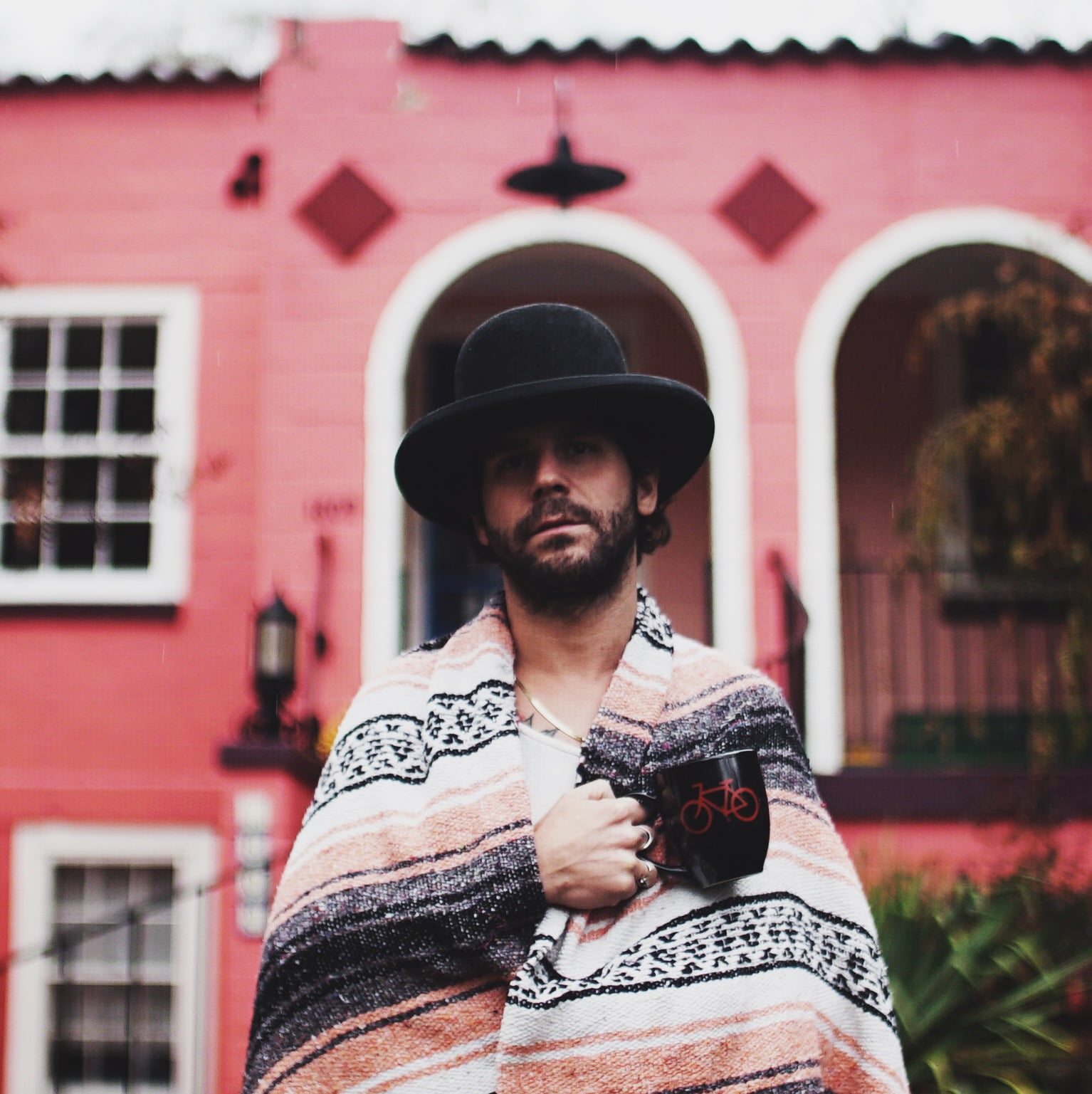
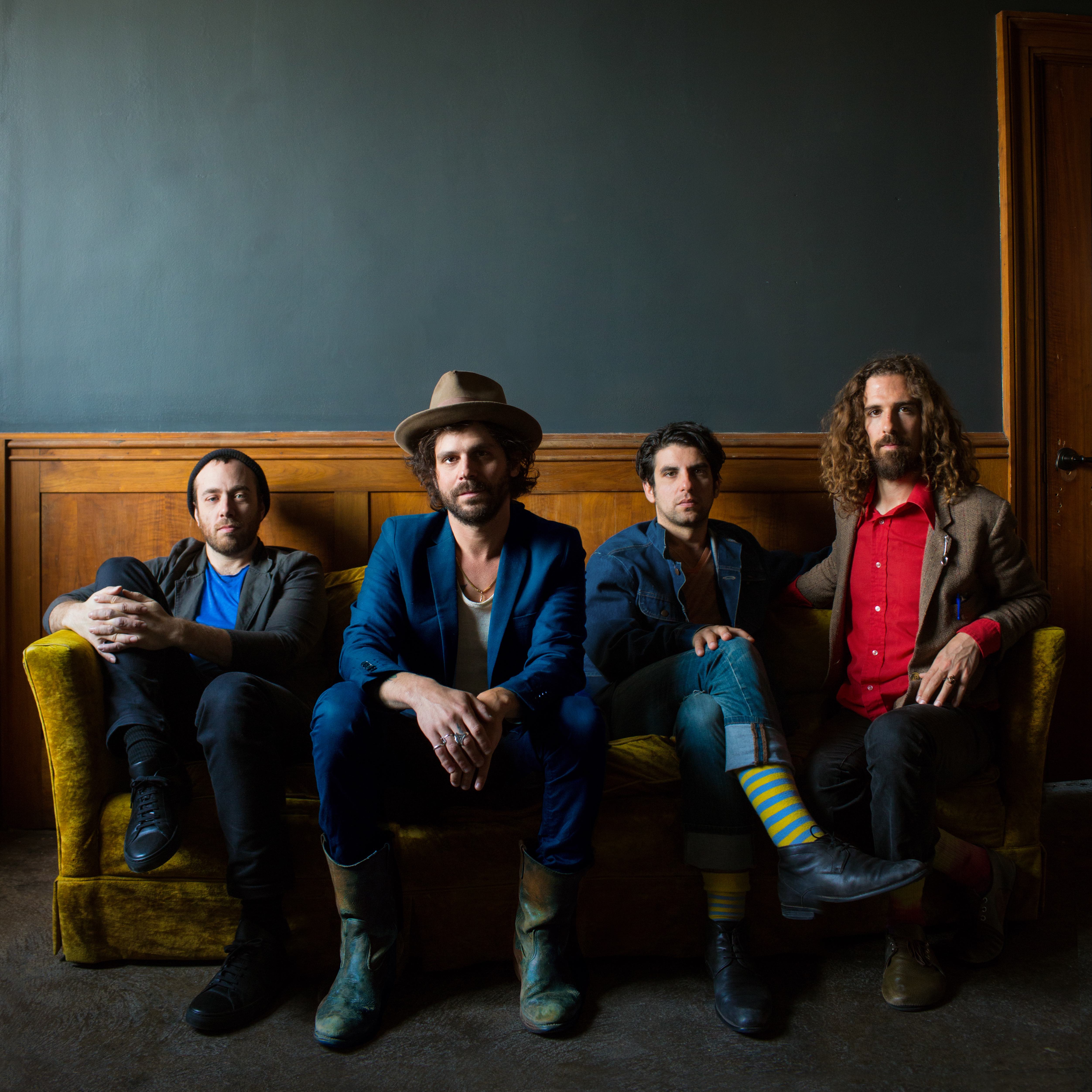
For the past 10 years, Sean Scolnick (a.k.a Langhorne Slim) has been winning loyal fans by playing and recording songs that blend the sensitivity of modern folk with the energy of modern punk. With the release of his new album, The Spirit Moves, the 35-year old Pennsylvania-born songwriter and his band The Law are poised for a breakout year. Below, BGS contributor Michael Verity and Scolnick talk the pitfalls of drug use, the artistic edge of sobriety and how to find yourself amidst the ruins of our modern malaise. Editor's note: This interview has quite a lot of adult language in it, so if you're uncomfortable with that, you should click on something else.
We share a few things in common. My brother-in-law lives in Langhorne, PA; my mother-in-law used to live in New Hope.
No way. I went to school in New Hope and did my first 18 years in Langhorne. Small world.
We’re almost like cousins.
Absolutely! Even distant brothers.
Do you get back there at all?
I do. My mother still lives in the same house where I was raised. My grandmother, Ruth, lives with her, for the last few years since my grandfather passed away. And my other grandmother is in Northeast Philly. Most of my family is still on the east coast — Pennsylvania, New York, New Jersey — and I live in Nashville so I definitely get back whenever I can.
My mom still lives in the family house; my mother-in-law lives right in downtown Philly.
Are you from that area originally?
I grew up near Ithaca, New York.
I lived in New York, in different places, for about eight years. Then I decided to leave the east coast after the first 25 years of my life. I moved to California, fell in love in Northern California, which took me to the Napa Valley area, then to Portland for a couple of years. Then found myself in Nashville for the last three years.
Nashville’s a good place to be.
Great place to be. The way my life was changing at the time, it was the perfect environment, the perfect energy. Somehow it all came together as a great home. I even bought a house there. I’m rarely there but, when I’m off the road, I do feel at home there.
There’s a lot of great musical energy there.
Absolutely. It’s a lot of people doing similar things. In different ways, of course. But when you’re in a town full of touring musicians, you all stand on a common ground, understand one another, in a base kind of way. That’s comforting and you feel supported. That’s how I’ve found it.
You’ve placed quite a few songs on TV shows and in commercials. Did you actively think about that before people starting picking up your songs?
Good Lord, no.
I’ve been making music ever since I could, writing it in my head since I was a little kid. The inspiration and impetus was simply a need to be creative. There’s music rolling around in your head and, for some reason, you’re one of the people who can hear it and needs to sing it and needs to write it. If you had asked me then how I'd feel about even entertaining something like putting my songs in commercials, I would have been against it.
But at the time, I didn’t realize how the musical universe has changed and how technology has changed and what it’s actually like to make music my livelihood. Through these commercials and films and TV shows, we can afford the band the ability to continue doing what we’re doing and promote our music to a wider audience.
Though I come from a love of punk rock music and that kind of feeling and spirituality, I’ve always been honest with myself and anyone who would listen that I very much want to be a known musician, that I want my songs to be heard. I’ve always had that kind of sickness. I’d still play music if there were just three people there but I’d prefer if there were a lot more.
Mixed into that is the fact that music has always been my own therapy, my way of getting out what I need to. If I didn’t have it, I truly believe I would spontaneously combust or melt or something fucking dangerous and terrible and bloody.
Folk music is the original do-it-yourself genre and it’s really the original iteration of the punk rock ethos. As I was listening to the record, I thought: ‘He’s really caught the energy of a do-it-yourself brand of music.’ Tell me what your goals were heading into the studio.
My goal is always to be a real, raw motherfucker, if you don’t mind me saying so. It’s not to capture the universe's or the human animal's truth but to capture my own truth, at the time and to know that I am getting as deep with it as I can. Hopefully, not in an overly intellectual or heady way but, hopefully, in the opposite way of that. I try to shut down the intellectual, because I struggle with that, and just be open to my more energetic or spiritual center and be true to that.
There had been a couple of musical things that I let out in the past that I wasn’t 100% sure of. I found that very difficult to consider while in my more introspective or insecure moments. Then I realized that, if things don’t go the way you want them to but you’re living your truth, it’s a lot easier to deal with. For the most part, I’m super confident about what I was putting out. But there were a few little things here and there and it haunted me. So, with my last record (The Way We Move), I made a vow to myself to really open up and have no more fear of the scary things; to embrace the scary shit; to expose it for myself and find strength in that. It wasn’t like I said, "Well, today, I’m going to open up myself to my fears and write a song about it" — but, as an overall kind of ethos, that’s something I embraced and found great strength in.
With this record (The Spirit Moves), my life had changed dramatically. I had left Portland, was floating around on tour, crashing on couches for almost two years. Then I found myself a single man for the first time since I was a kid. I got to Nashville — and felt really good about that — and got sober. I had been high or drunk every day for 15 years. I knew from the time I was a kid that drugs and alcohol were going to take me down if I didn’t confront them. I knew if I could confront my addictions before they took me down, I was going to step into the next phase of my life. And that phase was going to be really special because of the strength that comes with facing that creature, which is a difficult fucking creature to face and take down. Thank God I was in a position in my life where I could do that and it changed everything.
When I started performing sober and living sober two years ago this past August 20, which is also my 35th birthday, there was just a whole different light that was shining. I don’t understand energy but I believe it has everything to do with what’s going on with us and around us. If you’re able to change your own energy and perceptions, things change around you. It’s not really hocus pocus or even a religious thing; it’s my experience with life.
With that change, there was fear of whether or not I could write the record, whether I was going to be able to be who I really was, without all that stuff, just being naked, just finding myself at 33 years old. Even though I’d lived a lot of lives in those 33 years and I’d been fortunate to travel so much and meet so many people and play professionally for a long time, it was a coming home to myself. I talked to my grandfather about it before he passed away and asked: ‘When do you figure this shit out?’ And he said: ‘You never do. And probably never should.’
I had a friend who used to say: ‘It all comes clear about 20 minutes after you reach room temperature.’
That’s cool. If I stop trying to figure it out, maybe things will be a little clearer.
This article isn’t about me but I share some of the same experiences as you with drugs and alcohol. My experience is that, for some people, drugs and alcohol are just heavy energy. Some people can’t live under the weight of that heavy energy. The lucky ones are those who learn to live with a lighter energy, even though the heavy vibes are sometimes very attractive.
That’s a very cool way of putting it. I relate and connect to that. The reason I got into drugs and drinking is that it provided what I thought was a lighter energy … and it did in ways.
Of course.
But when you start depending on it to dictate your moods and your creativity, it’s very very dangerous. And that heavy energy is dark. The way I put it is: for years and years and years, it was blocking my love. Not romantic love or sexual love. My love for being here. My love for music, my love for people.
It would allow me to reach a certain level; then my head hit the ceiling. I had a band that was together, we were playing shows, we were making records, I had friends, people started to know who we are, great girlfriends and all those sort of things but breaking through that ceiling of addiction provided an amazing opportunity to move on through my life.
It’s a beautiful and terrifying thing to keep digging, to continue getting real with yourself. To write sober, to record sober, to live sober were things that were brand fucking new to me at the time. And like I said, my fear was: 'can I write?' When I was writing a song and couldn’t get it finished my thought was: "Man, a bottle of red wine, the way I always did, would be great right now. A couple of pills, that I used to love, but would hurt me more than anything."
I have a great friend who goes by the name Cracker Farm He takes all the photographs for the Avett Brothers and he’s taken photographs for me over the years. We’ll meet at the YMCA like two old men and hang out in the steam room. We'll sit in there and catch each other up. Actually it ‘s more me complaining.
He‘s been sober for many, many years and has helped me immensely. I said: "Man, I'm fucking scared I won’t be able to write, I’m scared of what’s going to happen to my creativity." He’s like: "There are some people who are just born a little insane, a little strange, and you’re one of these people. Sobriety might change the lens of how you see things but it’s not going to stop you from being creative." He’s been around me when I’ve woken up with a song in my head. He’s like: "That’s not natural. Not everybody dreams songs." Having a friend who I love and respect and trust really validated that it wasn't gone. Drugs weren't creating anything. It was just a suit I put on a long time ago to go to that party and I just took that suit off. And I found I don’t want that suit anymore. I hope I find new suits to dance in.
I’ve been sober for almost 25 years. My experience is there will never be an artist in this realm who doesn’t have a conflict between the head and the heart. It’s the head that says "you’re this or you're that." The Buddhists say you have to inhale that fear into your heart and breath back compassion. When you’re capable of doing that, you’re one step closer to being free from the conflict of head and heart.
Wow. That’s so incredibly right on. Maybe that goes back to what we were talking about regarding the inspiration for the music. Maybe I’m trying a little too hard to quiet the head — telling the head to shut the fuck up and go away — as opposed to embracing it with compassion, knowing that’s part of being human. That’s a constant battle for most people, especially for artists. I feel like we are ultra-hyper and sensitive but we’re so lucky we have the release for it. If I didn’t have music, I’d be chained to a bed some place. And I’m trying to be more compassionate with my head.
I’ve heard it said that everyone is "buddha," whether they’re pissed off or enjoying pleasure. If you’re pissed off, you’re just pissed-off buddha.
Are you Buddhist?
Since I was 18, which is longer ago than I like to consider. So, getting back to the music: I think it was The New Yorker that equated you to Leadbelly and Dylan. How does it feel to carry that around in your head? Or don’t you?
Oh, I don’t. I mean that’s very nice. They’re two of my musical idols but I don’t buy into that. Going back to the "head and the heart" thing: what sticks with me more, and always has, is the guy that’s looking at his watch during the show, the girl that’s walking out. Me thinking they don’t like it when they’re just going to take a piss or get a beer or something like that. So, The New Yorker saying that beautiful thing is something I tuck away a little bit: like, that’s cool they said that. And if someone attacks my sincerity or my integrity, then I would be so hurt by that. But I learned a couple of records ago that I had no interest in reading any of these reviews, whether they’re praising me and the music or calling it bullshit. Because I don’t want to feel a greater sense of myself because of what someone is saying in a magazine and I don’t want to feel negatively about myself because somebody doesn’t get it. I’m on a path to have a sense of who I am without needing that.
I will say that this kind of conversation I’m having with you is very new in my career of 10 or 11 years. To have a really enjoyable, what I feel is a deep and real talk with somebody as opposed to it being something you have to do because it’s part of the deal and it almost hurts, which it did for years.
This has been a lot of fun for me, too. But just for kicks I do want to talk about some of the songs on the record. I’m going to go to the end of the record and talk about “Meet Again,” because I think that’s pretty fantastic.
I’m happily surprised you picked that as one to talk about. “Meet Again” is one of the oldest song on the record. It was written about this amazing woman I spent five years with. It was written around and for the Way We Move record.
I always feel like I don’t have enough material. [Laughing] That I didn’t write the right songs, that I don’t have enough shit. Then I get freaked out toward the end, like cramming for a test or something. I'll have all this material, bits and pieces, songs that are done. I guess I’m not good at counting them all up or something. So, as it gets closer to making the record, I start to write an awful lot.
In the case of The Spirit Moves, I was flipping through old journals and notebooks and finding old tapes and listening back. And I was reminded of that song, which we did record for the last record, in a different version that didn’t make the cut. It didn’t fit cohesively with the rest of the music but it was always a song I was very fond of. When I discovered it again, I started playing it around the house and it took on a different meaning for me. At one point, it was a sad song to me but then I started finding strength in it. And it became a happy song. I’m not one to reminisce but to feel those feelings that were once heavy and confused and be at peace with them and to have the song feel that way it does today is special to me. That time with that woman was a big part of my life.
There’s a nice balance on the record between what we might call modern folk and the edgier, punkier stuff. Now it’s your turn to choose a song.
A lot of the songs on this record I worked my ass off to "get it." Some of them came easy but a lot of them didn’t come that way. There’s a song on there called "Wolves" that effortlessly dropped upon me. I felt like I said what I wanted to say and understood what the fuck I was talking about. Which doesn’t always happen.
It was inspired by the poet James Cavanaugh’s book called The Men Too Gentle to Live Amongst Wolves. I read the preface to that book and it floored me. I think there are truths already in our bones; shit that is ancient. I'm attracted to music that awakens that, that validates that spark, and lights a room in your heart or soul that you didn’t even know was there, because when it opens, it’s familiar. That’s the shit that moves me so deeply. I read the preface to this book and I felt like I was part of something. There ‘s a certain sect of freak out there that have a certain kind of soul understanding. The way he was writing about it provides a lot of comfort. It was super powerful.
I’m going to pick one more: "Put It Together," because it so different from the rest of the songs on the record. A big sweeping production piece, one of those 12/8 ballads like Phil Spector used to produce.
It's one of the most difficult, heart-wrenching tunes I've ever written. It was through the great patience and help of my very good friend and musical soul brother, Kenny Siegal, that it wound up happening.
So the story of that song is: I had a 1977 Mercury Comet — a beautiful car — and I took it to my favorite Mexican restaurant in Nashville to get some tacos, down the street from my house. I left my keys in it, as I so often did. For two years, nothing bad ever happened to that car. Then I walked out of Mas Tacos and my car had been stolen. I felt pretty shitty about it. [Laughs] I like to think one doesn’t need pain and adversity in life to create music and art but it certainly provides some help, when you do feel the feelings. I was feeling frustrated and upset. So plugged into a little Fender Champ amplifier and started to play the riff of that song , which was a lot heavier on that day, in my bedroom, through that amplifier. It kind of turned into a soul '50s kind of tune.
A year or so later, I was going to Catskill, New York, to see Kenny. I always let ideas kind of percolate and then I go see him and we work the tunes out. So we just sat there and got weird until the right lines came out. It was painful getting there but it came out. I feel like it was hard work not done in vain.
Yours is a cool record. I have a 15-year old who’s into modern folk, who writes songs. He walked into my office one day while I was working and I said: ‘You gotta check this guy out; he knows how to write a tune.’
I appreciate that, man. That means a lot. More and more we see kids and parents and grandparents all coming to our shows together. That’s the greatest shit for me, man, because I was so close to my grandparents. It’s a beautiful thing; it makes me very happy.
Photos courtesy of All Eyes Media