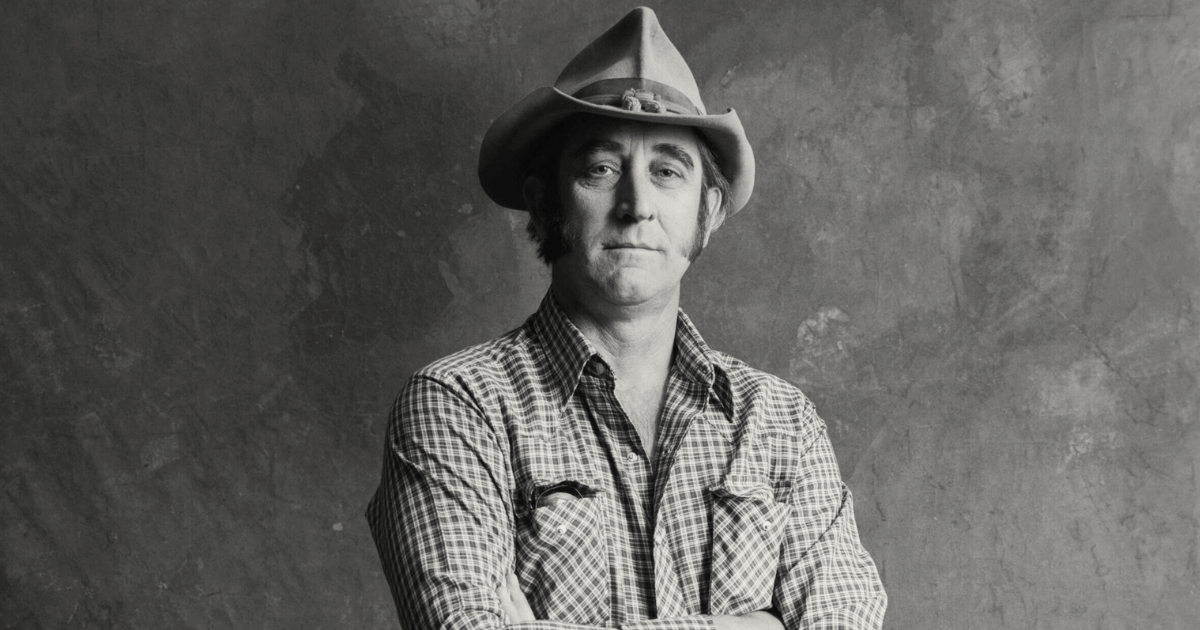
It’s the age-old dream of the music fan: To unearth old recordings from a favorite artist, laid down in their prime and never heard. And with Epilogue: The Cellar Tapes from the late Don Williams, the dream is 100 percent real.
Capturing the famed Gentle Giant of country music at his creative zenith, 12 new tracks revive one of the format’s most soothing voices, nearly a decade after his passing. Inducted into both the Country Music Hall of Fame and the Grand Ole Opry, Williams’ soft-spoken manner underpinned 17 Number Ones between 1972 and 1992, with enduring hits like “Tulsa Time,” “I Believe in You,” and “Lord, I Hope This Day Is Good” showcasing his simple style. It’s been said that country music is three chords and the truth – but Don Williams could do it with two.
After his 2017 passing, Williams’ son Tim went down to the family’s cellar and came back with a treasure trove of tapes, recorded during his dad’s creative peak. Languishing in the dark for 40+ years, they were surprisingly complete. The younger Williams was stunned.
“I was like 12 or so when these things were cut,” he says.
He then turned to the work’s original producer, Garth Fundis, and together they’ve added a remarkable new chapter to a legendary story, which fully lives up to the Williams legacy. Like a window back to a different era, the icon’s tender vocal is in fine form, while a long-gone, patient production style recalls a time in country music when quiet wisdom was a selling point, and men could share feelings directly – no clever turn of phrase necessary.
Williams and Fundis spoke with Good Country about taking the project on, the memories it brought back, and how the Don Williams legacy stacks up in 2026.
I think this story is amazing. This is some really great music that I’m glad people will get to hear. But tell me off the top, why were these songs never released?
Garth Fundis: No particular reason other than when you’re making a record, sometimes you cut more songs than you need. … You might have a song or two songs that sound kind of similar and it might get pushed aside for something else. I think that was the case in most of these. They weren’t things we didn’t like, because there’s strings on some of the [original] stuff and percussion, and those were usually the last things we put on a record.
The intention was there to probably use them, but for one reason or another, something outshined a song we were considering. I remembered all these once I heard them again and remembered working on them, and it’s not like they were bad songs. They just got set aside and then we went on to the next project.
Tim, could you tell us how you became aware of the recordings? Were they stashed somewhere hard to find?
Tim Williams: No, not at all. We have a root cellar at our house that I live in now – the same house that I grew up in – and I knew [Don] had put some stuff down there. They were the big two-inch tapes, like 16-track tapes down there, and I just basically hadn’t thought anything else about them. And I didn’t think anything about them, until recently when my dad’s manager, Robert Pratt, wanted to see what was there. He wondered what was left – what we could transfer digitally, and just see if there was anything usable and viable to release.
Your dad passed away in 2017. What did it feel like to play the tapes that first time? Songs are an intimate thing and an artist has to be vulnerable to capture them.
TW: Well, when Robert was talking to me about doing this, I was pretty lukewarm about it, to be honest. Then we got the actual multi-track rendering and opened them up in Pro Tools, when I heard the vocal tracks, I just thought “That’s just so good.” It’s just right during his primo sweet spot of where his voice was during his career [high]. At that point I was pretty determined that we should carry it to fruition.
So you were a little bit skeptical. Is that because you didn’t want to put anything out that wasn’t up to your dad’s standards?
TW: Yeah, for sure.
GF: That’s where I came from, too. I was hesitant. But Tim said, “Come on out here and hear this stuff.” I remember the songs, I remember recording them with Don. But hearing that voice again, crystal clear and in his prime, it got me hooked. I said, “Yeah, I’m in.”
That’s what’s interesting here. I think when most people hear about a project like this, they might assume these were songs that didn’t quite make the grade. But that’s not the case at all.
GF: I hope you feel that way. That’s the way we feel about it. We think other people will think that, too.
Tim, you were so young when your dad was in his prime. Did this make you see him in a different light?
TW: Well, really it just reinforced what I thought. When you’re listening to the absolute raw audio and there’s nothing between the voice and the microphone and the board, and it’s just as raw as you can get, it proves how technically good a singer he was. It might’ve bolstered that thought.
Garth, you’ve mentioned a couple times now that you remembered cutting these original tracks back in the day. What was it like to start working on them again? Do you remember that first day?
GF: It was just like hearing an old friend again. And like Tim said, just to be able to pull that vocal up and listen to it all by itself without the band and the track and everything around it. … It was really fun to hear that familiar voice and hear just how good it was. To have worked with him and to hear the quality of his voice, the simplicity of how he sang – he didn’t shout, he just kind of framed the song. He always wanted the song to be the focus and not to get above it.
How much did you actually have to change from the original recordings?
TW: The stuff that survived, we used as they were. Garth doesn’t know this. I don’t guess I might’ve shared this with you, Garth. The only thing I had to move at all to get it to lock in, was “Leaving Louisiana [in the Broad Daylight].”
Really?
TW: Yeah, we had to replace so much on that track that I did wind up quantizing that one. The only thing that survived the transfer was Daddy’s vocal and Danny Flowers’ harmonica.
GF: When I first heard what Timmy had done to the track and how the guys had worked to replace a lot of those instruments, I wasn’t involved with that part yet. But I remember thinking, “Well, this isn’t anything like the original track we got. This is so much better.”
TW: But everything else, if the bass part, piano, or whatever survived the transfer and hadn’t deteriorated from sitting in a root cellar for 40 years, we used it.
Garth, you mentioned the simplicity of the way Don sang. It’s so nice to hear that today. Plus, heartfelt country songwriting that’s not trying to be too clever or edgy. Do you think it’s good for the genre to remember that?
GF: I think so. I applaud anyone’s success and good for them. But Don was not a person who needed to shout or sing so hard that he was trying to convince you of a performance, or convince you in any way that would help the song. He came from a folk music background. So he was accustomed to just being easy. Let the song shine through. And, that you cut good enough songs you don’t have to shout. Not only did he have a gentle manner, he had a gentle manner with the microphone and I was able to put the microphone right up next to his mouth. That’s why you get this intimate feeling when you’re hearing him sing – because he’s not shouting, he’s singing.
Which one of these is the most impactful song in your point of view?
TW: Well, there are two or three. I remembered when Daddy originally cut “I’m the One.” I loved it then and I was hoping that was going to be one of the songs that was on these tapes we found. I was thrilled about that. As far as what I like, just consistently enjoy going back and listening to? Because of Daddy’s vocal, it’s “How Can I Miss What I Never Had?” I just think of everything, if you wanted to play for an alien what Don Williams sounded like, I would play that one.
GF: I’d go along with Tim on “I’m the One.” Don’s feel, what he thinks about, how he feels about music, everything about it, is in that song. And fortunately, somehow Tim didn’t really hear the original version of “I’m the One” until I showed up one day with a tape copy of how it was originally recorded. I said, “Hey, have a listen to this.” And we liked both versions so much we just had to keep both of them on the album.
How did he feel about music? What do you mean by that?
GF: I would say he always felt so strongly about trusting the song. If you’ve got to go to the trouble finding something that you can sing, and feels like it belongs in your repertoire, that was the first thing he looked for when he was searching for songs that would feel like him. It had to feel like it’s something he could say and it had to have a good melody to it, and just don’t get above your raisin’. So just take it easy and frame the song.
I did want to ask you about “Leaving Louisiana in the Broad Daylight.” That song became a Number One for The Oak Ridge Boys just after Don recorded it. It was in that same era. So Garth, do you remember why he cut that?
GF: Well, we listened to that song a bunch before we cut it and when we finally started in on it. … We had redone the vocal, I know, because there’s rapid-fire lyrics. It took him a little while to get comfortable with it. It wasn’t necessarily his style, but we put a lot into that, working on that song and then not knowing that The Oak Ridge Boys were coming out with it as a single.
Is that right?
GF: We were working on it about the same time they were finishing it. Don was on the same record company and the same booking agent that worked with The Oak Ridge Boys, and somehow we missed knowing about that. So we kind of stepped aside and just put that one away for safekeeping. Now 30, 40 years later, I’m not thinking about The Oak Ridge Boys record. Congrats to them for the Number One record, but it kind of foiled our plans at one point. Tim and the musicians built a great new track for that song. [Co-writer] Rodney [Crowell] was really tickled when I played it for him. He said, “It was even better than my version.”
Do you think there are any more songs to unearth down in that cellar?
TW: Nope, that’s it.
When this project was announced you said Don would’ve been proud of it. What would he want listeners to take away?
GF: Don always was asked that question, “What do you want people to think about your music?” I often heard him say, “I want people to feel something.” So in the way he communicated a song to the listener’s ear, I think that was first priority for him.
Tim, how about you?
TW: Well, along those same lines, everything started and was sustained throughout the whole process by the song. If it was a good song, regardless of genre, the way it was approached or whatever, a good song delivered authentically was going to be appealing to people. These are just more examples of that, and I think he would expect people to be moved by a song delivered authentically.
Photo Credit: Jim McGuire