They started playing music as farm-bred young boys growing up amid the Appalachian mountains of Southwestern Virginia, sometimes using sticks of firewood to mime picking banjo and guitar.
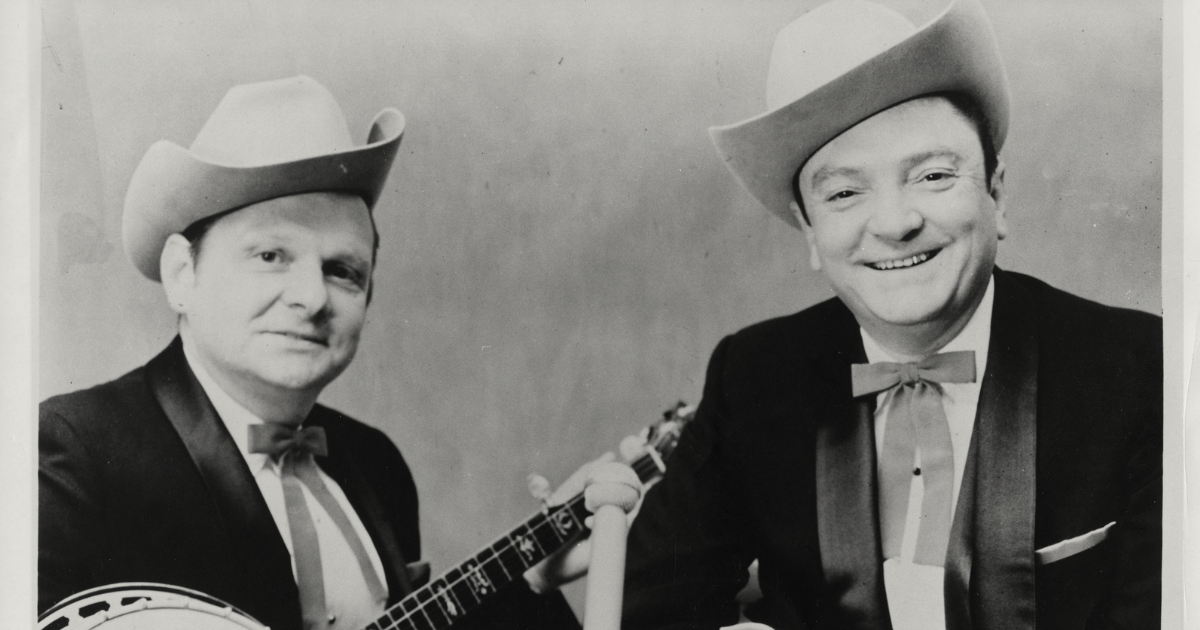
A few years later, Ralph and Carter Stanley embarked on a 20-year professional journey as the Stanley Brothers. The music they created starting in 1946 lives on, bringing them widespread fame. It survives in their hundreds of live and studio recordings, and as a deep influence heard in cover performances by artists from Bob Dylan to Billy Strings, Vince Gill to Patty Loveless, Emmylou Harris to Ricky Skaggs, Elvis Costello to Dierks Bentley.
Carter, the older brother, lead singer, and guitarist, was born in 1925 and died tragically young in 1966, ending the brothers’ career as a duo. Banjoist and tenor singer Ralph, born in 1927, lived until 2016, building a legendary career of his own.
In March 2026, the Stanley Brothers achieved the highest honor available in this field, membership in the Country Music Hall of Fame. Their formal induction in October recognizes not only their distinctive body of creative, deep-roots music, but also the strong impact they have had on performers within and outside of bluegrass.
For years, Carter Stanley’s daughter Jeanie had led legions of family and fans to press acceptance of the brothers by the Country Music Association voter pool that picks new Hall of Fame inductees. In regular social media posts, Jeanie described previous bypasses of the act as ridiculous and called upon followers to write and implore CMA insiders to honor her father and uncle.
From a bluegrass point of view, it didn’t make sense to overlook an act recognized as one of a few foundational artists of the style, along with Bill Monroe and Flatt & Scruggs, who were inducted in 1970 and 1985, respectively. But voters in the Veterans category of membership choose among acts eligible 45 years after each emerged in country music. This formula meant that the Stanley Brothers had been eligible since 1991, but also allowed more recent “veteran” stars such as Tanya Tucker to be honored in increasing numbers, with each year that passed.
For all the Stanley Brothers’ authenticity and artistic merit, they only enjoyed one Billboard chart hit, a jokey number called “How Far to Little Rock.” It says something that the Music-City-based CMA honored the brothers even though they never moved to Nashville and never joined the Grand Ole Opry during their years together. (Ralph became a member of the historic show in 2000.)
All of that aside, the Stanley Brothers’ Hall of Fame induction illustrates their increasing recognition as a cornerstone act, each year growing new legions of followers, both in America and far beyond. String-band-music phenomenon Billy Strings, who regularly performs for houses of more than 10,000 fans, features songs at each show that were first composed or brought to wide attention by Ralph and Carter Stanley. There’s no way to measure how much that exposure means.
Overall, the richness of the Stanleys’ sound and legacy means it pops up over and over again, not just in bluegrass or country settings, but also among pop acts. A story circulates that the Rolling Stones’ Keith Richards once mouthed “Stanley Brothers!” to a bandmate to illustrate the mournful backup sound he wanted for a performance.
In more formal recognition, the Library of Congress added the brothers’ rendition of the Albert Brumley composition “Rank Stranger” in 2008 to the prestigious National Recording Registry, an annual listing that “highlights the richness of the nation’s audio legacy.”
Elsewhere, “The brothers rose to fame performing traditional religious songs in an Appalachian bluegrass style marked by tight, high-pitched harmonies and strongly influenced by Bill Monroe,” their Encyclopedia Britannica entry reads in part.
Why include this Britannica language, even though it overemphasizes their gospel orientation? The Stanley Brothers’ acknowledgement in a top-rank information source shows the distance the brothers covered during their million-mile journey from a tough childhood, through countless challenges, to creative triumphs that have kept creating new fans in recent years.
Down Home
Born in rural Dickenson County, Virginia, the boys were raised by banjo-picking mother Lucy and ballad-singing father Lee Stanley among mountainside farms and busy lumber camps, living in an atmosphere of homegrown food, spring-drawn water, and lamplit rooms through their early years. Church music, sung unaccompanied in the traditional style, became a mainstay of the brothers’ own music, along with Celtic-derived story songs, neighbors’ country-string music, and eventually the commercial country music heard on a battery-powered radio. The music they learned emerged as what’s now called “pre-bluegrass” until Ralph and Carter first heard the riveting sounds of Bill Monroe and Earl Scruggs on WSM’s Grand Ole Opry.
Starting out on country radio stations such as Bristol’s legendary WCYB, the Stanley Brothers recorded their early sounds for the busy regional label Rich-R-Tone, then graduated to major labels Columbia and Mercury before winding up on Starday and King, as well as a handful of smaller outlets.
Many standards of bluegrass and country music, such as “I’m a Man of Constant Sorrow,” “The White Dove,” “Rank Stranger,” “How Mountain Girls Can Love,” “Pretty Polly,” “Harbor of Love,” “Angel Band,” and “Could You Love Me One More Time,” were written or adapted by Carter and Ralph Stanley.
Both brothers wrote songs, but it is Carter who has been recognized as perhaps the most gifted songwriter in the style. It wasn’t until the folk revival and the later country traditionalist movement that Stanley Brothers songs commonly reappeared in versions by other artists.
Covers by the Hundreds
Carter Stanley had co-written songs with bluegrass founder Monroe, and pitched his song “Going to the Races” in 1957 to the recently formed Washington, D.C.-based act the Country Gentlemen. The Gents’ recording of this song, released by the Stanleys in 1958 as “Gonna Paint the Town,” represented an early example of what would become hundreds of the brothers’ songs reflected in other artists’ recordings.
Bob Dylan’s 1962 release of “I’m a Man of Constant Sorrow” hasn’t been definitively linked to the Stanley Brothers, but decades of the folk legend’s work have reflected their influence. He’s performed a batch of Stanley-connected tunes – including “Hallelujah I’m Ready” and “Searching for a Soldier’s Grave” during his endless touring years. Dylan recorded “Rank Strangers” and “Driftin’ Too Far From the Shore” as solos, and “The Lonesome River” in a 1998 duet with Ralph.
Brotherly innovation, including the skyscraping “high-baritone” harmony, influenced members of the West Coast bluegrass scene going back to the 1960s, Byrds founding member Chris Hillman once said in an interview. The striking harmonies produced by Carter and Ralph likely played a role in the two-part sound the Byrds came up with when recording their first hit, Dylan’s “Mr. Tambourine Man,” he said.
The influential Johnson Mountain Boys from the Washington, D.C., area helped move bluegrass back to its roots from a newgrassy direction in the early 1980s, serving up such Stanleys classics as “I Don’t Want Your Rambling Letters,” “Harbor of Love,” and “Our Last Goodbye.”
Elvis Costello, an artist who shook pop music in the 1970s, has been best known for hard-hitting, sometimes abrasive New Wave pop and rock. In a 2015 interview with New York Times writer A.O. Scott, Costello remembered early days embracing all sorts of country music: “From the ’70s through the mid-’80s, I absorbed all the American music, not just country music like Nashville country music or Bakersfield country music, but older, more traditional styles, even the Stanley Brothers and that stuff.”
Jammin’ Stanley-style
Before Billy Strings arose, a swath of bluegrass artists brought awareness of the Stanley Brothers to new generations of fans through cover renditions. The Grateful Dead, especially co-founder Jerry Garcia, cited the Stanleys as an inspirational source, adding fuel to the jam-band movement that in recent years has brought giant crowds to bluegrass.
Del McCoury, also a Stanleys believer, draws mighty crowds to his festival, DelFest, where mashups of straight bluegrass and Dead-driven improvisational bands are common. Bluesy Larry Sparks, a onetime member of the Stanleys’ Clinch Mountain Boys band, cooks up his own mix of gospel, country and ‘grass, also citing the brothers’ influence on any music he produces.
Fellow Country Music Hall of Fame members Emmylou Harris, Ricky Skaggs and Keith Whitley also served as key testifiers to the greatness of Ralph and Carter Stanley.
Disciples since their youth, Skaggs and Whitley were overheard by Ralph Stanley in 1970 singing note-for-note recreations of the duets of Ralph and Carter. Ralph was an hour late to his own gig, due to a flat tire; when he arrived, he initially thought the venue was playing a Stanley Brothers recording. Still in their teens, they would go on to tour, record and release music with Ralph Stanley as members of the Clinch Mountain Boys.
After a starry career as a bluegrass sideman, Skaggs had early hits as a solo country artist that included versions of the brothers’ “I’ll Take the Blame” and “Could You Love Me One More Time.” His 1997 roots-return CD, Bluegrass Rules, a Grammy winner, included a large helping of Stanleys numbers, including “Think of What You’ve Done” and “Midnight Train.” In concert appearances years before the Stanley Brothers’ Hall of Fame induction, Skaggs paid tribute to the act and talked about how richly they deserved the honor.
Emmylou Harris, Skaggs’s onetime employer in her Hot Band, also helped advance the Stanleys’ legend through her recording of their songs. Her dedication to country and bluegrass produced cuts of “The Darkest Hour is Just Before Dawn” and “Who Will Sing for Me.” Harris even took part in a gospel album and act called “Angel Band” along with Vince Gill, Emory Gordy Jr., and Carl Jackson. And Harris and Skaggs joined voices on the Stanleys’ “Could You Love Me (One More Time),” on Skaggs’s first solo album in 1979.
Why the Stanleys?
There’s more to the long reach of the Stanley Brothers even than the captivating sounds of the brothers’ voices, the hard-hitting stories of their songs, and the driving rhythm of their instrumentals. Fans sum it up as authenticity.
When country music veered into steel-driven honky-tonk and later the smoothness of the Nashville sound, the Stanley Brothers stuck mostly to the music they’d come up with in their early days. Oh, there was the steel guitar of “If That’s the Way You Feel,” the Elvis-esque sounds of “Blue Moon of Kentucky,” and the R&B side-trip of “Finger Poppin’ Time,” but Ralph and Carter stayed almost entirely acoustic, always leaning on their hardcore mountain sound, true to their rural roots.
This quality of authenticity touched countless musicians and fans on first hearing. Patty Loveless shared an IBMA Award with Ralph Stanley for their recording of “Pretty Polly” on the all-star Clinch Mountain Country album and even helped inducted him into the Grand Ole Opry at the Ryman Auditorium in January 2000. Released later that year, the inclusion of “I Am a Man of Constant Sorrow” (newly recorded by the Foggy Bottom Boys) and the a cappella rendition of “O Death” by Ralph Stanley were highlights on the multi-million-selling soundtrack to O Brother, Where Art Thou?, bringing new attention to their style of roots music.
For a California punk musician named Gillian Welch, one Stanley Brothers cassette was all it took for her to find “her music.” In 2018, Americana star Welch and partner David Rawlings were among the performers at an evening tribute to Ralph and the Stanley Brothers at the Country Music Hall of Fame and Museum, with country star Dierks Bentley as host. The event was a celebration of a Ralph Stanley exhibition opening at the museum.
That night, Bentley brought on the Traveling McCourys, the act starring Del’s boys and other musicians, as well as the Black Keys’ Dan Auerbach. Others on the show included Ralph Stanley’s son, known as Ralph II, bluegrass duo the Gibson Brothers, and the hot-picking Justin Moses and Sierra Hull.
The evening of music from a diverse group of performers shone with songs such as “I’ll Just Go Away,” “Could You Love Me One More Time,” “How Mountain Girls Can Love,” and the first Stanleys hit, “Little Glass of Wine.” It reflected a theme universal to myriads of musicians and fans, that the Stanley Brothers’ music hits so hard and so deep that it has served as a foundation for followers going back generations.
“Some of the first songs I ever saw played on a guitar were Stanley Brothers songs,” Auerbach said, according to Rolling Stone.
Closer to the present and into the future, Compass Records this year announced an all-star tribute album marking the 80th anniversary of the Stanley Brothers’ debut as a performing act in 1946. Last year, the label gave a hint of the disc’s content with a single release of “Ralph’s Banjo Special” featuring Kristin Scott Benson, Gena Britt, and Alison Brown.
Through the years, fans have treasured the forthright values of the Stanley Brothers and admired the ways they combined the traditional music they loved with creative new ways of addressing those sounds. Sad to say, the Stanley Brothers endured some hard times just to play the music they had fashioned, instead of changing their sound to follow the whims of music-business fashion. Carter once addressed their steadfast point of view with a note in a publication written to be mailed to their fans.
“For the past few years, we have tried to bring to you country people the kind of entertainment you enjoy,” Carter wrote. “In doing this we have been criticized by some for not being more modern. Since we were raised with this old-time music as part of our background, we have never had and still do not feel any desire to change our way of playing.”
Sticking to their guns remained the Stanley Brothers’ trademark through their two decades of touring, performing, and recording together. Some 60 years after Carter’s death ended those years, the Stanley Brothers’ legacy has paid off for them with membership in the Country Music Hall of Fame among country music’s most highly esteemed acts.
Photo courtesy of the Country Music Hall of Fame ® and Museum.