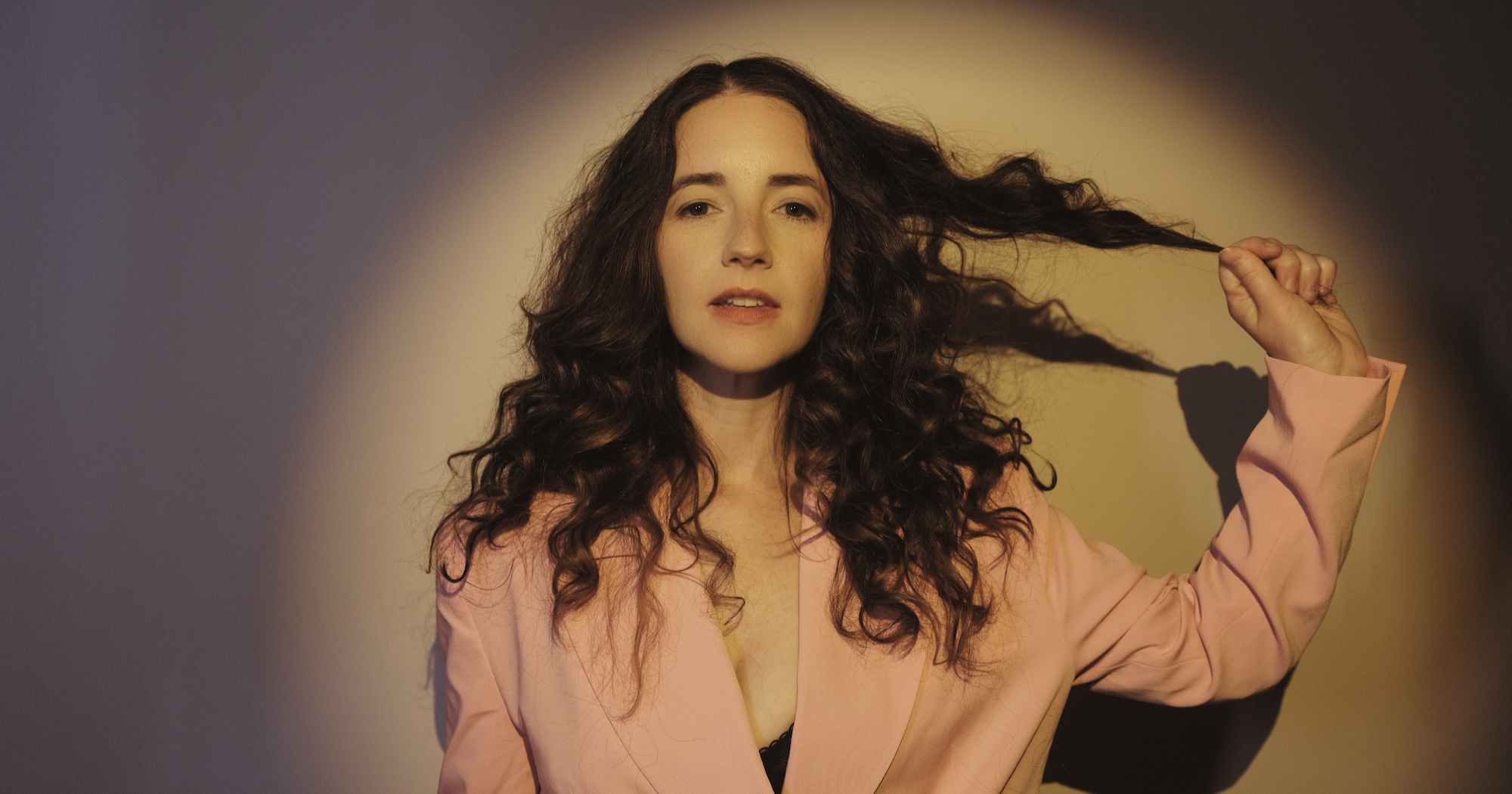

Michaela Anne’s life underwent a cosmic shift over the last several years. She had two kids and quickly learned how “physically taxing” parenting can be, she says. That physical transformation directly feeds into her latest album, These Are The Days, a creatively bold, poetic, and profound set of songs about getting older, fading beauty, and music’s connective tissue.
While out on tour, years ago, Anne stopped by a friend’s house and witnessed several young kids playing, laughing, and making a whole lotta noise. Admittedly, she didn’t know if she’d ever have kids herself. “My friend said to me, ‘Yeah, but this is going to feel like a high for you, like falling in love with these children,’” she recalls.
“I remember the first year of being a mother, texting her, ‘Oh, I know what you’re talking about now.’ And that has really surprised me, that exhilarated feeling that I’ve gotten just from the experience of having children and getting older,” Anne reflects. “What has also surprised me is that you hear people talk about it all the time, how, especially in your 40s – I just turned 40 – you don’t give any fucks anymore. And it’s just whatever. And I’m like, ‘Does that just magically happen?’
“And I have been surprised to feel the progression of ‘it does.’ You start to care less because you just get so exhausted from the energy you’ve spent caring about the things that mattered a lot [before], like status, what people thought of you, or inclusion. That has been very delightfully surprising and freeing.”
These Are the Days swirls with a kind of knowledge you only acquire when you hit your 40s. The changes it reckons with have almost a baptismal effect. Songs like “We’ve Got Bigger Plans” and “Will You Still Love Me with a Broken Heart” reflect her ever-changing self, whereas “Two Pianos,” a song co-written by Caroline Spence, and “B-Sides” capture the magic of music in Anne’s life. “If Your Body Fails You” finds Anne bottling up both her mother’s deterioration post-stroke and our society’s obsession with youth.
The album, produced by her husband Aaron Shafer-Haiss, emerges as a timeless ode to the ephemeral nature of human existence. Letting go, relishing the mundane in busy everyday life, and embracing middle age echo throughout the nine tracks like a starling bobbing and weaving across a rosy sunset. Something is calming about it, and you trust that you’ll get to where you’re going soon enough.
What has been your journey of learning to let go?
Michaela Anne: It is continual. It’s such a common thing to hear people say – and this is kind of woo-woo new age-y saying – “just surrender.” But the actual practice of surrendering to all that is, I have found, incredibly challenging and essential to really being open to what life presents to us. I’m a millennial, and I feel like the way that we grew up is, “Dream big, you can be anything you want.” That was so ingrained in me. I have a song from a previous record called “By Our Design.” It was this whole thing about writing it down, manifesting it, and making it happen. And it didn’t take into account that nothing is actually within our control.
So things happen, like global pandemics or your mother has a stroke. [Or] friends that I witnessed in this age group who want to start a family desperately and can’t get pregnant or deal with pregnancy loss. There are so many things that we cannot control that determine a lot of factors in our lives, and a lot of things about whether or not we can have the life that we envisioned. And accepting it is a daily practice, and really keeping my eyes open to what all that is here, rather than continually looking in my mind to the places I thought it should be, is painful.
There’s also the element of not caring what other people think. I imagine that’s even more difficult as an artist.
I try to consciously reconnect to why I make music all the time. Inevitably, there is an element of wanting to be seen when you’re sharing art that you make and wanting to be loved, wanting to be received and affirmed. And that is beautiful, but it can also be really tricky and detrimental. If we’re looking at it in this transactional way, or also career success– I’m also a military kid. I grew up moving every other year. I was socially conditioned to try and make friends fast and be well-liked, and just fit in and survive the next couple of years before we moved on to the next town. I have to constantly remind myself: it is okay to not be liked by everybody. But I always go back to, “Am I doing my best to show up in kindness and in love and openness?” And you still might not be liked by everybody.
Social media certainly doesn’t help either.
No, it’s corrupting our brains. Now, we have this false sense of metrics to measure ourselves that we translate to our worth. How many likes we get, how many followers, how many streams, and it’s really unhealthy.
Have you ever found that affecting your creativity in any way? Have you ever thought, “Oh, this song has this many streams, maybe if I write something like that, it’ll take off?”
I think I would be lying if I tried to say, “Oh no, it’s separate.” I’ve found that whenever I do try to make something, I don’t actually know what people want from me. And what one person wants from me is different from what the next person wants. Collectively or culturally or music industry-wise, that’s changing so fast all the time that it’s fruitless to try to morph myself into that. I’ve definitely gone outside of the box that I think I was seeing, fitting into, and not seeing the response that I hoped for and have had to do the work of, “Well, that’s okay.”
We can confuse streaming numbers with a measurement of artistic purity. They’re very different things. I always go back to, “Did that feel true to me?” I can only write the songs that feel true that come out. Sometimes that’s well received, and sometimes it’s not. It’s always a gamble.
Another essential piece of the album is enjoying the mundane things in everyday life. What things have you come to appreciate more?
Routine. I used to think I hated routine. I loved being on tour all the time, because there was sort of chaos within a routine. You knew where you had to be every day, but then every show is different and every place was different. I’ve really come to love the routine of waking up around the same time–I have two children, depending on when they wake up. I have a morning routine, that first cup of coffee, just all of that stuff has become really enchanting to me.
When you’re addicted to something, you need more and more to feel the high. I used to need a lot to feel excitement. It’s almost like I’ve come down to stasis, where now, to be totally honest, I sometimes open my compost bin and it’s all these different colors. I think it’s so beautiful. [Laughs]
I don’t go out and get drunk and meet new people all the time. It’s a different high. It’s the calm. Now, bouts of excitement are way more exhausting to me than they used to be. Maybe that’s also just middle age. Kids being asleep, getting a couple of hours to myself or a cup of tea and maybe a bath and a book – that is so exciting.
The wonder of music also comes into play on the album, such as with songs such as “Two Pianos” and “B-Sides.” What moments in your life do you cherish most around music?
Music has always been my companion, my way to cope and understand things. The very first song I ever wrote was called “When Daddy Comes Home.” My dad was a submarine captain and he was out to sea for long months at a time. I always say music was my way of processing longing and sorrow. But it is such a companion for joy. I think about every big moment of my life, there’s a soundtrack, you know? Getting married, there are songs that were part of our wedding. Giving birth, there are specific songs that were the soundtrack that we were playing when both of my children entered this world.
Music is everywhere in our lives. Sometimes, I think when it becomes a career, it can taint it a little bit. I have had to remember this is a relationship on my own that doesn’t need to be influenced by outside forces. Some of the bigger moments are those when we put on songs and just dance in the living room with our kids.
Another thread in the album is the idea that beauty always fades. In your song “If Your Body Fails You” you ask a series of questions about why we avoid the mirror and continue to uphold youth on a pedestal. Why do we do those things?
Capitalism. That song is rooted in watching my mom lose many physical abilities from her stroke. As well as the way that her body looked changing and witnessing her experience that, grappling with my own experience and my own relationship to my mother’s body. It was not something I really thought about. While also experiencing so many changes in my own body, growing a human for the first time. And that paired with this idea that it feels like it’s getting to a fever pitch of this expectation, especially for women, to look preserved, to look frozen, to look so smooth, and not aged at all. And noticing that infiltrates my mindset.
I don’t know why we are obsessed with that, literally, other than powerful marketing campaigns have convinced us to spend a lot of our money trying to freeze our faces and our bodies. But it’s something that I really want to resist, which genuinely feels challenging sometimes, because of those messages.
Numerous celebrities, from Kate Winslet and Meryl Streep to Barbra Streisand, have opposed plastic surgery for just that reason: to resist body standards. Hopefully, that leads to a cultural change eventually.
I hope so. It’s really helpful when public people put that out there in a really positive way, so that we don’t think, “Oh, this unrealistic expectation is what we all need to do.” When I see people owning it, it inspires me and builds my courage to also own it in the same way. When I see women rocking gray hair in their 40s, I’m like, “Okay, I’m going to skip my next hair appointment.” [Laughs] I don’t want to dye my hair.
“Two Pianos” is lyrically hopeful but musically somber. That’s an interesting dichotomy.
The strings were written, arranged, and performed by Kristen Weber, who’s one of my really close friends and has done strings on almost all my records since 2019. I wrote the song with Caroline Spence, who is also a very good friend. Both of those women have been really intimately witnessing my life over the last several years – and vice versa. Some days it’s really hard to recognize all that we have. And I’m going to be honest, sometimes I compare. Sometimes I feel really sad. For what reason, I’m not sure.
But how do I sit in gratitude and keep this kind of, you know, remember to remember – how we say in the song. I actually got it from Chris Wood from the Wood Brothers. He said that in a podcast that I host with my husband. We were talking about all the things in life and how to stay healthy. He said, “Some days, we just need to remember to remember.” Musically, we wanted it to feel expansive, but also be an intimate experience of being really close at your kitchen table, but how universal that experience is for everybody.
The lyric “I never trust my own point of view” stands out. To both remember that you can be an unreliable narrator and to trust your gut.
At least in my experience, my mind can play tricks on me. It can tell me stories that maybe aren’t actually true. Sometimes, it’s good to be distrustful of my own point of view and try to get grounded in what’s reality. Other times, it’s dangerous to ignore my point of view, but that continual challenge and journey to know who I am. And it’s really hard to ground our individual selves in this world.
Other than music, how do you ground yourself?
I have to move my body. Every morning, I work out for a short amount of time, like 15 minutes. Since having a second child, it’s something my husband and I support each other [in]. Every morning, we take turns while the other person is doing breakfast and packing lunches. Fifteen minutes to do yoga, or a little dance video, or go on a run. That stuff is really essential. My ideal would be to be able to meditate and go on hikes more often. Nature really grounds me. But it’s really hard to find the time. And therapy.
“We’ve Got Bigger Plans” reminds me of the saying that “when you know better, be better.” Whether that’s with social issues or in our relationships with others, it’s about actually learning from the past.
That song is very personal, about my experience [over] the last several years of becoming a mother and having a lot of dreams. The first verse opens up with, “I used to be a dreamer who would dream things you couldn’t see.” I stopped believing, and my husband, partner, the producer of my record, Aaron Shafer-Haiss, was the one who was like, “Life is not over. What are you doing?” We can still have so much beauty and opportunity. We can always make art.
The inspiration for the second verse comes from our daughter, and how mystical and magical it was to witness this little child coming to life, and greeting the moon and stars at night. The kind of ritual of seeing the world really opened up my eyes and my heart in a new way. It’s about not getting pulled into unhelpful, unhealthy belief systems and trying to fill your cup where it doesn’t need to be filled. Looking beyond some of these little things that we can get tripped up on and knowing that we’ve got a bigger view.
What’s it been like adding a podcast to your professional life?
It has been so enriching. It is challenging, like balancing the time. But the conversations that we get to have, and the caliber of artists that we get to meet, it feels like such a gift. And I’m constantly like, “This is so cool that we get to do this and that we get to talk to people who create things that mean so much to other people and us.” Then, really get to dig in on what the human experience of it is. And it’s a great source of comfort to me to know that people I admire have a lot of the same anxieties and hopes and fears. And it just reminds us that we are just human beings.
Photo courtesy of the artist.