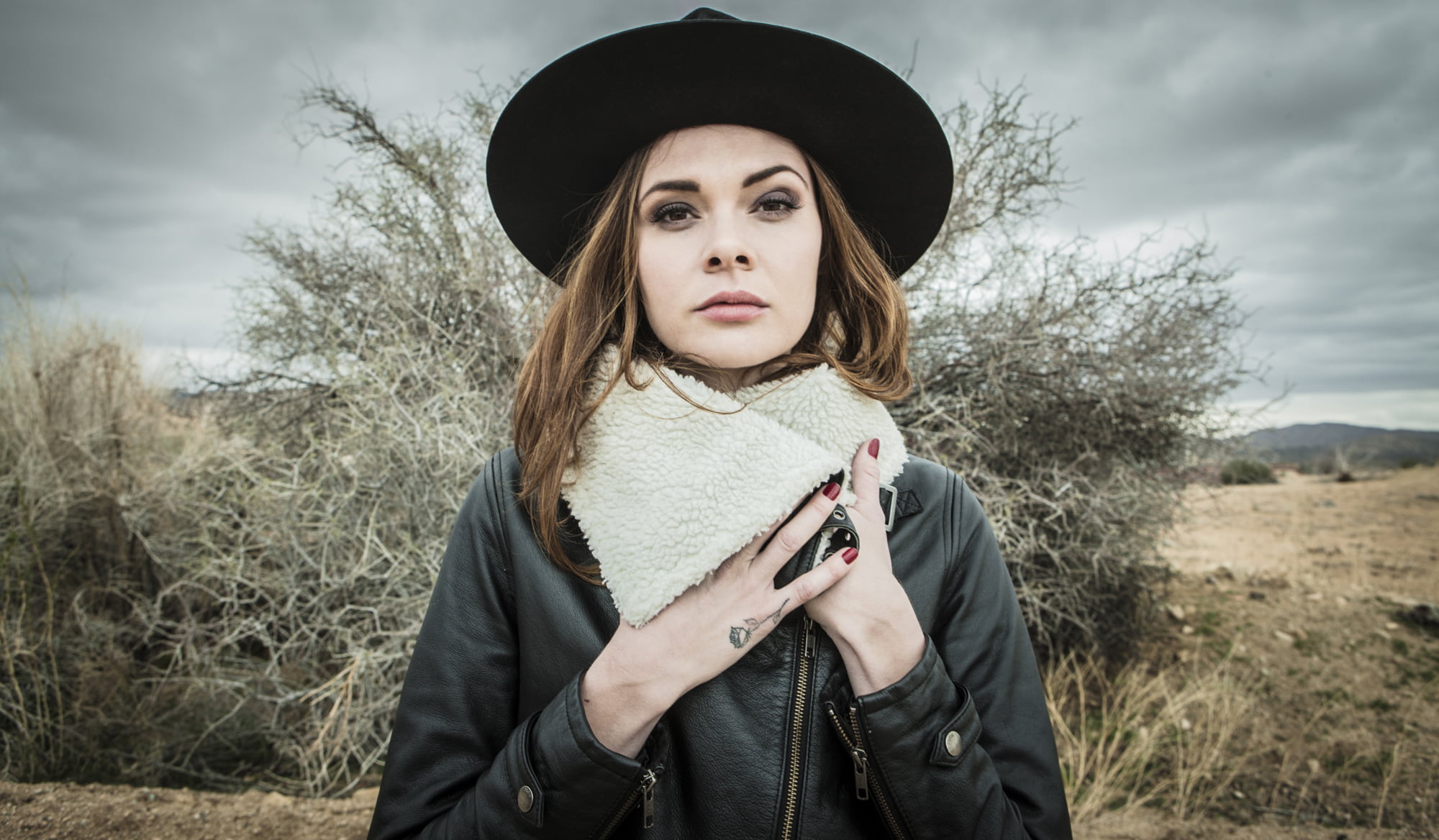
Articulating desire can be a fraught act, especially for women. In many ways, the patriarchal mindset still undergirding society isn’t comfortable with women wanting things, let alone sharing what those things might be. Speaking about desire, therefore, denotes a kind of rebellion. Suzanne Santo, one half of the harmony-drenched duo HoneyHoney, sets loose her desires — all her longings, cravings, and lusts — on her debut solo album, Ruby Red. Named after Butch Walker’s studio where she recorded it, Ruby Red sees desire flicker up like a fire lapping at the atmosphere’s oxygen and growing bolder with each inhale.
The album’s first track, “Handshake,” is a raw, sensual reckoning that blurs the lines between want and need after a relationship ends. “I ain’t your friend, babe. I don’t want a handshake. I need a piece, I need a taste,” she sings, her voice practically quavering for her lover, who wants to shift their label. Santo isn’t prepared to fake it. She doesn’t want to be friends. “Don’t water down my whiskey, babe,” she crows, her voice full of a mettle that gives these declarations an intoxicating power. This is not a shy record.
Ruby Red runs electric with crackling confessions: about who Santo is, who she wants to be, and the many way she’s failed both those identities. But she continually bores beneath the surface, looking for answers that might offer some form of understanding in one song or a greater sense of empowerment in another. After 10 years with HoneyHoney and partner Benjamin Jaffe — both in the studio and out — by her side, Santo is shaking off any preconceptions and laying bare her desires.
What was it you set out to learn outside HoneyHoney?
It wasn’t so much setting out to learn — though I learned a lot — but we were just tired. We love each other a lot and, if you spend that much time with anybody, you start to not appreciate it anymore. The past year, we haven’t toured hardly at all, but we’ve had some great flat-out dates, and every time we’ve played together, it has been so much fun. That’s sort of what we set out to do — an absence makes the heart grow fonder kind of thing.
But at the same time, when I was in the studio without Ben, I was blown away by what I was capable of. We both played these roles in the band for a really long time, and you get used to a certain gear; then you take the other element out of the equation, and it was amazing. I never thought I could do arrangements. I never thought I could produce as much as I did (with Butch). Butch and I worked together a lot; he’s such a safe place to try stuff. This was such a bonus to have all those things revealed to me. I’m really interested in engineering now and working on my own stuff in that way because I never thought I could do that. I don’t want to approach this from a feminist standpoint, but I’d be remiss if I didn’t say I’m usually the only woman in the studio. I don’t want to do things “just because,” but I did have that reignited sense, like, “Oh, wow, I can do this.” I found my boner for it. It’s super scary because it’s like learning a new language.
If you only ever remain in your comfort zone, you never learn what you’re truly capable of.
That’s kind of where I feel the whole world is at right now. Even though some of it is really scary, it’s par for the course of real change that needs to happen. This is when the most extraordinary things happen, and I hope people will continue to evolve toward the happier, more positive things rather than all this shit.
Hopefully! Whether or not it comes to fruition, I don’t know. But hopefully.
I have to tell you something really funny: I have this one friend who really started throwing himself into the brick wall of politics by writing diatribes. Yes, it’s good to be informed, but the vehemence of his blogs … But in the interim of his meltdown, his girlfriend thought it was a good idea to foster a litter of kittens. There’d be these heinous posts and these adorable photos of kittens.
So, he’s basically running Twitter.
Yes, totally. I had to tell you that because I think it’s amazing.
There are definitely people who are angry at what they’re seeing, but they’re not channeling it properly into action. It’s just more verbiage we need to parse through. So, yeah, we could all use more kittens.
What’s even funnier … he’s a very talented engineer and, when I got my test pressing for my vinyl a couple weeks ago, I went to his house. What was so great is that I got to sit and listen to my record surrounded by kittens. I had three in my lap. It was one of the greatest days of my life.
What a contrast between what you’re singing and what you’re experiencing with the kittens.
Oh, it was not lost on me. It was hilarious.
Actually, so speaking about your friend’s writing … I’m interested in your relationship with words. In “Best Out of Me,” you talk about words as shrapnel. And you also mention you’re unloading your gun in “Bullets,” which I took to be you being quiet and not using words in such an aggressive way. How are you thinking of your own writing and its power and its impact, especially in this day and age?
I, too, have anger, but I internalize it a little bit more, and I usually make war on myself. That’s something I struggle with and work really hard to get through. The overall recurrent theme of this record is accountability and recognizing these things, and being okay being wrong, and making sure I know where the source is coming from. “The Wrong Man” is really important to me because, much like the political word vomit that comes out, a lot of time, you’re shooting the wrong man. It’s really easy to be angry about this one thing, but in general, there are other things going on that we all need to figure out. We have to be accountable, we have to be able to recognize our own shortcomings, to say “I’m sorry” and mean it. “Bullets,” especially, is about letting it go.
In some of the songs you’ve done as HoneyHoney, that nuance gets played out in really compelling ways. You’re never willing to lay blame on someone; it’s always about culpability. I’m thinking of “Yours to Bear” off 3. I can see how this theme is playing out in Ruby Red. How, then, are you pushing it even further now that you’re writing more on your own?
I’ve never been drawn to “fuck you” music. Don’t get me wrong: I love Rage Against the Machine, but that’s a different kind of songwriting. I have a lot of really great friends, and I’ve been through some traumatic stuff in my life and have had to go into some serious therapy to reconcile some really difficult stuff. I’ve never been drawn to victimizing myself, or it’s really hard for me to connect with someone whose definition is what’s happened to them. At the same time, what’s happened to you molds who you are. It’s your relationship to it. I heard this quote once when I was really grieving, and it was so hard, but it’s so true: “Suffering is an invitation for wisdom.” But it’s only an invitation. It’s not like, once you start suffering, you have this gateway of knowledge. You have to sit with that shit and clean it off and understand it; it usually comes back when you don’t expect it to. I think, if I didn’t play music, I would want to be a therapist or always working with people in a psychiatric way.
You seem really interested in sorting things out, digging beneath surfaces.
Yeah, and giving everybody the benefit of the doubt, too. I don’t push my therapy on other people. I don’t push my specific journey. I see that a lot, where people are like, “Oh my God, I know exactly how you feel. I’ve been through that, too.” I think that’s a really insensitive thing to say to somebody because you never know how someone is feeling. Know that you can talk and be a comfort — it’s welcomed — but everybody’s got a different suitcase.
Absolutely. And navigating an artistic career that can take you away from a sense of stability means that you’re more reliant on yourself.
Right now, I’m kind of going through some loneliness. Ben and I are still partners in HoneyHoney and we still have HoneyHoney stuff, but there’s definitely this lone wolf thing. I still have really good friends, but you have to go through your stuff on your own. I’ve also lost some friends. When you get older and people change, that’s been really hard. I don’t have a crew. I think that loneliness gets enhanced the more I’m gone. It’s up to me to make sure I maintain contact with people, which I have no pride about. That’s totally fine. I have that loneliness to contend with, but it doesn’t sink my ship.
It’s definitely a space to figure out as you get into your 30s when friends are making different life choices. If you’re going to walk a different path, you have to be comfortable with who you are.
You know, Ben and I were together romantically, and it was so hard. We got to a point where we had to make this separation — I haven’t told anybody this, but I think it’s probably a little obvious — and we needed to heal. We still talk all the time, and we have business decisions to make, and if he needs me, I am there, and if I need him, he is there. But there’s still this parting of ways that we’re consciously doing to have a healthier life. Being in my 30s, there’s a lot of rebuilding happening in order to facilitate that empty space. What’s really cool is, we love the band, and we want the band to continue making records, but we’re not ready for that yet. Don’t get me wrong: There’s no ill will. To become privy to how beautiful of a separation it is, and that people can do it, I feel so lucky that that’s what I have.
And also the space that it’s opened up for you to get to know yourself again and find new creative fulfillments.
It’s great and, like I said, whenever we get together we’re making the best music we ever made. We’re not buried in it anymore, now it’s a choice. That’s how it started, originally. Like a lot of things in life, if you get too much of something, it gets overwhelming.
So true. Well, women are still criticized for expressing their desires and, to me, you so perfectly slap that in the face, especially that line in “Handshake” about “Don’t water down my whiskey, babe.” How long did it take you to find that strength and wear it so proudly?
Wow, thank you. I’ll be honest, when I wrote it and recorded it, I had a real freak out afterward. I was like, “This is so raw. This is so revealing. There’s sex in here. There’s drugs.” I had to sit with it for a minute and find my courage, I guess. I sent it to my parents, and I got a voicemail from my dad. He started crying at some point — I still have it — and he said, “Just got done listening to your filthy, raunchy, beautiful, incredible record. I’m so proud of you.” He told me, “You’re so brave, and please don’t stop telling stories.” For my dad to be, like, “It’s okay. You’re human.” I feel comfortable having these stories as a reflection of myself, but it’s also a piece of art. That is empowering because I think sometimes people have a hard time separating the actor, but they’re a different person in real life. I think music is similar to that, in a way, but I feel really comfortable now. But definitely, at first, I shocked myself. Like, “Oh, shit. Okay, this is very sexy.”
That is the perfect word for it.
I want to write happy songs, but they just keep coming out like this! I think that’s a real anthem for most of my life: authentic. Any of the fabrications or subterfuge that’s created, it never feels right, and even if it’s hard to accept the truth or it’s not as romantic, I’d so much rather have that than some watered down version or something that’s not real.
Photo credit: Marina Chavez