
Nashville is a company town; not necessarily meaning that you will run into your favorite singer next to you in the grocery store, but it is a complex ecosystem of producers, writers, and musicians. Because of the depth of this ecosystem, so many musicians come to town to be produced or recorded, and its small rooms burst with a huge variety of sounds. At Nashville’s best there are ways to grow, to make a living writing. Thinking about Maya de Vitry’s new album, All My Faith, and thinking about how well she has done in Nashville, there’s a little hope that the town can still sustain someone as remarkable and dedicated to making music.
Towards the beginning of the millennium, de Vitry recorded five albums in five years with cult favorite trio The Stray Birds. On each of those albums, she concentrated on a fiddle sound which had a quiet, almost discreet, formality. That formality folded into a harmony whose quietness rewarded an intimate listening. Describing her sound to BGS in 2013, she explained, “I grew up in a family that also played a lot of this music. We always had a circle of friends that would sit around and play on a Friday night.”
Listening to those early Stray Birds records, there is a certain humility — they do sound like the results of playing music on a Friday night, and they expand traditionally understood family harmonies. These are not to be mistaken for Appalachian records, though. She is from Lancaster, Pennsylvania, one of America’s oldest interior cities, and though she has recorded murder ballads like “Down in the Willow Garden,” the work on her last few albums is not a separation from her roots, but a kind of transplanting where the roots have deepened and grown denser.
Though a nominal solo record, there is a modesty to All My Faith which brings to mind the Stray Birds. De Vitry doesn’t lead her band as much as the band works together, providing an ethereal, feather-light movement, working towards a barely perceptible feeling. This is heard especially on “Adaptation.” Though the song talks about being a prisoner of feeling, Ethan Jodziewicz’s bass and Joel Timmons’ acoustic guitar are airy and free. The lyrics of control work against the delicate, open weave of the music, a soft juxtaposition which is the key to Vitry’s practice.
Produced by de Vitry and engineered by Sean Sullivan, All My Faith is an excellent example of someone playing for a long time, well and often. In conversation while she was driving to a festival in West Virginia, de Vitry works out some of that history, and sometimes, in the words of her mentor Iris Dement, lets the mystery be.
BGS: You’ve talked before about how you didn’t necessarily have a trained voice, but you sing really well on the record. I’m just curious what you think about trained versus untrained. Do you have some anxiety about that?
De Vitry: I think using the word “trained” is probably related to the fact that I grew up playing classical violin. That’s the instrument I had formal training on. Like, this is how you fold the bow, this is the way your pinky is curved, and this is how to balance it on the strings of the violin, and all those technical aspects. I can describe them and I could tell somebody else about it, too. I could articulate what I’m doing. But with singing I feel untrained because I don’t actually know very much about what is going on.
I’ve learned some things over time, by trial and error, especially once I started singing on a dynamic microphone as opposed to a condenser microphone with the Stray Birds. We were all singing into one mic and often blending our voices before they would go out into the audience. Once I started singing into my own mic and having a monitor mixed on stage, I started to have more information about my voice and (realized), “Oh, I can do this softly in this place but still be heard.” I guess I just started playing with the dynamics of my voice even more.
Can you talk a little bit about the choices you made about what instrumentation to include? I’m curious about how that has shifted and moved historically for you.
Yeah, in some ways it’s similar because in the core of The Stray Birds we had several acoustic instruments we played. We worked with a producer named Larry Campbell and he added some pedal steel. That was the first time that I was around a pedal steel in the studio, but he would add it as an overdubbed texture later on. The Stray Birds was also my first time collaborating with a drummer because we had Shane Leonard in there, and then later Dominic Billett, who plays on All My Faith. So we were experimenting with some textures. But the difference for me now being solo means I can really imagine each set of 10 or 11 songs on an album in their own sonic world, and it feels very free because I can choose the individual people (to play on them). It’s like casting a movie and choosing the people who are going to play with certain approaches, certain textures.
In this record, All My Faith, I knew that that pedal steel sound was something I wanted from the beginning. One of the first musicians I wanted to pin down and book for the session was Spencer Cullum on pedal steel because I was familiar with his playing. I admired it from afar but never got to make music with him. I thought it would be a wonderful texture and a wonderful voice.
I wanted to ask about the title of the album and what it means.
The title comes from the song “All My Faith,” with that line, “I want to touch time with all my faith.” A lot of it is about relationships. I think that’s come up for me quite a bit. It’s the theme that’s running through this album. It’s like faith in a relationship, in creating opportunities for a two-way street with somebody whether that’s your partner (or someone else). There’s a song called “Traveller,” and the last verse is about the last time that I spent with my grandmother and her giving me this crystal prism. Then there’s a relationship with nature, and a relationship with time in a way that feels grateful and not fearful. I think faith in a relationship is worth examining and worth the effort and the discomfort in life. That’s a key part of faith for me.
I read that it took you three days to make this record. Can you talk a little bit about this?
It was November 23rd, 24th, and 25th. I remember the days because the last day, the 25th, was Joel Timmons’ birthday and he’s one of the harmony singers in the band. I think that having that focus for three days was perfect. We had to record about three or four songs each day and Shelby Means, Joel Timmons and I rehearsed the harmony vocals very intensively before the session.
I got together with them once in Nashville, and then I got together with them on their porch in South Carolina where they live. We just made sure we knew those songs, and we had our phrasing locked in, and our delivery and our tone and all of those things really refined before the session. So, they really internalized the songs. They were inside of them. They knew what was going to happen. Then I was able to rely and lean on them as a couple of other people in the studio who were sort of inside the songs and could energetically help the band.
When we played a song for the band and they heard the three-part harmonies, they could tell that I was serious that we were going to record this live because the vocals were all ready to go. A lot of times harmony vocals are the very last thing that people add to a recording. They go ahead and do that as an overdub. Then you’re sort of dancing around the gestures that are already there, maybe muting some things. But once everybody in the band heard that (harmony), they realized, “OK, everything that I play matters here. I’m not going to be erased and I’m not going to be muted. What I play, it’s the final thing.” It’s a real testament to the way those guys came together and they were able to be in such supportive roles.
There’s that really funny and quite moving song about Nashville called “Bachelorette Lessons” on this record. You’ve lived in Nashville for about 10 years, right? What’s it like to live in Nashville and what’s it like to be in that culture?
I guess I moved here because I wanted to be in a place with a saturation of music. And I wanted for that to bring an ease to my life, because it would feel like a sense of belonging, that it was normal to be a musician, because that’s so different from where I grew up. But the other end of that is that in 10 years time, the same thing that makes you want to come to a place, you can feel the opposite (about it), like, “Get me out of here!” It’s just so saturated. It can be tiring just to get around it, but I’ve got a pretty good balance and I love the community here.
Also, I have a lot of hobbies that are outside of my career path to music and that keeps me feeling pretty grounded. I explore a lot in Tennessee outside of Nashville, maybe more than a lot of other musicians who live here. Me and my partner Ethan Jodziewicz, who’s also the bass player on this record, have explored so much in Tennessee. We love going to different state parks and hiking and camping and just enjoying the Cumberland Plateau region of the state. We even recently started a side project band called the Regional Adventure Band, whose sole purpose is to go and play in these small towns outside of state parks around Tennessee, in mom-and-pop general stores and things like that, just because we love that part of this region.
We also like to have jams at our house in Nashville. It’s just people getting together to sing songs and trade instruments around. Maybe try to play an instrument that they’re not necessarily feeling super confident on, but they are curious about trying to play the bass or trying to play banjo. That feels fun too. I like to make it feel fresh and make it feel like you’re not bogged down by an industry. …
Like, this trip up to West Virginia right now feels really important to go to. I was just playing on a recording session for a few days and I was doing a lot of trips to the post office to mail more orders of my album, and doing lots of admin work for the fall tour. And now it feels really good to hop in the minivan and go out to West Virginia for a few days where we’re going to see our friends who are just gathering to play music for fun. As part of this music tradition of old-time, just trying to stay in touch with those kinds of things – that’s really, really important.
Editor’s Note: Hear what other songwriters say about Maya De Vitry on the Mayafest episode of Basic Folk.
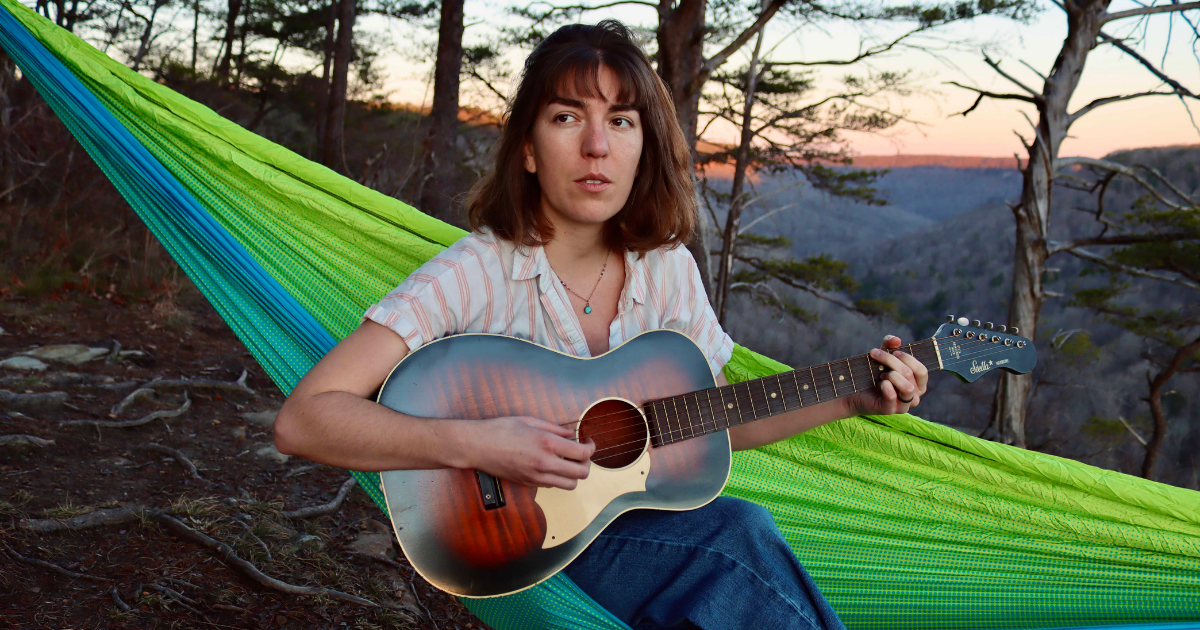
Photo Credit: Ethan Jodziewicz