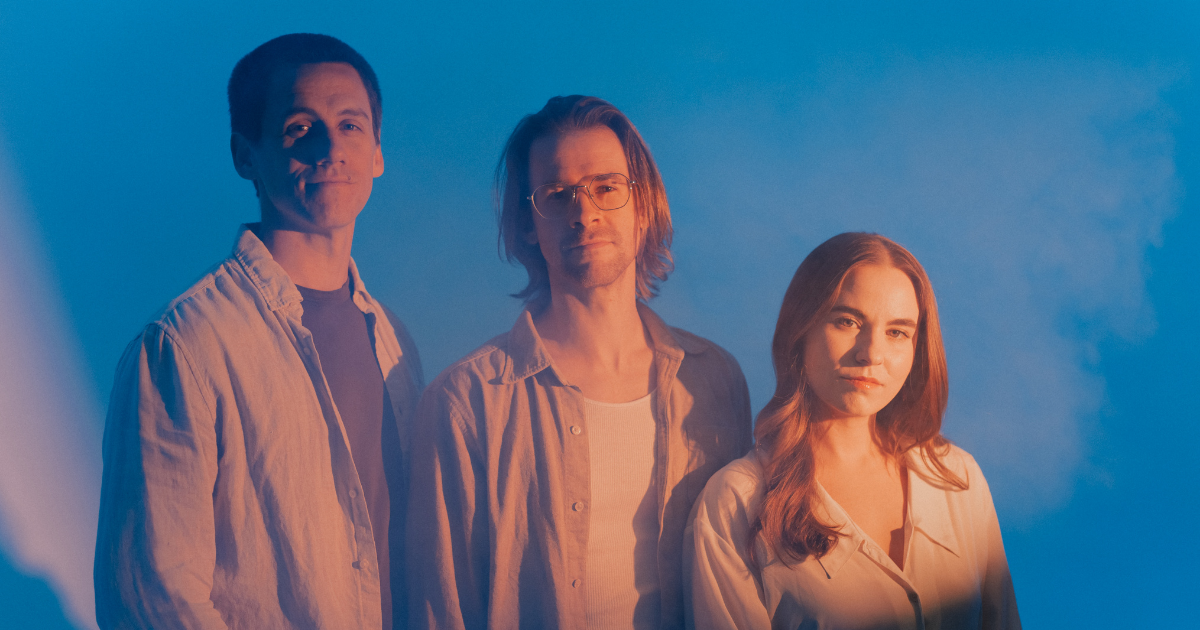
The Arcadian Wild may be named for the utopian landscape in Greek mythology, but they’re keeping things real on their new album, Make It Out Alive. As always, the Nashville-based trio eagerly experiments with acoustic music while keeping a pleasant vocal blend and instrumental dexterity at the fore. The songs are sometimes nostalgic, sometimes a bit cynical, yet refreshingly transparent. At times, it’s like the members of the band are opening pages from their family scrapbooks, or maybe their journals, giving listeners a deeper insight into their lives.
Founding members Lincoln Mick (mandolin/vocals) and Isaac Horn (guitar/vocals) met more than a decade ago as choir students at Lipscomb University in Nashville. Bailey Warren (fiddle/vocals), a band member since 2020, wrote songs with Horn and Mick for the first time for the new project. Her expressive soprano adds another interesting texture to Make It Out Alive. In addition, the band enlisted an outside producer for the first time, working with Micah Tawlks (Judah & the Lion, The Brook & The Bluff) to carry their imaginative sound one step further.
Isaac Horn called in to BGS to share his thoughts about songwriting inspiration, the inevitable pull of the ocean, and the ups and downs of life in a touring band.
BGS: When someone plays this album top to bottom, they’re gonna hear “Jubilee” first. I was wondering, what do you like about having that song lead off this album?
Isaac Horn: I don’t know that it was going to be the lead-off song from the get-go. Honestly, that was one that we’d written and we had arranged it, and I felt that it was a little lackluster whenever we were in the studio tracking. Then we had an overdub day where we invited a bunch of our friends to come in and play various things on the songs. One of our friends, Gabe Scott, is an incredible hammered dulcimer player. I wanted that song to have a bright, shiny feel to it, but I hadn’t given him much instruction or anything, just “Listen to the song and then follow your heart.”
And right away, with the first notes that he played, it finally became itself. We were all looking around at each other, like, “Okay…” I kind of breathed a sigh of relief. This is what we wanted it to be, and it felt like such a bold and joyful start. There’s no ramp up. There’s not an intro that welcomes you into it. It’s just like, here you are, a sunrise kind of moment. The day has begun officially.
I like that phrase, “bold and joyful.” Where else in this album are those bold and joyful moments, do you think?
“Jubilee” is definitely the most in your face – that’s all it is. But there are other ones. In “See It to Believe It,” the chorus to me is bold and joyful, especially because the verses are not. The verses are us… I mean, complaining is a little bit harsh, but it’s us being real about all of the difficult things that happen whenever you are chasing a dream. For us, that’s being on the road and playing shows. You run into these weird, challenging scenarios that you might never have expected.
Then the chorus is the total opposite of that, where it’s supposed to feel like a victorious chant or a battle cry, where we’re reminding ourselves to look at how far we’ve come, and that where we are now is where we wanted to be. This is where we dreamed about being 10 years ago. So whenever I play it, and specifically when I’m playing it with my friends, I can’t help but smile.
There’s a lot of nature imagery in your songs, and I was curious if you ever find inspiration from being away from the screens and out in the world.
One hundred percent. When we’re on the road, especially. There’s not an excess of downtime, but when we do have some time, we always try to get outside, find a trail somewhere, go and walk, go and run. If we’re by the ocean, it’s like, “Okay, pull over, let’s go.” Even if it’s stormy outside, let’s go put our feet in the water. We try to make a point to do that because being outside, engaging with the earth, there’s an energy there. I also think there’s an energy there that is particularly aware of the fact that things ebb and flow, and that we need to find some way to move through those things.
That’s what the world does, and it’s always on display. Whenever winter comes and all the plants die, they’re not worried about it, right? Because they know every year in March and in April they’ll be back. I think it’s easy to tap into that kind of life whenever you’re actually in nature. So, yeah, I love going and finding a trail and just kind of being away from it all, surrounded by trees.
What was on your mind as the song “Spinning” was taking shape?
I started writing that one during one of the ice storms that we had here in Nashville. The ice storms that we get here can be pretty brutal, just because no one’s prepared for it. People can be without power for weeks and the roads are just terrible. We were stuck at home and we couldn’t go anywhere for a few weeks. There was ice everywhere and it was gray and dreary, and you start going down in this downward spiral, and start to think like, “This is how it is, and it’s always going to be this way…”
I realized how many times I do that in my life, and not just in the down moments. It’s also in the really exciting highs. I think what happens, maybe naturally as you age, is that you gain a healthy perspective on each of those moments. Like, whenever you’re feeling particularly low, it is helpful to remind yourself that you’re not going to feel that way forever. The same thing goes whenever you’re feeling like you’re on top of the world. Sit in that. Enjoy it. It can be helpful to remind yourself that this isn’t how the rest of your life is going to be.
I’ve gotten the sense in your records, at least one person in the band likes to read. Maybe all of you do, but on this album, “Queen of Abilene” is almost like a short story in the way it unfolds. I wanted to ask if you think there’s a literary influence to your music.
We do love to read. We also go through reading phases, then other times we haven’t read anything in a while. But we’re always looking for stories to write songs about, and it’s honestly kind of a cheat code. Whenever you want to write a song, it’s really easy to find inspiration from a book or a movie. You can take one character who maybe is just barely mentioned, and you can extrapolate about their life or about their experience. I think we’re pulling from that all the time.
“Queen of Abilene” is a song that Lincoln wrote about his mom. She was born in Nigeria into a missionary family, so she was all over the place for a while and then ended up in Abilene, and that’s where she met Lincoln’s dad. She’s just this incredibly kind and generous person. You feel like she’s your best friend the moment you shake her hand, and I definitely think her life has a literary narrative quality to it. Just in its beginnings on the other side of the world, lots of traveling, coming over, coming back here, more traveling. The way that it affected who she is and the way that she interacts with people. The streams that are coming off of her, connecting her to other people, is probably the most intricate web of connections that I can imagine, and they’re strong strings. It’s impressive. It’s really, really beautiful.
I would imagine at this point, Lincoln’s family is your family, and vice versa. What’s that like to be on this musical path with somebody who’s been in step with you for so long?
Yeah, he and I have been doing this together for a long time, 12 or 13 years. I met him in 2012. I didn’t realize how much it was going to be like premarital counseling. We’re both married, but we started the band first. It’s kind of funny like that. There’s no other relationship in my life that is more similar to being in a committed relationship. It is a committed relationship. There’s a degree of trust there that’s present now. It’s just kind of unspoken, it’s implicit. It’s easy to take for granted, which is something that happens in all long-term relationships. And it’s a reminder of how long you’ve been together, but it’s also a reminder to keep showing up for each other.
I think that’s how it is with Lincoln and I. We’ve both been through so many challenges, and we’ve both hit so many walls. We’ve hit them together. We’ve hit them on our own. Then we start to ask big questions, like, “Do we keep going? Is this anything? Do we need to hang it up?” And just the fact that he and I have both chosen this thing, this path together, and we’ve done it for so long – at this point, I do think that we can handle anything that’s thrown our way.
Photo Credit: Shelby Mick