The Avett Brothers: A Truth That Soars Above the Bickering

True Sadness is an album about duality. It would have to be, really, for the boys behind the big-smiled, unbridled, foot-stomping joy on-stage at an Avett Brothers show to be naming a record something that sounds like such a drag. From lyrical jabs at the aging process to a well-rounded foray into new instrumentation, the Avett Brothers' effort catapults the listener and its authors into a sort of maturity where sadness isn’t a monumental event, but rather an underlying part of everyday life.

“It’s not necessarily this ongoing bummer,” Seth Avett says. “True sadness isn’t about becoming this dark thing, where you’re just giving up and realizing, ‘You know what? Screw it. Everything sucks.’ It’s more about just sort of accepting, as Bob [Crawford], our bass player, has very eloquently put it many times, that the human heart is fully capable of experiencing great joy and great sadness simultaneously.”

For True Sadness, the band’s fourth consecutive full-length working with producer Rick Rubin, every song began with a bare-bones recording using only the core trio of Seth, Scott Avett, and Crawford. Then, the songs were recorded with the full seven-piece band all live in the same room — a studio setup they hadn’t pursued since 2007’s breakout record, Emotionalism. They didn’t stop there: With Rubin’s assistance, a third step brought the final tracks well outside of their boundaries, instrumentally.

“We worked with another engineer who took the raw tracks and sort of re-imagined them with all these different samples and synths — just all these crazy sounds,” says Seth. Then they re-performed every song with the added depth of the tape sounds and synths, with certain tracks maintaining more of the new territory than others.

“What we ended up with was about four versions of every song,” Seth offers. “’You Are Mine’ ended up being one of those that was in, like, that third stage … third or fourth stage … it’s kind of everything mixed up in one.”
While this experimental, synth-stained streak reveals itself most clearly on tracks like “You Are Mine” and “Satan Pulls the Strings,” the energy behind the songs is unmistakably created by the same band that came up screaming and stomping their way through Southern stages.

“The simple answer here is that we do our best to just follow the song. Whichever way the song is represented best, that’s the way we leave it. We try not to get too caught up in how we’re perceived,” Seth says. “Like, ‘Well, we’re an American Roots band or and Americana band, so every song has to have only acoustic instruments’ and all that. We’ve never really felt any kind of allegiance toward that. [If] one song was kind of an oddball, [it’s because] it felt right like that.”

While the band is tapping into new sounds for True Sadness, they continue to thrive thematically with material that can be continuously re-interpreted by the listener: On standout track “Smithsonian,” the narrator rails through universal truths about aging like they’re breaking news. The song zeroes in on the strange quality of certain lessons or life changes that you have to experience yourself to truly understand, keeping pace with the album’s overall perspective.

“It’s a lot about resolve,” says Seth. “Just coming to a resolution about breaking down, and how that is completely, 100 percent natural — 100 percent normal — and it’s all good. It’s fine!”

A scroll back through the Avetts’ catalog almost feels prescient. Lyrics like the forlorn mention of elections on “Head Full of Doubt, Road Full of Promise” feel almost political today, where they may have once felt coming-of-age. The Avetts’ songs evolve with the listener in a way that’s given them a timeless quality, and True Sadness expands upon that facet of their music admirably.

“The truth remains the truth,” Seth muses. You won’t hear the Avetts proselytizing about current events — despite the ongoing controversy in their home state of North Carolina — but that’s not to say there aren’t takeaways that feel bigger than heartbreak or personal strife. “If you have your heart in the right place and you’re making your comments about humanity from the right place,” he says, “I think that it soars above the bickering within the political landscape.”

Lead single “Ain’t No Man” makes a strong argument to that point:“Ain't no man or men that can change the shape my soul is in / There ain't nobody here who can cause me pain or raise my fear.” You can take it as a personal pick-me-up, a nod to religion, or a knowing wink at current events, but you certainly won’t come away from the song feeling weighed down.

“It’s meant to be self-motivating — a little bit of currency to buy yourself a little confidence when you’re not feeling so confident,” he says. “We don’t always wake up in the morning thinking, ‘All right! Now I’m gonna knock it out today. I’m going to be joyful and I’m gonna be confident, but I’m also gonna contribute!’ Some days, you’re stepping into ‘em feeling just like a wounded animal. It just takes everything you’ve got to act civilized, in a way. So I think the song is a little like just giving yourself a motivational speech, and just getting solid and getting centered and kind of squaring your shoulders up, picking your head up, and just getting into it.”
True Sadness was announced to the world in an open letter about the ways that the Avetts’ music has become intertwined with their real lives, pointing from the very beginning to the heightened thematic complexity in each number.

"It does occur to me now, that in some regard, before any professional success, we were perhaps paradoxically more self-aware. The songs would show mere versions of ourselves — the heartbroken introvert, the frantic worker, the forlorn traveler, the philosopher, the romantic, the loner — all somehow imbued with the meaningful sheepishness of a James Dean character. We used to hope and vie for that attention, that perceived personality, that coolness."

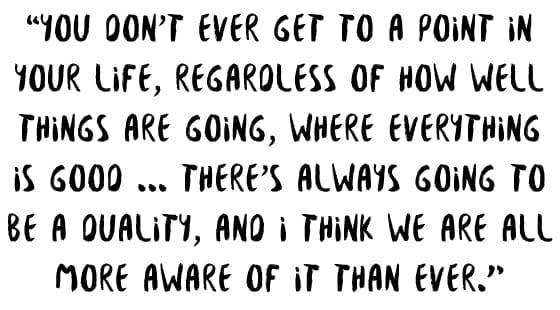
If their previous work was about compartmentalizing the parts of themselves that feel, True Sadness abandons the pursuit of cool in favor of a pursuit of the optimistic and honest. “You have to come to a place of resolution within the tragedies that are always happening,” says Seth. “You don’t ever get to a point in your life, regardless of how well things are going, where everything is good — where it’s all good. There’s always going to be a duality, and I think we are all more aware of it than ever.”

Leave it to the Avett Brothers to serve up True Sadness and leave us mostly with real, gritty, imperfect joy.


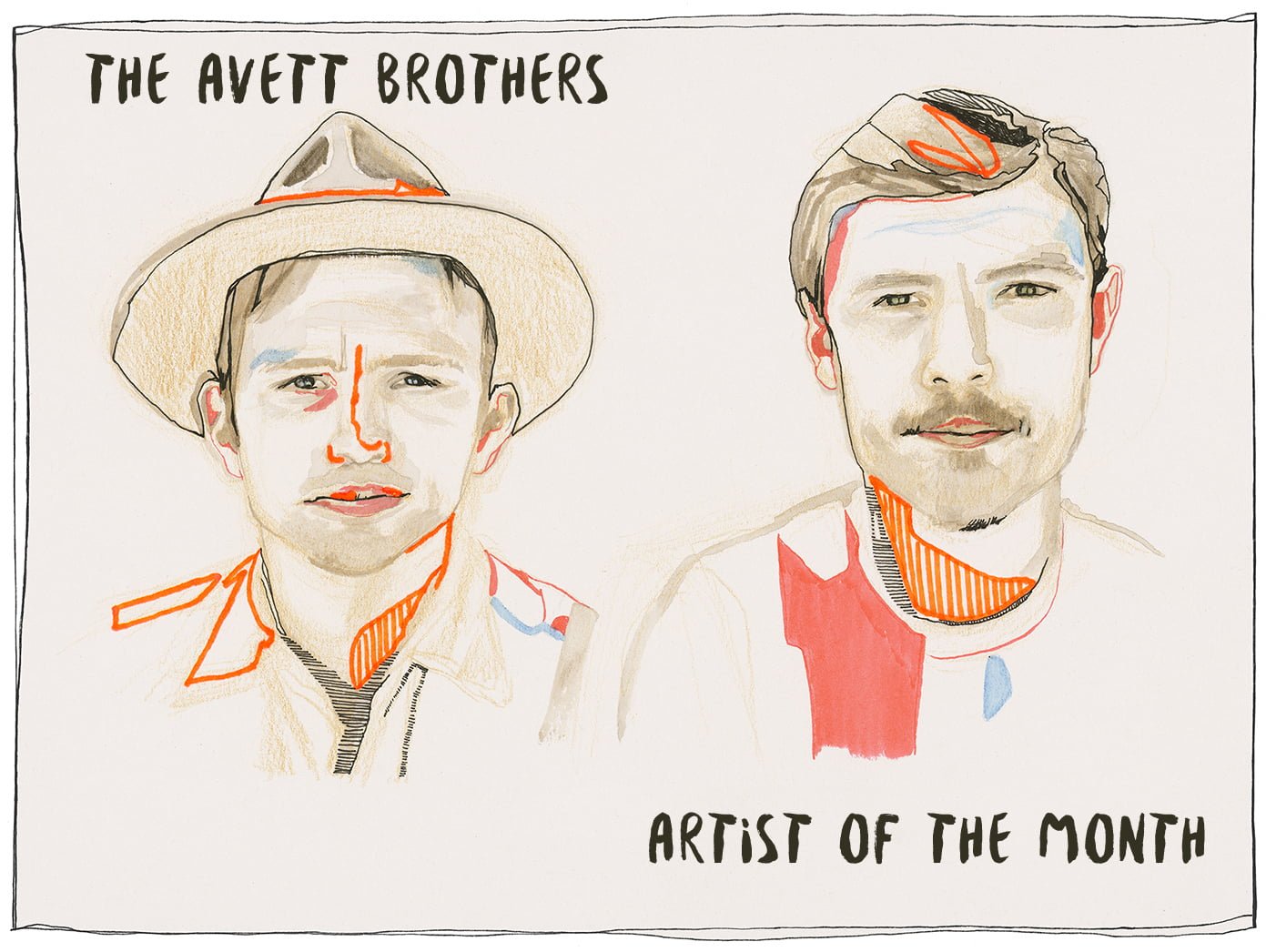
Lede illustration by Cat Ferraz.

Graham Nash: Pursuing the Hopeful Path

It’s been 14 years since Graham Nash released his last solo album, Songs for Survivors. In the interim, the 74-year-old has experienced rather significant challenges — both personal and professional — all of which have naturally informed his new album, This Path Tonight. Not only are Nash and his wife Susan Sennett divorcing after 38 years of marriage, but the singer/songwriter also called the future of Crosby, Stills, and Nash into question when he admitted to Dutch magazine Lust for Life in early March that David Crosby had treated him “like dirt” and he wouldn’t be participating in any future CSN records or shows.

As harsh as those comments seem given his typically amiable demeanor, they might have as much to do with the creative place he’s in as a solo artist. The tough experiences he’s faced have let loose a veritable musical flood. Working with producer/guitarist Shane Fontayne, the pair produced 20 songs over the course of one month, 10 of which would eventually comprise This Path Tonight. And Nash doesn’t appear to be slowing down anytime soon. “I’m still writing with Shane,” he says. “We were writing last night, as a matter of fact.”

It seems the prolific songwriter has once again found his creative sweet spot and, while the circumstances instigating that output are less than ideal, they’ve sparked an album of brooding intensity. “Everything is going according to plan, but it’s an emotional rollercoaster, and This Path Tonight is my emotional journal through my life, at this moment,” Nash admits in a forthright tone.

If it seems like This Path Tonight would be a woebegone album thanks to the themes of loss, heartache, and nostalgia which arise in certain songs, think again. Hand a songwriter as talented as Nash difficult moments, and he deftly transforms them into rich introspections offering messages of hope. “If there’s any message in This Path Tonight, it’s that you have a future. Figure out what you think will make you the most happy, and go grab it and run,” Nash says, his voice taking on an optimistic note as he discusses his latest work.

Both melodically and thematically, This Path Tonight reveals Nash at his contemplative best, oscillating between the melancholy nature of questioning one’s place and path in life, and the hope that can be attained from finding answers … or at least enjoying the search. Unlike Songs for Survivors — which felt like a stiff, overly structured album — This Path Tonight contains a lush quality all the more intriguing for its simple, straightforward arrangements and production. “I’m really proud of this record,” Nash admits. “I think it’s a good piece of work.”

Nash has struck on the magic that makes him such a legendary songwriter. On “Fire Down Below,“ the song’s bluesy feel — found largely in gritty guitar riffs and rhythmic piano underpinnings — contrasts Nash’s airier vocals, but all work together to build into a chorus that feels plucked from the 1970s. It’s as catchy as it is meaningful, a hard combination to hit upon.

While having to venture down that path of self-discovery at 74 could, understandably, feel like a burden considering such soul-searching tends to fall within a more youthful domain, Nash’s natural curiosity about practically everything helped guide his way. Beyond his songwriting, he pursues artistic expression in myriad forms, including photography, painting, and drawing. “I’m a curious man,” he admits, recounting a time he received a blast from his past while doing a book signing for his autobiography, Wild Tales: A Rock & Roll Life. “A kid came up to me, and he gave me an 8×10 manila envelope. He said, ‘You need this.’ In this envelope is my report card from when I was 11, and the first thing that a teacher said on my report card was, ‘This boy wants to know everything.’ And I guess I haven’t changed,” Nash chuckles.

That kind of curiosity allows him to communicate back from the trenches, so to speak. “I’ve already realized that it’s the duty of every musician and every artist to reflect the times that they live in, and that’s exactly what I’m doing here,” says Nash. “These songs are what’s happening in my life right now, and probably to a lot of people out there happening to their lives at the same time.” It’s a gift he’s been offering listeners ever since he put pen to paper to melody and formed English pop-rock band the Hollies in the 1960s.

Nash displays a penchant for writing particularly instructive songs. He’s long been attuned to the political issues and social injustices that continue to affect the world. Explaining a new song he’s working on with Fontayne, he says, “I saw a terrible photograph that somebody sent me last night that was taken in the 1940s, and it was of four beautiful children sitting on a stoop outside their shack next to a sign that said ‘Four Children for Sale.’ In the 1940s, there were people that were so poor they had to sell their children. Don’t think that didn’t start me thinking, so Shane and I started to write a song.”

Two of the songs on This Path Tonight’s deluxe edition continue a similar political work even while the rest of the album concentrates on more personal fare. Nash wrote “Mississippi Burning” about three college students murdered in the 1960s when they tried to help black people vote, while “Watch Out for the Wind” deals with the morning Michael Brown was shot and killed in Ferguson, Missouri.

Still, he takes issue with the fact these situations keep surfacing with no clear resolution in sight. “It’s one of the saddest things about being a songwriter,” he candidly says. “Yes, I’m loving the fact that people still love to hear ‘Military Madness’, but holy shit, what a drag to keep singing it. I wrote that 45 years ago about my father going off to WWII.”

He continues, “The world is so crazy. It is so nuts out there. I mean, just look at the political landscape, for instance: It’s a clown car. It’s insane. And that’s just the politics, not the wars, and Syria and Yemen and Afghanistan and Iraq. The world is crazy. We have to hope it will get better.”

Music offers one such balm, and it’s a point he examines in one of his new songs, “Golden Days.” Nash plays upon the song’s title, a phrase that arises and shifts with each verse, beginning as “olden days” before transitioning to “golden days,” “broken days,” and finally back to “golden days.” With each utterance, memory alters the way one looks at the past. Set against a solemn melody plucked on guitar, the song’s central theme concerning time’s passage gives way to what music offers life through all its ups and downs. Nash sings at the song’s close, “Songs with soul and words with so much hope for a brighter day.”

The hope that informs his music plays a large role in his own personal outlook. “My basic understanding is that life truly is simple. Take care of the area around you, take care of the litter around you, encourage your child, smell a flower, do something every single day that makes you smile and you will live longer. Well, I’m 74 now, so it’s stood me in good stead,” he says.

That would be prosaic advice coming from someone who wasn’t aware of the world’s greater injustices and dilemmas, but from Nash, it’s a sage attitude steeped in understanding.

As music journalist turned cultural critic Ellen Willis wrote in a 1967 essay about Bob Dylan, “In a communications crisis, the true prophets are the translators.” The same could be said of Nash. At the heart of it all, he remains a translator, one who skillfully expresses those personal crises threatening to undermine even the strongest individual in order to offer listeners an inspiring perspective instead.


Lede illustration by Cat Ferraz.