The Steel Wheels’ Songs for Humans, by Humans

It’s common these days to wring hands over the many ways powerful tech companies have meddled, without permission, in how we discover and listen to music (among other things). It’s just as common to fearfully declare that music’s good old days are past and gone. But after 20 years as a working band, we know that the strength of community through music is much more enduring; and we see it all the time.

There is no greater force than a group of people who are ready to share a joyful experience. It doesn’t matter if they’re gathering to jam, attend a concert, or anything else. People in community can create strong connections in a heartbeat, under almost any circumstances, and music is a powerful vehicle for it. Some days it feels harder than others to find that spark, but it’s always there if we come together and dig for it. Every day the pressure grows to strip the things we all have made and love for parts, but collectively we can raise our voices and push back. As a band, we’re choosing to resist that force and to keep building things. Together.

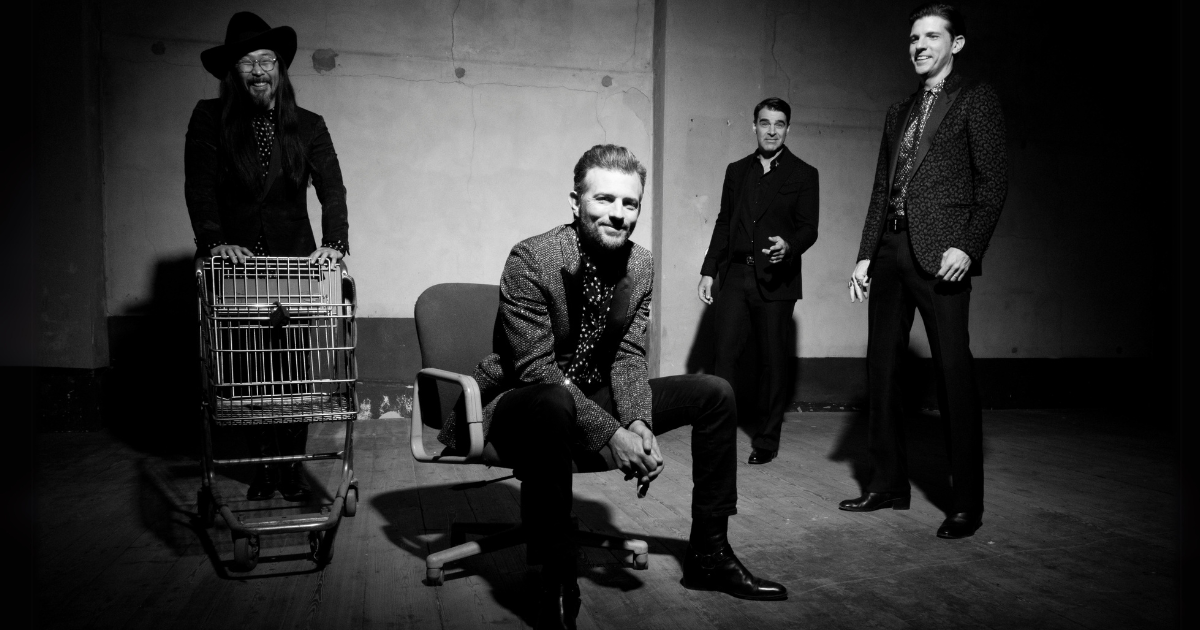
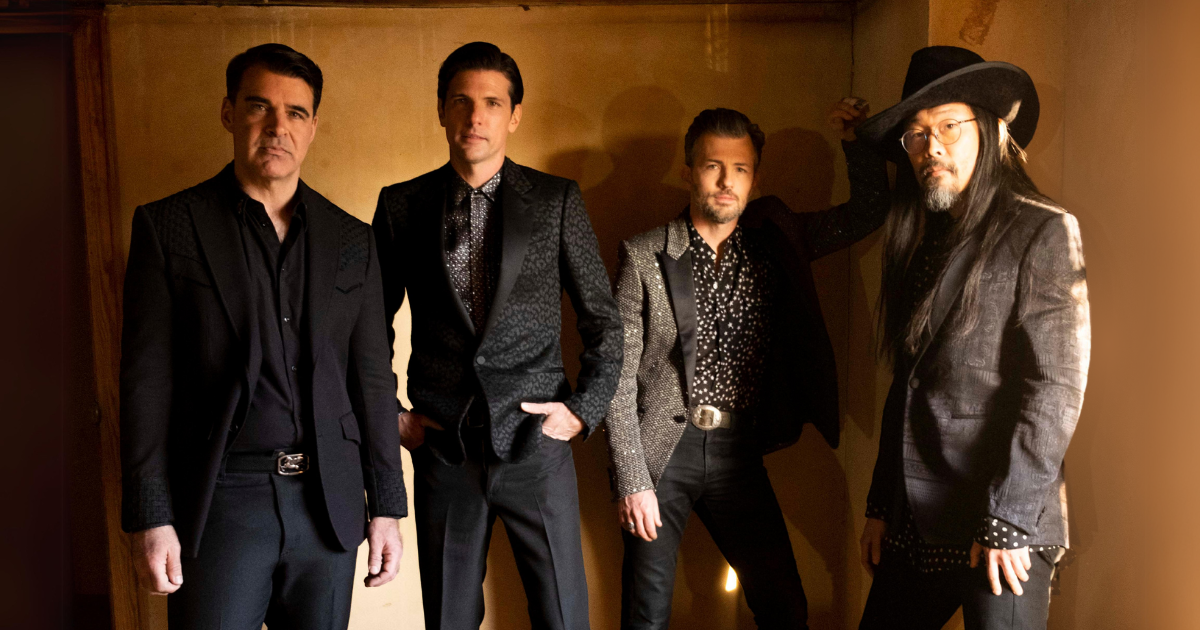
This playlist features artists that we feel musical and professional kinship with, bands that have been around and are well into their careers. The songs we chose come from albums that are worth spending time with over and over again. These folks have played lots and lots of gigs and revel in the energy of a great show as much as we do. You’ll also find some music from our 9th studio album, The Steel Wheels, too. Music that we made together in a room. – The Steel Wheels

“Easy” – The Steel Wheels

A breezy song with a swirling fiddle intro and a big question at its heart. We live in the future now, with the entire world available to us on the other side of our screens. So why are we lonelier than ever? If everything is supposed to be easy, why does it all feel so hard?

“Talk Is Cheap” – Dr. Dog

Because they inspired me with one incredible Bristol Rhythm & Roots Reunion set probably 15 years ago. Their old amps, their confident trailblazing of their sound that was clearly referential and respectful – but not chasing what a lot of other bands were chasing.

“Los Angeles” – Big Thief

An artist’s job is to remain open and soft to the world and to distill all that pain and joy into work that transmits emotion across space and time. Somehow, Big Thief seems to only become less jaded with time, maintaining curiosity and exploration as part of their creative process.

“Go Back” – The Steel Wheels

All deep relationships come with joy and with pain. To be rid of one you would also lose the other. It’s part of lived experience, this is a reminder to embrace all of it. True connection is worth it.

“Waiting For The Sun” – The Jayhawks

The Jayhawks are a band that prove you can continue to forge your own way and make it through the highs and lows. I was still really just a kid when I discovered them through some older cats I was playing with at the time. Son Volt and Wilco were very much in the alt-country scene and the Jayhawks just had something a bit different going on.

“Worried About The Weather” – Greensky Bluegrass

I love the way this song pivots between the anxiety of pushing forward through uncertainty and the breezy delight of taking a moment to enjoy the journey. There’s momentum to both things and “Weather” has tons of it.

“Keep On Dancing” – The Steel Wheels

Let’s take a break from responsibilities to just see ourselves and each other. Don’t forget to breathe and to appreciate the unadorned peace that can fill the spaces between us.

“I And Love And You” – The Avett Brothers

Even a track like this, one full of solitary stillness, shows the Avetts’ songs are packed with other people. They always remind me that I’m not as alone as I often feel. You can sense the presence of old partners and family throughout this song even though the speaker is alone in their car.

“Valerie” – The Brothers Comatose

These guys are everybody’s friends. Maybe the acoustic Dawes? I don’t know. We’ve known them a long time and they keep bringing joy and fun with warmth and grounded songs that don’t rely too heavily on bluegrass tropes.

“Sway / Endless Highway (Pt. 2)” – Watchhouse

Watchhouse invest deep thought into every lyric and intention into every note without ever seeming to overthink their process or get held back by previous work. “Sway / Endless Highway (Pt. 2)” demonstrates how the band is constantly in conversation, transitioning between tempos and driving down into a deep groove with a breeziness that belies the technical mastery of their acoustic instruments. At a Watchhouse show, the crowd will hang on every note and every silence, sharing a reverence for the song with the band.

“Slow Rise (to the middle)” – The Wood Brothers

Oliver, Chris, and Jano seem to be propelled forward by some groove force that penetrates everything they do and they invite listeners to join in on the funky joy. Their track “Slow Rise (to the middle)” tips a hat to their musical journey. To be in an audience is to get lost in the moment, only to occasionally remind yourself how wild it is that all the sounds coming from the stage emanate from just three musicians.

“Way Down Yonder ” – Chatham County Line

I first heard Chatham County Line when I opened for them at The Livery in Benton Harbor, Michigan, with a jamgrass band I was in, probably 20 years ago. They were tight and had their act together. I was blown away by their professionalism and it made a big impact on me. I will never forget that moment and I’m still inspired by their creativity and longevity as a band.


Photo Credit: Monik Geisel

Valerie June is Weaving Spells Again

Valerie June’s new album – Owls, Omens, and Oracles (released on April 11 by Concord Records) – begins with a snare and a hi-hat. A simple, straight-forward rhythm. Something to wrest you from your chair and get you moving your body.

After a few bars, her distinct, earnest, energetic vocals enter and it feels as though you’re surrounded by a circle of Valerie Junes singing in delightful unison. Urging you on. It’s just her voice and the drum for thirty-five seconds, then she lands on the word “joy” and the whole song bursts open with a distorted guitar and so many cymbals.

Like the “Joy, Joy” for which the song is titled, sound layers build and build, rippling out further and further until it all fades. By then, you’re well into the room. The colors are swirling. There seems to be joy and love hanging from the chandeliers. If you close your eyes, perhaps you can imagine the colors bursting forth from the guitar when it finally takes a solo.

Indeed, whether or not you experience synesthesia – a condition some musicians report where they associate sound and color – there is something undeniably colorful about the music June puts into the world. This is as true as ever on the new disc, which feels even more focused on joy’s pursuit and on holding joy aloft once it is within one’s grasp.

The celebrated poet and activist adrienne maree brown, who wrote June’s promotional bio for the project, notes: “This album is a radical statement to break with the skepticism, surveillance, and doom scrolling – let yourself celebrate your aliveness. Connect, weep, change, open.”

Indeed, connecting and weeping – through joy and heartache alike – is central to June’s artistic journey. This notion, that her music might be urging its listeners to celebrate aliveness, is particularly resonant on Owls. After all, June, who divides her time between Tennessee and New York, is a certified yoga teacher and mindfulness meditation instructor. One might extrapolate, then, that music, for Valerie June, is equal parts connective tissue and spiritual experience.

“No one who makes music can truly tell you where it comes from,” she said on a recent Zoom call. “We don’t know where we’re getting it from. It’s coming from someplace and I like to think that place is magical.”

Similarly, she adds, “Spirit is something that we don’t really know. We can’t really – exactly – put our finger on where it’s coming from. We just feel it. … I think that it’s a very spiritual thing to make music. It’s not necessarily religious, but it is definitely spiritual. It will connect you to a deeper part of yourself, but it will also connect you to deeper parts of other people – and to nature.”

Across her six albums in nearly twenty years, June has sung about nature plenty. The night sky, the creatures of the forest. From her rendition of a classic, “The Crawdad Song,” (2006’s The Way of the Weeping Willow) to the eagle and rooster in “You Can’t Be Told” (2013’s Pushin’ Against a Stone), to the “still waters” and “dormant seas” of “Stardust Scattering” (2021’s The Moon and the Stars: Prescriptions for Dreamers), June has turned to nature for solace, clarity, and metaphor.

Lately, though, she has been somewhat haunted by owls.

“In Tennessee,” she explains, “we have a pond behind the house and there’s a lot of wildlife. There’s muskrats and frogs and snakes and fish and all kinds [of animals]. We just went and bought like ten carp fish to go in the pond to help keep the algae down and stuff. But one morning, I was walking into the kitchen. I start my day with black tea and there’s mist on the pond in the morning, and so everything’s kind of like foggy. I’m making my tea. It’s like five o’clock in the morning and my eyes are all puffy. … There’s a window where you can see right across the pond and see this mist and everything, and there is an owl on this post of the fence on the far side. It’s just looking in at me, and I’m looking out at it.”

She and this same owl had a few more encounters after that initial one and June started thinking there was something to it. Whether it was a spirit visiting her on purpose, or just a magical coincidence that she and this creature were in the same place at the same time on a planet so full of people and creatures, there was something to this brief, recurring coexistence.

While June admits she never sits down on purpose to write a song – she opens to them and they come – the owl started to worm its way into her periphery while she was writing. She started reading everything she could find about owls, learning about their habits and idiosyncrasies. She felt like she was harnessing some owl energy as she captured the melodies that would make up this album.

“You can listen to the old blues songs,” she explains, “and you will hear about the black snake, or about the mojo, or different things like that. There’s magic in the music, if you ask me. I … enjoy being a root worker and understanding that music can shift moods. It has that power. It can start movements. It can energize people or make them feel so tender that they’re able to cry when they need to.

“I definitely feel like I work with those energies. I don’t just sing, you know. Because, I mean, there’s a lot of singers who have more beautiful-sounding voices than me. I’m weaving spells.”

Indeed, June’s spells weave their way through Owls.

One moment, she’s turning off the news to remember we’re all indelibly connected “like branches of an endless tree” (“Endless Tree”). Then, she’s breathing through doubt with “Trust the Path,” a quiet, echoic piano song that sounds like it blew in on a breeze. There’s the spoken word piece, “Superpower,” with its meditative background and dreamlike soundscape built atop her voice and producer M. Ward’s guitar, among other things. Suddenly June is clawhammering a banjo and singing about misguided love (“My Life Is a Country Song”). And finally, there’s the folky earworm song “Love and Let Go,” with its horns and piano and layered unison vocals.

The album starts with joy and ends with acceptance – which is part of joy. Though it weaves through different styles and soundscapes, there is this throughline of keeping to the path, trusting the light, sourcing the joy.

Most of this is due to June’s songwriting and performance, of course. But at least some of it can be credited to her producer Ward – the chameleon-like guitarist and singer-songwriter who has produced for and collaborated with a who’s who of indie artists. As for her experience with this particular collaboration, June doesn’t hold back when lavishing Ward with praise.

“It was kind of the most amazing experience I’ve had in making records,” she says.

“He can play anything. He’s on the vibraphones. He’s on the keys. He’s on the guitar. I mean. … [For him,] whatever genre a song wants to be is what a song is and at the end of the day I enjoy rocking out. I like turning up my electric guitar and my amp and just going crazy with this kind of like a dirty blues-rock sound. And him – he got the best tones and sounds in his guitar playing.”

The pair first decided to make a record together when they crossed paths at Newport Folk Festival. June noticed that they were on the schedule for the same day, so she texted Ward and he invited her up to sing with him.

“When I got offstage, after watching him play that blues-rock like just a genius, [my] jaw [was] on the floor. Like, that was amazing. It was just him solo, too, with like three or four different guitars up there. So I said, ‘Well, when are we gonna make this record we’ve been talking about making?’”

Two months later, they crossed paths again, this time at San Francisco’s Hardly Strictly Bluegrass Festival. “We were on the same day again, so auspicious,” she remembers. “And so we worked together there. He said, ‘Okay, we have to make this happen now. We’ve seen each other two times in one year.’”

Before another year passed, they were in the studio, running with the genre-defiant sounds that were pouring out of June’s magic mind.

The phrase June used to employ for describing her music was “organic moonshine roots” – a description she’s stopped using since her friend who coined it passed away. Meanwhile, her life has taken on its own metamorphoses. She has found and lost love, has branched out in new directions, has pulled in guitar, ukulele, and banjo. She has made music with artists as variant as the Avett Brothers and Blind Boys of Alabama (the latter appear in the background on Owls). When not on the road, she hosts meditation retreats and teaches mindfulness at places like the Kripalu Center for Yoga and Health in the Berkshires. She writes poetry and has published a picture book for children.

Naturally, all of this has fed her appetite for melody and it’s all added to the tapestry of sound that defines her music. There is country in there, for sure. Also some semblance of jazz, R&B, pop, and just plain individualistic, raw grit. This time around, on Owls, Omens, and Oracles, genre seems like a silly thing to even try to pin down.

During a SXSW interview in 2023, writer Wajahat Ali asked June about the ineffability of her style and she didn’t hesitate. “It’s Valerie June music,” she told him. “I’m a singer-songwriter and whatever comes out, comes out. Sometimes it is honey, sometimes it’s vinegar.”

Sometimes it’s black tea and mist on a pond, crickets chirping and muskrats scattering, an owl standing still on a post, blinking its eyes as you stand there blinking yours. It’s a reminder of what truly matters.

To June, what matters is everything.

“Are you ready to see a world where we can all be free?” she asks. “I’m ready to see a world where we can learn to disagree with each other and still live together peacefully.”

“We’re ready to see this world be a place of togetherness,” she adds later. Learning to cooperate, she says, is “not just important for humans. It’s important for all of nature. … Nature will be okay, of course, without us. But it would be nice if we could figure out ways to move toward a more cooperative existence with all [things] in nature.”


Photo Credit: Travys Owen

The Avett Brothers’ Musical, ‘Swept Away,’ Heads to Broadway

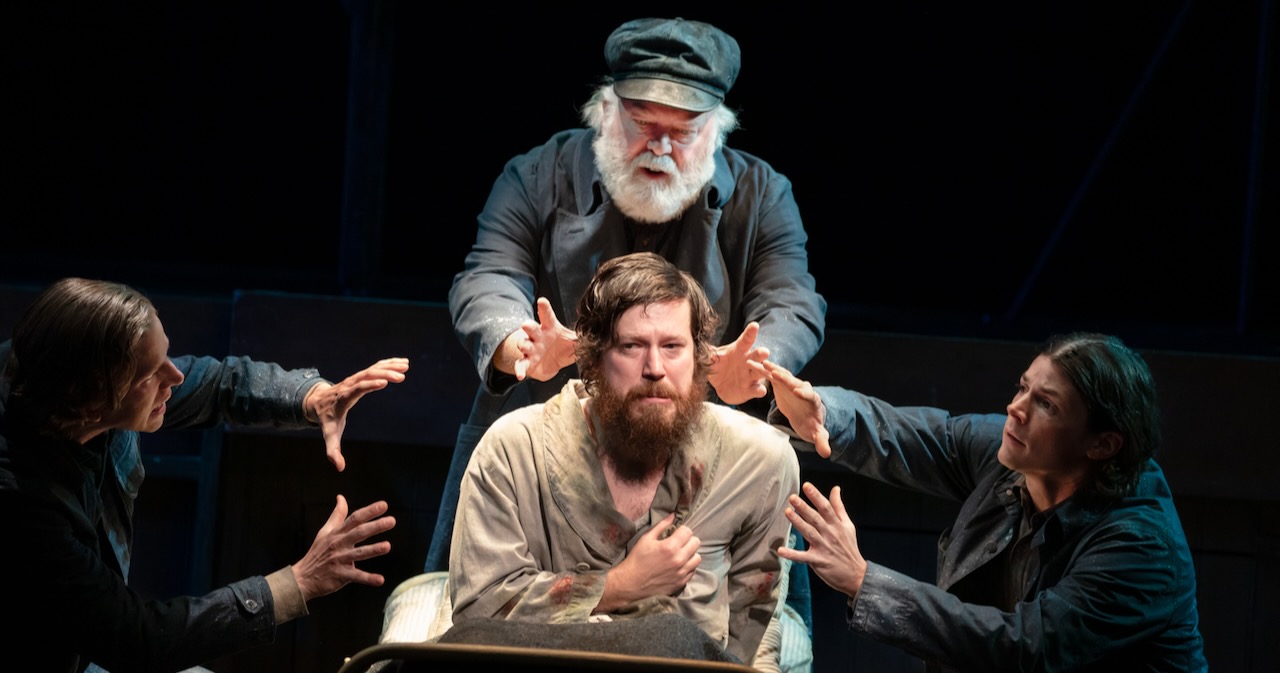
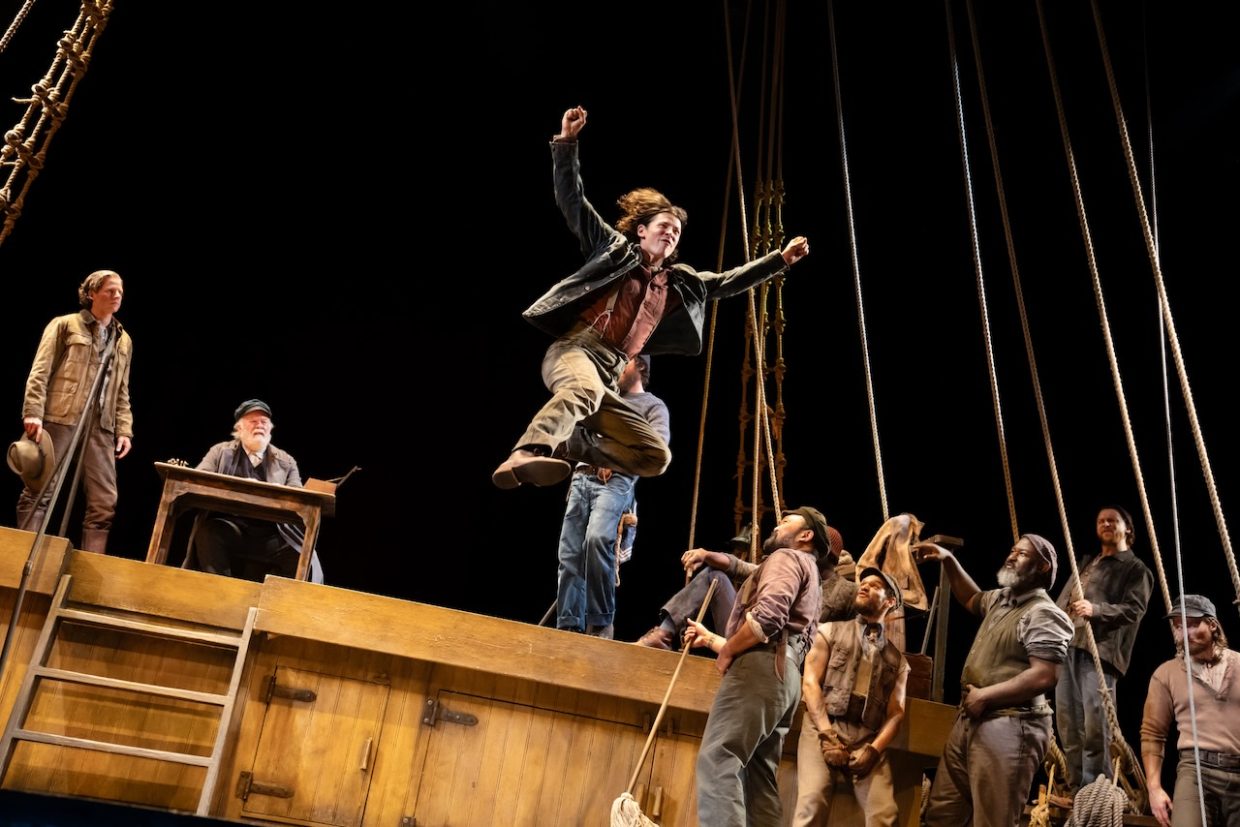
It has been two decades since the Avett Brothers released their shipwreck-themed concept album Mignonette. This fall, the musical Swept Away, based on the album’s story, will premiere on Broadway as the latest in a bevy of roots-based musicals lighting up those storied theaters.

Swept Away is presented in 90 minutes without intermission. During previews in San Francisco and Washington, D.C., the cast and creative team received high praise from theater critics and Avett Brothers fans alike.

The Avetts’ original song cycle was based on the story of a shipwreck near the Cape of Good Hope that left four survivors in a lifeboat. To survive, three of them killed the fourth and ate him for sustenance. When they were finally rescued, the three stood trial, breaking a tradition of maritime law that up to that point had carried the spirit of, “What happens at sea remains at sea.”

It’s quite a story for a band of brothers who have become known for their stirring sincerity. But, Scott Avett told Broadway.com, “We were driving around to places that seemed unknown, in a van. We seemed to have nothing but this belief that we were doing something that was true. … It was easy to see that van as our vessel.”

“It was scary,” adds Seth. “We felt very driven to survive.”

Adrian Blake Enscoe and the Company of the Washington, D.C. Arena Stage production of ‘Swept Away.’ Photo by Julieta Cervantes.

The Avetts discovered the story via their father, Jim Avett, who had a special affection for stories of shipwrecks and handed them a book about its history, The Custom of the Sea: A Shocking True Tale of Shipwreck, Murder, and the Last Taboo. When they wrote Mignonette, the brothers Seth and Scott were 23 and 27, respectively, and just beginning to rise from the clubs. But the disc pointed the way toward a bright future for the Avetts, which then included only the brothers with bassist Bob Crawford.

It was that trio which caught the eyes, ears, and imagination of a young John Gallagher, Jr. Gallagher spent a summer day in 2005 at the Philadelphia Folk Festival, aimlessly checking out bands he’d never heard of before.

Folk audiences were a handful of years out from the release of O Brother, Where Art Thou? – the film that ignited a wildfire of interest in bluegrass and old-time music for a new generation. Plenty of bands in their 20s were throwing their flat caps into the ring. But, Gallagher recalled recently over Zoom, “The thing that struck me … about the Avetts is that they were feeling it, you know. You can’t fake that. You can’t deny that. When you see someone bring that to the stage or put that on a record, it’s totally undeniable.”

That night, while driving back to Delaware with his sister and friends in their mom’s minivan, Gallagher commandeered the discman attached to the cassette adapter that fit into the car’s tape deck to insist everyone listen to the CD he bought after the Avett Brothers’ set.

Mignonette was the only one they had on offer that summer. They’d released it a year earlier on Ramseur Records. Gallagher played its first two tracks – “Swept Away” and “Nothing Short of Thankful” – before moving on to Green Day’s American Idiot, which had also just released.

Fast forward a handful of years and Gallagher was developing a new musical for Broadway based on the very same Green Day album. In his dressing room at the St. James Theater, he’d hung a small poster that showed Seth Avett handing his guitar off to a tech at a live show.

Mignonette had long since turned the young actor into a self-described “fanboy.” Even as he sang eight shows a week of Green Day tunes, he couldn’t have possibly known he’d eventually be cast for another Broadway show, this time based on the Avett Brothers album he’d played in that minivan back in Philly.

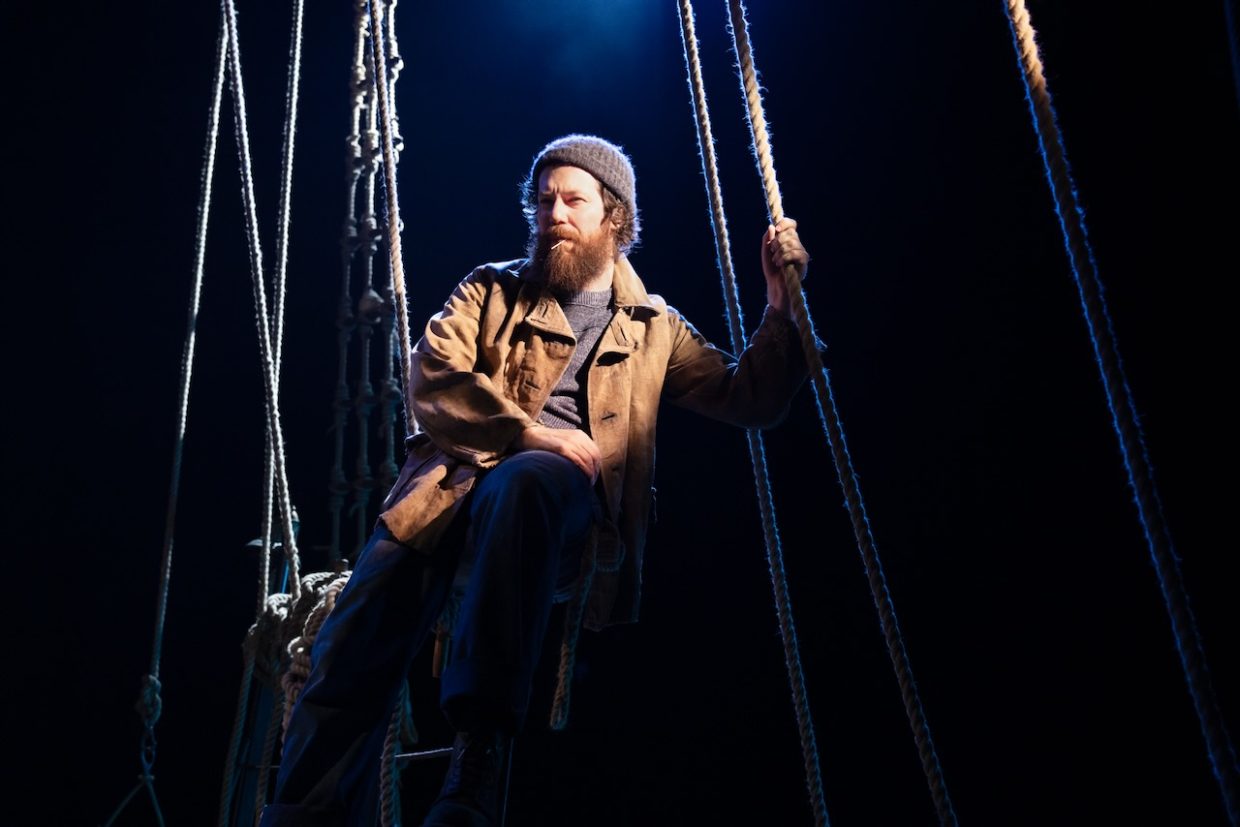
John Gallagher, Jr. in the Washington, D.C. Arena Stage production of ‘Swept Away.’ Photo by Julieta Cervantes.

When it dropped in 2004, Mignonette was lauded by the roots music press of the day. Paste extolled the band’s “James Brown precision (in a bluegrass context of course).” No Depression, then still in its original print run, applauded tracks from the album that harnessed “palpable yearning and hope.”

The playwright and filmmaker John Logan (Moulin Rouge) recalls how, in 2017, he received an email from producer Matthew Masten, asking if he’d ever heard Mignonette. After listening to the album for a day, Logan was sold.

He flew to North Carolina, where he pitched his vision for the musical to the Avett Brothers, asking them to open their entire catalog and to write a new song only for the stage. Once they agreed, Swept Away was set in motion. Michael Mayer, who was directing Gallagher in American Idiot at the time – a very different show with a score written by a very different band – was tapped to direct.

The show these men and their team would create would be titled after the album’s opening song, “Swept Away.” It would be somewhat of a jukebox musical, but not really. Somewhere between Jagged Little Pill (which told a new story with Alanis Morisette’s breakthrough album) and Hadestown (whose Tony-winning set designer Rachael Hauck joined Swept Away’s creative team). Plus maybe a little Come From Away. On a ship. In the 1880s.

In recent years, Broadway producers have been more and more interested in revivals (Merrily We Roll Along, Cabaret) and movies-turned-musicals (The Notebook, Moulin Rouge). True originality is more rare on the Broadway stage. Swept Away may be adapted from a 20-year-old folk album, but its songs pull from across the Avetts’ catalog and its book is entirely new.

Like Gallagher, Adrian Blake Enscoe, who is originating the Little Brother character, is a musician away from Broadway. His band, Bandits on the Run, has the scrappy busking energy of early Avetts and he especially appreciates the way the show incorporates the “rough and spontaneous” elements of the Avetts’ music into a score that can resonate with the theater crowd.

“It’s really hard to capture the magic of the little things [about folk music] and translate it to other people,” he acknowledges. Then adds that the music supervisors and arrangers, Chris Miller and Brian Usifer, “did an incredible job of recreating the magic.”

Swept Away is set to open on Broadway October 29, 2024, at the Longacre Theatre on 48th Street.


All production photos courtesy of DKC/O&M. Shot at the Washington, D.C. Arena Stage production of Swept Away by Julieta Cervantes.

Lead Image: Stark Sands, John Gallagher, Jr., Wayne Duvall, and Adrian Blake Enscoe in the Washington, D.C. Arena Stage production of ‘Swept Away.’ Photo by Julieta Cervantes.

The Many Folk Art Threads of Jake Xerxes Fussell’s ‘When I’m Called’

Two weeks before the release of his new folk album, When I’m Called (available today via Fat Possum), Jake Xerxes Fussell’s sister, Coulter, who is a quilter, had a show of her work in Oxford, Mississippi. In this show, Coulter patchworked 24 small quilts with fabric sourced from her friends and fellow quilters. There was one quilt for every hour of the day.

Though Fussell has said that he and his sister do not talk about her work very much, there are some profound resonances between her quilts and his music – the idea of updating tradition by the use of unusual materials and freer forms, for example, or the idea of using old material to make new texts, but also something deeper. The songs and the quilts mark time, but not in conventional ways. Instead, they track time in a looping, stuttering fashion. Time is both abstracted and made concrete, as a quilt can appear like midnight and a song can be both a work song and a travel song; but also how a quilt or a song can be a mark of a 19th century technique using 21st century material.

The sources for these records and quilts are a network of people. They include those as close as their parents or close family friends, but also as wide as academic song catchers from the 1950s and 1960s, the folk revival of the same era, the careful annotaters of 1990s web forums, or 2020s Instagram accounts. In the time I spent talking to Fussell, he was careful to note these networks, where and who he learned from, the songs he picked up, but also the methods.

These methods were not only adapted from family and friends, but also professional contacts and music legends who pursue a similar ambition to extend what “folk” means. They include Blake Mills, who has been a session musician for everyone from Bob Dylan to the Avett Brothers; or Robin Holcomb, the avant garde vocalist and multi-instrumentalist whose estranging 1992 album, Rockabye, provides a conduit from artists like Bill Frissell and John Fahey to contemporaries like Blake Mills or Daniel Bachman.

For Fussell, the creation of a drawing, painting, quilting, or song-making can come from the same geographical site, the same kinship network, or the same historical records. His parents were academics who painted, sang, wrote, and quilted, but he also had friends like Art Rosenbaum, who painted, gathered songs, taught them in and outside of the University of Georgia, and won the 2008 Historical Recordings Grammy.

Rosenbaum died in 2022 and the songs on this album are in his memory, absorbing captured Scottish songs from the 1970s. The track “Feeling Day” is both bright and mournful, moving in the body of Rosenbaum from Georgia to Scotland and back, where it was taught to Fussell and then captured here. The intermingling of technology, memory, curiosity, professional competence, and ancestor work all made contemporary by skill and memory. (Like the quilts.)

Fussell talks about reclaiming and re-interpreting these songs, versions of versions, updated for contemporary listeners. The album includes the work of Rosenbaum, but it can also be seen on the very first track, about the Mexican painter Maestro Garry Gaxiola, whose decades-long (and most likely one-sided) feud with Andy Warhol centered on questions of what populist art is and what folk art is.

It can also be seen in how Fussell sings “When I’m Called,” a song partially composed from a found paper scrap (again, the quilting) containing a child’s to-do list. It reminds me of the folk anthologist Harry Smith, who spent a long time cataloging paper airplanes he found on the street. It can especially be seen on Fussell’s version of “Gone to Hilo.”

Depending on who you ask, the song’s original title is either “Johnny’s Gone to Hilo” or “Tommy’s Gone to Hilo.” For most versions, those who sing “Tommy” think that the song is about Ilo, Peru and those who sing “Johnny” think it is about Hilo, Hawaii. Fussell sings “Johnny.”

The song is not really a sea shanty, because they require a stronger beat to function as a work song; but it was intended as a song for sailors, a kind of lament, and the gap between forms here has deepened as it has moved further from the sea. The work quality dropped, and the lament quality ratcheted up. It has been sung by dozens of people, one of those tracks that criss-crosses the Atlantic with the folk – Peggy Seeger sang it when she was in England with Ewan McColl, for example.

Perhaps the saddest version of the song is by Paul Clayton. I think maybe three people in the world care about Paul Clayton, and Fussell is one of them. Clayton grew up in New Bedford, Massachusetts, and collected songs about that town’s whaling history since before he was 20. He went to UVA and studied under the legendary song collector Arthur Kyle Davis, traipsing through Appalchia finding songs and then moving to the East Village, integrating himself with Van Ronk and especially Dylan. Fussell claims that his version of “Hilo” is directly in the tradition of Clayton – that how he weaves a song is how Fussell weaves a song.

Between 1954 and his too early death in 1967, Clayton made almost a dozen records of revolutionary war songs, sea shanties, timber shanties, songs of marital discord, songs which Dylan ripped off, and songs which are only remembered by enthusiasts. Fussell is an enthusiast, his version is the lament that Clayton created from the work song and the interweaving of the lament and the work song – the doubling down on the historical memory, the absorbing of a technique renewed in the knowledge of history – is key to the whole enterprise.

Listen to how Clayton emphasizes certain words – for example, “bully boy” – but also listen to how it’s just Clayton; a clarion voice, and a melancholy one. Listening to Fussell’s, with Robyn Holcolmb singing harmony, the sadness is still there, but the tradition is too. The tightness of the version traps tradition, that it is in the middle of the album, that it’s a single, marks a network of relation, an aesthetic about public choices, and a wrestling with tradition.

Folk music asks again and again, “Why are we making these choices?” and, “Whose choices are we making?” Fussell, at his best, makes choices that are smart, open, generous, and mark a time and place – be it Georgia or Hilo or Oxford, Mississippi or a room where Clayton and he can have a conversation with all those 19th century sailors.

Thinking again of Coulter’s quilts, they both mark time in an abstract sense – the idea of what noon or midnight looks like – but they also mark the time it takes to create a work. There is this idea that time is linear, that it marches forward relentlessly. The quilts mark the history of their creation, the actual moments that Coulter made them, but they also weave together the stories of those who gave her their scraps, the interlacing of decades of commercial and domestic enterprises intended to make an object which shows its sources/seams.

Everytime someone sings a traditional song, this kind of citational practice renews the song, the text, the material. Like a quilt, when Jake sings, time bends and loops, inviting other people’s time, other people’s lives. In a worst-case world, this could be greedy, or wolfish, consuming without respect; in Jake’s work, a much better world, this is a kind of kinship network, sharing and consuming mutually.


Photo Credit: Kate Medley

The Avett Brothers Go Lights-Out

Over the nearly two-and-a-half decades since their debut, the Avett Brothers have constructed their own creative universe.

They’ve released 11 studio albums, earned a Grammy award (plus three more noms), and bounded around stages for countless tour dates and festivals the world over. May It Last, a documentary film about the influential North Carolina group, offered a glimpse at the band’s dynamic through big and small screens.

Scott has also been a working visual artist since before The Avett Brothers as a band even entered the public consciousness, earning a BFA in studio art from East Carolina University in 2000 and depicting Southern family life through paintings and sculptures that would go on to make moving exhibitions—all while he also created stunning album cover imagery (for his own band as well as the great Brandi Carlile) or provided the visuals for such epic music videos as “Head Full of Doubt / Road Full of Promise.”

Musical theater, too, has been touched by the Avetts: Their musical, Swept Away, will make its mark on Broadway this fall. But the band’s eleventh album, The Avett Brothers, feels less like a charge into new creative territory and more like a reflection on the other things that have sustained them over the years.

“There’s certainly an unsettling feeling in that shadowy twenties and thirties where you get trapped into thinking that you are what you make,” Scott told Holler Country last year. “I’m settling into a season of life where I’m welcoming the reality that I am because I am, not I am because I do.”

That realization gets top billing on The Avett Brothers. Classic ballad “2020 Regret” sounds so quintessentially Avetts that it could have easily appeared just about anywhere in their catalog, if not for the veiled references to the year. It, too, embraces the idea that a life without regrets is less about what you do than it is about the people you do it alongside.

“Life cannot be written,” read the lyrics on album standout “Never Apart.” “It can only be lived.” The song muses on a long-term relationship; it’s presumably a romantic one, but would it be so crazy to listen to it through the lens of the band and its legacy?

Most bands don’t wait twenty-plus years into their trajectory to release a self-titled album — in large part because a lot of them simply don’t last that long. It’s a banner accomplishment to forge a musical path that sustains itself in any capacity for multiple decades; it’s entirely another to push forward with nearly the exact same cast of characters you started with, still collaborating and creating with the same heart and satisfaction as before.

“It’s trust. It’s a trust that’s built in,” explained Seth to NPR last month when asked about the secret to the band’s longevity. “My trust in that Scott has my best interests in mind is something that it would never occur to me to question.” He may be referring specifically to the lifelong brotherly bond he shares with the other Avett in the group, but certainly the larger band has formed a different kind of family.

Bob Crawford, who has been playing upright bass (among other instruments) with the band since 2001, took a year off to support his daughter’s battle with cancer and Avett fans followed and supported the journey at every turn. Cellist Joe Kwon, too, has an immovable fixture in the band since 2007; crowds go wild for him at every show. “We’ve been lucky and blessed to transform with each other,” added Scott, “to change with each other and watch this happening to us.”

“Cheap Coffee,” one of the album’s underrated masterpieces, makes great fodder for the idea of a group that constantly evolves and grows together. Producer Rick Rubin, who has been with the band since their major label debut, I and Love and You, apparently cut all the lights out and had them record the song entirely in the dark. The story holds up well for a song that engages so many senses: the distant smell of coffee, the feel of an outgrown apartment, the sound of a kid imagining the very highest number they possibly can. “Didn’t know how, didn’t know how good it was,” the group sings, lyrically balancing major milestones with the types of tiny details in a memory that feel insignificant at the time, but become the stuff of nostalgia decades on.

“We’ve always had this quasi-fatalist attitude, like oh, this might be the last time we ever do it,” joked Seth in an interview between their tenth and eleventh albums. “Now we’re really like, okay, we’re probably only gonna do this one more time.” In the interview, this line reads as a joke, but fans have speculated the same thing many times, too, cobbling together similar statements from the documentary film and various other interviews to try and guess how many more albums they might get.

Regardless of the band’s plans for the future, this eleventh album embraces plenty that fans love about the past. “For the Love of a Girl” is the jump-around number you can’t wait to hear live. And “Country Kid” offers an ambling glimpse at a rural North Carolina upbringing, with a heavy twang and plenty of backwoods imagery to match.

Taken altogether, The Avett Brothers feels like a worthy prize for the five-year wait between releases. “We’re not in the same hurry we used to be,” Scott explains. “Our home lives are super busy. We’re teaching kids things.”

In a way, maybe the greater message of The Avett Brothers is that the work will always be there — the opportunity to create, to explore, to have some kind of output. So maybe it’s really not so surprising that the band would wait to release an eponymous album so many years into their career, or that they might take five years since their last full-length to release it, or that they might not make promises about the future. As their influence has grown, so have the demands for their time and the expectations around what they make — not just how much of it there should be, but what it should sound like and how it should reflect the world around them.

What a beautiful thing to ignore those voices, to be enlightened by the past without being imprisoned by it; to turn off all the lights and sing in the dark.

(Editor’s Note: Read more about our selection of the Avett Brothers as Artist of the Month, explore their discography, and check out our Essentials Playlist here.)


Photo Credit: Crackerfarm

It’s a Great Time for Roots Music on Broadway

Utter the phrase “Broadway musical” and most folks are likely to assume you’re referring to the jazz-hands-inspiring works of Richard Rodgers and Oscar Hammerstein; the emotionally manipulative drama of Andrew Lloyd Weber; or the inventive playfulness of Steven Sondheim. But folk and roots music have a long legacy on the great white way — and a bit of a folk boom has been happening in those storied theaters lately.

Granted, Broadway producers have long presented shows that pull in the music of roots-informed artists. Folk-pop singer-songwriter Duncan Sheik delivered a stunning musical score for the groundbreaking Spring Awakening, cementing the careers of Broadway stars Lea Michelle and Jonathan Groff back in 2006. Let’s not forget brief runs of musicals that pulled from the catalogs of Dolly Parton (2009’s stage adaptation of 9 to 5) and Bob Dylan (Girl from the North Country, which debuted in 2020).

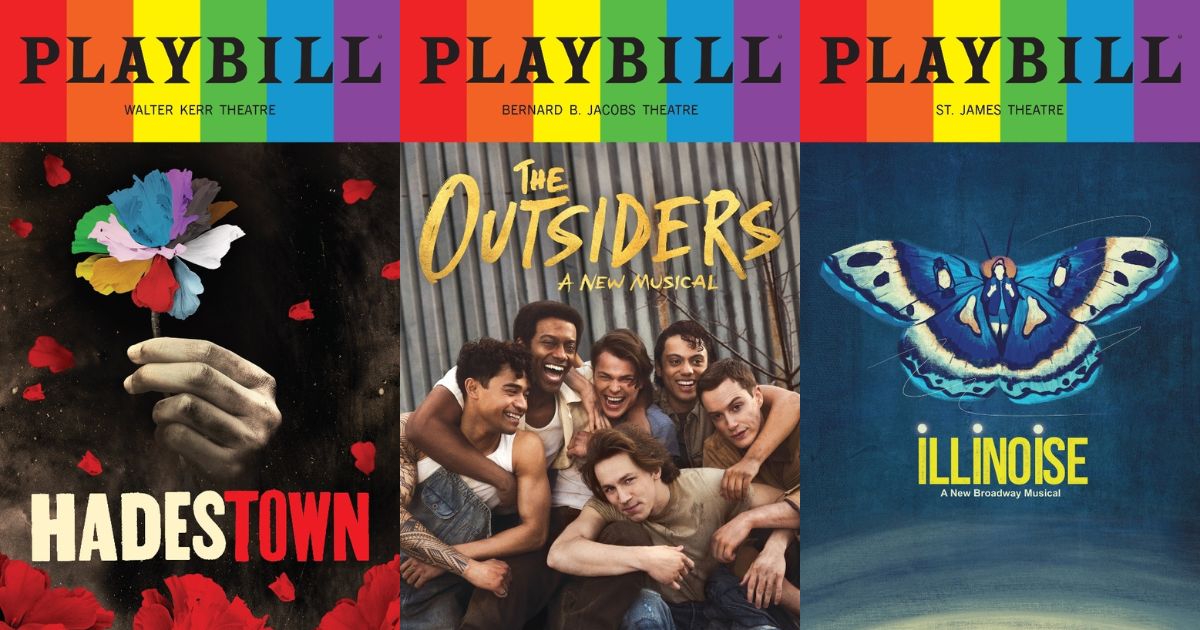
Of the shows currently occupying midtown theaters, Anaïs Mitchell’s Hadestown has run the longest, having just passed its five-year mark. With eight Tony Awards from its 2019 debut, the musical pairs the Greek myth of Orpheus and Eurydice with that of Hades and Persephone. Though its original cast has scattered to other projects, beloved folksinger Ani DiFranco spent a bit of her winter and spring this year offering a stunning run as Persephone.

Ani DiFranco and Anaïs Mitchell outside the Walter Kerr Theater in New York City. Photo by Matthew Murphy.

Fans may know DiFranco trained for many years as a dancer, even as she was building her singer-songwriter street cred. She proves to be a triple threat in the role, embodying the storied arbiter of summertime with a deeply rooted, empathic swagger. And though her June 30 departure feels like the end of an era for the musical, her latest album Unprecedented Sh!t (released May 17 on Righteous Babe Records) charts some new sonic territory via her political POVs.

Further, it’s hard to mourn DiFranco moving on when it was recently announced that British country favorite Yola will replace her in the role of Persephone, beginning July 2.

Hadestown was briefly joined last year by fellow roots musical Shucked, which came and went too soon. Awash in silly corn puns and Tampa-centric storyline, its earworm score was penned by Nashville mainstays — and Grammy darlings — Brandy Clark and Shane McAnally.

Last month, Illinoise opened at the St. James Theater on 44th St. Pulling tracks from Sufjan Stevens’s sprawling, ambitious 2006 album of the same name, the show reorders the songs to depict a group of friends sharing stories around a campfire. There is no dialogue. Instead, a 12-piece band and a trio of vocalists in magical butterfly wings perform the music in the background.

Upstage, Illinoise tells its stories through exquisite choreography that runs the gambit from lyrical contemporary to hip-hop, some sweet Broadway jazz, and even one number (“Jacksonville”) with a lightning-fast tapper in pinstripes. Dancers touch on love and loss, fear and transcendence.

“Zombies” becomes a scene about the immigrant experience, as dancer Jeanette Delgado (“Jo”) tries to outrun the ghosts of America’s founders, whose complex legacies still haunt the present day. “The Man of Metropolis” becomes a comical superhero-themed character romp. And former Billy Elliot star Ben Cook (“Carl”) delivers a heartbreaking and inspired series in Act II to track an emotionally complex love triangle.

By show’s end, there is a pervasive sense of the opportunity art grants us to transcend our selves and build a better world together. It’s no wonder the show was nominated for four Tony Awards, including Best Musical. If it wins, it will be the first time a dance musical has won the prestigious award.

The Outsiders, meanwhile, is running now just one block away, at the Bernard B. Jacobs Theater. It sets to music the novel by S.E. Hinton, which was immortalized in a 1980s film by Francis Ford Coppola. Produced in part by Angelina Jolie, with a book by New York theater fixture Adam Rapp (Wolf in the River, The Sound Outside) and music by Americana mainstays Jamestown Revival, this musical version unfortunately doesn’t measure up to the other two roots musicals in the neighborhood.

Granted, perhaps it doesn’t have to. The Broadway League and American Theater Wing don’t seem to be anything less than impressed, having nominated the musical for a whopping 12 Tonys this year. It may not translate seamlessly to the Broadway stage, but The Outsiders is a story that has been beloved by numerous generations. It was a treat to witness members of Generation Alpha giddy with excitement to take in the narrative arc of Ponyboy and the other Curtis brothers — a story that feels to this writer as though it’s rooted in Gen X sensibilities, despite being set in the 1960s.

Choreography by Rick and Jeff Kuperman was athletic and stunning — plenty of leaps and jumps and long, denim-clad legs spinning in the air like human helicopters. The Kuperman brothers’ martial arts background comes through even beyond the inventive dance-fight scenes. There is water on the stage, somehow, and it splashes up from time to time, for some reason. It doesn’t matter why. The effect is properly dramatic.

Brent Comer, who plays “Darryl,” steals the show with his powerful Zac Brown-reminiscent twang. He has some of the most compelling solos, embodying the exhaustion of a stay-at-home-mom as he folds clothes and laments his lot in life, “somewhere between brother and father” since their parents died. Jason Schmidt as “Sodapop” matched his rootsy musicality with the second-act heart grabber, “Throw in the Towel.”

But it is Joshua Boone’s “Dallas” who is perhaps the show’s greatest revelation, with his Bill Withers-esque vocals on solos like “Little Brother.” Brody Grant as Ponyboy seemed a bit lacking during the matinee performance this writer recently caught, but it could have been an off moment. Eight shows a week requires almost superhuman amounts of energy reserve.

Or perhaps it was a side effect of Grant being in his 20s while his character is supposed to be 14. Indeed, despite the electricity of The Outsiders’ score and choreography, the script doesn’t feel as authentic as its emotional realities demand. Hinton’s book offered readers a revolutionary view of teen struggles, written by a teenager. Perhaps the Broadway show should have brought in some teenagers to consult.

Regardless, both Grant and Boone were nominated for Tonys (as was Sky Lakota-Lynch, who delivers a haunting performance as Johnny). For folks just interested in what Jamestown Revival did for the show’s score, an Original Broadway Cast Recording is available now.

All told, there is no indication Broadway is going to break its love affair with roots music anytime soon. The Avett Brothers are set to make their Broadway debut with shipwreck-themed musical Swept Away this fall. The show has previewed in California and Washington, D.C., and has received critical praise already. Swept Away’s score is drawn from the Avetts’ 2004 album, Mignonette, plus four other songs from their canon — a treat for the band’s incredibly loyal fanbase and Broadway subscribers alike.

Further on the horizon is an adaptation of the classic labor movement-inspired film Norma Rae, with music by Rosanne Cash. In an email, her manager indicated a possible 2025 opening. One can only hope. And, just last week, Dolly Parton announced an upcoming original musicalHello, I’m Dolly, set to arrive on Broadway in 2026.


The 77th Tony Awards will be held on Sunday, June 16, 2024 and will air on CBS. Find out how to watch here.

Playbill images courtesy of Playbill.com

Artist of the Month: The Avett Brothers

(Editor’s Note: On May 17, The Avett Brothers released a new, self-titled album. BGS is proud to bring them back as our Artist of the Month for June 2024.

Below, enjoy a musical exploration of their illustrious career and prolific catalog. Plus, you’ll also find our Essential Avett Brothers Playlist for even more discography digging. And, you can revisit our feature from June 2016, when they were first selected to be our AOTM eight years ago.)

Depending on how you reckon it, you could say The Avett Brothers’ career goes back about two-dozen years – or Scott and Seth Avett’s entire lives. Even if you know nothing at all about them, all it takes is a few seconds of hearing them singing together to realize that they really are brothers.

Elder brother Scott’s voice is usually earthy and down below to Seth’s angelic up above. They meet in the middle to harmonize on songs about a series of quests – for love, redemption, family, pretty girls from far-away places, or just to be seen. Small wonder that one of their latest undertakings is Swept Away, a musical inspired by the mythology of their musical world.

To celebrate our Artist of the Month, here are a dozen songs about The Avett Brothers’ remarkable journey.

“Pretty Girl From Matthews” (2002)

Pretty girls are, of course, a perennial songwriting topic for the Avetts – most of them identified simply as “Pretty Girl From.” It’s taken them far and wide, from Michigan to Chile, Annapolis, San Diego, Cedar Lane, Raleigh, Feltre, Locust and even “at the Airport.” But here is the earliest example in all the Avetts’ early, detuned glory, from a town southeast of Charlotte. Originally titled “Song For Robin,” “Pretty Girl From Matthews” was the opening track on 2002’s Country Was.

“Talk on Indolence” (2006)

Folksy Americana trappings aside, Seth and Scott started out playing in bands that did a lot more screaming and thrashing than crooning and strumming. And even as their music has grown more polished and stately over time, their raw streak still comes out regularly. This breathlessly paced head-banging rant, which kicked off 2006’s Four Thieves Gone: The Robbinsville Sessions at an amphetamine pace, is one they still play at most shows.

“Distraction #74” (2006)

Another Four Thieves Gone recurrent, “Distraction #74” evokes British seafaring vibes seemingly tailor-made for raucous pub sing-alongs. And it has a perfect Avett Brothers lyrical theme: Torn between two lovers, the protagonist mostly wonders which of them he’s going to miss the most. The only certainty is that he’ll blow it with both of them.

“Die Die Die” (2007)

In which the Avetts don’t just make a simple pop move, but pull off what might be the least-likely Beatles rip ever. “Die Die Die” opened 2007’s Emotionalism, their first album to crack the Billboard 200 and a showcase for new cellist Joe Kwon. Among the Fab Four echoes here are Beatle-esque vocal harmonies and a guitar solo that’s pure George Harrison. Onstage, they’ll sometimes make it even more overt by closing with flourishes from “I Want to Hold Your Hand.”

“Paranoia in Bb Major” (2007)

Nothing fancy, just a little banjo and glockenspiel number from Emotionalism that perfectly captures the Avetts’ manic whisper-to-a-scream mood swings. Then it closes with one of their quirkiest recorded moments, wordless falsetto chanting that is somehow adorable.

“Murder in the City” (2008)

From 2008’s The Second Gleam, “Murder in the City” came out right when this cult act was about to go mainstream. It feels like one last look back before stepping into the spotlight, a series of epigrams about love, jealousy, family and forgiveness.

“Murder in the City” remains one of the Avetts’ regular live set-pieces, with lyrics that have evolved to reflect the brothers’ evolution from children to parents themselves. It’s a cinch they’ll still be playing and updating it someday when they’re grandparents, too.

“Head Full of Doubt/Road Full of Promise” (2009)

Fittingly, “Head Full of Doubt/Road Full of Promise” was the song the Avetts played during their star turn with Mumford & Sons behind Bob Dylan at the 2011 Grammy Awards. “Decide what to be and go be it” might be their most durable manifesto, which is a big reason it remains their most-performed song live. According to Avett Brothers super-fan Tim Mossberger’s database, it’s closing in on 1,000 live performances. And it still kills. All it takes is hearing Kwon’s cello riff to bring on chills.

“Laundry Room” (2009)

Like “Head Full of Doubt,” “Laundry Room” is drawn from the Avetts’ 2009 big-league debut, the Rick Rubin-produced I and Love and You – their first gold record. It’s a beautifully poignant portrait of stolen-moment love that may or may not be doomed.

“Tonight I’ll burn the lyrics/ ’Cause every chorus was your name,” Scott sighs, contemplating a “head-full of songs” he dreamed up overnight. The double-time hoedown outro plays like a bittersweet wake. “Laundry Room” ranks second on Mossberger’s live-performance database.

“Live and Die” (2012)

From 2012’s The Carpenter, the Avetts’ first to crack Billboard’s Top 10, “Live and Die” is just about the poppiest they’ve ever sounded – even with banjo as lead instrument. In contrast to the Avetts’ usual outlook, it is surprisingly optimistic, which made it the perfect upbeat closing-credits accompaniment for director Jud Apatow’s romantic comedy, This Is 40.

“Satan Pulls the Strings” (2014)

The studio version of “Satan Pulls the Strings” appeared on 2016’s True Sadness, but this one was around for years before that. In fact, its best incarnation is as entrance music for the live show. Among my favorite in-concert memories of the Avetts was watching the entire seven-piece band enter the stage one by one and start in on this song on New Year’s Eve 2014 in Raleigh, North Carolina. That performance appears on 2015’s Live Vol. Four.

“No Hard Feelings” (2016)

In recent years, “No Hard Feelings” has been the Avetts’ customary show-closer, ending each night on a prayerful, elegiac note. As depicted in the 2017 biopic May It Last: A Portrait of the Avett Brothers (overseen by Apatow and Michael Bonfiglio), recording it for 2016’s True Sadness LP was an overwhelmingly emotional experience. It triggered a meltdown by Scott immediately afterward, a sequence that proved to be the film’s most memorable moment.

“Operator (That’s Not the Way It Feels)” (2022)

On-record as well as onstage, the Avetts have always had splendid taste in covers, dipping into the songbooks of Townes Van Zandt, John Prine, Bob Wills and many others. There’s also “Operator (That’s Not the Way It Feels),” a 1972 Top-40 classic by the late great folk-rocker Jim Croce. Seth started doing a stripped-down acoustic version of “Operator” with bassist Bob Crawford back in 2012, and it’s one they still dust off regularly 12 years later.

Read more about the Avett Brothers’ eleventh and self-titled album here.


David Menconi’s latest book, Oh, Didn’t They Ramble: Rounder Records and the Transformation of American Roots Music, was published in 2023 by University of North Carolina Press.

David would like to thank Tim Mossberger for assistance with facts and figures.

Photo Credit: Crackerfarm

BGS 5+5: Frontier Ruckus

Artist: Frontier Ruckus
Hometown: Detroit, Michigan
Latest Album: On the Northline (out February 16)

(Editor’s Note: All answers provided by Matthew Milia.)

If you had to write a mission statement for your career, what would it be?

“Celebrate the minutiae.” It’s no secret that that’s what my lyrics are all about. Specificity, specificity, specificity. I truly believe that the universal resides in the particular. And, that by singing about things in extreme detail, enormous truths are unlocked. Hence my apparent mission to name every landmark of my local universe/my personal mythology: The mall where my mom worked when I was a kid, my Catholic grade school, the soccer field where I first experienced the holy human emotion of humiliation.

On the Northline is a continuation of that ongoing catalog of catharsis. Me constantly digging deeper in the junk drawer of memory. You’d think that approach would be an almost unlistenably niche experience for the audience – but I’ve found it to be the opposite. I was so stunned the first time we played in London and kids in the front row were singing lyrics back to me about obscure Michigan towns and situations. They told me after the show that I might as well have been singing about their own towns, that the truths were universal. That was one of the best feelings ever.

What has been the best advice you’ve received in your career so far?

We once opened for blues harmonica legend Charlie Musselwhite in Houston and his parting words for us were: “Remember, the only chords you need are I, IV, and V.” Anyone who’s listened to Frontier Ruckus knows I definitely did not heed that advice, as I’m constantly trying to insert labyrinthine chord progressions and every melodic trick I’ve absorbed from 38 years of listening to pop radio.

Advice that we’ve found more apt came from our first manager, Dolphus Ramseur – an old-school North Carolinian known for discovering the Avett Brothers. He would always say, “Matthew, a career’s not a rocket ship, it’s a balloon ride.” And though we’d often laugh at the down-home, fortune cookie flavor of that mantra, it proved truthful time and again. The little career peaks came and went – playing Bonnaroo, Lollapalooza, whatever. But the thing that really allowed us to build anything of lasting value was the very gradual “one fan at a time” approach. Back-alley performances of the song someone wanted to hear, who drove from another state, sending out lyrics that someone wants tattooed in your handwriting, favoring intimate living room shows over bar gigs. I’m sure my bandmates Davey and Zach would agree, those are the things that have made Frontier Ruckus a glorious balloon ride.

How often do you hide behind a character in a song or use “you” when it’s actually “me?”

Constantly. People think the majority of my songs addressed to a “you” are to a love interest or even an enemy, depending on the song. It’s almost always me speaking to me. Sometimes encouraging myself; sometimes beating myself up. Internal monologues, at least mine, are mercurial and neurotic. Putting them into song really helps me work through some stuff, psychologically. That bit of distance allows me healthy perspective. A chance to pep myself up to fight another day. To quote myself singing to myself: “If only you knew what you are.”

Which artist has influenced you the most – and how?

It’s no doubt cliched, but it has to be Dylan. My dad raised me on him and it’s what activated my love for language. The potential playfulness of words. Their athleticism and malleability. The infinitude of connotation. The element of surprise packed into unexpected metaphor. How a line can be drop-dead-serious and winking at the same time. I also think Dylan is an underrated melodist and chordal architect. Look at all the non-12-bar-blues songs on Blonde on Blonde. The energy is propellent, continually cascading in an amphetamine avalanche. And it’s not just the words, it’s the chords providing the lyrics a perfect vehicle to ride in. The erosion of really intentional chord progressions in modern music is something that worries me quite a bit.

What other art forms – literature, film, dance, painting, etc. – inform your music?

I studied poetry in college under an incredible poet named Diane Wakoski who came out of the New York beat scene. She really informed my fondness for striking images, unexpected metaphor, and surprise revelations. Other than my bandmate David Jones, she was one of the earliest champions of my writing who helped me hone my voice and style.

Sometimes I wanna write songs that feel like a David Lynch film: A shiny Americana veneer on the surface, a severed ear of fractured emotion buried in the grass. I love quaint things with a shady underbelly. I’m obsessed with ’90s sitcoms set in New York, but with obvious LA studio back-lot sunlight. Any art form where sharply antithetical images are juxtaposed in magnetic conflict inspires me. On the Northline hopefully portrays a similar landscape: An insular world where the darkness and light necessitate one another.


Photo Credit: John Mark Hanson

See the Winners of the 2023 Americana Honors & Awards

The Americana Music Association announced the winners of its 22nd annual Americana Honors & Awards this evening (September 20) at a star-studded show at the historic Ryman Auditorium during the week-long AmericanaFest conference and festival in Nashville. Performers at the marquee event – which felt, as it usually does, more like a concert interspersed with awards presentations than vice versa – included Bonnie Raitt, Bettye LaVette, S.G. Goodman, Noah Kahan, The Avett Brothers, Adeem the Artist, William Prince and many more with Buddy Miller once again as music director for the Americana All-Star Band.

The evening’s presentations also spotlit this year’s Lifetime, Trailblazer, and Legacy Award Honorees: The Avett Brothers, George Fontaine Sr., Bettye LaVette, Patty Griffin and Nickel Creek. Allison Russell, nominated in two categories, was bestowed the Spirit of Americana / Free Speech in Music Award by the infamous Tennessee Three, Tennessee state representatives Gloria Johnson, Justin Jones and Justin Pearson, whose expulsion by the Tennessee General Assembly after protesting in support of common sense gun legislation earlier this year made international headlines.

A full list of categories, nominees and winners at the Americana Music Association’s 22nd annual Americana Honors & Awards is below, winners in bold. Congratulations to all of the honorees and awardees!

ARTIST OF THE YEAR:

Charley Crockett

Sierra Ferrell

Margo Price

Allison Russell

Billy Strings


ALBUM OF THE YEAR:

Big Time, Angel Olsen; Produced by Angel Olsen and Jonathan Wilson

Can I Take My Hounds To Heaven?, Tyler Childers; Produced by Tyler Childers

El Bueno y el Malo, Hermanos Gutiérrez; Produced by Dan Auerbach

The Man from Waco, Charley Crockett; Produced by Bruce Robison

Strays, Margo Price; Produced by Margo Price and Jonathan Wilson


SONG OF THE YEAR:

“Change of Heart,” Margo Price; Written by Jeremy Ivey, Margo Price

“I’m Just a Clown,” Charley Crockett; Written by Charley Crockett

“Just Like That,” Bonnie Raitt; Written by Bonnie Raitt

“Something in the Orange,” Zach Bryan; Written by Zach Bryan

“You’re Not Alone,” Allison Russell featuring Brandi Carlile; Written by Allison Russell


DUO/GROUP OF THE YEAR:

49 Winchester

Caamp

Nickel Creek

Plains

The War and Treaty


EMERGING ACT OF THE YEAR:

Adeem the Artist

S.G. Goodman

William Prince

Thee Sacred Souls

Sunny War


INSTRUMENTALIST OF THE YEAR:

Isa Burke

Allison de Groot

Jeff Picker

SistaStrings – Chauntee and Monique Ross

Kyle Tuttle


Jack Emerson Lifetime Achievement Award

George Fontaine, Sr.

Legacy of Americana Award (Presented in partnership with the National Museum of African American Music)

Bettye LaVette

Lifetime Achievement

Patty Griffin

The Avett Brothers

Spirit of Americana / Free Speech in Music Award

Allison Russell

Trailblazer Award

Nickel Creek


Photo Credit: Bettye LaVette by Danny Clinch; Allison Russell by Laura E Partain; Billy Strings by Jesse Faatz; SistaStrings by Samer Ghani.