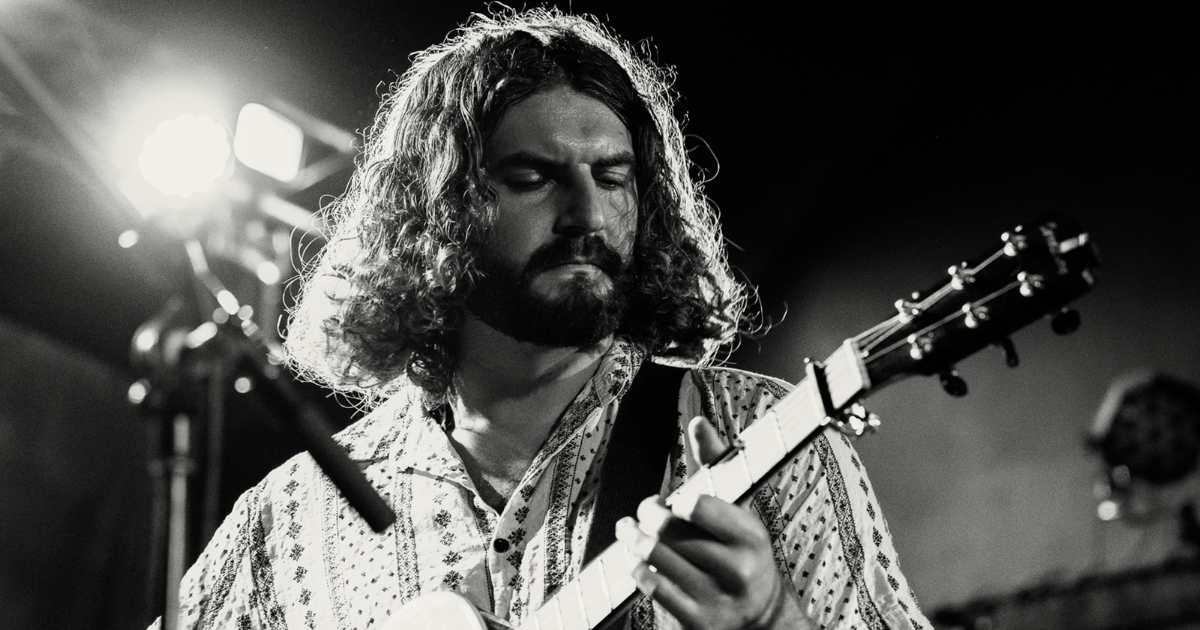
Editor’s Note: Last month, we featured an interview with singer-songwriter Cole Chaney on the site for the very first time. The Kentuckian artist was more than generous with his time, spending a couple of hours speaking to BGS and Good Country contributor Alison Richter.
Many lovely portions of their interview ended up cut for length, so we’re excited to share a few selections from those edits here as a bonus follow-up to our feature conversation. Below, enjoy Chaney discussing how songs morph and change over time, his practice regimen, guitar and songwriting as crafts and forms of expression, and much more.
Songs Evolving Over Time
The intention is the same as it was back then [when they were written], but your taste grows as you develop as an artist and musician.
When you listen to the Mercy version of “Ill Will Creek” (above) and the Live AF version, those are two almost completely different songs, but they’re still the same. The thread, the root of the song, remains the same. They’re just wearing a different coat.
Practice and Technique
I don’t have a concrete practice routine. I’ve never been able to sit down and make myself do scales or anything like that. I’d probably be a lot better guitar player if I did more technical playing.
I’ve always idolized guys like Hendrix, and if you look into how he looked at it, he didn’t have time to practice because he was always writing riffs and coming up with cool guitar licks or creating in some capacity. That’s what I do when I have a guitar in my hands. I warm up and play some scales or whatever, but it eventually turns into, “Oh, man, that sounds cool. What can I attach to that?” and I start writing riffs. That’s just how I do it.
I would be a much more technically proficient guitar player if I actually did sit down and make myself practice a lot. But I think a lot of that creativity comes out of me having a weird picking style and not being necessarily educated on what is supposed to sound good and where that’s supposed to go, and just letting stuff happen where it happens.
Guitar As Expression
Especially in recent years, as we talked about the bands I’m influenced by – very guitar-heavy bands, for me – it always starts with a riff. I like chunky, heavy stuff a lot of the time. A song doesn’t always call for that; sometimes you write something that may sound a little more sensitive, but the direction it’s gone with me has been catchy riffs that stay in your head when you play it. That’s when I know I’ve got something cool and that I should keep plugging away.
I sat down last night with a little $300 Breedlove and plucked away at this riff I’ve been messing with for two-and-a-half hours, just seeing what I could add in here, if this would sound cool there. And so, yes, the guitar is just as important, if not more, to my music as the lyrics.
The Craft of Songwriting
It’s not always riffs first, lyrics second, but I find that is most often the way it goes down. I don’t know. I can’t give you a way my songs come together. It feels like it happens in a different way every time. I’m very melody-driven; it’s the way I listen to music. Everybody’s got different things they’re trying to get out of the songs, but, for me, the melody is the most important thing.
Reinterpreting “Spirit” for In The Shadow Of The Mountain
It was a work in progress, because there’s a challenge in having songs be out for two or three years on their own as solo acoustic pieces.
I kind of look at the OurVinyl [Sessions] as demos– in a way, that was not necessarily what I saw as the finished product for any of those songs. And then they get the attention, that becomes the versions of the songs that people know and love, and it puts pressure on the situation of, “Oh, damn, people care about this song now, so I have to do it justice.’ It has to be tasteful, it can’t be too much, and all these things. It’s an equation that you’re trying to find the answer to.
“Spirit” maybe took the longest out of all of them. There’s me and Duane Lundy and Zachary Hamilton co-producing. If you talked to them, they would probably tell you the same thing – it took us the longest to get that song to where we were all feeling really good about it.
We were maybe one day away from having to have the mix completely wrapped up on everything and send it off to be mastered. I was listening to “Spirit” on my way to the studio and I was like, “This sounds really good, the groove is there, but something’s missing and I don’t know what it is.” It was driving me nuts. I was wracking my brain. “What would sound good on this? What would sound good?” And I was like, “It needs a piano, an actual piano.”
I’m a huge Bruce Hornsby fan, so I wanted something nimble like that. The one person I knew I could lean on to do it was Aaron Bibelhauser. I called him, and it was one of those “something that’s meant to be” type of things. It was, “Man, I don’t know if you can get in here today. We’ve only got one day left to finish this thing, but ‘Spirit’ really needs a piano on it. And if you’re around” — he’s from Louisville — “and you can make the trip, I’d love to get you to put some piano on it.” He said, “I’m actually in Lexington right now, so I can just run right on over.”
I think it really tied the whole song together and made it the full picture that I had been envisioning for that song the whole time.
Looking Ahead
I still write and love to write folk songs, but I keep running into this issue while I’m writing folk songs of trying to make them a little too brooding or complex when they don’t need to be all the time. You can have complex folk songs. I think Billy Strings is a good example of that. “Gild the Lily” is a fantastic song, and that’s complex, but it’s still very much a string band song.
There’s a lot of creative energy flying around in the Cole Chaney realm right now. I don’t know what it looks like yet, so I can’t step out on a limb and say a whole lot about it, because there’s nothing certain happening.
But we’re all working on contributing towards something that will be really interesting and cool, if it ends up coming to fruition, which I think it will. It will probably be a thing on its own. I need to do a dedicated rock project — I’ll just leave it at that. I think it’s safe to say at some point there will be electric guitars involved.
Read our full interview with Cole Chaney here.
Want more Good Country? Sign up to receive our monthly email newsletter – and much more music! – direct to your inbox.
Photo Credit: David McClister