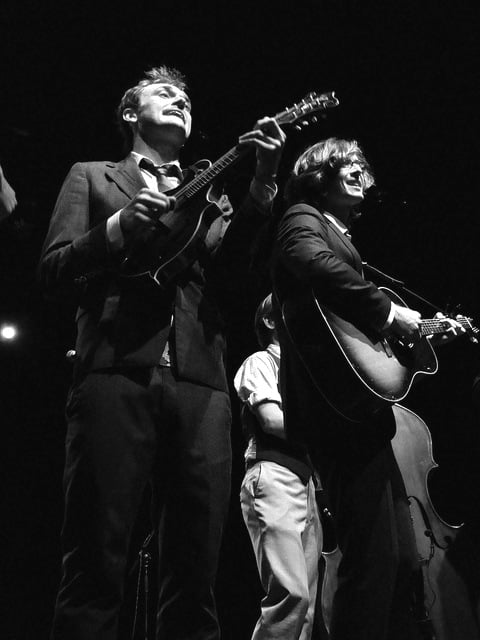
The Milk Carton Kids have been about nothing if not duality. That’s down to their very name, which evokes both comedy and tragedy, and their stage presence, in which some of the stateliest and most delicate songs possible are broken up by riotously deadpan banter. They’ve always been about duo-ality, too — two voices and guitars, gathered around a single microphone, contemplative Everlys for the 21st century, unaugmented by anything that would have seemed rank or strange to the Stanley Brothers back in the 1950s.
But now, suddenly, almost everything you know about the Milk Carton Kids is wrong — at least the formal elements. They’ve dropped the formal suits and picked up separate mics… and a full band, too, while they were at it. Could this be their Dylan-goes-electric moment? Not to worry — there probably won’t be any cries of “Judas!” greeting their fifth album, All the Things That I Did and All the Things That I Didn’t Do, or a touring ensemble that no longer fits in a single front seat. It’s not just that the new material is superb — although that never hurts — but that the fuller arrangements sound like a natural progression in what is still scaled for intimacy.
Before we get to the Kids, we queried producer Joe Henry for his thoughts about how necessary or smooth the transition was, going from duo to band configuration. He admitted there was at least the fleeting consideration of a backlash — “I don’t imagine it possible that the Kids weren’t individually and collectively pondering the response of an audience that has been so steadfast in their devotions to the band’s brazen and brave duo commitment to date.” But, Henry says, “I saw no evidence that the looming question gave them any pause… And no one involved that I’m aware of had any doubt that such a shift was now not only timely but imperative: they’d reached a point where the color of the light, so to speak, needed to reflect their growth as musicians and songwriters––this batch of songs being so particularly strong as to invite, nay, insist on a presentation equal in its evolution.”
The producer adds that the Kids are “still very much a duo in ethos and execution. There is real drama in the intimacy of Ken and Joey pushing up to a single mic in symbiotic solitude, and it was important to all three of us going in that that image remain intact ––even as new sonic weather kicked up and swirled around them.”
When we sat down with Kenneth Pattengale and Joey Ryan at a Van Nuys coffee shop in June, we found that off-stage they’re just like they are on-stage… only more so.
As part of changing things up, you’ve decided this is also the right time to go for street clothes in concert, right?
Joey: Talk about decisions that were never actually made.
Kenneth: Yeah, that one’s still TBD. I mean, we get on the tour bus tonight. Joey’s near his closet, but I didn’t bring anything from Nashville, so if I’m wearing a suit tomorrow, I’m gonna have to go to the Men’s Warehouse in Tucson. The advice I’ve gotten from literally everybody on earth is that they’re gonna be saddened to not see me in a suit, and that we should be wearing them. But… f— ‘em. [Laughs.]
Joey: Well, I never wanted to wear a suit. The reason that we wore suits in the beginning was as a part of a collection of survival techniques.
Kenneth: Given your druthers, you’d dress like an ass-clown, that’s why. And you can quote me on that!
Joey: [Sighs.] See, how can people not love us? No, it was a part of a suite of survival techniques that we developed when we were playing in very…
Kenneth: Techniques or tactics?
Joey: Techniques.
Kenneth: There are survival techniques? I think they’re mostly tactics. It’s interesting to hear you’ve developed survival technique. It sounds like something they’d sell in the Valley.
Joey: Those words are synonyms. It’s a survival tactic and a technique. In any case, in the early days, we were playing this really sonically fragile show, and the only places that would book us were like the smallest rock club or bar or coffee shop sometimes in town. In a dive bar, we would wear suits to visually indicate that it was just something different than what they would maybe expect to see in that room, so that you could have some chance for the first couple minutes of people taking note and going, “Alright, what is this gonna be? I’m going to shut up and listen for one song.” You at least have a song. You have that chance to get ‘em to stop talking loudly in the bars that they’re used to talking in and maybe pay attention to the show, because our show required that.
It’s not like an attention-seeking preciousness. It’s like a physical, sonic fragility that we had, because we mic-ed our guitars, and you just can’t turn it up that loud. The perfect example is how we played at the Beachland Tavern in Cleveland, Ohio, many times. It’s a great place but the beer fridge is louder than we could get the PA, so we had to ask the bar to unplug their beer fridge, and they were so accommodating. I don’t know what happened to the beer. And they would also bring in rows of folding chairs, which literally no other band would ever even ask them to do. But we always wanted to be in a theater where people would be able to receive what we were trying to present, and the suits were just part of that. Now, with the band…
Kenneth: You’re gonna go back to flip-flops!
Joey: With the band… [Long, exasperated pause.] See, people always say we’re antagonistic. I think it’s just him. No, with the band, we don’t have the sonic fragility that we had before. … And so the whole misdirection of wearing a suit in unexpected places is not required. That was a long way of saying: I’m excited to not wear suits.
How early or late in the process did you decide to go with a band for this album?
Joey: We decided three years ago in Dusseldorf, Germany that we weren’t going to make the next album as a duo… It was just a moment. It wasn’t like we even talked it out. [To Kenneth:] You were like, “I think we should probably do the full-band thing next.” And I was like, “Oh, thank God you said that, because I’ve been worrying about how to bring that up.” But you always break the ice.
Kenneth: Yeah. I’m a talker.
I’m always interested in how people who are identified with a very specific thing decide to change it up… or not. A lot of times, people back away from giving up the thing that people identify as unique.
Kenneth: It’s always risky to go down these philosophical rabbit holes in interviews like this, because invariably they come out not reading exactly as intended, but I’ll go anyway, because who gives a shit? One of our blind spots -– and I think it’s a common blind spot for artists specifically — is that Joey and I for a long time had a complete inability to understand what was good about our band, while also knowing it in our core. And it’s necessary. If we knew what that was, I think that we would lean into it, and it would get tired very quickly and wouldn’t mature and evolve.
But for the first year and a half of our band, Joey and I didn’t realize that we were good just because when we sang together, it sounded like something that people either had never heard before or hadn’t heard in a while, or it bore a trueness that was just apparent in its physics. Joey and I thought that it was a result of all the hard work we do about making sure our harmonies are tight or about phrasing or about all these marginal things that we quibble over. You really lose sight of what the fundamental thread is that actually is the reason the whole thing exists. And we still have that blind spot. There’s something that’s just innate in what you do from the beginning that we take for granted.
So what is the thing you have the blind spot about, that your audience totally gets?
Kenneth: To put it really simply, when Joey and I sing together, it reminds people of Simon and Garfunkel, the way they actually physically combine, like alchemy in the air, or the way the Everlys did it, or the Louvin Brothers. When Joey and I sing together, there is some physical chemistry that is actually, like, we have to try hard to f— it up. And we have from time to time, but we’ve got an advantage coming out of the gate to other people singing harmony together, in that there’s something that just works about it.
And then there’s a similar shared vision in our writing and stylistic choices, and even essential life administration, where, outside of a few blowouts where we figured out what the problem was, the way they rub together results in this strange band that people haven’t kicked out of life yet.
Read the second half of this interview.
Photo credit: Joshua Black Wilkins