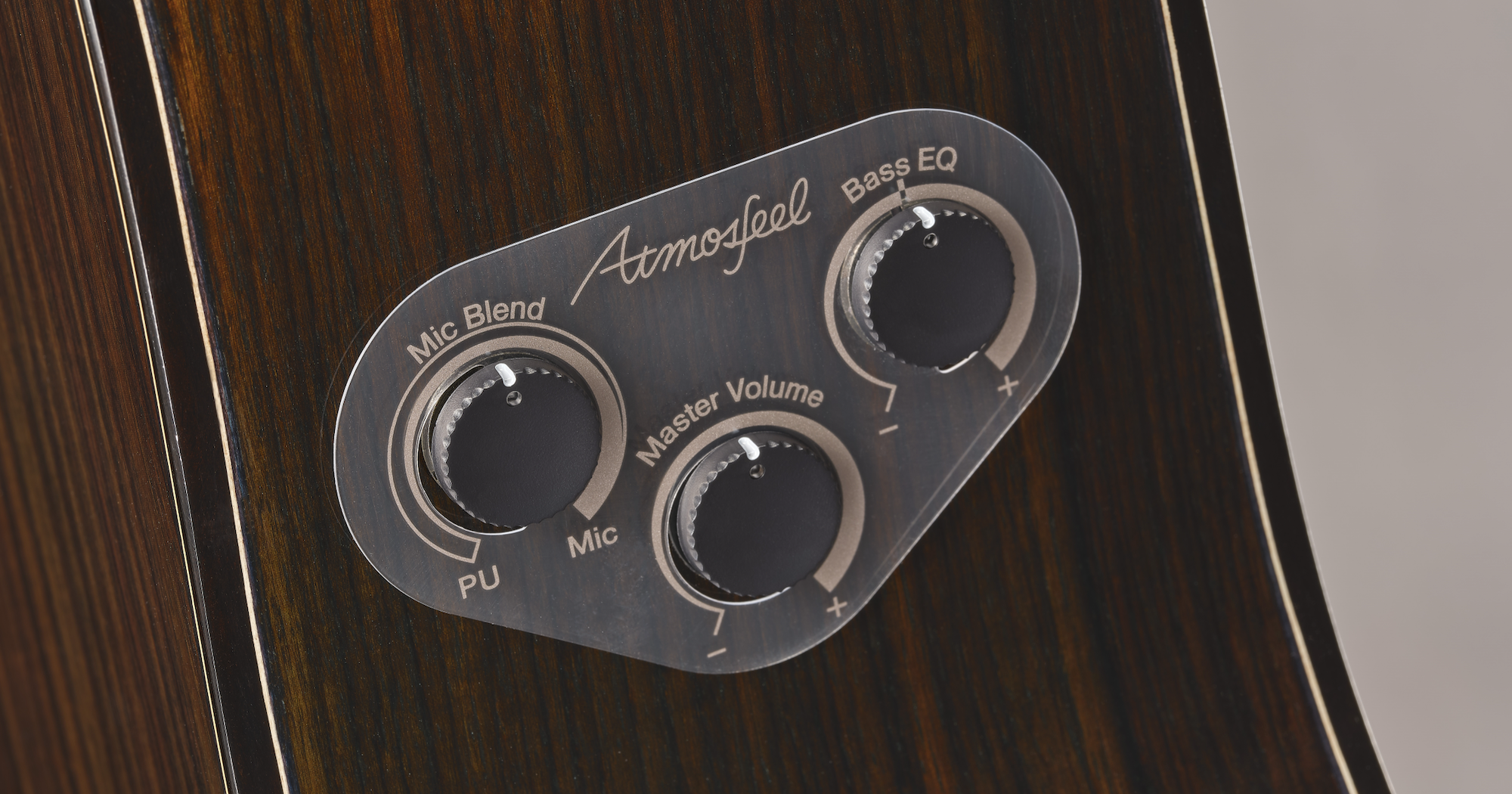
The great Doyle Dykes once remarked, “The Bible says, ‘Sing unto the Lord a new song and play skillfully with a loud noise.’ Of course, I guess it helps to have a good amp to do that!” The team at Yamaha Guitars has taken that theory a step further to include a good pickup/preamp system. That’s why they designed Atmosfeel.
Atmosfeel is user-friendly, easy to use, and available in the X models of Yamaha’s exquisite FG Red Label acoustic guitars and concert-size FS series. Its 3×3 concept – three elements, three knobs – may appear simple, but in fact it was almost five years in the making.
According to Yamaha Guitars marketing manager Brandon Soriano, development of the Atmosfeel system began in 2014, prior to its original launch, plus an additional three years leading up to the FG/FS9X guitars.
Like all Yamaha products, Atmosfeel was created with the musician in mind, says Soriano. “Yamaha’s consistent process is that we include a lot of feedback from artists, from our internal employees, and from partners we work with. This pickup system was geared toward artists and performers from the very beginning, so their feedback was essential in crafting this system.”
There is no shortage of choices when it comes to acoustic guitar pickups and preamps. What makes Atmosfeel different? Once again, says Soriano, it comes down to R&D by musicians, for musicians. With guitarists often searching and settling for what he calls the “least bad” option, Yamaha was determined to offer “actively good” the first time, every time, with technological advancements that don’t require an engineering degree and 200-page manual to make the magic happen.
“What we noticed is that the pickups on the market tended to not sound like your guitar,” says Soriano. “There was the sound of your guitar in the room, and then this other sound that happens when you plug it in. Our goal was to make a pickup system that sounds natural – a true representation of the guitar you have, of your tone onstage, while keeping it simple enough to use and easy enough to make changes on the fly, and to have the same sound in the room and through the speakers when you plug it in.”
Atmosfeel was developed alongside the FG and FS guitars, which allowed Yamaha to voice the pickup system to specific models within the series, guaranteeing accuracy and precision at every level. “Our process is so in-depth that we leave no stone unturned,” says Soriano. “For example, the 9 grade FG and FS guitars have Adirondack tops, which are a different stiffness than the Sitka tops you’ll find on the 3 and 5 grade guitars. The [more recent] 9 level guitars have a slight taper going on, where the outer edges are about .2 millimeters thinner than the center point.
“We have exact measurements of how each of those tops resonate, how they vibrate, what their headroom looks like. We have all of these [minute] details at our disposal because we made the guitars. We know that the back and sides might have a slightly different thickness between rosewood and mahogany. We know that the stiffness of Sitka and Adirondack is different to this exact measurement.
“When we’re crafting the pickup system, we take all those things into account and modify the voicing accordingly, with the ultimate goal of all these guitars outputting the most accurate sound we could possibly come up with, compared to what the guitar sounds like acoustically in the room. The guarantee is that we spent years developing this system and specifically voicing each model’s pickup system to that guitar.”
To further dial in accuracy and ensure that Atmosfeel could deliver anywhere, at any time, the system was thoroughly artist-tested prior to its debut.
“We come up with a voicing we’re really confident in and then we’ll bring in artists to do evaluations,” says Soriano. “In real time, we have the guitar hooked up to a computer, and a person is behind the keys adjusting the voicing based on the feedback the artist is giving us. We do this with a number of artists until we arrive at something that works for them and is the most versatile for all their different styles.”
How does Atmosfeel work, why does it work, and how does something so advanced remain simple and easy to use? This brings us back to the 3×3 concept, which was not a coincidence, says Soriano, but instead a carefully thought-out design balance between “How much is too much?” and “How little is too little?” One knob means few, if any, options, while an assortment of knobs becomes cumbersome and tricky, especially for guitarists who need quick-touch adjustments.
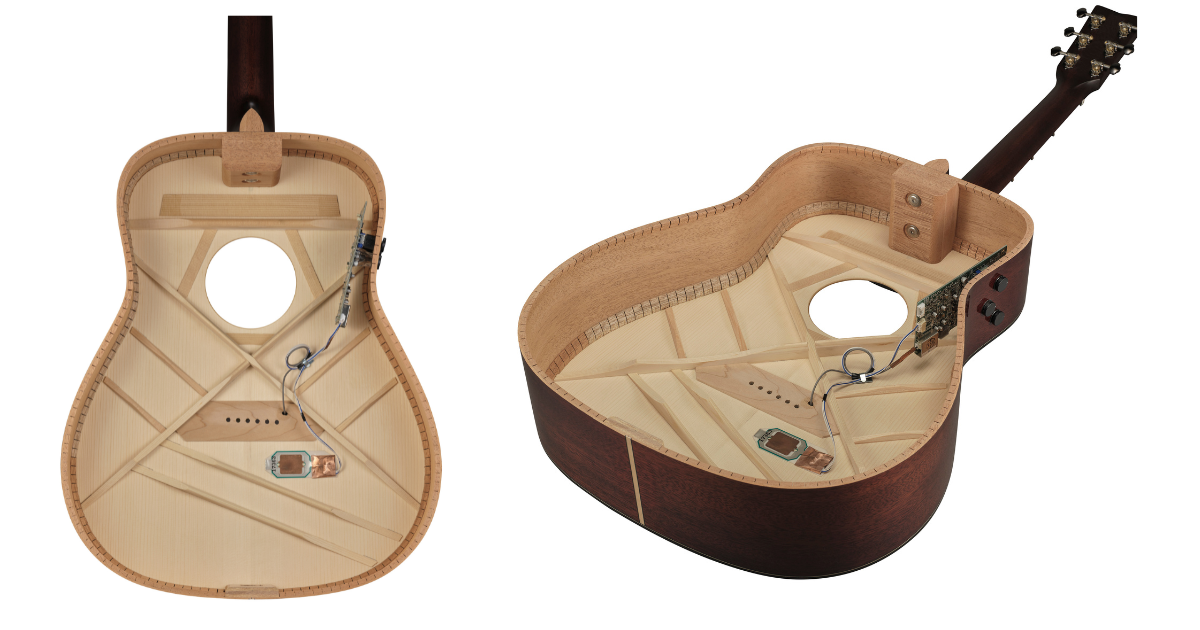
Atmosfeel is comprised of three elements: an under-saddle piezo pickup for low end, miniature condenser mic for mids, and proprietary, whisper-thin but deceptively strong, transducer contact sensor for overtones and clarity.
“Our approach was, first of all, to find out what are the strengths and weaknesses of all three elements,” says Soriano. “The under-saddle piezo pickups do a great job of capturing a bold and consistent low end. The weakness is that the high end has a tendency to sound unnatural to guitar players. That’s where you start to get a different sound than what your guitar is like in the room.
“The contact sheet, which is under the top wood of the guitar, is the inverse of that. It’s a paper-thin sheet that has a positive and a negative, and it captures the vibrations of the top. It’s really good at capturing air, high-end presence, and sparkle, and the low end is not as resonant.
“We’re taking the low end of the under-saddle and the high end of the contact sheet and creating what we consider to be the ideal blend between those two. That was the first step. Of course, neither of those technologies independently are completely new. Under-saddle pickups have been around for a long time. But the combination of the two, and the detail of how we blend them together, is what’s new in this system. That has created a new approach.
“The microphone, aimed at the side wood at the upper bout of the guitar on the low E string side, covers the mid-range character of the guitar, whether you choose mahogany or rosewood. Essentially, the system lets you have an ideal low end, an ideal high end, and you can blend the microphone in so that you get a mid-range to taste. We figured out how to take existing technologies to the next level and optimize them.”
All of this is controlled by three small knobs. “You get a Microphone Blend, which is really effective for shaping your midrange and overall character,” says Soriano. “You get a Master Volume, which is essential, and then the Bass EQ is really interesting.
“When you’re playing live, a lot of feedback can happen in the bass frequencies. The Bass EQ is a cut or boost knob, which can help with controlling feedback or warming up your signal. If you’re playing solo and need to take up more room in the mix, you can crank that Bass EQ knob. Vice versa is true as well. If you’re playing with a band and there’s a bass player, you don’t want to step on their toes, so you’re probably going to want to roll off some of that bass.
“The Microphone Blend can be used to pop in and out of featured parts or solos. If you need a smaller, more compressed sound just to be in the background, you might use less of the Mic Blend. When it’s time for you to step out and take your chorus, you can crank that microphone up, stick out in the mix momentarily, and turn it back down when the time is right.”
Atmosfeel was designed for player flexibility – style, genre, attack, in the studio, onstage, on your own, with a band. Wherever you go, whatever and however you play, the system’s versatility works with you and for you.
“If you’re an arena- or stadium-level act, chances are you have a pretty silent stage,” says Soriano. “Those acts today are using a lot of in-ear monitoring. You can get away with a lot of Microphone Blend in that setting, because you don’t have sound coming back at you with an onstage wedge, and the risk of feedback is probably lower. Also, in a larger space, the sound has more room to dissipate.
“If you’re in a coffee shop, you have a floor wedge aimed at you, and the room is small, your risk for feedback might be pretty high. In that instance, you want to reduce the Microphone Blend and maybe the Bass EQ to accommodate for those things.
“And, of course, everything in-between exists as well – clubs, mid-sized venues, things like that. The system lets you tailor your settings to each of those without being too complicated. It’s just three knobs. If you know how to use them, you can optimize your sound for whatever setting you’re in.”
Yamaha designed Atmosfeel with musicians’ peace of mind foremost, meaning durability on the road and reliability onstage and in the studio. Choose your settings and rest assured they will remain in place, even if you don’t. “The Bass EQ knob has a notch at 50 percent,” says Soriano. “When you get to that spot, it locks you into place. Of course, it’s not too hard to move out of that space, but it certainly will not move on its own.”
Best of all, the 3×3 setup means easy to use, easy to remember. “Even the highest level of professional musicians are human,” says Soriano. “When you’re onstage, you have adrenaline going, and you have to make quick decisions, you don’t want to pause and remember which one of your seven knobs does what. You want to reach down and do what you need to do quickly so you can get on with the performance. The three-knob system is extremely user-friendly for that. You don’t have to spend time thinking about it before making an adjustment.”
Atmosfeel is perfect for recording in a pro studio, home studio, or on the road. “The vast majority of the time, if you’re recording an acoustic guitar, you’re putting a microphone on the guitar,” says Soriano. “Nowadays, especially with the rise in home recording, a lot of people might have trouble getting a clean signal with a microphone in front of their instrument, especially if your room has a lot of reflections in it.”
What does this mean for bluegrass players?
“A lot of artists we work with are primarily bluegrass players,” says Soriano, “so bluegrass was absolutely a primary focus in the development of the FG9X guitars. Bluegrass players most commonly use dreadnought-style guitars, so when we were voicing the pickup system in the FG9’s, we knew they had to be able to use this and be happy with it. That was a big part of our testing.
“Bluegrass tends to be quite guitar-forward, especially if there’s a solo section, for example. Bluegrass players are discerning when choosing their instrument. A lot of players have a strong preference. They want rosewood or mahogany, and there’s a reason behind that. If you’re going to make that decision, and it’s going to show your artistry and your taste, you should be able to have that come through when you’re performing live, even with a pickup system.
In a world of bells and whistles, where everything has to be shiny with lots of buttons and gizmos, Atmosfeel is deliberately stripped-down – no flash, no glitter, just durability and refreshing beauty in its simplicity.
“When you have a minimal setup that’s well dialed in, well executed, and well developed, when you put that work in on the front end, you earn the ability to have a simpler user interface,” says Soriano. “Because we are so confident in the voicing of this system, and in the fidelity and quality of the components, we didn’t have to put a million knobs on the guitar. We could afford to keep it simple and be confident that it’s going to sound great.”
This content is brought to you in partnership with Yamaha Guitars. All images courtesy of Yamaha Guitars.