Yamaha’s Atmosfeel Was
Created by Musicians for Musicians

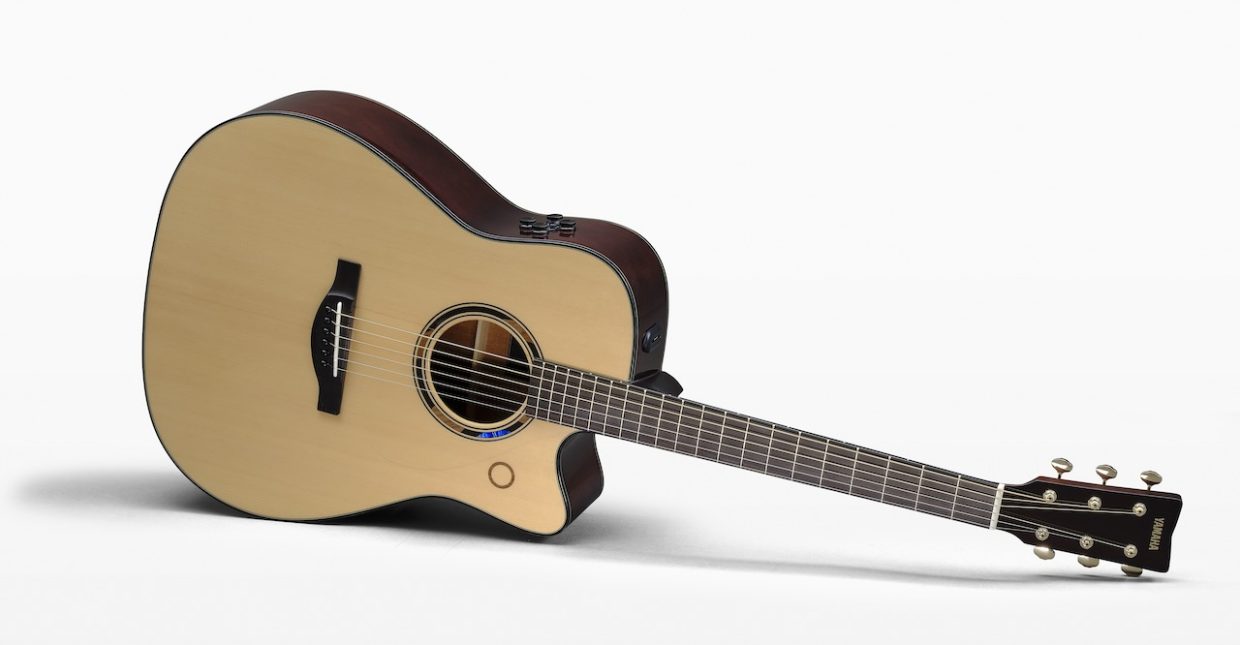
The great Doyle Dykes once remarked, “The Bible says, ‘Sing unto the Lord a new song and play skillfully with a loud noise.’ Of course, I guess it helps to have a good amp to do that!” The team at Yamaha Guitars has taken that theory a step further to include a good pickup/preamp system. That’s why they designed Atmosfeel.

Atmosfeel is user-friendly, easy to use, and available in the X models of Yamaha’s exquisite FG Red Label acoustic guitars and concert-size FS series. Its 3×3 concept – three elements, three knobs – may appear simple, but in fact it was almost five years in the making.

According to Yamaha Guitars marketing manager Brandon Soriano, development of the Atmosfeel system began in 2014, prior to its original launch, plus an additional three years leading up to the FG/FS9X guitars.

Like all Yamaha products, Atmosfeel was created with the musician in mind, says Soriano. “Yamaha’s consistent process is that we include a lot of feedback from artists, from our internal employees, and from partners we work with. This pickup system was geared toward artists and performers from the very beginning, so their feedback was essential in crafting this system.”

There is no shortage of choices when it comes to acoustic guitar pickups and preamps. What makes Atmosfeel different? Once again, says Soriano, it comes down to R&D by musicians, for musicians. With guitarists often searching and settling for what he calls the “least bad” option, Yamaha was determined to offer “actively good” the first time, every time, with technological advancements that don’t require an engineering degree and 200-page manual to make the magic happen.

“What we noticed is that the pickups on the market tended to not sound like your guitar,” says Soriano. “There was the sound of your guitar in the room, and then this other sound that happens when you plug it in. Our goal was to make a pickup system that sounds natural – a true representation of the guitar you have, of your tone onstage, while keeping it simple enough to use and easy enough to make changes on the fly, and to have the same sound in the room and through the speakers when you plug it in.”

Atmosfeel was developed alongside the FG and FS guitars, which allowed Yamaha to voice the pickup system to specific models within the series, guaranteeing accuracy and precision at every level. “Our process is so in-depth that we leave no stone unturned,” says Soriano. “For example, the 9 grade FG and FS guitars have Adirondack tops, which are a different stiffness than the Sitka tops you’ll find on the 3 and 5 grade guitars. The [more recent] 9 level guitars have a slight taper going on, where the outer edges are about .2 millimeters thinner than the center point.

“We have exact measurements of how each of those tops resonate, how they vibrate, what their headroom looks like. We have all of these [minute] details at our disposal because we made the guitars. We know that the back and sides might have a slightly different thickness between rosewood and mahogany. We know that the stiffness of Sitka and Adirondack is different to this exact measurement.

“When we’re crafting the pickup system, we take all those things into account and modify the voicing accordingly, with the ultimate goal of all these guitars outputting the most accurate sound we could possibly come up with, compared to what the guitar sounds like acoustically in the room. The guarantee is that we spent years developing this system and specifically voicing each model’s pickup system to that guitar.”
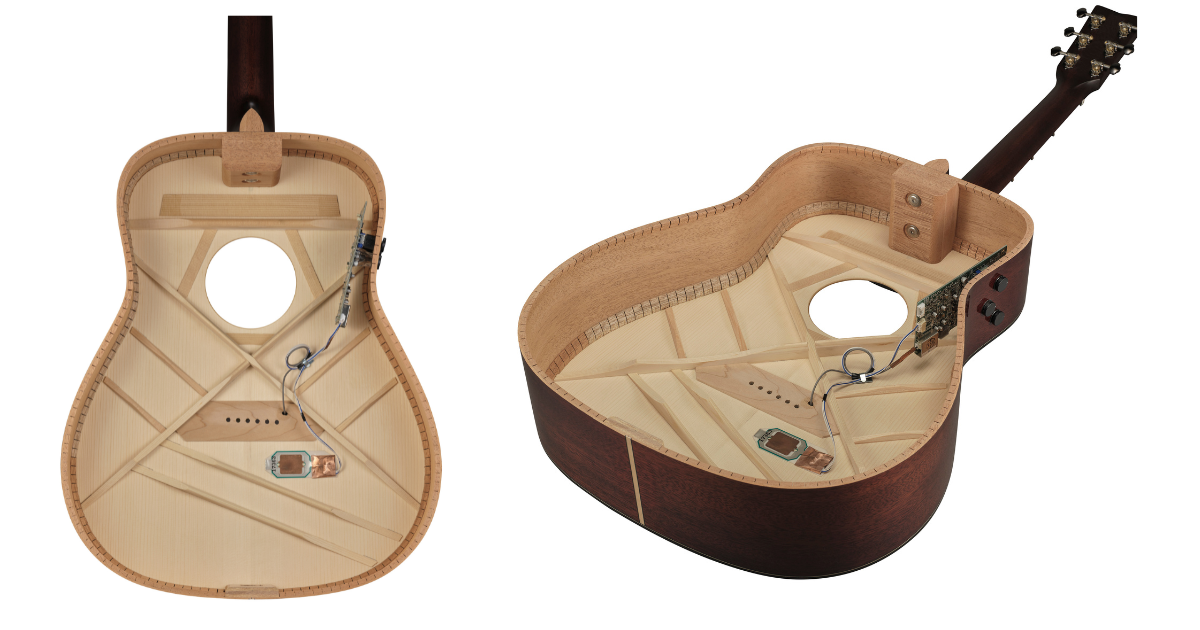
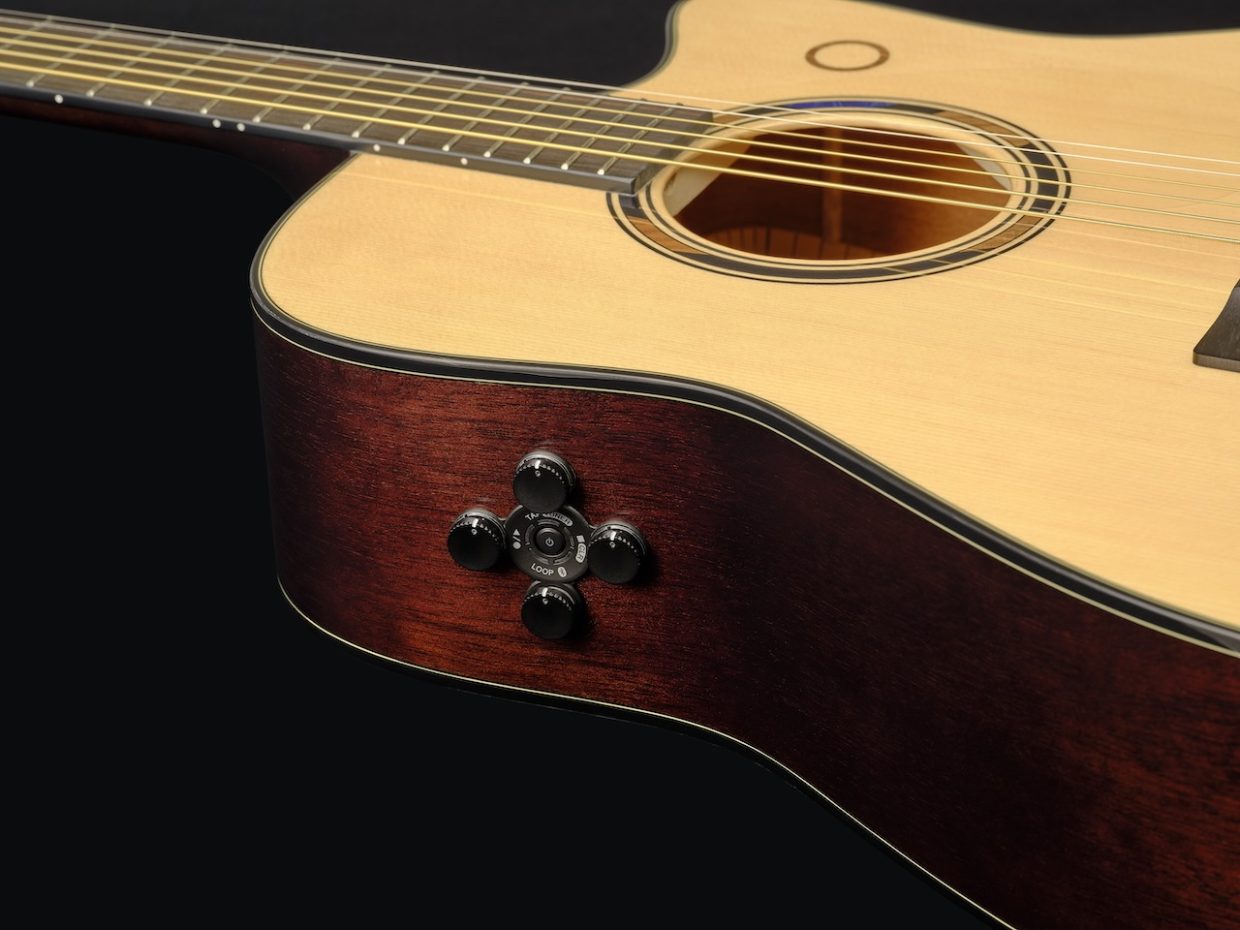
The onboard electronics and Atmosfeel system of a Yamaha FG9 MX guitar.

To further dial in accuracy and ensure that Atmosfeel could deliver anywhere, at any time, the system was thoroughly artist-tested prior to its debut.

“We come up with a voicing we’re really confident in and then we’ll bring in artists to do evaluations,” says Soriano. “In real time, we have the guitar hooked up to a computer, and a person is behind the keys adjusting the voicing based on the feedback the artist is giving us. We do this with a number of artists until we arrive at something that works for them and is the most versatile for all their different styles.”

How does Atmosfeel work, why does it work, and how does something so advanced remain simple and easy to use? This brings us back to the 3×3 concept, which was not a coincidence, says Soriano, but instead a carefully thought-out design balance between “How much is too much?” and “How little is too little?” One knob means few, if any, options, while an assortment of knobs becomes cumbersome and tricky, especially for guitarists who need quick-touch adjustments.

Atmosfeel is comprised of three elements: an under-saddle piezo pickup for low end, miniature condenser mic for mids, and proprietary, whisper-thin but deceptively strong, transducer contact sensor for overtones and clarity.

“Our approach was, first of all, to find out what are the strengths and weaknesses of all three elements,” says Soriano. “The under-saddle piezo pickups do a great job of capturing a bold and consistent low end. The weakness is that the high end has a tendency to sound unnatural to guitar players. That’s where you start to get a different sound than what your guitar is like in the room.

“The contact sheet, which is under the top wood of the guitar, is the inverse of that. It’s a paper-thin sheet that has a positive and a negative, and it captures the vibrations of the top. It’s really good at capturing air, high-end presence, and sparkle, and the low end is not as resonant.

“We’re taking the low end of the under-saddle and the high end of the contact sheet and creating what we consider to be the ideal blend between those two. That was the first step. Of course, neither of those technologies independently are completely new. Under-saddle pickups have been around for a long time. But the combination of the two, and the detail of how we blend them together, is what’s new in this system. That has created a new approach.

“The microphone, aimed at the side wood at the upper bout of the guitar on the low E string side, covers the mid-range character of the guitar, whether you choose mahogany or rosewood. Essentially, the system lets you have an ideal low end, an ideal high end, and you can blend the microphone in so that you get a mid-range to taste. We figured out how to take existing technologies to the next level and optimize them.”

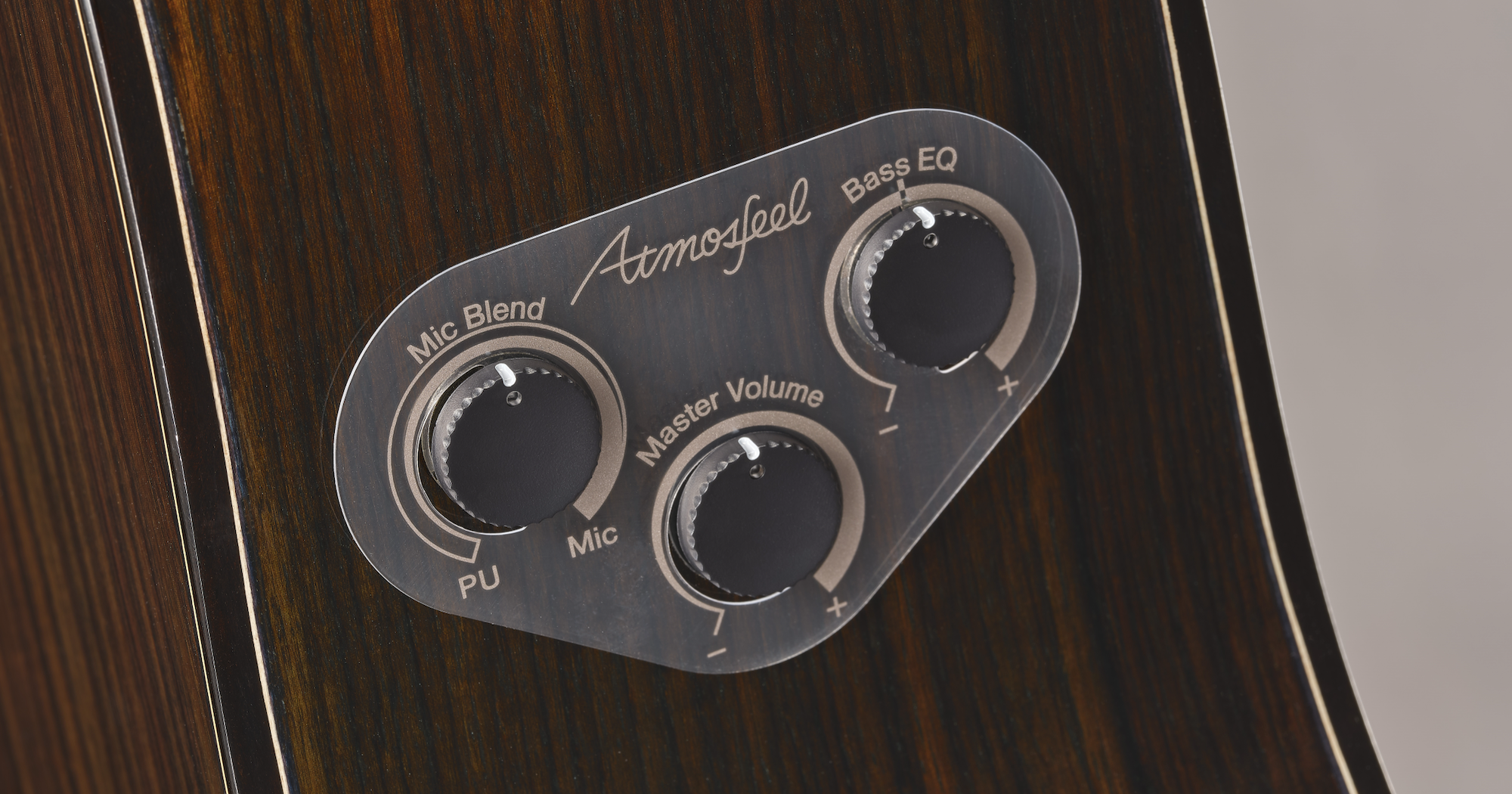
All of this is controlled by three small knobs. “You get a Microphone Blend, which is really effective for shaping your midrange and overall character,” says Soriano. “You get a Master Volume, which is essential, and then the Bass EQ is really interesting.

“When you’re playing live, a lot of feedback can happen in the bass frequencies. The Bass EQ is a cut or boost knob, which can help with controlling feedback or warming up your signal. If you’re playing solo and need to take up more room in the mix, you can crank that Bass EQ knob. Vice versa is true as well. If you’re playing with a band and there’s a bass player, you don’t want to step on their toes, so you’re probably going to want to roll off some of that bass.

“The Microphone Blend can be used to pop in and out of featured parts or solos. If you need a smaller, more compressed sound just to be in the background, you might use less of the Mic Blend. When it’s time for you to step out and take your chorus, you can crank that microphone up, stick out in the mix momentarily, and turn it back down when the time is right.”

Atmosfeel was designed for player flexibility – style, genre, attack, in the studio, onstage, on your own, with a band. Wherever you go, whatever and however you play, the system’s versatility works with you and for you.

“If you’re an arena- or stadium-level act, chances are you have a pretty silent stage,” says Soriano. “Those acts today are using a lot of in-ear monitoring. You can get away with a lot of Microphone Blend in that setting, because you don’t have sound coming back at you with an onstage wedge, and the risk of feedback is probably lower. Also, in a larger space, the sound has more room to dissipate.

“If you’re in a coffee shop, you have a floor wedge aimed at you, and the room is small, your risk for feedback might be pretty high. In that instance, you want to reduce the Microphone Blend and maybe the Bass EQ to accommodate for those things.

“And, of course, everything in-between exists as well – clubs, mid-sized venues, things like that. The system lets you tailor your settings to each of those without being too complicated. It’s just three knobs. If you know how to use them, you can optimize your sound for whatever setting you’re in.”

Yamaha designed Atmosfeel with musicians’ peace of mind foremost, meaning durability on the road and reliability onstage and in the studio. Choose your settings and rest assured they will remain in place, even if you don’t. “The Bass EQ knob has a notch at 50 percent,” says Soriano. “When you get to that spot, it locks you into place. Of course, it’s not too hard to move out of that space, but it certainly will not move on its own.”

Best of all, the 3×3 setup means easy to use, easy to remember. “Even the highest level of professional musicians are human,” says Soriano. “When you’re onstage, you have adrenaline going, and you have to make quick decisions, you don’t want to pause and remember which one of your seven knobs does what. You want to reach down and do what you need to do quickly so you can get on with the performance. The three-knob system is extremely user-friendly for that. You don’t have to spend time thinking about it before making an adjustment.”

Atmosfeel is perfect for recording in a pro studio, home studio, or on the road. “The vast majority of the time, if you’re recording an acoustic guitar, you’re putting a microphone on the guitar,” says Soriano. “Nowadays, especially with the rise in home recording, a lot of people might have trouble getting a clean signal with a microphone in front of their instrument, especially if your room has a lot of reflections in it.”

What does this mean for bluegrass players?

“A lot of artists we work with are primarily bluegrass players,” says Soriano, “so bluegrass was absolutely a primary focus in the development of the FG9X guitars. Bluegrass players most commonly use dreadnought-style guitars, so when we were voicing the pickup system in the FG9’s, we knew they had to be able to use this and be happy with it. That was a big part of our testing.

“Bluegrass tends to be quite guitar-forward, especially if there’s a solo section, for example. Bluegrass players are discerning when choosing their instrument. A lot of players have a strong preference. They want rosewood or mahogany, and there’s a reason behind that. If you’re going to make that decision, and it’s going to show your artistry and your taste, you should be able to have that come through when you’re performing live, even with a pickup system.

In a world of bells and whistles, where everything has to be shiny with lots of buttons and gizmos, Atmosfeel is deliberately stripped-down – no flash, no glitter, just durability and refreshing beauty in its simplicity.

“When you have a minimal setup that’s well dialed in, well executed, and well developed, when you put that work in on the front end, you earn the ability to have a simpler user interface,” says Soriano. “Because we are so confident in the voicing of this system, and in the fidelity and quality of the components, we didn’t have to put a million knobs on the guitar. We could afford to keep it simple and be confident that it’s going to sound great.”


This content is brought to you in partnership with Yamaha Guitars. All images courtesy of Yamaha Guitars.

“Ohana Means Family”
to Ohana Music, Too

When Ohana Music founder Louis Wu says, “Ohana means family,” it’s not hyperbole; it’s the tenet upon which the company was built.

“On an unspoken level it drives everything, including staff, dealer interactions, customers, and products,” says Chris Wu, who oversees the ukulele company’s operations and product marketing.

The Ohana story, which is also Louis Wu’s story, is an inspiring journey of determination and accomplished goals. Wu grew up in Hong Kong and relocated to the U.S. after high school to study engineering. In 2006, after twenty years in his chosen field, he decided on a career change, primarily to spend more time with his wife and two young children. That priority – family – became and remains the basis of Ohana.

Chris Wu was 10 years old when his father launched Ohana. He spent his teen summers alongside his father “doing a little work here and there.” In 2018, after college and a career in accounting, he says, “Things fell into place where it made sense to come onboard full-time.”

From Louis Wu’s Long Beach, California, garage to a 6000-square-foot warehouse, Ohana’s slow and steady growth has taken them from a small business serving one customer at a time to leaders in their field with both their expansive product line and custom shop.

“I have to give full credit to Louis as the visionary leader of the company since day one,” says Wu. “He knows how a company should and needs to be run. Myself and all the staff are here to support that vision, and that really drives the growth. As a team, we’re improving internally every day, and that has been life-changing. It’s wonderful seeing our employees grow in what they do and in their passion for their jobs.”

Ohana’s international reach stems from the dedication of a surprisingly small workforce. “We’ve never had more than ten people at one time,” says Wu. “It is a small company, but the size helps our operation run smoothly and efficiently.”

Ohana ukuleles are available across a spectrum of styles and price points, from beginner models to pro series. Built overseas, the instruments are individually inspected in Long Beach to ensure flawless playability. “At the core, again, we view our customers as family, and we don’t want family to end up with subpar instruments,” says Wu. “Every instrument is given a full inspection and proper setup before it goes to our worldwide dealers. This does affect our output, our capacity, per day, week, month, or year, but that is the way it should be done. We’ve always been proud to do things that way.

“When you receive your Ohana ukulele, you can rest assured that you can take it out of the box and start playing. At the end of the day, being able to connect people to their instruments and spread the joy of music – it feels like introducing another family member to something we love, something we know they will love, and that will work for them.

“As a disclaimer, I will say that there are manufacturers who offer things that we do not, for example, plastic or carbon fiber instruments. Those materials can take a beating on long journeys or camping trips, if you need an instrument to meet those needs. Those ukuleles have their place, but we stay away from making them.

“We focus on sound, acoustics, wood choice, and the quality of the instrument you’re getting right off the bat. Between our 150 to 200 different models, there’s something for everyone. When you buy an Ohana ukulele, you know there is love behind it. Our team has set it up with you, our family, in mind. We want you to have a good instrument, plain and simple, for the right price and the right value. With our custom shop we’ve expanded that range while still keeping the value, the quality setup. We’re just covering a larger market.”


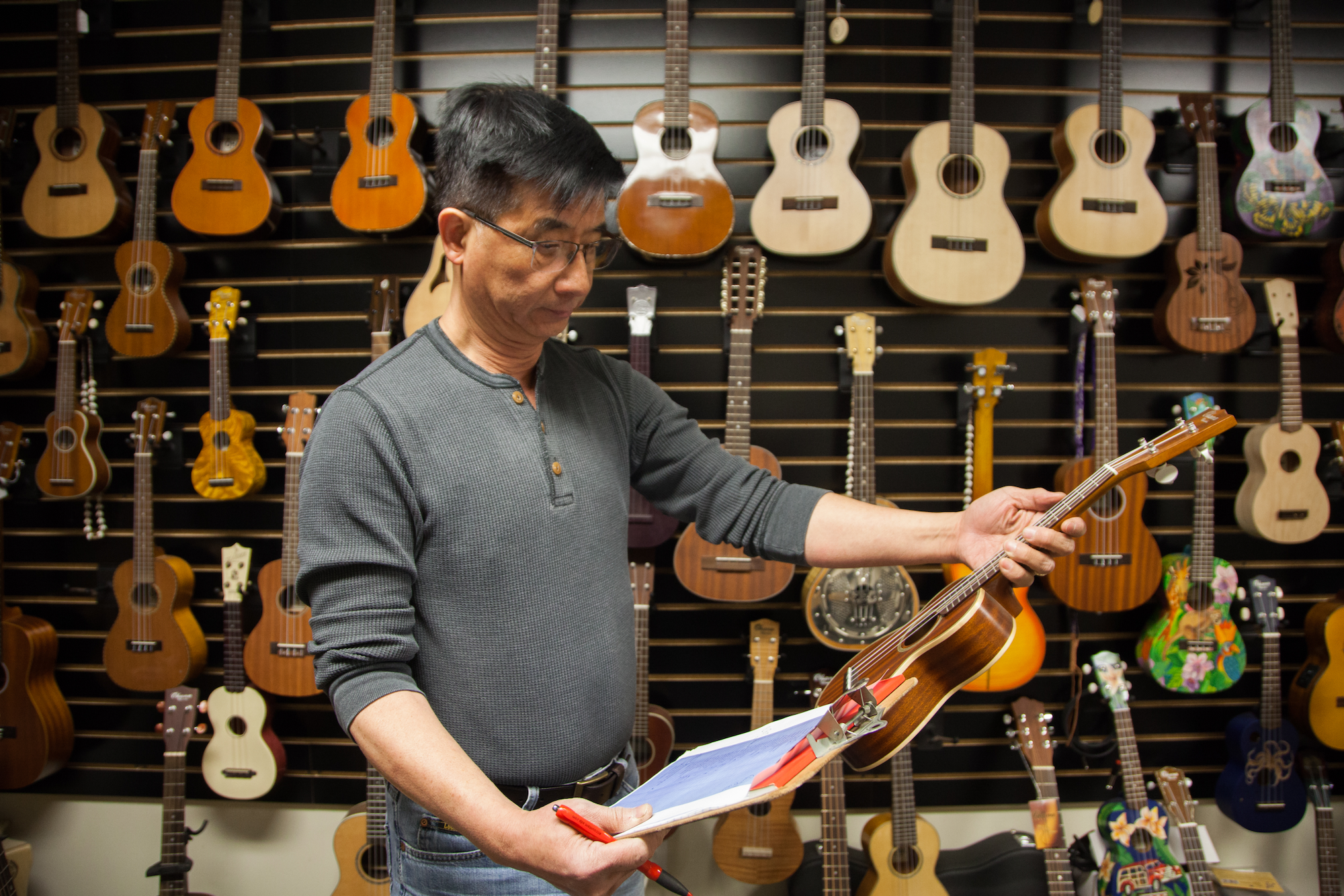
Ohana Music founder Louis Wu peruses the Ohana showroom.

All Ohana tonewoods are sustainably sourced. Most popular, says Wu, are redwood variations from the Pacific Northwest, which feature prominently in limited-edition models. They also source Hawaiian Acacia Koa, Canadian Engelmann spruce, and mahogany, cedar, and other wood sets from local harvesting companies. “We take our time to go through which sets look and sound the best, but are also in compliance with CITES,” he says. “Anything on that list, we won’t touch.”

Ohana Ukuleles will celebrate their twentieth anniversary in 2026. The lead-up to that milestone began unofficially this year at the 2025 NAMM Show with the introduction of their Custom Shop electric tenor and baritone ukuleles.

“Louis and our master luthier, Brad Kahabka, go all out when it comes to planning and executing things that come from the custom shop,” says Wu. “After building acoustic instruments and getting the shop going, it was a question of ‘What’s next?’ We made simple custom instruments, more elaborate custom instruments, and we even built one with wood from The Tree. We had explored the whole range of acoustic instruments and electric was the natural progression. We were excited to enter the market with electric instruments this year. That’s really been our focus for 2025.”

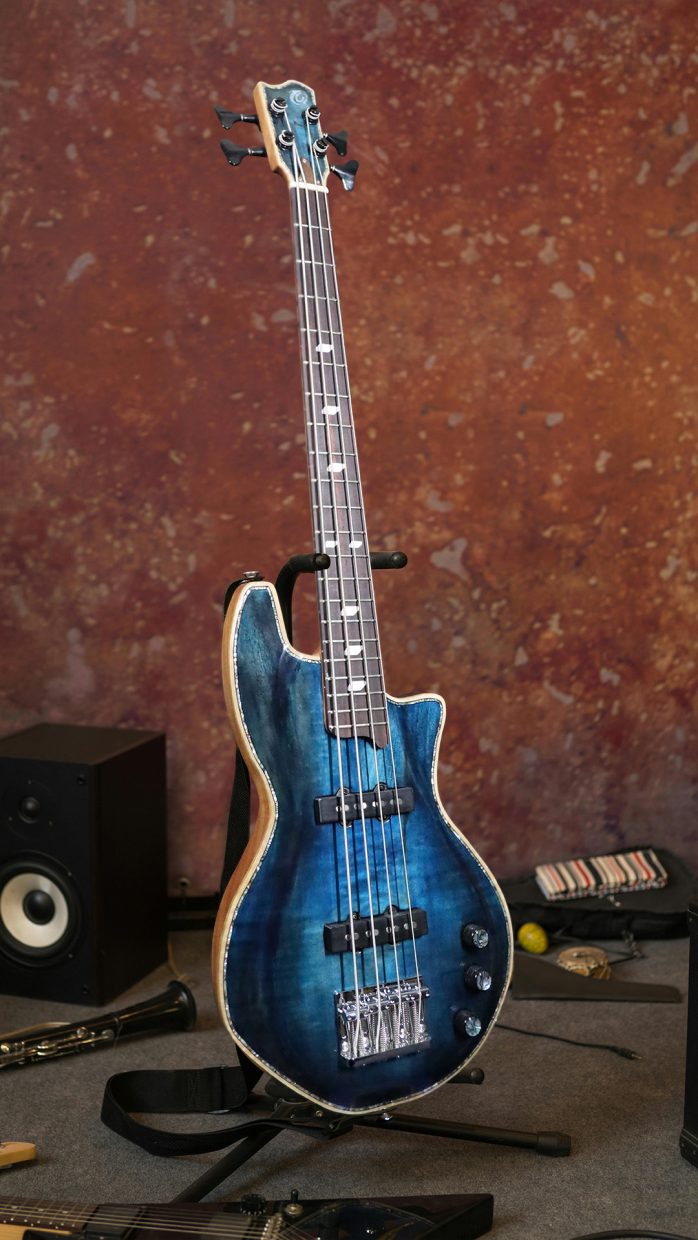
This month, Ohana debuts their Custom Electric Bass, also built by Brad Kahabka. The new instrument, which the company describes as “a counterpart” to their OBU-22 short-scale acoustic-electric bass, features a solid mahogany body, maple top, custom pickups, cutaway design, and 28-inch scale.


The brand new Ohana Custom Shop Electric Bass, which launched this month.

“We’re super excited to bring the first 28-inch-scale bass to market,” says Wu. “There are short-scale basses out there, but after trying different scales, Brad and Louis wanted something portable that we could make here in the shop. We wanted to come to market with this middle ground that still gives you the proper electric bass sound, but is more affordable and still does a lot.”

NAMM 2026 will mark the official kickoff of Ohana’s 20-year celebration, with other events and activities planned for the coming months. “We’ve been thinking about how we want to expand the family brand, ways we can look at to differentiate ourselves,” says Wu. “We’ve been successful in trying that out with our custom electric instruments, which can be additionally customized with different finishes, tuners, and other features. I think the future is in offering options to buyers and customers. We’re looking forward to exploring that more and offering some exciting things for our 20th anniversary.”

Once a wildly popular, then somewhat more niche, instrument – and, to some generations, an accouterment for tiptoeing through tulips – only to regain and increase its “cool factor” during the 2000s, the ukulele continues riding the crest of its popularity. (What could punch the uke’s “hip card” more than Taylor Swift…?)

“They call this the ‘third resurgence,’ this explosion of attention and rise in the number of ukulele players,” says Wu. “The pattern of history is that, in the last century, there were a couple of other rises and falls in popularity and maybe that’s the natural lifecycle of any instrument.

“What really pushed it along this time was the import side – specifically, affordable instruments made overseas, usually in China, but now also in Vietnam and Indonesia. You can pick up a ukulele for anywhere from under a hundred dollars to a few hundred. Making the instrument accessible that way, people took a new interest in ukuleles and stuck with them. There are also companies with longer histories that kept the torch going, and they, too, are part of this resurgence. Ohana began in 2006 and we’re proud to be a part of it.

“It’s been a community effort to get the instrument back on its feet and it’s staying popular. Music is somewhat recession-proof, at least on the stringed instrument side. Throughout COVID, also, people needed music and the ukulele community was able to provide that.”

Ohana keeps eyes and ears on the changing wants and needs of their growing family of customers. “The stereotype of a ukulele player was someone maybe a little older, or retired, or a person with disposable income and the time to play and collect different instruments,” says Wu. “Now, however, we have a younger demographic that is eager to get out there and explore. They see ukuleles all over TikTok, and that’s something we can’t ignore.

“We see patterns, we get feedback from our dealers and customers, and we also see that people of all ages like the baritone ukuleles, the larger instruments. Or they’re developing tastes for certain features: beveled edges, slotted headstocks, armrests, cutaways, different pickups. The options and combinations are endless.

“All of this plays a factor in our innovation, coming up with new combinations and new instruments that people are after. Going back to the baritone, for example, what used to be a one percent demand for that size instrument is now ten percent or more. That number doesn’t sound large on its own, but it is a significant jump. We keep a pulse on what’s out there, what people like or dislike, and we innovate based on that.”

One of Chris Wu’s personal and professional goals is to further expand upon the relationship between bluegrass and ukuleles. “I’ve learned a lot from our bluegrass players, including local players,” he says. “I don’t have a background in bluegrass, but I’ve learned from watching them play bluegrass on ukuleles how much can be created musically from that and in combination with other instruments as well.

“One of our new team members, who helps us with social media, played in a bluegrass band. Watching them go at it was just amazing, and I would really love to explore more of that. Ohana makes banjoleles, and we tried our hands once at a resonator ukulele. It might be time to bring that back. Who knows? As a company, I think bluegrass is something we could tap into.”

@ohanaukuleles @Bernadette from Bernadette Teaches Music demos the Ohana BK-70-8 Baritone from the More Than Four series! #baritone #baritoneukulele #multistring #morethanfour #ukulele ♬ original sound – ohanaukuleles

Integral to Ohana’s legacy and footprint as they enter their third decade is their philanthropic work and community involvement, including ongoing assistance with music programs following the Los Angeles wildfires of 2025.

“As often as we’re able, we love supporting the ukulele community far and wide,” says Wu. “It’s not such a big world, once you’re in it, and it is closely knit. Brands, manufacturers, artists – everyone knows each other, and it becomes even closer when organizations need our support. We do that whenever we can. It’s one of the crucial foundational things that Louis has always worked for with Ohana.

“A lot of times it’s local – schools and, lately, libraries that have started ukulele programs or clubs. We’ve partnered multiple times with the Los Angeles Public Library System as individual libraries have started programs. We provide support and ukuleles.

“A couple of years ago, after the unfortunate wildfires in Maui, one of our music store dealers on the island contacted us about helping rebuild school music programs. We shipped two large pallets of ukuleles to them. We’ve also partnered with Four Strings At A Time, a ukulele nonprofit in Hawaii, to help their local schools. On the continental U.S. side, there’s Ukulele Kids Club, which provides music therapy to children and also instruments to children in hospitals.

“As small as the ukulele community can feel sometimes, especially compared to the guitar community, there are still endless ways that people need support. It’s a blessing and an honor to be able to provide that to them.”

As Ohana moves into the fourth quarter of 2025, prepares for holiday sales, looks ahead to NAMM 2026, and plans its upcoming anniversary, Wu reflects on the year-to-date as “interesting, especially with the tariffs. Everyone has responded a little bit differently, but everyone has also been hanging in there, as much as I can speak for our music stores, our retailers, and the players,” he says.

“We’re looking forward to next year for new things, exciting things. It’s been interesting, but we’ve been getting through it and that’s all we can ask for.”


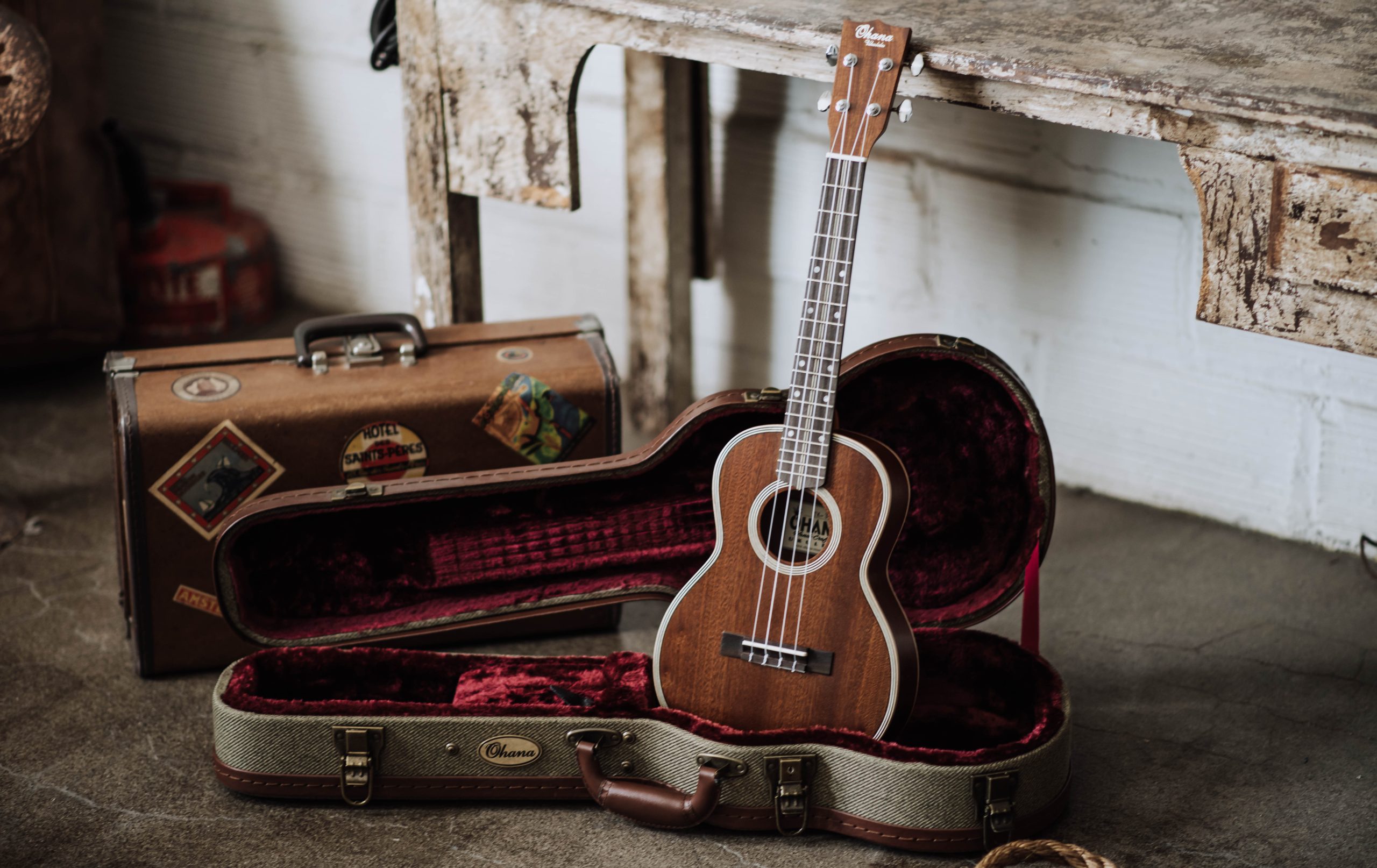
Ohana Vintage Line, 39 Series.


All images courtesy of Ohana Music. Lead image: Ohana O’Nina and Pineapple models lounge on the beach. 

Yamaha’s Groundbreaking Second-Generation TransAcoustic Guitar

Yamaha Guitars knew they were breaking ground – and raising eyebrows – when they debuted their TransAcoustic Guitar at the 2016 winter NAMM and Musikmesse trade shows. The original TransAcoustic Guitar turned heads immediately, thanks to its innovative technology and, of course, the quality acoustic guitar body and sound that musicians have long associated with the Yamaha name.

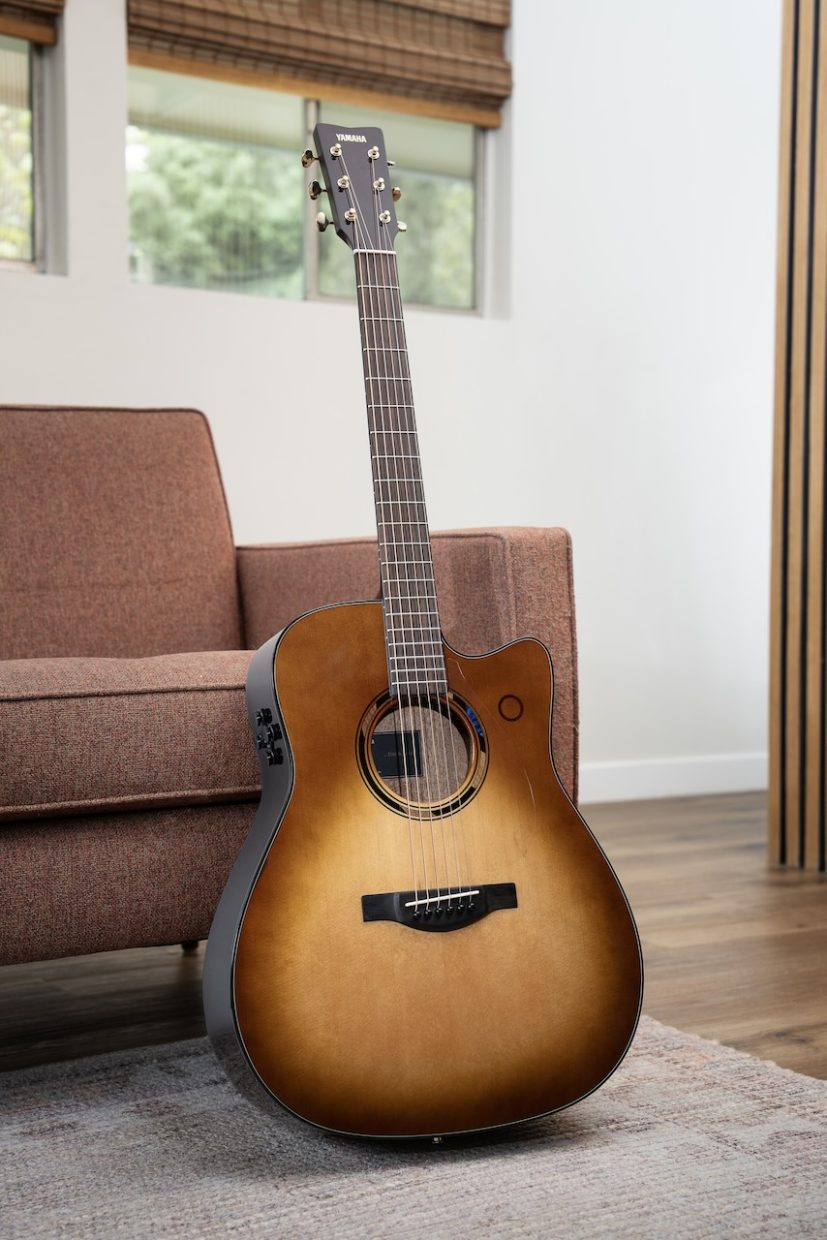
Fast-forward eight years and Yamaha has introduced the second-generation TAG3 C, a completely new model offering advanced features and more options. With Bluetooth capability, a built-in looper, a rechargeable battery with a five- to eight-year life, iOS and Android compatibility, and a plethora of controls and effects — reverb, chorus, delay, its TAG Remote app, and more — the TAG3 C is a workhorse, opening new avenues for artistry at all levels. It’s also a beauty, with its dreadnought body, solid Sitka spruce top, and solid mahogany back and sides.

The TAG3 C was designed for guitarists and, in a sense, by guitarists. When the first generation entered the marketplace, Yamaha’s Product Manager, Shingo Ekuni, was hands-on with customer reviews and interviews – what they liked, needed, and ultimately wanted. “We concluded that we needed more capabilities for creative players,” he says, “for the person who is proactively doing their practice at home or creating songs at home.”

This presented the challenge of creating a high-tech yet user-friendly guitar that sparks interest in tech-minded musicians without alienating traditionalists. “From my perspective as a player, and with most of my friends also being musicians, guitar players can be very particular about their sound,” says Yamaha’s Marketing Manager, Brandon Soriano. “They want the level of control. One person might prefer a plate reverb while another prefers a hall. They might want a very specific decay time or tone, and the same thing goes for chorus or delay. At the same time, guitar players don’t want a lot of barriers to actually playing the guitar. They don’t want an overly complicated user interface and experience. The way the TAG3 C is structured, you get all of the control over the specific sounds you want in the app, but when it comes to actually using the guitar, it’s a very simple interface.”

A cursory glance at the TAG3 C might cause one to scoff, “Second-generation guitar, TikTok-generation players.” But – curmudgeons rejoice! – this is not the case. No interest in apps? No worries. “You don’t need internet to use the guitar,” says Soriano. “You don’t have to connect it to Wi-Fi. And it doesn’t require the app to run. Straight out of the box, without downloading the app or anything, you can turn the guitar on, effects will already be dialed in, and you can use all the functionality.

“If you want to use the Bluetooth audio, of course you need to connect your phone or another Bluetooth output device. And if you want to get into the parameters of the effects, like changing from a plate reverb to a hall, that’s where you start using the app. But you can fully use the guitar without using the app.”

“Something really great with this guitar is the quality strictly as an acoustic guitar,” he adds. “It’s built to Yamaha standards, which, as we all know, are very solid, rigorous, and high level. Even if you were to take out all the technology, I would still love it just as an acoustic guitar. I think that’s going to add to people wanting to pick it up.”

“Nowadays, with our mobile devices, the ‘smart’ devices, with tools for guitarists, everybody is using the tuner, the metronome, [from] the very basic stuff to more complex and connected devices,” says Ekuni. “Customers are happy to accept new technology for a new type of product. Parallel with that, the TAG3 C is an authentic acoustic guitar, but the technology can expand the possibility of acoustic guitar playing.”

“We are in a technological age, and it’s all around everybody all the time,” Soriano agrees. “There is a little more open-mindedness to innovation, even in commonly traditional circles like bluegrass, for example. Customers also want to know that their money is well spent and that they can be confident in their purchase from a quality standpoint, durability, sound, playability, all those things. Those are some of the main pillars of Yamaha — delivering the best quality for the money at any price point, from the $400 guitars to the $4,000 guitars.”


This content brought to you in partnership with BGS sponsor Yamaha Guitars. Discover more about Yamaha Guitars and the TAG3 C here.

Photos courtesy of Yamaha Guitars.