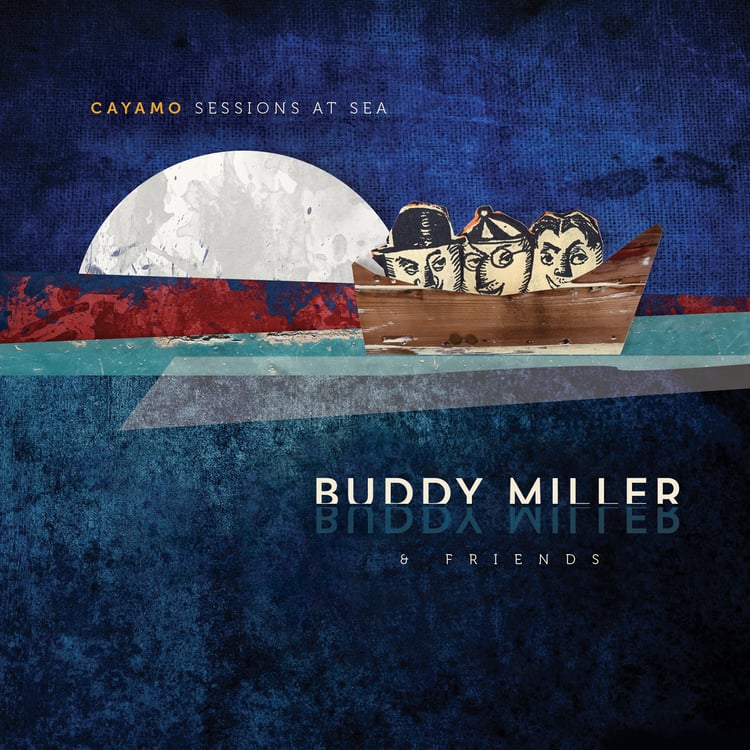
Even if you weren’t already aware that Cayamo Sessions at Sea was recorded on a cruise ship, even if the title didn’t spell out the circumstances of the album’s creation, you could probably guess as much. Featuring several generations of roots artists covering old country songs, the record sounds sunny and breezy, light but not lightweight. Buddy Miller and Lee Ann Womack make “After the Fire Is Gone” sound more about the make-up than the break-up, and Elizabeth Cook emphasizes the buying rather than the crying on “If Teardrops Were Pennies.” Even Kris Kristofferson’s new take on “Sunday Morning Coming Down” sounds like nothing so serious as having to disembark at the end of a week at sea.
It’s to Miller’s considerable credit that none of that is a bad thing. A producer and central performer, he keeps things light, as though you’re flipping through vacation photos, but that strategy showcases the amiable dynamic between performers and singers more than the ocean-bound environs. It sounds like it would have been a blast to make, even if they held the sessions in an outhouse or a bank vault.
For nearly a decade, Miller has been a prominent figure on the Cayamo Cruise, which sails from Miami to St. Maarten and Tortola and features a who’s who of roots and country artists. In that time, he’s only missed one boat, and that’s only because he was recovering from a heart attack. It struck him onstage but, professional that he is, he finished the song.
Over the last 40 years, Miller has emerged as one of the most imaginative musicians in Nashville, both on the stage and in the studio. A former Deadhead turned sideman turned producer, he has helmed albums for a mind-boggling range of artists: Shawn Colvin, Emmylou Harris, the Carolina Chocolate Drops, the Devil Makes Three, the McCrary Sisters, Dr. Ralph Stanley, and Robert Plant. When Patty Griffin wanted to make a gospel record, he had her sing at the pulpit of the Downtown Presbyterian Church in Nashville, with the band on the floor playing up to her.
“Every record has a story to tell,” he says. “Every record is a whole different world. I don’t come into anything with a preconceived nothing. I might hear things before we go in, but I won’t impose that on an artist. I just hire the players I love and see what’s going to happen.”
Why did you want to make an album on the Cayamo Cruise?
I grew up loving music, in general. I loved blues. I loved rock. I loved folk. I was a Deadhead at the age of 14. When their first record came out, I bought it pretty much for the cover. And then I started going to every show I could make it to, until around ’72 when Porter Waggoner, Tammy Wynette, and Ralph Stanley won that war. I stayed in that country music camp and gradually drifted away from the Dead. But I remember, from that very first show, there was a sense of one big family coming to those Dead shows. Now, it’s legendary and they make movies about it, but even at those first shows, you’d see the same people. They were immediate friends — an extended family. Everybody loved each other and everybody was there for the same reason.
I guess that’s a long way of saying that there’s a similar feeling on the boat, although it’s a different … I hate to use the word “demographic.” Is that what the politicians are using these days? It’s a different set of people, but all with the same heart. They’re all there for the music. It’s not a party boat. It’s a lot of people — 2,000 or 2,500 people — and I just want to hang out with them all. They’re all great. And I thought it would be interesting for them to have the veil pulled back on the process of recording. That’s why I did it. I don’t think people have any idea how records are made. I don’t even know how magical records are made. How does that magic happen? So we’re showing them the nuts and bolts — what musicians do, how they play together in a room, pick a track, fix it up, do all that stuff. I thought that would be of interest to these people that I love. That, and I worked on this television show called Nashville. I don’t know if you’ve ever seen it …
Definitely.
I worked on the pilot for Callie [Khouri, who created the show], and then, when the first season got picked up, I worked with T Bone Burnett producing [the music for] it. Most of the things we produced together, I would say. I continued with it, but I think it drove him crazy. I have a higher tolerance for bullshit, I guess. But now I love it and I love the people — especially these two little girls, the Stella Sisters. John Prine was going to be on the cruise, and what I wanted to hear was those two little girls, the Stella Sisters, singing, “Daddy, won’t you take me back to Muhlenberg County?” And then John would come in singing the verses to “Paradise.” It seemed like a good thing to document. It’ll make the sweetest record. Unfortunately, John got sick and couldn’t make it.
But that was where the idea came from. What I do is, I try to engineer collaborations. That’s just how I think: Let’s pair this with that. I think in collaborative terms. I don’t know if it’s because I’m lazy and don’t want to do all the work by myself. But I think it’s because I just want to hear certain things. Shawn Colvin asked me to do a record of hers a while back, and I thought, "You know what? Brian Blade and Bill Frisell. I would love to hear her voice framed by those two musicians." That’s what I’m talking about. It’s all about coming up with your dream teams.

Tell me about setting up a studio on the boat.
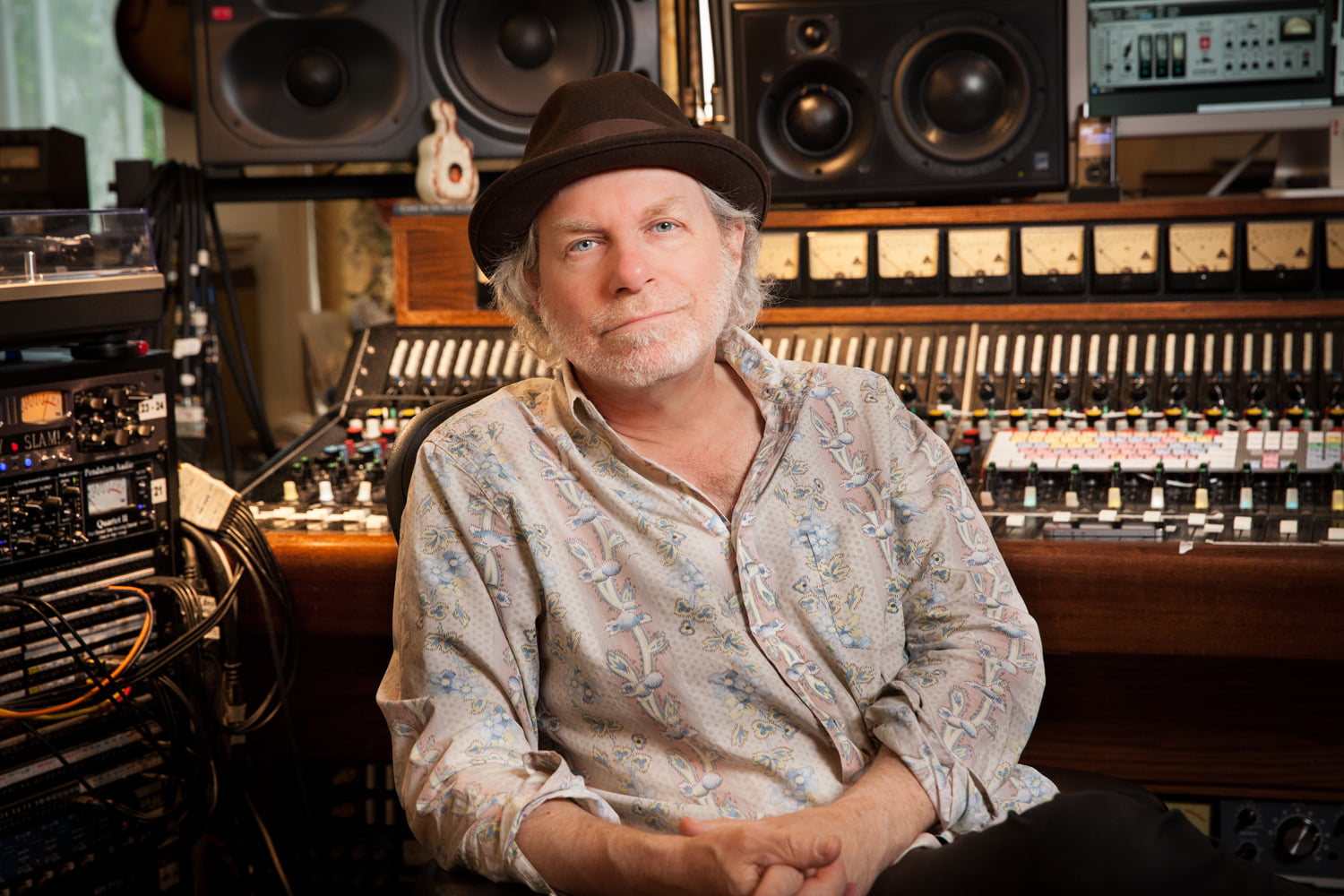
I asked one of the engineers I work with, Gordon Hammond, if he wanted to go on this cruise. We bought a bunch of microphones, a lot of gear, and set up in what was a bowling alley on the ship. We managed to turn it into this vibey … I hate that word, “vibey.” It’s very homey and warm, with all our gear set up and the band set up in a circle. There are about 100 chairs, because we couldn’t fit more than that in there and I didn’t want the sound of more than 100 people breathing on the same time to work its way onto the record.
What are some of the challenges that come with recording on a boat?
I guess I don’t look at it that way. There are certainly challenges, like when somebody turned on the wrong light switch. Boats just have a lot of switches on them. We couldn’t always tell what they were for, so somebody turned on the disco ball accidentally and it started blasting some dance song. That was actually a fun moment. And an easy problem to fix. You just don’t want to stop if there’s a flow going. It’s as much about the lighting in the room, the air in the room, how it feels. All of that affects the music. Outside of that, there aren’t really any challenges that are any different from recording on land.
The one and only cruise ship I’ve been on felt very institutional to me. Aside from the scenery and the sun, it didn’t feel like it would be especially conducive to making music.
That could be anywhere. That could be any recording studio. It’s all about … I don’t want to use the word “staging.” I’ve been working on television too long. But it’s about the feel of the room, how close people are together. I like people to be right on each other. You can bring in nice-looking rugs, even on a cruise ship. You can drape things on the wall, turn the lights down. You can make any room feel nice. That’s what we did in that bowling alley, which actually felt pretty nice to begin with. And it felt great when we had it set up and started recording. I think everyone enjoyed themselves — the artists and the audience. They loved to see that recording process, even though this isn’t really the process. The vocals went down with the track, and the track went down fairly complete. Maybe a couple of tracks have two or three overdubs and a few vocal fixes, so it’s not really like making a record. It’s a little more honest than that, but it still gives people a view into that world.
So there’s an instructive or an educational element to this project.
Exactly. I thought, if people love music enough to get on the boat, then they might love to see that process and see how artists say, "You try singing that part. Let’s flip on the chorus, and you take the harmony while I take lead. Let’s leave that line out. Hold the drum till the chorus. Don’t have the bass come in until the fourth bar." All of that stuff is worked out long before the audience gets involved, so they don’t know what goes into it. This is a very, very simplified version, but it’s still something I think they find fascinating.
There’s a nice range of artists on this album. You have younger artists like Kacey Musgraves alongside older singers like Kris Kristofferson. Was that something you were thinking about, that generational exchange?
Yeah. It’s a funny thing: My name is on the record, so I have to be involved somehow, playing or singing or just having a presence on it. My part is very minimal, but I had to be there. If it was just me doing whatever I wanted to do, I probably wouldn’t even be on half of those tracks. I would have put Kacey singing with Kris or someone else, not me. But it’s my record company and my name goes on the album, so I have to do something. I think it’s a good record. I like it. Maybe because I don’t hear myself is why I like it so much. That’s what makes my records so hard to listen to.
Nashville is like no other place in the world for songwriting. People come here from all over the world — songwriters, young singers, all these young women. In addition to the cruise and the television series, I do a radio show on Sirius XM. Usually it’s weekly, or just whenever I can get it done. I have a guest come over every week, and lately I’ve had some of these younger writers that I run into. I find it amazing that they’ve been doing this since the age of 13 or 14. That’s when I knew I was going to be making music for the rest of my life, but some of these kids have already started writing songs. A lot of them have their parents’ support, too. That was something that wasn’t really around, when I was a kid. My parents wanted me to do anything but music, maybe because there was this whole other subculture that was tied to the music. I think there’s less money in it now than there was when I got started. I think. I don’t really know much about that end of it, but it does seem like the music business has dried up. You might know more about that than I do.

I hear conflicting reports. Some people say it’s still possible and there’s great music being made, and others are very pessimistic. I guess it all depends on who I’m talking to.
There’s always great music. Sometimes you just have to look a little harder for it. I think with downloads and iTunes and everything, it’s more about singles than it is about albums. That’s the part I miss. You would make a record. The Grateful Dead made Anthem of the Sun in 1968, and you wouldn’t think about chopping it up into 10 little songs. Ralph Stanley made Something Old Something New back in the early ‘70s and, even though I’m sure there was no intention of it being a themed record, it just flowed together so well that you had to listen to it in that sequence. You wouldn’t want to download just one song. Or Porter Wagoner. He was doing concept records before the Beatles. So I’m glad vinyl’s making a comeback.
I think that’s something that’s overlooked in country music, especially. There are so many incredible singles, but there are a lot of amazing albums, too. Making a good record is a very different process than making a great song.
I don’t know a whole lot of big country artists. Well, I know some, I guess, and I think they still look at it as as making a record. And gosh, when I was growing up — and I’m old! — it was about the single. That’s what got played on the radio, in mono. It was all about the mono mix. So, maybe, in a way it’s not so different; but I would make a point to buy the albums and listen to side one all the way through, then side two. There might be a stinker in the middle of side two, but that was all part of the package.
When you start working with an artist, is that what you’re thinking about as a producer? Are you looking at these projects as albums rather than songs?
Completely. It’s funny you ask that, because I’ve never thought about it. I think that’s because I don’t produce anything that is going to end up where people are going to care about singles. In my mind, the audience is buying an album, so we’re making an album. I just finished a record with Steve Earle and Shawn Colvin — a duets record. They’ve made some incredible records, and all they cared about with this one was the vinyl. Steve, in particular, was very concerned with sequencing for vinyl. We cut a lot of songs together, but we just put enough songs on there that would fit and sound great on vinyl. I’m happy to be thinking along those lines.
That’s one thing I actually went to school for as a kid, was to learn to use a Scully lathe. For most of my life, that was a great skill to have. Then it became pretty useless. I don’t actually have a lathe. I have enough useless stuff in my house that weighs 500 pounds. But I like being around all that old equipment with all of its old smells.
I do think the weight of that equipment — the tactile quality of it, the smell, and look of it — does add to the way you experience music.
I’ve got so many old, heavy microphones. I guess the heaviest one I have is an RCA 44-BX, that big … I don’t know what you call that shape. Not the big egg, but the one with the angles on it. You see Frank Sinatra singing into it all the time. It weighs a ton. It’ll take down any mic stand. It’s a warm mic, a beautiful-sounding mic, so it’s difficult to record with. But I’ll put that up or my old Neumann U47 because they take the singer someplace. You look into that thing; you get up close to it and you can smell it. You look into that thing and you start singing and you think about who has sung into it for decades. That’s part of creating the world that you record in, and it affects the music. There are great new microphones, of course. I keep buying new ones that sound really good, but when it comes to the singer trying to tell a story, you have to give them a mic that’s really been down the road.
Photo credit: CJ Hicks