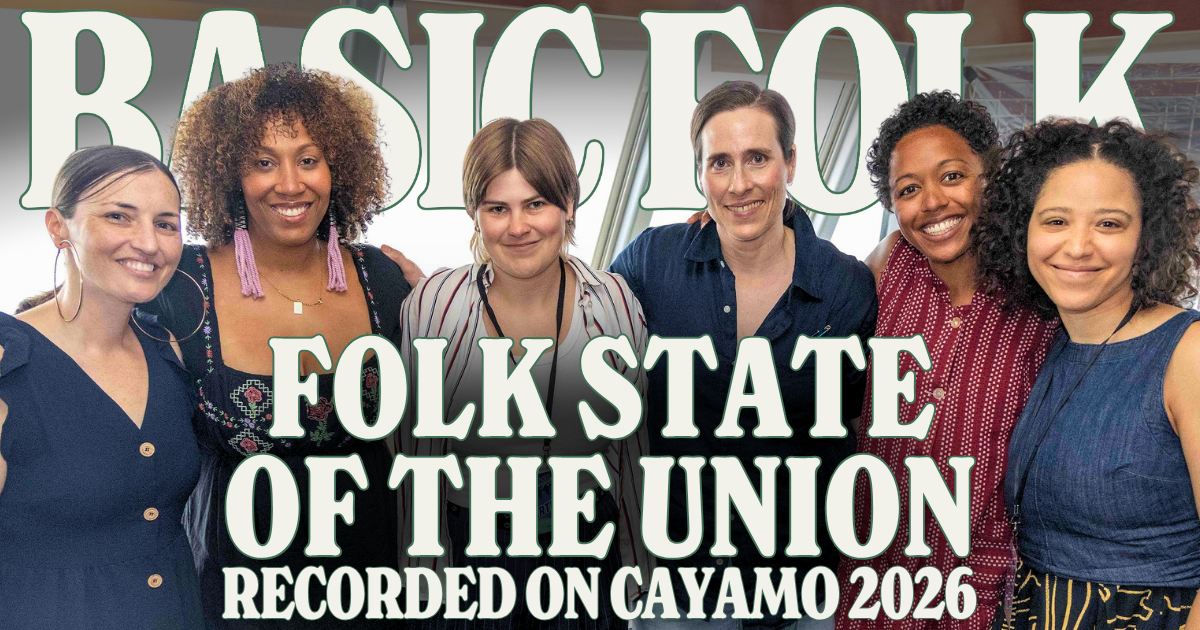
Well, is this not an excuse to get the girlies together if we’ve ever heard one!? For our final live interview aboard Cayamo, we arranged a check-in with some of our favorite folks to talk about the state of Folk Music (and folk-adjacent music). Our panel included country artist and host of Apple Music’s Color Me Country Radio Rissi Palmer, Canadian sweethearts Rose Cousins (CEO of emotions) and Kaïa Kater (Dean of Sad Songs), and Jobi Riccio, a self-proclaimed “rizzler.” We spoke about the function of folk songwriting, the hope and confidence of Gen Z, the inspiration taken from elders, and the fact that there are Black people in the future (thank you, Alice Randall).
We’ve noticed some folk songs coming out recently about moving forward and persevering despite living in hard times. It seems like the folk zeitgeist is collectively coming together to say something and we wanted to explore what’s happening with folk musicians at this time. What is the function of folk songwriting in modern times? Comfort? Information? Inspiration?
Folk is the big scoop that catches everyone. We need there to be a place for everyone else – and we are the everyone else. When you choose to be in this community, you grab onto this big rope, pulling against all that needs pulling against (feeling, current events, poverty, capitalism, things that homogenize, surveil, and control). These artists and the stories they tell take care of communities in a way that is similar to healthcare workers, but how are these workers being taken care of? We wanted to ask, “What’s the state of your workplace and how is care being taken?” And, “What does it feel like to be moving through the world playing music for people at this time?”
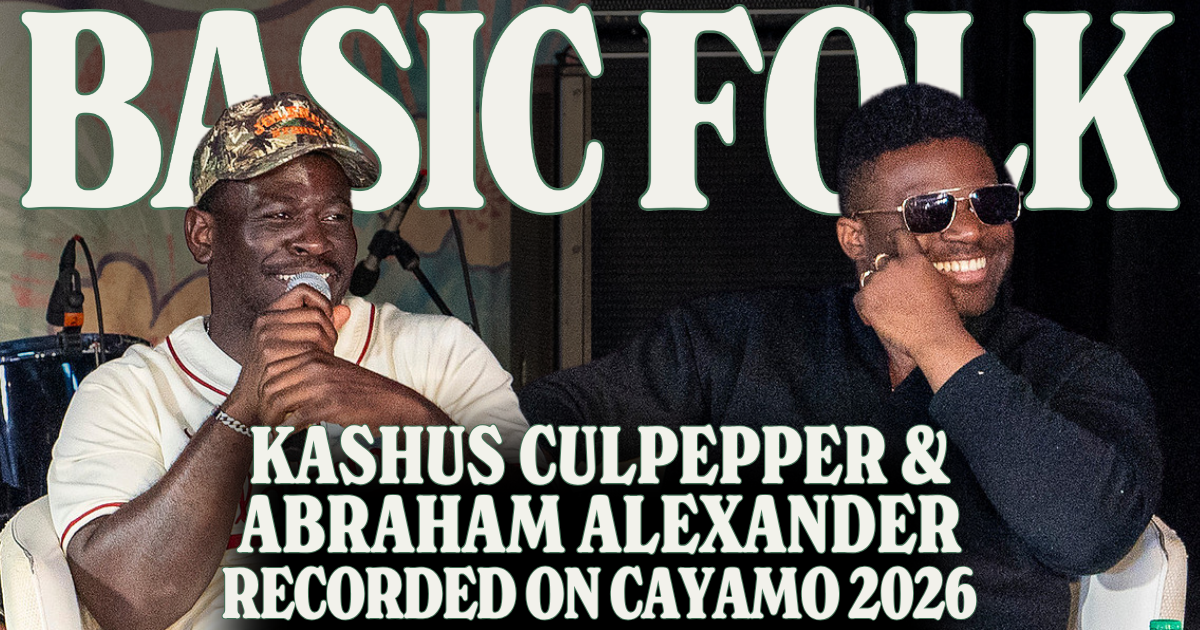
We are live at sea aboard Cayamo 2026 with Abraham Alexander and Kashus Culpepper! The pair had not met prior, but we found a couple of very cool parallels between them, so we decided to interview them together. Plus, we knew it would be more fun to have them both up on stage in front of an audience. Abraham, based in Ft. Worth, Texas, and originally from Greece, has had an impressive rise in profile thanks to opportunities from friends like Leon Bridges, Gary Clark, Jr., and Adrian Quesada (Black Pumas). Quesada actually worked with Abe on the song “Like a Bird,” which was nominated for an Oscar for its inclusion in the deeply moving 2023 film Sing Sing. Navy veteran Kashus Culpepper, born and raised in Alexander City, Alabama, grew up singing in church and learned to play guitar while deployed in Spain. His deployment actually occurred during the pandemic in 2020; left with nothing to do and nowhere to go, he spent his time learning guitar, drinking plenty of sangria, and playing for his fellow sailors (who would also be enjoying said sangria).
Abe and Kash have a few things in common that we discuss: their emotive and boisterous singing voices, learning guitar as adults, intense histories with sports, and, of course, being very handsome. We introduce our conversation with the two musicians as “Handsome Club,” (a shout out to Lizzie No’s OnlyFans handle, @handsomelizzie) and ask them to speak about their relationship with beauty. After ensuring them that we were for real, they spoke of beauty found in the process of turning pain into something positive, and how confidence in yourself is everything. We have some poignant moments and some major laughs that are enhanced by an awesome crowd. Thanks to everyone on board Cayamo for making the first meeting of Handsome Club so successful!
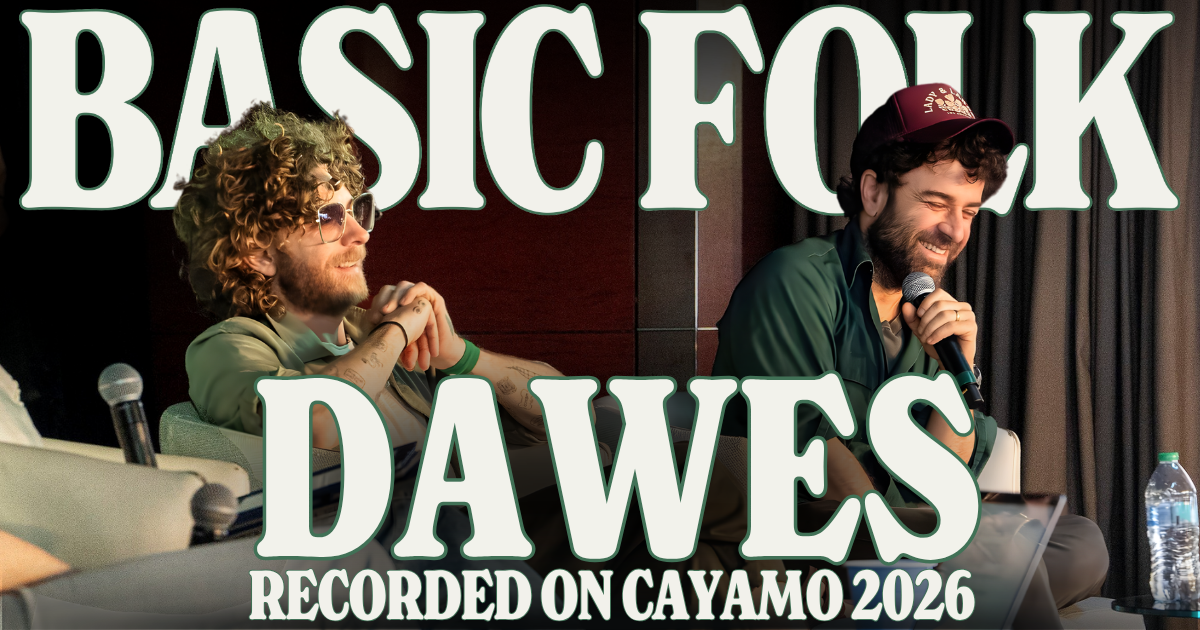
We are so excited to kick off our Interviews at Sea series with DAWES! We had the chance to talk to brothers Taylor and Griffin Goldsmith aboard Cayamo: A Journey Through Song in front of a packed audience during the music cruise’s 18th voyage in March 2026. The guys have been performing as Dawes since 2009, but the band has been a duo since their 2024 album, Oh Brother.
The Goldsmiths have been singing and playing together their whole lives inspired by their musician father, Lenny Goldsmith, who toured as the lead singer of Tower of Power in the 1980s. Taylor was never told it was hard to play guitar or sing, so he just did it. He always knew he wanted to be a professional musician. We talk about the ways his musical career turned out as not quite what he had expected. We also touch on how their singing has evolved over the course of their lives together.
Both Taylor and Griff are fathers, so of course we asked about the freedom that comes with priorities changing in their lives and careers – as well as what toys they may have regretted ever letting their kids have.
One thing following Dawes around for the past year is the aftermath of the January 2025 Eaton Fire in Los Angeles. Both brothers and their parents suffered immense loss due to the flames sweeping through Altadena, California, destroying thousands of homes and causing over 30 deaths. Griffin’s son was born two weeks after the fire, a month early. Dawes became the musical face of the disaster with an emotional performance on Jimmy Kimmel Live! and opening the GRAMMYs with Randy Newman’s “I Love LA” with a veritable supergroup: Sheryl Crow, Brad Paisley, Brittany Howard, St. Vincent, and John Legend. The brothers get into what the experience taught them about healing and reaching a place where this tragedy does not define them. We hear a bit about Taylor’s love of collecting first editions and his fear of the comment section and we wrap up with a fun “Which One?” lightning round. Thanks to Dawes!
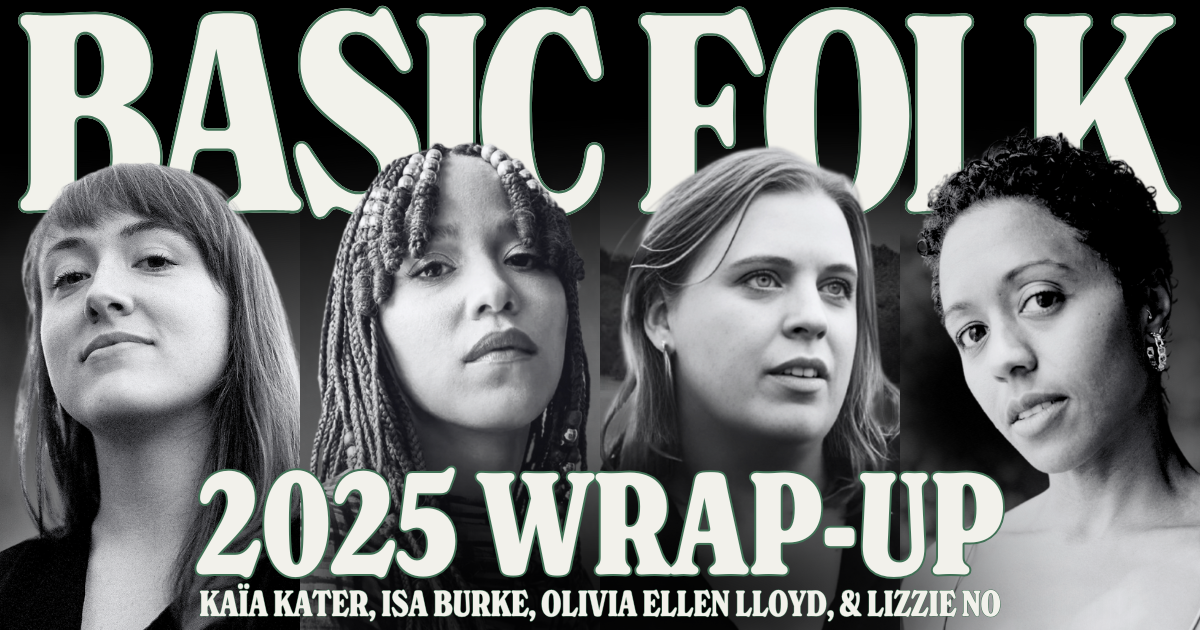
To send 2025 off into the great abyss, we have a sensational year-end Basic Folk roundtable featuring Lizzie’s group chat: Kaia Kater, Olivia Ellen Lloyd, and Isa Burke. It can feel so challenging to know which media you can trust and whose takes you can really take to the bank. There is no one we trust more to wrap up this wild and wacky year than these gals. We turned to them at the end of 2025 to hear their hot takes, what they’re grateful for, what they’ve learned, and what four poppin’ folk musicians were up to in this crazy year in the industry.
We also share a couple of Basic Folk clips from 2025! Our most-listened-to episode featured Ani DiFranco and Carsie Blanton onboard Cayamo, so of course we wanted to share a portion of their conversation about periods. Lizzie tees up a clip from her favorite episode featuring Cindy’s meet-cute moment with Morgan Toney. Morgan spoke of how he started to get more familiar with his Indigenous musical heritage and shares incredible insights about how to connect with your cultural heritage as a marginalized artist.
Lizzie & Cindy then get into what each has been up to this year, together and separately. They especially reflect on their trip to Alaska with Parlor in the Round, the pod’s new baby, Lizzie’s Yallidarity Social Club podcast, and the latest on their dogs – including one emergency surgery to remove a six-month-old corn cob. Goodbye, 2025!
Lead Image: Olivia Ellen Lloyd by Mandi Fountain Photos; Isa Burke by Sam Kassirer; Kaia Kater by Janice Reid; Lizzie No courtesy of the artist.
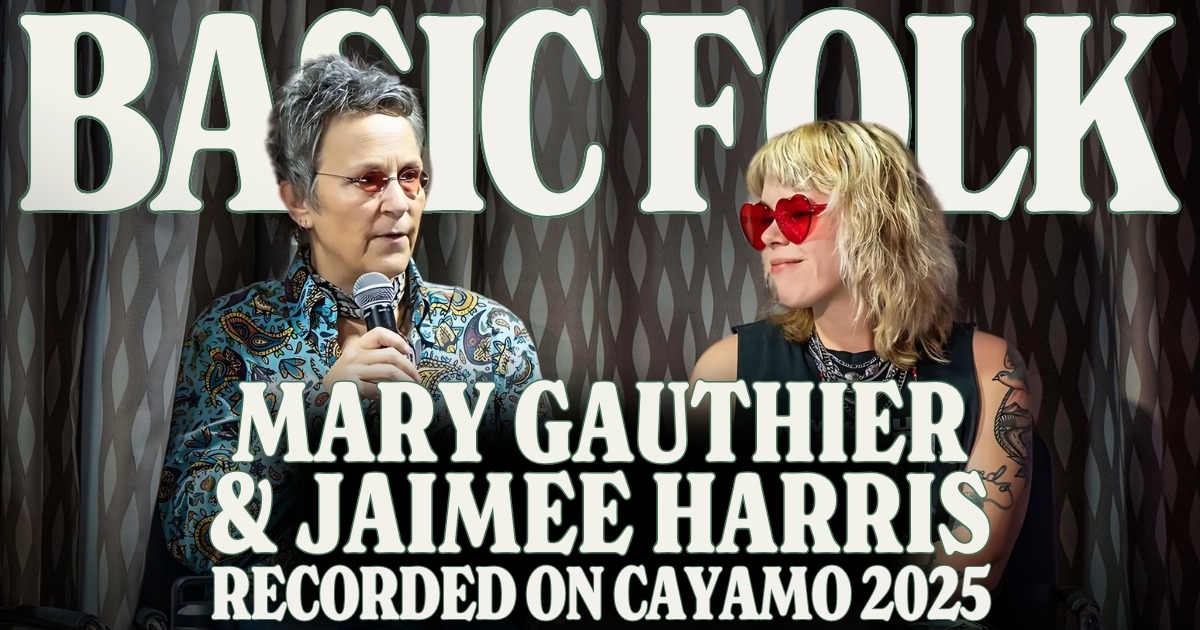
Mary Gauthier and Jaimee Harris talk to Lizzie and Cindy for Basic Folk onboard the Cayamo cruise in front of a live audience. We get down to business in addressing nice things by asking Mary what kind of shoes she’s wearing – as she has a reputation for enjoying the good stuff, especially on her feet. After that, we asked and Jaimee enthusiastically answered the age-old question: What is the correct number of shoes to bring on tour? They generously share about their relationship, which began two years after they met as teacher (Mary) and student (Jaimee) in a songwriting workshop. Interestingly enough, both Harris and Gauthier have been playing music for about the same amount of time, despite their age difference. Jaimee, mid 30s, and Mary, early 60s, are also both sober and expand on what it’s like to be students of their own patterns.
We also talk about their touring life, songwriting processes, and the alchemy of transforming personal trauma into art. We get to hear the very cute story of how Jaimee first heard of Mary Gauthier, by way of Ray Waylie Hubbard’s song “Name Dropping.” Mary, in turn, talks about her first impressions of Jaimee’s songwriting (spoiler alert: she was completely floored). They share their future plans with us, where they say there will be a Harris-Gauthier album, right after Jaimee completes the three records in her head and Mary writes her second book. They also share what it’s been like when they are together and around people who know Mary (who has a higher profile in the Americana world), but don’t know Jaimee. Each comment that they feel for partners in relationships with people who are “actually famous.”
We end with a great Lightning Round, a game we like to play with partners called “Which One.” We think they might have enjoyed that, because on the last day of the cruise Mary, getting off the boat, shouted, “Thanks for the interview! The Lightning Round was a real moment!!”
The dynamic songwriter and multi-instrumentalist Susan Werner spoke to Basic Folk onboard the Cayamo cruise, which she describes as a “paid vacation.” Reflecting on her upbringing on a working farm, Susan discusses the hard work that shaped her, but also how she’s learning to embrace rest and relaxation. With humor and insight, she navigates the balance between a hardworking mindset and the need for downtime, revealing her strategies for managing stress and expectations in both life and music.
Susan’s latest album, Halfway to Houston, is a continuation of her exploration of a place through its music. Previous releases found her examining New Orleans and Florida. In this particular case, she is focusing on the state of Texas, including the interconnectedness of communities across borders; the song “Sisters” is about twin sister cities El Paso, Texas, and Juárez, Mexico. As a seasoned artist, Susan dives into the importance of consistency and authenticity in her craft, emphasizing that hard work alone doesn’t guarantee success – it’s about being consistently excellent. She also touches on the political landscape and how her songs aim to foster empathy and understanding, even in divided times.
Photo Credit: Lead image by Bryan Lasky, alternate image by Will Byington.
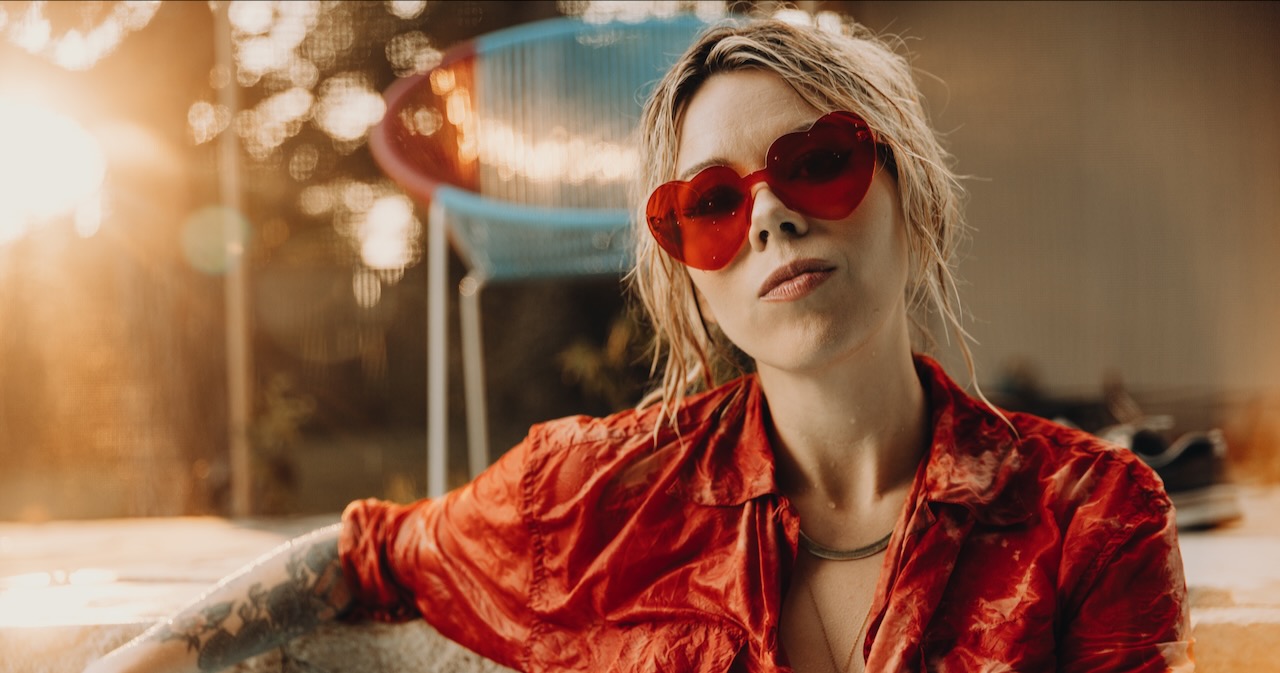
Jaimee Harris is a thoughtful songwriter, a kind and quirky human, and an insightful individual. It was an honor to speak with her about her upcoming tour, the inspiration behind her songs, and how she takes care of her mental health in a demanding industry. Our conversation touches on everything from her daily routine – right down to crafting the perfect cup of coffee each morning – to how she stays grounded on the road, to the process behind her songwriting.
We dive into her haunting song, “Orange Avenue,” written about the tragic shooting at the Pulse LGBTQ+ nightclub in Orlando, Florida – a thoughtful and chilling track. We also explore the details of the title track of her 2023 album, Boomerang Town, a story song rooted in both fact and fiction. It follows intriguing characters with intricate pasts, the restless ache to escape small-town limits and achieve something big, and the soul-crushing realities of a harsh world.
I hope you can feel Jaimee’s humor, intellect, and warmth through this interview.
You have four months of touring coming up. You’re playing shows across the U.S. and you’re also headlining a tour in the Netherlands and Belgium. How does all of that feel and what are you most excited and anxious about?
Jaimee Harris: Mary [Gauthier] and I just got home from being on this incredible thing called Cayamo, which is like a floating music festival on a cruise ship. We were on that boat for seven or eight days and just got home last night. We leave again this weekend for tour. So I’m trying to pretend I’m not home right now. Because if I switch into this mentality of, “I’m home now,” then that just disrupts the system. So I’m looking at this week as if I’m still on the road. With just like a couple days off.
I’m so excited about touring the Netherlands. It’s one of my favorite places to play. It’s one of my favorite places to be. I love the people there. I love the culture there. And it’s been cool because I’ve been over there many times as an opening act, but I’ve never done my whole set there. And it’s been my experience that the people in the Netherlands can really handle and really enjoy the dark songs.
How do you find constantly being on the road? And, how do you balance that with mental health?
Well, I’ve learned that I need to have a couple of things in place to make me feel comfortable and it doesn’t take much, but one of them that is so important to me is my coffee, which might seem silly. But there’s this coffee I love from Austin, it’s called Third Coast, and Mary Gauthier, my partner, used to run restaurants in Boston and one of the only things she kept from her restaurants when she sold them to move to Nashville to become a songwriter is this industrial coffee grinder.
Every morning we grind it and make espresso and that’s like a huge part of my joy. And we bring it on the road with us. I bring a little kettle and my Hydro Flask, I’m a Hydro Flask girl.
Me too! Mine is right here! [Pulls up Hydro Flask]
Amazing! I love them so much. So the water bottle is a huge deal on the road.
Every morning when I start my day with that coffee, it sets me up for success. Having a little bit of routine to keep me tethered to something while we’re on the road is really helpful. I’ve found that I can always find 15 minutes throughout the day to move my body. Making that a priority for me helps everything while I’m on the road. I love being on the road. Today, since we just got home yesterday, I’ve just been on the couch all day. Re-entry is always hard for me. So today I’m just watching movies and being a weirdo on the couch.
Could you tell us about your recent interactions with Emmylou Harris?
I think coming off this thing we just did on the boat was incredible and Emmylou Harris is my number one hero of all time.
Her guitar tech, Maple Byrne, gave us a heads up a few weeks ago that Emmy might want me to play guitar and sing with her for this [songwriters] round we were in. I literally was driving a car in the Hill Country in Texas and I had to pull the car over and scream. I was like, “There’s no way! That’s my number one hero!” And I didn’t even believe it was gonna happen until it happened.
Earlier that day [during Cayamo], I played a show as me on the boat. Twenty minutes before I played, security walked Emmylou Harris and her friend to my show. I literally had to run to the bathroom! I was like, “I’m gonna be sick. I can’t handle this. This is crazy! THIS IS CRAZY!” I literally forgot the first two lines of the first song, because I was so in shock. I just couldn’t believe that happened and then I got to play with her later that afternoon. My wildest dreams have come true!
You’ve mentioned Mary a little bit. What has it been like for you to find a partner, Mary Gauthier, who is both a partner in life and also a partner in music, playing shows and touring together?
It’s been incredible. I have learned so much from her about what it is to be a troubadour from the business side of things. She’s so wise, because she came to music after running three restaurants. She has a lot of business experience that she’s been able to apply to the world of being a troubadour, which is incredible. She’s been able to do what she does inside her own integrity in a way that’s really beautiful to learn from. And I get to live in a house with one of the greatest living songwriters. I truly think she’s one of the greatest songwriters of all time, and it’s made me a better writer. Just getting to watch her, how hard she works on songs. She is a real hard worker. I mean, she’s got a lot of natural talent, but she chisels and chisels and chisels songs out of the marble. And so it’s made me up my editing game.
Your song “Boomerang Town” is so beautiful and relatable and intimate; it’s a story-song format. How did you come up with the idea for “Boomerang Town” and what does that song mean to you?
It came in different stages. I’d always wanted to write a song about where I grew up. I’m from a small town just outside of Waco, Texas. I remember being in my early twenties and trying to explain to people where I grew up and I came up with the phrase, “It’s a boomerang town.” People try to leave, they end up going back there pretty quick. That phrase had been in my mind for a while.
In 2017, I got asked if I wanted to sing a verse of “This Land Is Your Land” during this 4th of July celebration. The songwriter hosting the song said, “What verse do you want?” I said I want the steeple verse. The verse is: “In the shadow of the steeple, I saw my people/ By the relief office, I saw my people/ They stood there hungry, and so I stood there asking/ Was this land made for you and me?” In my hometown, there’s an interstate, I-35, that runs through the center of it and on the east side of that interstate there’s a steeple from the Truett Seminary in town and on the west side there are two relief offices. The interstate creates a bridge and there’s been a community of people living under that bridge for decades, like my entire life.
When I saw those words, I saw my hometown. The songwriter said, “I always thought Woody got it wrong with that verse.” I couldn’t believe that he would have such a different take on that verse; that planted a little seed for me. I worked on that song for years. I tried a bunch of different perspectives. I initially started with myself and I couldn’t find a way for the song to move forward if I was the narrator. I tried it from the perspective of a veteran. Then I tried it from the perspective of a woman who worked at a cafe. I decided her name was going to be Julie, because I’m a huge fan of Buddy and Julie Miller. I finally landed on the perspective of the 17-year-old boy who worked at Walmart that knocked up his girlfriend. Which is a combination of me when I worked at Walmart and somebody else I knew. That’s when the story started to take off.
I’ve had so many experiences where people came up to me and said, “Hey, you got that song perfectly right.” Like, “My brother died under that bridge, I know all about that scene.”
Also, being a woman from Texas, with the way things are going there – nationally and politically, that song, how it ends, has a way deeper impact than I could have imagined when I wrote it in 2020. The choices women had in 2020 are more than we have now in 2025. There’s no way I could have known that when I was writing it.
You’ve just passed 11 years of sobriety. Is there anything that you’d like to share about your sobriety, your support system, and addiction in general?
Well, I couldn’t have done it without 12-step recovery. I’m very active in 12-step recovery. That’s been my lifeboat, doing it with other people. Someone in recovery said this thing that has stuck with me: “At five years, you get your marbles back. And at 10 years, you get to play with them again.” I feel like that’s true. I’m learning every day.
I remember when I first got into recovery, people would say this thing that I could not understand, “I’m so grateful to be an alcoholic.” When I got there, it was through the criminal justice system, so I was going there to get a paper signed. I was like, “What are these people talking about?” I can’t tell you how many times over the last six years I’ve said, “I’m so grateful, because I have a support system in a time when a lot of people feel really isolated.”
You spent some time in Florida in 2022 and you wrote a song called “Orange Avenue” about the 2016 shooting at the Pulse LGBT nightclub. What does this song mean to you, and what was the process of writing it?
I decided to visit a bunch of spots in Florida to collect stories and write and record a song in each town. I spent a month traveling the state. I wasn’t even gonna go to Pulse, and then somebody mentioned it and I said, “Okay, I’ll check that out.” Everything about it really floored me. I was imagining this bar being in an entertainment district, where there are a bunch of bars. It isn’t like that, it’s a neighborhood bar. So it’s just house, house, house, house, a Dunkin’ Donuts across the street, and then Pulse. Of course it was a gay bar, but it was also a bar that you could get into if you were 18 and up. So it’s also a place where younger kids could get in and just go dance and have a good time. Which is why the youngest girl that was killed was 18 years old. She was there on vacation with her family.
Now it’s been deemed a national monument. When I was there, it was kind of makeshift. There are pictures of people, notes to loved ones, poems, just all sorts of tributes. Then there’s this one kind of official-looking plaque. It has the names of 48 people that died in the shooting. To the side of it says at the request of a family, one name has been left off this list. I was wondering, what’s the story there? I looked it up and it turns out there was a man of Middle Eastern descent and his family didn’t know he was gay until he died in the shooting.
They were ashamed of that. It took quite a long time for anyone to agree to come pick up his body. That’s how deep the shame was. At the time, I believe the police chief of Orlando was a lesbian and because of the element of it being a neighborhood bar, because there were people that were there just because they could get in because of their age, they weren’t necessarily going to come out and say, “Hey, this was a hate crime.” When they found out that that family didn’t want to come pick up their family member, they said, “We have to tell the world that this was a gay bar. This was a hate crime.”
I tried the song from my perspective, but it didn’t really have the impact that it did until I put it in a perspective of that man and his ghost and what it would be like to embody that man’s experience. It was an honor to write that song.
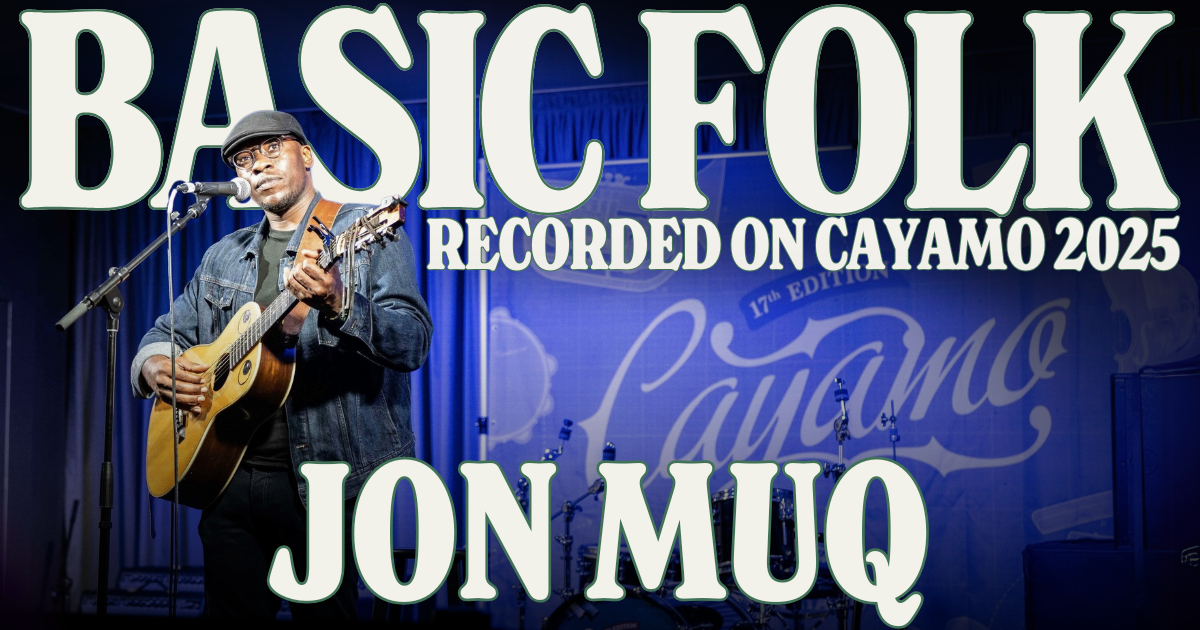
Originally from the village of Mutungo, Uganda (near the country’s capital of Kampala), Jon Muq‘s journey to his current life of touring with an Austin, Texas, home base has been unconventional. Onboard the Cayamo cruise earlier this year, we talked to Jon about his childhood experiences, including fetching water with friends and hearing “We Are the World,” which was the first Western music he ever experienced. He also recounts the emotional reunion with his twin sister at the Cambridge Folk Festival, revealing how distance from his family has shaped his identity as an artist. He had not seen her, his friends, or any family before that for many years due to leaving originally to work on a cruise ship (the same line we were cruising on!) and work visa realities.
Jon discusses the moment he first held a guitar at age 19, which felt like a natural fit. He shares how traditional Ugandan music influences his sound and how he began learning English through song before mastering the language. Jon speaks about his experience with food; growing up, his family was food insecure. When he started performing on cruise ships, he was overwhelmed by the amount of food available. He explained the ever-present googly-eyes on his guitar, which tie into learning about distinct cultural differences between America and Uganda. Like many countries, it is normal in Uganda for male friends to hold hands. This and many cultural differences were learned the hard way for Jon, so the eyes on the guitar symbolize an always smiling friend that will be there for him. He wraps up this episode of Basic Folk with a great lightning round giving us the inside scoop on the best food aboard Cayamo, his dream collaboration and, in his opinion as an industrial design student, what’s the most beautiful product in the world.
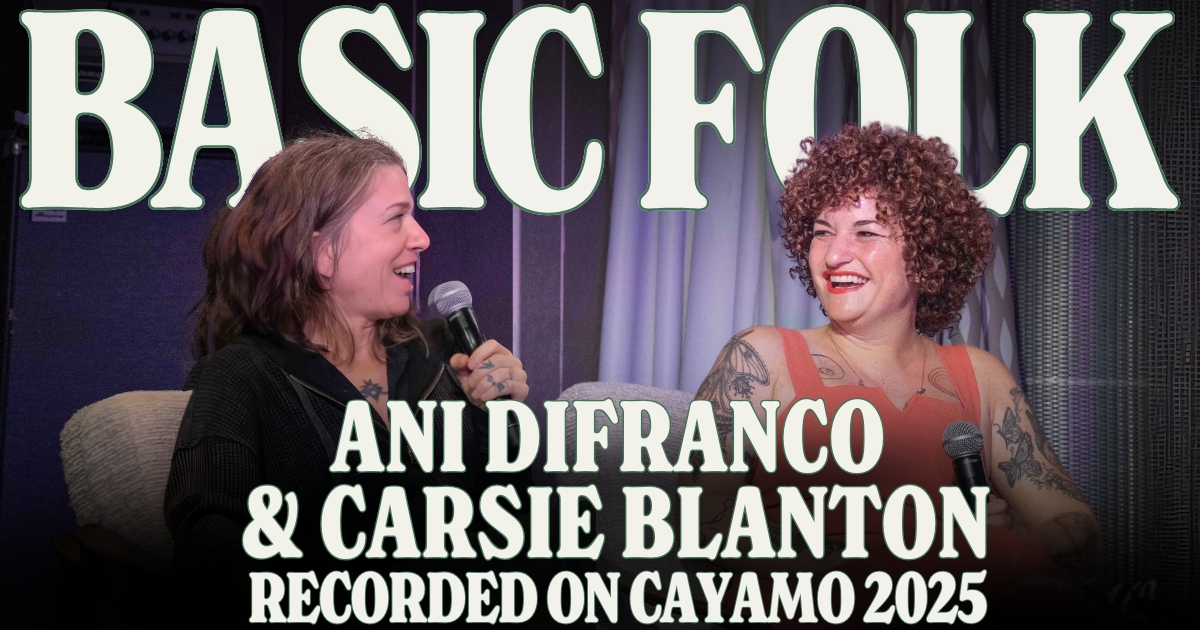
Basic Folk is making trouble at sea with Ani DiFranco and Carsie Blanton! Hosts Lizzie and Cindy had the opportunity to speak with the two like-minded radical songwriters aboard the 2025 edition of Cayamo, a roots music cruise. Our conversation kicks off with Ani sharing her transformative experience performing as Persephone in the Broadway show Hadestown, delving into the challenges of acting and the lessons learned from stepping outside her musical comfort zone. We navigate through Ani’s journey of independence, discussing Unprecedented Sh!t, her first album with a producer besides herself in 23 years – BJ Burton – and what it means to relinquish control in the creative process.
In Ani’s memoir, No Walls and the Recurring Dream, she writes about how her creativity is aligned with her menstrual cycle. She described the most creative part of her cycle as “THE WINDOW.” Cindy asked all three artists onstage to reflect on how their creativity relates to their periods. What resulted was a discussion on how creativity is impacted by not only menstrual cycles, but menopause and ovulation and how that has evolved over time. The conversation also touches on the significance of hair as a form of self-expression and how societal perceptions of women change with their appearances.
Ani and Carsie speak to the power of songwriting in addressing historical and political issues, emphasizing the importance of music as part of a larger movement for justice. They share insights on the necessity of community and collaboration among artists in a challenging industry, encouraging listeners to find strength in solidarity rather than competition. To wrap up, they reminisce about their parallel wild, youthful experiences and how those versions of themselves continue to influence their art today. As Ani had to leave the stage early, Carsie brought it home with an Ani DiFranco-themed lightning round.
BGS is pleased to announce a new partnership with its signature podcast, Basic Folk, which is now an official BGS production! Hosted by Cindy Howes & lizzie no, Basic Folk had been previously distributed on the BGS Podcast Network since 2021, but now officially becomes part of our brand’s stable of first-rate, original shows. We’re excited to continue to invest in this superlative folk podcast with creative visuals, more live appearances, and our commitment to fresh and envelope-pushing editorial content front-and-center. This announcement follows the recent debut of Basic Folk’s brand new logo (designed by Belhum) and theme song (composed and performed by Dietrich Strause), which both festively mark this new era of collaboration.
“BGS is one of the coolest media platforms in any musical space,” the hosts share via press release. “As the landscape of podcasting, social media, and roots music evolves at hyperspeed, we are stoked to be docked on ‘The International Space Station’ known as BGS. Our evolution is tied in with theirs. Cheers to another year of telling folk stories and making queer mischief on Basic Folk.”
2025 is already destined to be big for Basic Folk. The show and its hosts will be back onboard Cayamo’s signature roots music cruise, Journey Through Song – and with even more live events to come throughout the year. Already we have brand new interviews with the legendary Dobro player Jerry Douglas and visceral folk-artist Lutalo on the docket for January. Later this winter, Basic Folk will reach the momentous mile marker of their 300th episode.
“The spirit and mission of BGS are completely in line with Basic Folk,” Howes says. “It’s an honor to create this platform alongside BGS to dig deep into artists’ perspectives of the human condition. It only makes sense for Basic Folk to do the work of dignifying folk musicians in collaboration with one of the most rad music orgs operating today.”
Since 2018, Basic Folk has uplifted under-the-radar roots musicians by providing a platform that they might not otherwise have, alongside interviews from GRAMMY-winning guitar gods like Molly Tuttle, or Haitian American folk legends like Leyla McCalla, or deep feelers like legendary songwriter John Hiatt. The show is dedicated to showcasing the best in folk, bluegrass, acoustic, and Americana while including Black, Brown, and queer folx who have been excluded from the folk world or felt like they did not belong.
Cindy & lizzie each bring unique perspectives to their honest conversations with folk professionals. Basic Folk is equally dedicated to repainting the broad landscape of folk music as we are to tearing down the ivory towers of the music industry. BGS is proud to welcome the show into our family of programs.
This website uses cookies to improve your experience. We'll assume you're ok with this, but you can opt-out if you wish.AcceptRejectRead More
Privacy & Cookies Policy
Privacy Overview
This website uses cookies to improve your experience while you navigate through the website. Out of these, the cookies that are categorized as necessary are stored on your browser as they are essential for the working of basic functionalities of the website. We also use third-party cookies that help us analyze and understand how you use this website. These cookies will be stored in your browser only with your consent. You also have the option to opt-out of these cookies. But opting out of some of these cookies may affect your browsing experience.
Necessary cookies are absolutely essential for the website to function properly. This category only includes cookies that ensures basic functionalities and security features of the website. These cookies do not store any personal information.
Any cookies that may not be particularly necessary for the website to function and is used specifically to collect user personal data via analytics, ads, other embedded contents are termed as non-necessary cookies. It is mandatory to procure user consent prior to running these cookies on your website.