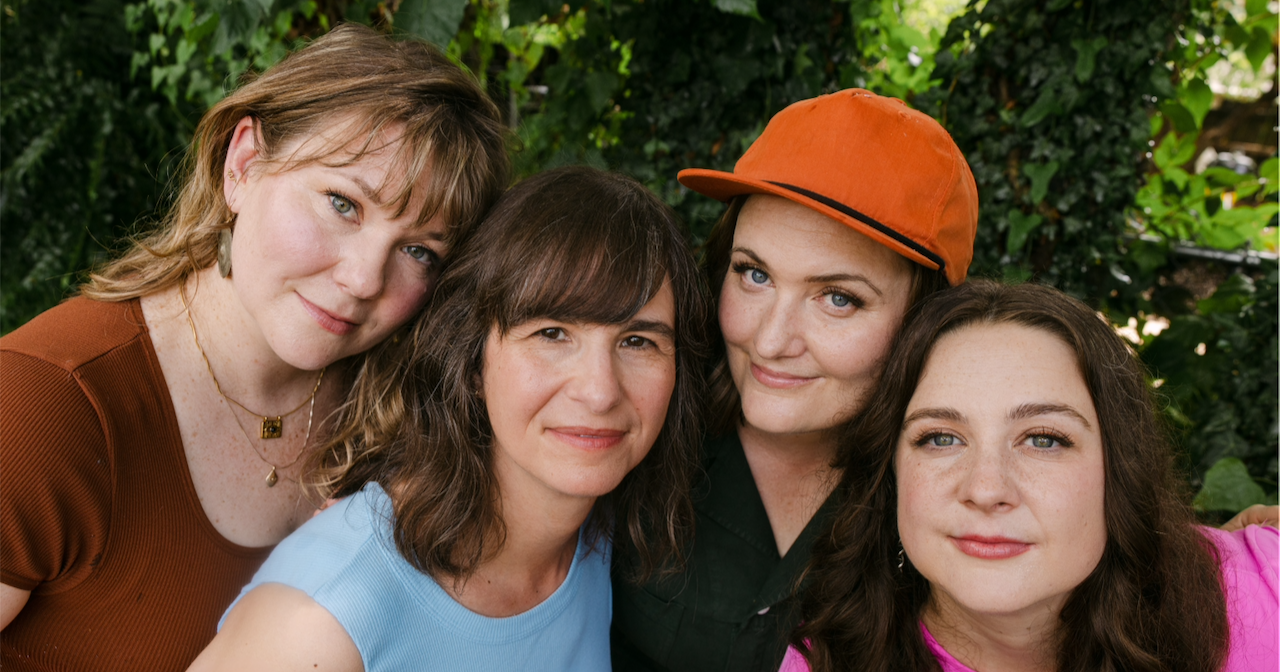
Fifteen years ago, bluegrass band Della Mae’s vocalist Celia Woodsmith wrote her future self a letter. She was 25 years old, burned out on trying to make it in Boston’s rock scene, and reeling from the loss of her father.
“If you can just die, why would you be doing something that you didn’t love to do?” she asked.
Her answer – and her hopes for her future self, which Woodsmith wrote into that letter – inspired the title track and underlying message of the band’s new album, Magic Accident, which marvels at the improbability of existence. As Woodsmith sings on “Magic Accident”:
We all start with something
No one comes from nothing
It took a millennia to get you here
You’re a magic accident, the way that fate bent
With a little carbon and gravity
Carbon and gravity
“Our life is just a series of these little accidents – my parents meeting, their parents meeting. And it’s a beautiful and magical thing that we’re all here right now. It’s a beautiful and magical thing that Della Mae is here,” Woodsmith says. “That’s the basis behind that song, and it’s the basis behind how I think about a lot of my life. It’s just a beautiful accident that I’m here at all. So I might as well enjoy it and do the best thing, the best that I can, while I can.”
Magic Accident, as an album, a song, a concept, and a band ethos, celebrates following one’s own path. All four members of Della Mae – Woodsmith, founder and fiddler Kimber Ludiker, guitarist Avril Smith, and bassist Vickie Vaughn – lost their fathers prematurely, which bonds them as a band and altered how each woman sees the world. And making it as one of the few all-women bluegrass bands inherently required the Dellas to push boundaries and carve out space for their lives and stories.
“If I could talk to the little girl inside of me/ I’d let her know the world ain’t what it seems/ And if she would listen/ Could I keep her safe from making my mistakes?” the band wonders on “My Own Highway,” the album’s second track. Later, they remind the next generation of the same sentiment in “Out Run ‘Em,” written by Smith (co-written with Caroline Spence) for her pre-teen daughter, advising, “If you go with the crowd, you can’t out run ‘em.”
Indeed, all of Magic Accident listens like a set of love and advice letters to the band’s younger and current selves.
“I don’t think we could have written this album as young women. This is an older, wiser woman sort of thing,” Woodsmith says.
Elsewhere on Magic Accident, the band appreciates life’s small, sweet, desperately important moments. “Nothing at All,” which Woodsmith wrote with Spence, is a gentle appreciation of love that’s aged comfortably, while “Little Bird,” which the pair also wrote, relishes slow days and simple life joys.
“What do they say? One of the biggest forms of revolution is having joy in spite of what’s going on around you,” says Vaughn, about including these kinds of emotional interludes on the album. “And sometimes, the little things are all we have right now, whenever all this bullshit is happening.”
These songs would not be confused with light subject fare, though. The weight and wisdom of lived experience grounds Magic Accident in conviction and clarity, even when it may appear uncomfortable. “Family Tree,” a furious track driven by producer Alison Brown’s banjo picking and Ludiker’s fiddle, explores what it takes to break harmful generational cycles. “What You’re Looking For” ends a relationship that no longer serves the narrator. On the album’s only cover, Bruce Robison’s “Lifeline,” Vaughn on vocals (with Mary Bragg on harmony), reaches a hand down to anyone struggling to find their footing in the buffeting of life.
“The weight has become unbearable,” Woodsmith says. “We speak our minds and we fight for the things that we think are right; we all feel strongly about a lot of the same things, like women’s rights. But that can be a heavy load to bear and to sing constantly night after night.
“Sometimes we choose not to sing some of these songs that we believe so strongly, just because it’s become hard to bear that weight. I think this album lets us see the light a little bit.”
Though it’s full of interpersonal songs, on the final track of Magic Accident Della Mae zooms out to consider the state of the world. Sonically bluegrass and lyrically a protest, “Takes All Kinds” – co-written by Vaughn and singer/songwriter Melody Walker – asks the world to consider its future, as well:
Oh, the politicians who write the laws
(Oh, lord it takes all kinds)
They say they stand for the underdog
(Oh, lord it takes all kinds)
But then they take my rights away
(Oh, lord it takes all kinds)
For a greenback dollar at the end of the day
(Oh, lord it takes all kinds)
Ludiker started Della Mae in part out of frustration with how few women she saw on concert bills and in bluegrass bands. “After talking with a lot of people, it was pretty clear that maybe those bands also wouldn’t hire women for various reasons; I eventually got the idea to start my own band,” she says.
“My brain just wouldn’t accept the fact that [otherwise] maybe I wouldn’t have some of the [same] opportunities that I would have if I was a boy.”
To that end, Della Mae has been part of building a more inclusive, supportive community in bluegrass. Indeed, Woodsmith joined the band soon after writing herself the letter that inspired “Magic Accident.” At the time, she planned to quit music and join the Peace Corps. Instead, 15 years on, Della Mae has produced six studio albums (including their GRAMMY-nominated This World Oft Can Be on Rounder Records) and toured over 30 countries with the U.S. State Department music diplomacy program.
Della Mae is, by their own estimation, the longest-touring all-woman bluegrass band. Which would prove, as they put it on their website, “once and for all, that a band of all women is not, nor has ever been, a mere novelty.”
“Hopefully we can inspire other little magic accidents,” Woodsmith says. “Like other women or other young people who want to play, who see us at the right time in their lives to push them forward to playing music, and to step outside of their comfort zones and do something they thought might be impossible.”
Photo Credit: Laura Schneider