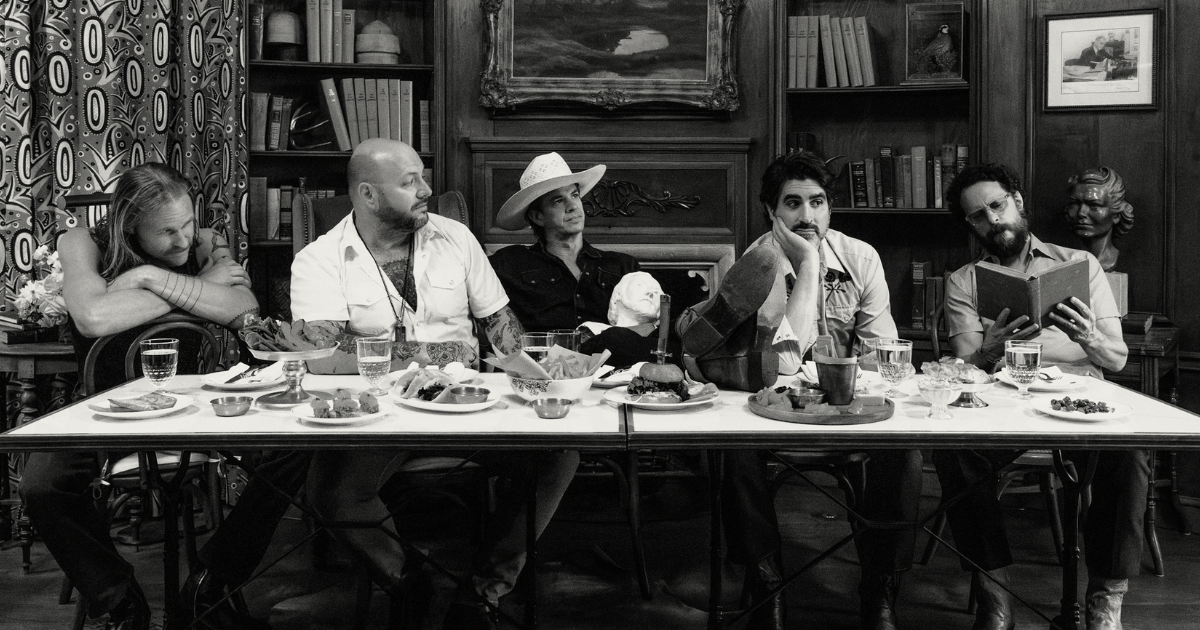
Don’t be fooled by their name, as the Band of Heathens actually give us something to believe in.
Coinciding with their 20th anniversary as a band, their new project Country Sides is equally feel-good and philosophical. The band’s co-founders and songwriters Gordy Quist and Ed Jurdi called in to Good Country from their homes in Austin and Asheville, respectively, to talk through their inspirations for the album, their writing (and rewriting) process, and how banjo fits into their house of music.
Just a few weeks after our visit, Country Sides and the single “Take the Cake” topped the Americana Music Association’s album and singles airplay charts simultaneously, a new feat for the well-established group.
“We have been really fortunate as an independent band,” Quist says. “We’ve never been on a label or been a part of the machine, and we just have a lot of gratitude for the 20 years we’ve had together as a band.
“This record is like a message of gratitude for all that we do have. And as much as we love making records, the live show is certainly my favorite part of this career. That’s what’s special about this band. When we get on stage, I feel lucky to be a part of this thing that really is fun live, so I would encourage people to check out a live show if you haven’t done it.”
As I was listening to the album, I was picking up a lot of messages of encouragement. It feels like a positive record to me. Is that a fair statement, do you think?
Ed Jurdi: Yeah, I think so. It’s like the musical retrospective of the band, in a way, sort of our history as an entity. Maybe in the background, with the realization that we’re making it 20 years at this point, there’s a little bit of a celebratory nature. I don’t know about Gordy, but in my writing process, I tend to almost have the opposite reaction to everything going on around me, outside in the world. If everything’s really negative, and the messaging is really negative, and there’s a lack of hope – maybe it’s a form of escapism for me, but I tend to lean into that [opposite reaction] a little bit more in my messaging.
And insofar as sharing music with people, it’s almost like the internal pep talk that I’m having with myself turns itself into the art and into the lyrics and something to share as a message with other people. We’ve never really been ones for beating people over the head with the message, but things are pretty wild and wooly – and not in a good way out there, in a lot of ways. So, I think some messages of community and togetherness and rallying around a common good – we could certainly use more of that.
Did you have a certain sound in mind as you made this record?
Gordy Quist: I think we talked about trying to make a country soul record. We were listening to some of the early Dobie Gray records and thought, “OK, what if we took a mix of soul music and country music melodies and textured it…” We put more pedal steel on this record than we probably ever have on any record. And that was intentional. From the beginning we knew we wanted to do that. I guess it was intentional to try to make a country soul record. Whether we did that or not, I’m not sure. But that’s how we arrived at whatever we did.
I like the spirit of fellowship in the song “High on Our Own Supply” and there’s a lyric in there about hearing the banjo playing soft and slow, like a stereo. This being the Bluegrass Situation (and Good Country), I’m curious, do you often reach for the banjo?
EJ: I do. I’m a terrible banjo player. You know, my buddy Graham Sharp in Steep Canyon Rangers is an amazing banjo player. So if I need a banjo on a record, I’d probably call him.
I think writing “High on Our Own Supply,” it was almost like we’re building a house of music. You know, if you were to go into any room in that house, there might be this different scene going on. You open the door and there’s someone in there playing the banjo, and it’s so good, it sounds like it’s just coming out of the stereo.
The song “Pleasing People” reminded me of soul music from the ‘70s and I wondered about that soul influence. How does that show up in your music?
GQ: I guess there’s two elements. I think the rhythm section is the foundation of soul music and the groove. That was something on this record we really tried to dig into. The band right now – Clint Simmons on the drums and Nick Jay on bass – are a deep and heavy rhythm section, so that lends itself to a style of American roots music that leans into soul music. But also, simplicity. Lyrics that sound conversational and simple but have some depth to them. It’s hard to do that well. That’s part of what makes soul music great – that it’s simple but it’s good.
It takes skill to make it look easy or sound simple. What’s your editing process and your rewriting process like for you?
EJ: It never really ends. Even after we record these songs, I definitely change lyrics to songs as we play them live. The cool thing about these songs, especially making a recording, it’s a snapshot in time. But songs, I think of all the artistic mediums, they kind of move with you through time in a really special way. What a song means to you at 16 can mean something completely different to you at 40. You’ve piled up life experiences and you view the world in a little bit of a different way. So that’s always fun, but editing is constant.
I would say Gordy and I both are doing a lot of lyrical editing and we’re doing a lot of musical editing, too. When we get together and make records, it looks something like Tuesday morning, 10 o’clock: “Hey, Gordy, what do you got?” You know, Gordy grabs an acoustic guitar, sits in the middle of the room… And I’ve [already] heard these songs we’ve worked on, the two of us, but that’s the first time that Trevor Nealon (our keyboard player) and Nick and Clint have heard the songs.
So it’s like, “Hey, OK, first impressions? Go!” and then we start filling the canvas up, taking stuff away, adding stuff, changing colors, all these different things, until we’re at a point where we feel like we’ve edited something down to a nice, presentable format. So, it’s a work in progress, always. To your point, the more you can tolerate the editing, the better things become. It certainly is the most challenging part of the job, but it can also be the most rewarding.
“Take the Cake” has a great vibe. I’m sort of a workaholic, so it’s a nice message to hear, to hit pause and go do something fun. What were you hoping to convey in that song?
GQ: I think I was playing with the idea of giving versus taking, in life. I’ve been working on that song and editing that song for a couple of years actually. I’ve had it for a while. You know, there’s a weird juxtaposition of giving and taking. If you are always taking, in theory you should have lots of things because you’re receiving them. But in reality, you usually end up empty, whether it be friendships or whatever.
The opposite is true also. If you’re always giving and generosity leads, in theory the fear side of you thinks you’re going to run out of stuff. But the opposite actually is true. And that’s kind of what I was playing with, just the idea of letting go of that consumerism or just the [mentality of] “I need to keep what’s mine.” And being cool with letting go of that and letting generosity be the leading force.
As you mentioned earlier, this album is like a 20th anniversary celebration of the band. Are you enjoying this period of your life? You still have a lot of years ahead, but you’ve got 20 years of experience behind you too.
EJ: Yeah, I think it’s a good vantage point. I’ve heard Gordy describe it as standing at almost the peak of a hill. We’re all dads, so we can look down and look at our kids and remember being their age. Looking the other way on the hill, we see our parents, and we remember our grandparents being that age. So, it’s kind of a trip to be in this middle age of life. We still have the energy of young people. I think the fire is still there. There’s no lack of commitment or of energy or passion to what we’re doing. But we’ve assimilated a little bit more wisdom, and we have a few more tricks up our sleeve, a few more shortcuts. It’s fun exploring those things and trying to share them with people.
GQ: Talking about this phase of life that we’re in, I have this feeling like, when we were young, making our first records, we would put everything into it and the goal always was, “I hope this is good enough that we get to keep making records and make another record.” At the end of every record we’ve made I felt like, “Man, that’s the best thing we’ve ever done and I don’t know how we’re ever going to top that.” Whether it is truly the best thing we’ve ever done or not each time, that’s not for us to decide, but it feels that way to us.
EJ: We’ve always left nothing on the table when we’ve made a record. Now we’re just a little bit more conscious of our surroundings and what our intentions are. Again, I don’t think there’s ever been a lack of effort, but now there’s maybe a realization like, “Hey, every time we get on stage, every time we sing, every time we make a record, it might be the last time we do, so let’s make sure we’re doing it with everything we got. Let’s leave it all out there, because at the end of the day, that’s all you got.” You can feel good about that in the rearview mirror.
Photos courtesy of the artist.