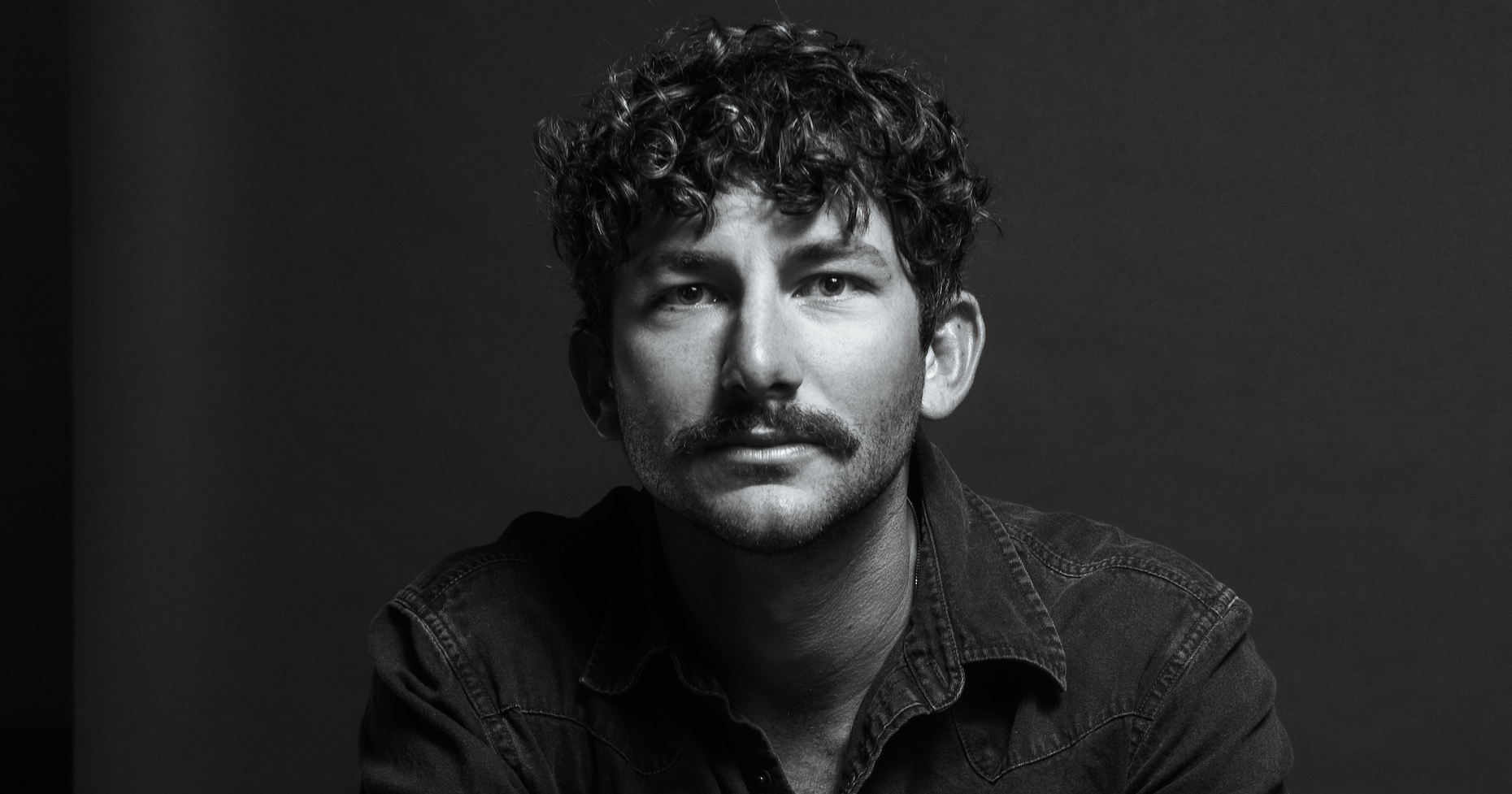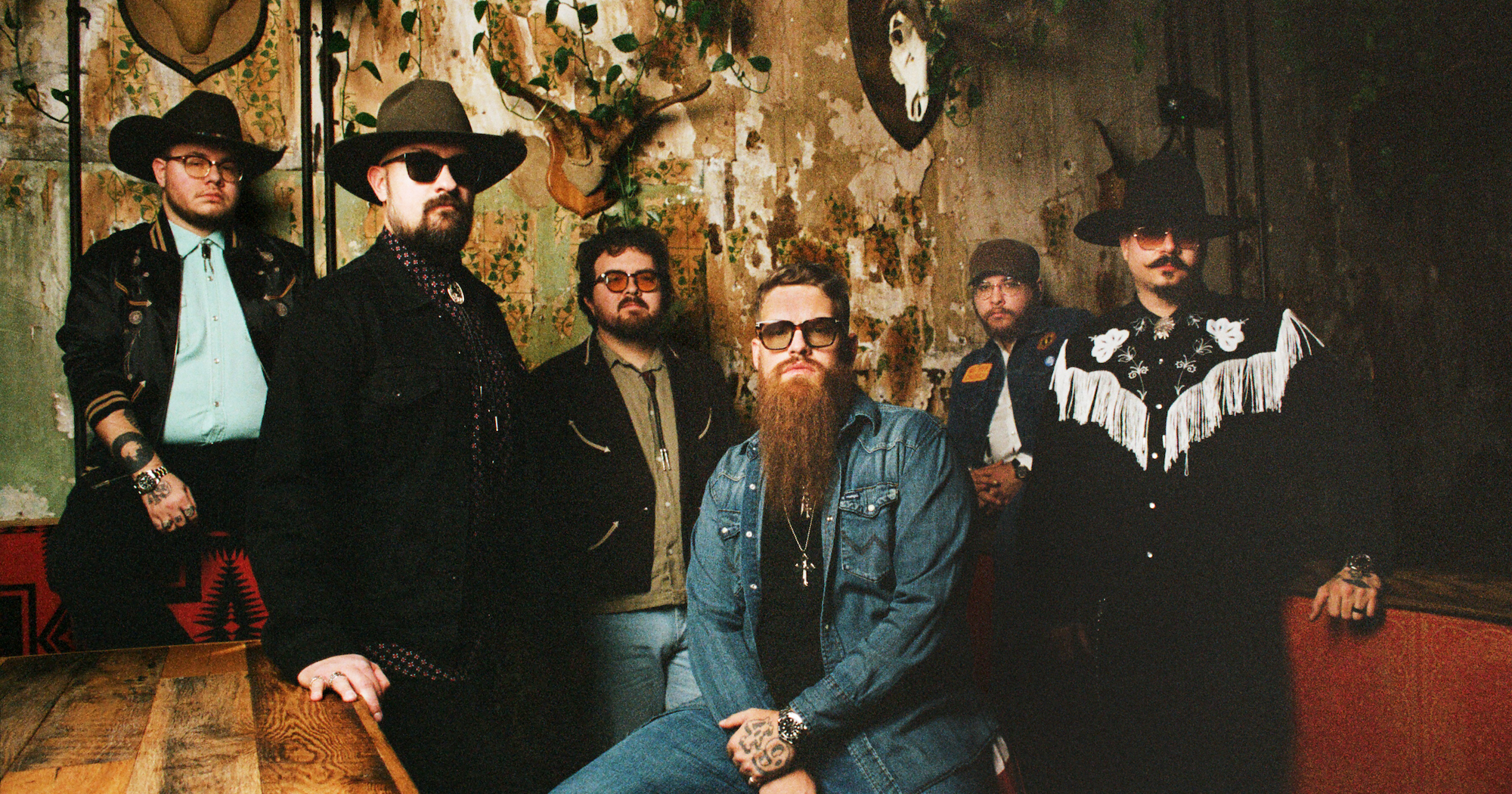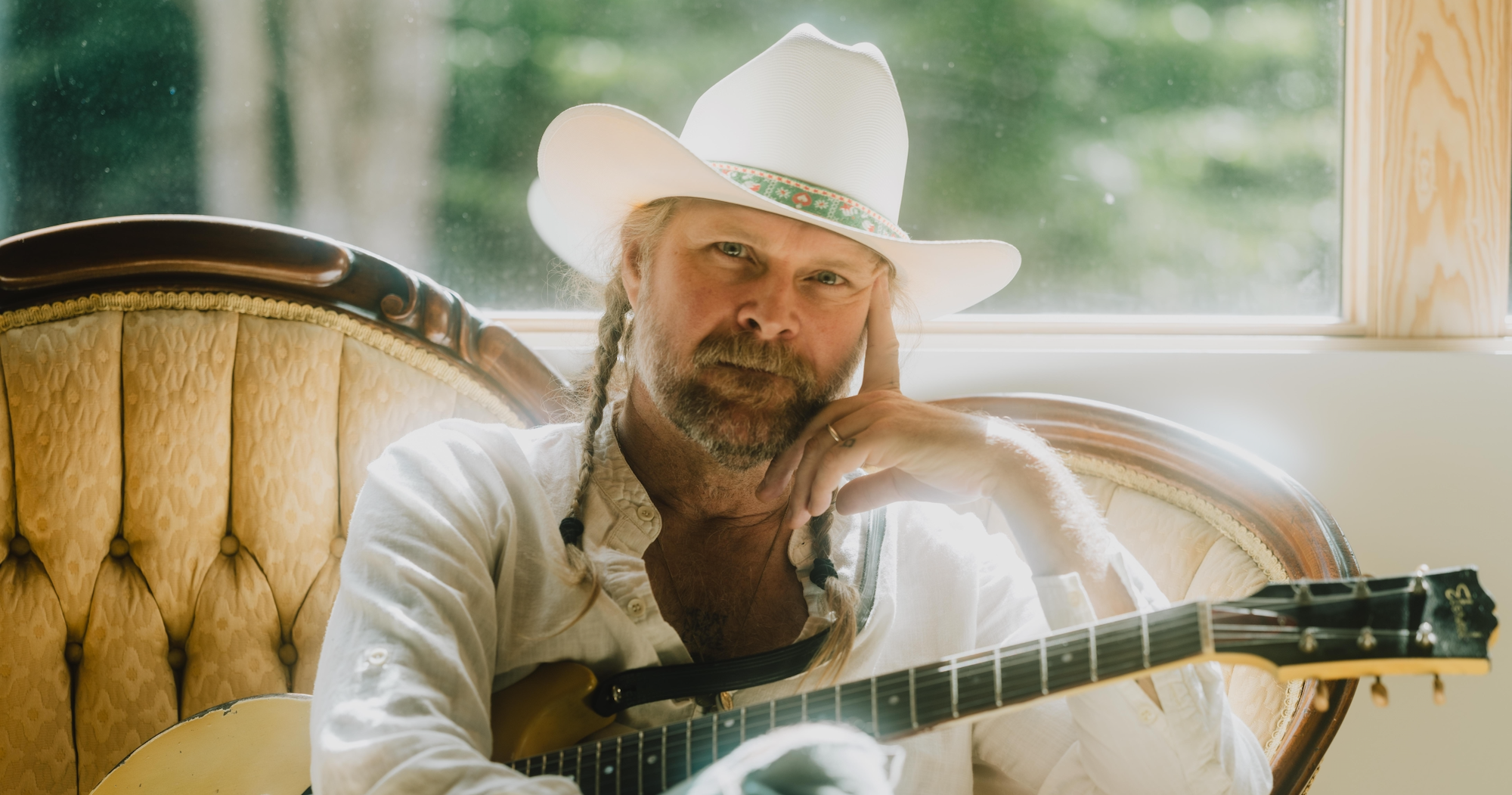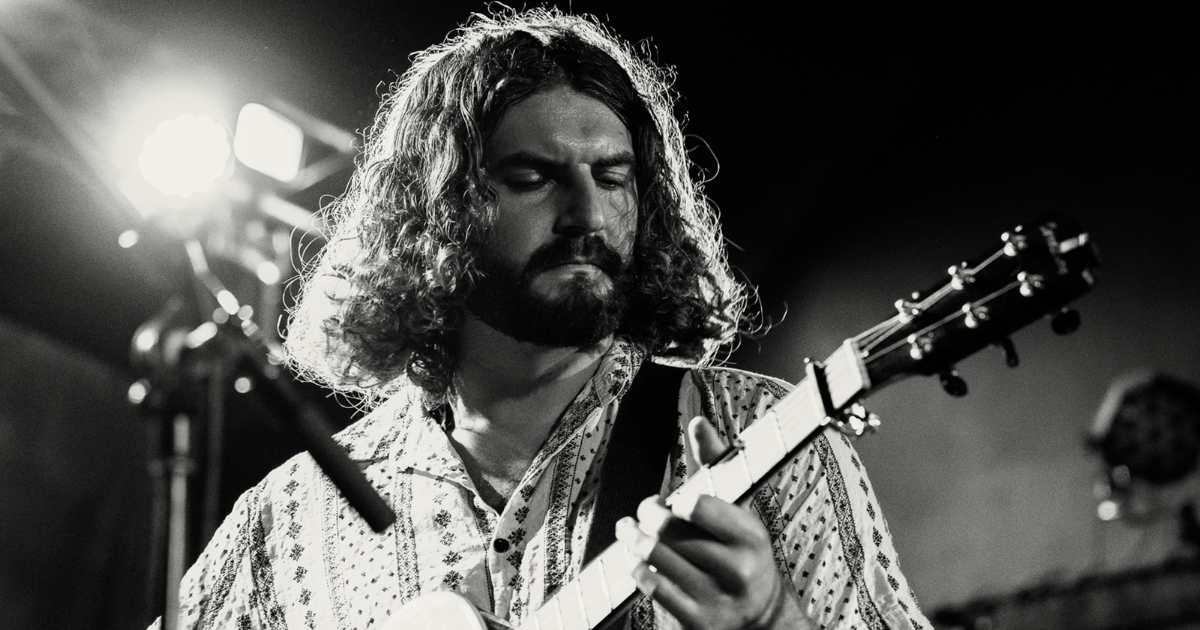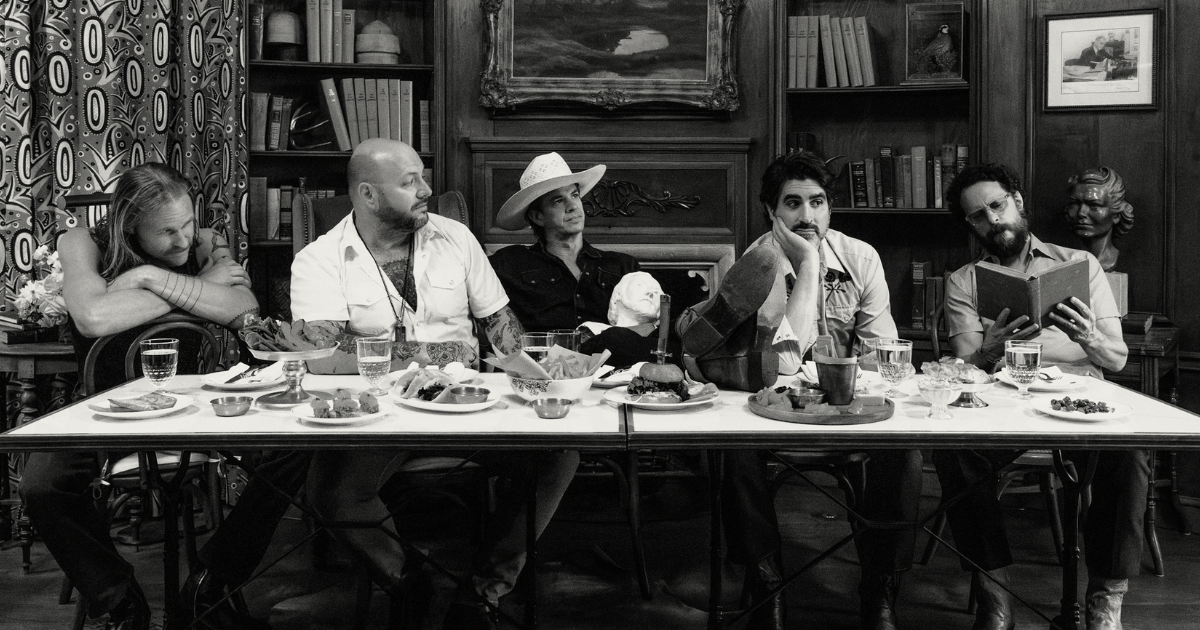
One of the most heartwarming stories in roots music over the past decade has been the emergence of 49 Winchester. The group of high school friends-turned-roommates – then bandmates – emerged from the hollers of Southwest Virginia to become an ACM Award-nominated group and a future household name, off the back of songs like “Hays, Kansas” and “Russell County Line.”
Now, on their new album Change Of Plans, they’re ready to take big next steps, enlisting help from someone who’s frequented that kind of territory to do it. Released on May 15, the group – Isaac Gibson (vocals), Bus Shelton (lead guitar), Chase Chafin (bass), Noah Patrick (pedal steel), Tim Hall (keys), and Justin Louthian (drums) – teamed up with Dave Cobb for the project. It’s their most expansive to date, as it navigates everything from honky-tonk (“Bringin’ Home the Bacon”) to Southern rock (“Pardon Me”) and 2000s alternative (“Heavy Chevy”).
The album is not only the band’s first with Cobb, it’s also their maiden venture with Cobb’s imprint, Lucille Records. (It’s being released in partnership with MCA, where Cobb was named Chief Creative Officer in 2025, and New West Records, 49 Winchester’s label home since 2022’s Fortune Favors The Bold.) Isaac Gibson knew that Lucille would be a good home for the band because he was confident that Cobb would grant them creative freedom. Which he did.
“I don’t think there’s anybody else in the world that has quite the same brain as him,” remarks Gibson. “He’s hyper-efficient and unbelievably tasteful with what he does. Because of that, there was a lot less overthinking than usual. It was very instinctual, like catching lightning in a bottle.
“We also tracked it live for the first time, which is always something we wanted to do. The best way to experience 49 Winchester has always been at a live show, so we wanted to capture some of that energy while also utilizing some of the tools only available in a studio. The result is a version of the band on steroids,” Gibson continues, laughing.
Ahead of the album’s release, Gibson spoke with BGS about the studio time with Dave Cobb, paying homage to Ozzy Osbourne, the band’s trilogy of law-breaking songs, and more.
Tell me about the decision to record the album in only eight days – was that a “Dave” thing?
Isaac Gibson: Previous records have taken a whole lot longer for us. There’s some really great records that have been labored over and over, and other ones that were like pulling a rabbit out of a hat. It was cool to have a different experience this time around where we just focused on doing the thing that got us here in the first place, which is playing and singing and saying things that resonate with us and make us feel good.
But doing things so quickly wasn’t a conscious decision either. It was just the first block of studio time we had available when we weren’t touring and happened to get things done fast. There was a lot of cohesive idea sharing, which was one of the most beautiful things about the entire experience.
One of the most intriguing moments to me came with the inclusion of “Changes,” a Black Sabbath cover that marks the first such tune to ever appear on one of the band’s studio albums. Why was this record and moment the right time to make it happen?
Ozzy’s death is definitely what lit the spark. I remember first throwing the idea for it out to the guys while we were eating lunch in a fellowship hall next to the church in Savannah where we were recording with Dave. We’d been tossing around ideas for dream 49 covers in a group chat for years, so when we decided to actually include one on the record, “Changes” was the first mentioned. We immediately went to record it, not even waiting to finish our lunch. [Laughs]
Once we started tracking it we wanted to grab hold of the raw emotion of it and send it home. It wasn’t even rehearsed – we talked about arrangements and song structure, then cut it. It was a really cool way to pay homage to not only Ozzy but also Charles Bradley, who died in 2017 and performed an awesome soulful version of the song that our version leans toward.
Would you say that “Changes” – both sonically and lyrically with the line “I’m going through changes” – is reflective of the band’s evolution present on this album?
That’s why we chose the title we chose, which is taken from a line in the song “Bluebird.” We’ve all grown so much since starting this band and seen a lot of change in our lives, but through it all 49 has remained steady. But right now has been a distinct season of change for us. We all started this band as kids just out of high school, and now we’re all grown up. This record is just as much about a new chapter for the band as it is new chapters for us individually. We’re all trying to be the best we can be every day, which is what a lot of this record is about.
Regarding “Bluebird,” is it a song about having a plan or vision for how you want a scenario to play out, only for something entirely different to happen instead?
You’re spot-on, and it’s something I’ve recently lived through, too. It sounds cliché, but I always want to write songs as honestly as I possibly can. I think the best thing you can do as a songwriter is give people a little bit deeper glimpse into your life than is sometimes comfortable for you. That’s also an example of what “Slowly” was for me, too. It’s me thinking I’ve got it all figured out, only to have circumstances change that make you rethink everything you thought you knew.
Whereas “Bluebird” focuses on plans not materializing as you’d hoped, it seems “Slowly” focuses more on personal growth and the process of trying – and sometimes failing – to get better?
That one’s not very abstract at all – it’s very direct. When you’re writing about your life sometimes you’ve got to commit to write about it all – the good, the bad and the ugly. Getting better and showing myself more grace through the ups and downs is something I’ve improved on a lot over the years, but I still have more to learn.
With that in mind, the writing on Change Of Plans feels in many ways like your most personal yet. What was the catalyst for that?
It was just a natural order of things. When you’ve only ever relied on your own experiences and feelings for songwriting, you have to find more ways to connect with folks as time goes on so you can get that little bit extra out. You can only write about love, breakups, and drinking so many times before it gets stale and you start wondering what you have left in the tank creatively. This record proved that we’re still able to dig in and continue to do things our own way while staying creatively fresh. As I write more I find myself getting more and more in tune with what I want to say, and this record is the culmination of that.
Jumping back to “Bluebird” and “Slowly,” there also seems to be a bit of yearning for a person on those songs as well. Which is also the case on “Oh, Savannah,” too, albeit with a more positive tone. Are there any other connections between them?
“Slowly” and “Oh, Savannah” were actually written on the same day. “Slowly” was a song I almost had finished before bringing to a [writing session] I had with Jessie Jo Dillon and Chris Tompkins to flesh out. After that we started working on something completely new, which wound up being “Oh, Savannah.” Jessie Jo knew we were making our record in Savannah, Georgia, and said she’d always wanted to write a song about the city, but painting the picture as if it were a girl instead.
As opposed to being something introspective or very personal to me, that one became more of a story song in the vein of “Damn Darlin’” that contains references to very Savannah-y things like the sand dunes and the Cherokee rose. It’s one of these places that aesthetically inspires creativity. There’s a vibe and age to it that I love being around, which made for some cool moments both with this song and the record in general.
Similar to the connection you just made between “Oh, Savannah” and “Damn Darlin’,” I can’t help but notice the ties between “Bringing Home the Bacon” and another track from Fortune Favors The Bold, “Hillbilly Daydream” – only the former is about running marijuana and not moonshine. Tell me about it.
That’s right! It’s part of a trilogy [with “Long Hard Life” from 2020’s III] of hard times and illicit substances being used as a way out of them. We wanted a real honky-tonker on the record and that song was one I’d sat on for about eight years. I had it finished at one point but couldn’t remember anything beyond the first verse, so we brought Aaron Raitiere in to help knock out the rest. He was the perfect guy for that particular song because he leans so hard into that humorous storyteller role like a modern-day John Prine. There’s always a nugget of something to crack a smile or chuckle about in his writing, and this song is no exception.
Are there any other songs on this record like “Bringin’ Home the Bacon” where the origins stem back years?
The first verse of “Heavy Chevy” was also something I sat on since before [recording 2024’s Leavin’ This Holler]. But those were the only two on this record that had been in the tank already without the chance to grow up yet. [Laughs] Songs are like that sometimes – they don’t come to fruition until you least expect it. Most of the songs I’m really proud of have happened very quickly and write themselves in an hour or two. But other times they don’t, and if you keep something of value for long enough then it’ll eventually turn into something else. Getting to breathe new life into something that was dormant and underground for a bit is super cool.
The band has been growing into bigger and bigger venues and straying farther and farther from Southwest Virginia with each passing year and album. Considering this, how has your perception of home changed since the band’s inception?
It’s difficult to say because our home is so linked to who we are. At the end of the day, you can take the boy out of the holler, but you can’t take the holler out of the boy. We’ve gotten to travel the world now and play music for people who don’t even speak our language, which is incredible. Doing that has actually made me appreciate where I come from even more. As I’ve gotten out and seen more, it’s also made me realize just how rare and difficult it is for us to do what we’ve done coming from where we did. In the early days we were still proud to be where we’re from, but we didn’t understand what it meant to be somebody paving the way for others and doing something no other band in Southwest Virginia had done until now.
What has the process of bringing Change Of Plans to life taught you about yourself?
Making this record got me to fall in love with all this again. We’ve worked really hard the past decade, which is good because there were a lot of cool opportunities coming our way, but a doldrum had set in on me that I was able to finally shake off working on this record. It really reignited my spark for the whole thing. My love for the live performance has always been there, but the act of touring can be so grueling. However, I now feel like I have so much left in the tank that I still want to say. This music is going to be our legacy long after we’re gone, so it’s important to stick to it and keep the pedal to the floor.
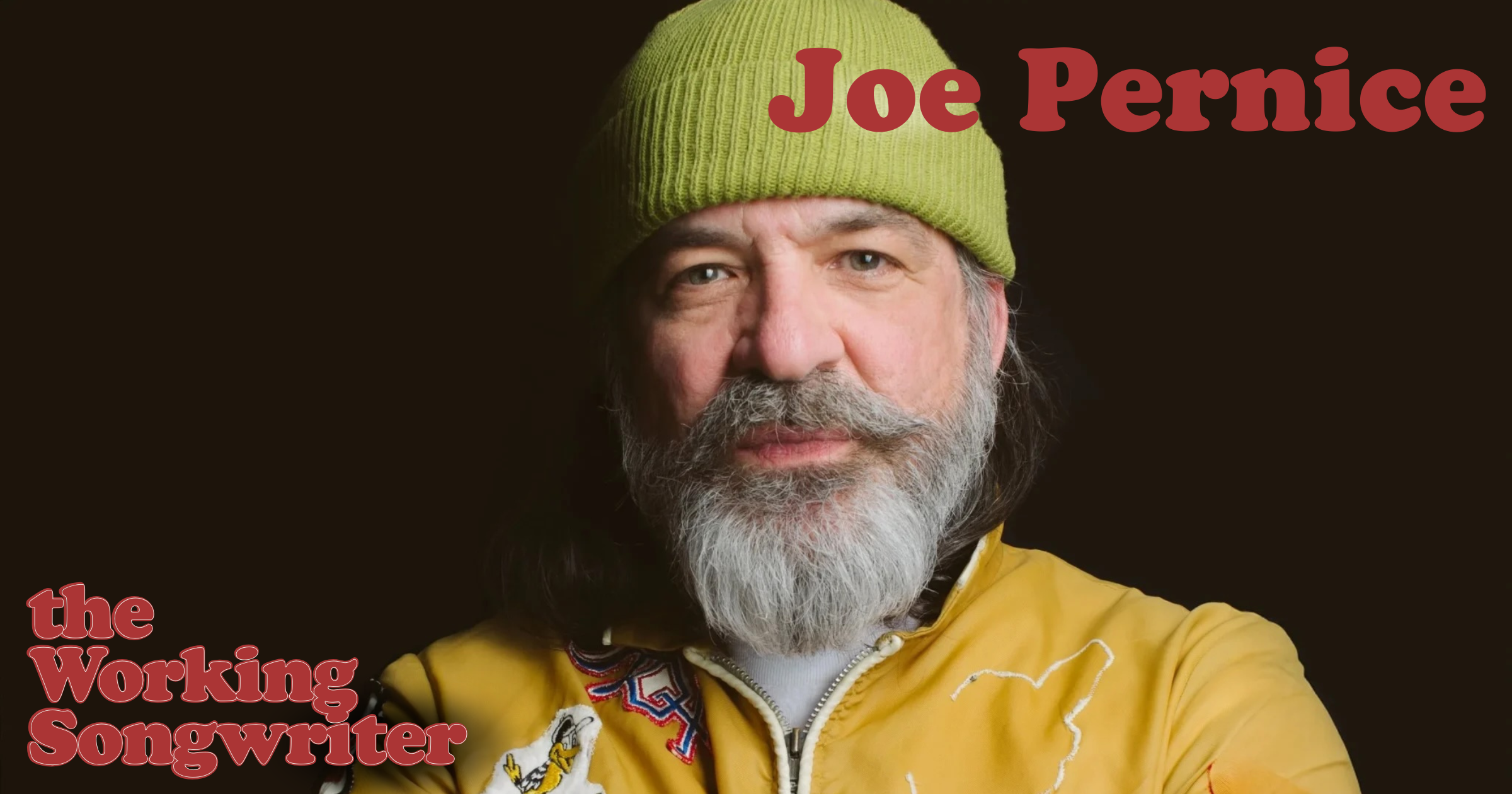
Our guest on the Working Songwriter this week originally hails from Boston, Massachusetts, and now makes his home in Toronto. Joe Pernice got his musical start, though, in Northampton, Mass. At the time, it was a hot bed of indie music creativity. His band the Scud Mountain Boys built a loyal following in the 1990s with a string of critically acclaimed releases. He’s recorded for Sub Pop, One Little Indian, Team Love, and New West Records.
Over the years Pernice has collaborated with a variety of blue-chip songwriters such as Aimee Mann, Neko Case, Norman Blake (of Teenage Fanclub), Jimmy Webb, Rodney Crowell, and Jim White. He’s also a man of many talents; his novel It Feels So Good When I Stop was published by Penguin Books in 2009. NPR calls him “a workhorse of a songwriter who delivers hard truths with the softest of whispers.” Brooklyn Vegan declared, “Few songwriters today imbue frustration and anguish into the sweetest of melodies as Joe Pernice.”
I got a chance to catch up with him a few months ago to hear about his musical journey so far.
Next year, singer and songwriter MC Taylor will have been leading Hiss Golden Messenger for two decades. For most of that time, critics and listeners have relied on a few familiar narratives about Taylor: that he is a singular figure, for example; or that his move from California to Durham, North Carolina, marked a formal shift from punk to Americana; or even that he thinks slightly more than he feels. Talking to Taylor, from his home in Durham (well, there was a Zoom call involved), I found these cliches about his practices were limiting, factually accurate but emotionally untrue.
Instead of laser-focusing on one narrative, on telling the same stories over and over again, listening to Taylor speak, I encountered a new understanding of his practice, one which placed Taylor in the background and moved his bandmates and genre-play into the foreground – shifting from the centrality of a singular figure to a greater emphasis on generosity and expansiveness.
That the new album is called I’m People is the first clue that Taylor wants to expand the perception of his music; it’s a title that considers mutuality as central to the enterprise of musicmaking. So, how does one expand this thinking – one could consider him geographically or complicate these tales of origin, or think about who is playing on this record, or even refuse the standard narratives of genre.
Instead of focusing on the fact that Taylor began playing in hardcore bands in California, think about the other influences: that he played in a band named after Joni Mitchell’s Court and Spark, an album marked by an urbane distrust of other people’s desires. Or that, around the time he was carefully listening to Mitchell, he was also following that most American portable utopia, the Grateful Dead. Or think about his move to Durham, not strictly to play in a band, but to study folk music academically.
Or, consider how this album was recorded – at least partially – in upstate New York. A more cynical writer would note that Taylor borrows from Dylan’s Nashville Skyline, and that album itself was the foundation of a more isolated, lonely understanding of tradition after abandoning folk music, seeking a slightly more commercial understanding. Recording this in the Hudson Valley could be considered a pilgrimage or homecoming.
I don’t think that it is a homecoming just for Taylor; the record sounds lush, expansive formally, too. Perhaps because the people who sing or play on this record play in a collective of other bands, including Rhett Miller, the Mountain Goats, Bonny Light Horseman, and the Hold Steady.
The expansive nature of the band is not only connected to the history of music they listen to, or the other bands that they play in, but also more unexpected influences like Sade. The idea that Taylor is the band is false, and it is not even that Hiss is the band. Taylor expands the possibility of Hiss, but Hiss itself pushes the possibilities – because of where they come from, their other projects, and even the possibility of geography. Not because Durham is magically a place where music coalesces, but because for a long time it was a college town where rent was relatively cheap and lots of people liked playing music together.
When addressing genres, the promotional material calls the album Americana – but Americana is a useless category, one which might be country or folk or something else entirely. I’m People has a kind of intense richness that is neither of these genres. Listening to the LP, something happens where the expansion or fracturing of those playing on this record becomes its own kind of post-genre.
There are a lot of reasons not to love America right now, but emphasizing the American instead of Americana allows us to consider this album as a consequence of the totality of American music – Taylor addresses the improv nature of jazz as part of this, or traditional folk music, or even 1970s easy-listening. He speaks fondly of the detective novels of Elmore Leonard, and on at least one of his early albums the photography of William Gedney became a powerful totem.
I think of I’m People as a kind of ebbing and flowing for and against tradition, part of that decades-long wrestling with aesthetics and history. Consider the last song, “Depends on the River,” is another of his great songs about waterways. In a 2016 profile of Hiss, New Yorker critic Amanda Petrusich wrote about Hiss’s long tradition of river songs and how it fits into a century of metaphors from blues singer Geeshie Wiley to Joni Mitchell, working this tradition. Petrusich writes: “Taylor frequently evokes river imagery in his work; the river, of course, can be understood as its own kind of road, a direct line to somewhere else, far away.”
I don’t know if that’s wrong, but I also think about rivers as they turn into oxbow lakes, rivers which flow into swamps – literally bogged down – rivers that flow into oceans, and rivers that dry up depending on the season. Hiss’s meandering, deepening quality depends on that river, both the direct line that Petrusich talks about and the larger metaphor, one where Taylor literally talks about whether he dares to cross it. On I’m People, he not only crosses it and crosses it again, but brings along a whole community of other performers. And, an audience who is hungry for the difficulty and ambivalence of so much time playing – and thinking – with him, to the other side.
I know you have a degree in folklore studies, I also noticed that in the last few years there has been a cluster of second- or third-generation performers who have some academic training in folk traditions (see also: Jake Blount, Jake Xerxes Fussell, Willi Carlisle, etc.). Can you talk a little bit about the kind of intersection of formal and informal folk studies and also about your relationship to people who are making this kind of work? I’m thinking about the line on the song “Mercy Avenue” where you talk about the “boys on the corner knowing more than those with PhDs.”
MC Taylor: Well, it’s been a really long time since I was in the academics here. And that universe was one that I feel like I passed through briefly. I wasn’t destined to be in that realm forever. So, I’m not sure that I can totally speak to [that]. Like the place of academic/creative work.
I will say that my time in that space was a really good time for me, when I was restarting my brain and re-centering myself. School was a good way for me to step away from whatever I had been doing previously. I did a lot of field work at that time. I interviewed a lot of people, and I think that it made me a much better listener.
I think that, more than anything else, [that] is what I came away with, this feeling that people really, really like to be heard. So I think I just really tried to develop my listening skills.
Can you talk a little bit about working with a band – especially this band – and about how the bandmates are part of their own creative worlds? Is there a kind of politics there, or a kind of community making?
The basic tracking of the album was done with JT Bates playing drums and percussion, Cameron Ralston playing bass – both electric and upright – and Josh Kaufman, who was producing the record with me, playing guitars, mandolin, piano. My friend Chris Boerner was engineering the record. He plays guitar.
The road version of Hiss Golden Messenger, you know, [are] involved in a whole variety of things. JT, Cameron, and Josh play in Bonny Light Horseman. All three of them have also at various times been members of Hiss and have toured with Hiss. And in fact, that’s where those guys met – playing in Hiss. All of us have known each other for many, many years, so I consider those guys really good friends.
But we’ve never made a Hiss Golden Messenger record before. … They’ve worked on [other] records [together], but we never came together to create a Hiss Golden Messenger record together. It was this funny and unique situation in which we were already old friends, doing something that felt new and fresh. It didn’t feel like a complicated record to make for me. I think Josh Kaufman maybe would say the same thing, but Josh was performing sort of a different task than I was in the situation. It was a complicated record to write, but that was something of the solitary endeavor that took place over probably a year or a year and a half.
I really love those guys and I am delighted that they could be there to play on the record. I think of them as absolute top-tier musicians, every one of them. Cameron is currently playing with the Mountain Goats, he plays all kinds of jazz, he plays in the Spacebomb House Band. JT Bates plays drums with Big Red Machine, which is Aaron Dessner and Justin Vernon. And [he’s] just a legendary drummer in Minneapolis. Josh Galvin plays with everybody.
There are some songs on this album about hope and I wondered about making work about hope in this specific social and political moment? “Shaky Eyes” or “Heavy Worlds,” for example.
[I am interested] in how we [have] the energy to get through the messiness of life. And not only this particular time that we’re living through – although that is the most depressing. But just like life in general. I don’t think that we can do – or I don’t think I can do – life alone. So, in a way this record is me writing to myself. Maybe now [about] how important other people are.
I think I realized that the most important part is moving through, and needs to involve being around [other people]. Over the past few years, just speaking personally, the idea of community has felt like a more and more important part of it.
Thinking about that – and how dense/lush the production here is – though you are marketed as “Americana,” I wonder about how you view genre. And also how your band does – I’m thinking about background vocalist Annie Nero’s bio for radio: “She loves to find the common thread between musical ideas and genres…but also break free of genres because life’s too short to limit ourselves based on perceived taste!”
I listen to lots of different stuff. I think all of that stuff finds its way into what I’m doing. It’s a little tricky. I used to have a stronger stay-in-your-lane [attitude] about the term “Americana,” but I just don’t think that I care very much anymore. It’s not a word that I generally use. But I understand why it exists. Many of my favorite songwriters exist in that world.
What would you call your genre then?
I mean, I wouldn’t. I guess that’s what I’m saying.
Like, if I was at the dog park and I was talking to a stranger, and they said, “Oh, you’re a musician? What kind of music do you play?” I’d probably say, “Kind of rock and roll.” I generally am not describing my music in terms of genre, I guess. If I told someone that I played rock and roll, and they asked me to extrapolate on that, I would say something like, “Rock and roll that’s really swinging.” I try and concentrate on the rhythmic elements. I love singer-songwriter type music from the ’60s and ’70s. I like really oddball stuff. I love Bruce Ruffin reggae; I love free jazz. There’s a lot of music that I have inside of me. There’s a lot of music that Josh, Cameron and Chris – [that] we all have inside of us. I think it’s just a question of how we get it out and put it into use in a way that feels genuine and not forced. …
Thinking about the tension on this album between distinct geographical spaces and a more universal emotions – for example on “Seneca (Time is a Mother, Baby)” or “Mercy Avenue.” And also that becomes a larger theme of your work, thinking about how Amanda Petrusich writes about your decades-long commitment to writing about rivers. There’s even the river song on this album. What do you think your relationship is to the land, to rivers – especially. when you sing “Depends on the River.” Or is there specifically one river?
On previous Hiss records there are specific geographical places like city names mentioned. And not only are those places part of the fabric of the story that I’m trying to tell, but they sort of served as poles, maybe? What I’m trying to accomplish is sort of like a poetic travelog of my life growing up in America. I’ve been traveling as a musician since I was 18. I have been, it seems like, everywhere in this country – more than once or some places 10 times. I’ve been all over every highway. So, maybe the dimension of place names throughout is sort of like carving my name on a tree or something. It’s just kind of like, “I was here.” “This is where we are in this song right now.” “This is where we are in my life.” And then, “Now we’re over here.”
In terms of rivers, a river is always flowing, always changing. A river can kill you if you’re not careful. It can keep you alive and get you to the next place if you treat it with respect and understand its rules. The coda on that song, [“Depends on the River”], the last thing that we hear on the record is “the line depends on the river exactly.” I guess the meaning depends on what river of life we’re talking about. It depends how lucky we get.
I’ve always been impressed by the wide range of your reading, listening, and looking. For example, your careful thoughts on the photos of Gedney. What are you reading, what are you listening to, what are you looking at these days?
Well, you know what I’m reading right now? I’m like about 200 pages into this Gary Stewart biography. Gary Stewart, the country singer. It’s called I Am From the Honky-Tonks. Gary Stewart actually was someone that Chris Smith from [record label] Paradise of Bachelors turned me onto like 15 to 16 years ago. Those of us that are obsessive about him all knew that this book was coming. It’s finally out and yeah, if you’re Gary Stewart fan, it’s kind of like you can’t believe it exists. I’ve been waiting for it.
In terms of what I’m listening to, I’m always listening to all kinds of stuff. I just bought this record [that’s] The Sun Ra Arkestra doing Disney themes. It’s so beautiful, really makes you think about those compositions in a different way, [about] actually how deep they are. I’ve been revisiting some Ted Lucas. I’ve really been liking this McCoy Tyner record called Asante. It’s a 1974 record; might be my current favorite. It’s very deep in the zone with like Alice Coltrane and Pharoah Sanders – that era. Oh, it’s beautiful. [I’ve been listening to] some Paul Brady from ‘78. He’s amazing! I’ve been listening to Welcome Here Kind Stranger. [Also] a record that I was checking out for a while [was] by the Universal Liberation Orchestra. It’s kind of this weird, very minimal– I guess it would be jazz.
While many young talents, willingly or hesitantly, bow down to music industry boardroom suits who promise stardom if they’ll follow a professionally curated path, Cole Chaney takes a hard pass. He knows exactly who he is, what he does, and how he wants to get there. He creates songs, not content. He’s a career musician, not a brand. And the only thing he hopes to influence, maybe, is someone, somewhere, who wants to make music for all the right reasons.
Chaney grew up in Catlettsburg, Kentucky, surrounded by the legacies and storytelling of his elders. After graduating high school he worked as a welder, uncertain of his career path, but already fueled by his passion for music. Today, he keeps one musical foot in the bluegrass traditions of his Appalachian roots and the other in guitar-centric, amplified bands like Soundgarden, Nirvana, Alice In Chains, and Stone Temple Pilots.
His debut album Mercy and subsequent OurVinyl Sessions reflect his love of acoustic music and showcase his leanings toward introspection and melancholy. In the Shadow of the Mountain, released last fall, takes that darkness to a new place, balances it with moments of light and leans into the aforementioned rock influences, while never losing the origins of his sound. All of this shines at peak level onstage, captured by Western AF on a Live AF Session.
Sitting outside at home on an April morning, drinking coffee and surrounded by the sounds of birds and a breeze, Chaney spent a couple of hours on the phone with Good Country. He spoke candidly about his music, faith, values, mental health, and the intertwining of inner peace and inner turbulence that make all these things uniquely him.
When you were ready to do this professionally, you went to Lexington. Most songwriters would have chosen Nashville. Was yours a deliberate decision or a natural one?
Cole Chaney: To understand that decision, you have to look at who I was looking up to at the time – and still do – and what drove that decision. When I was in high school, probably around my freshman or sophomore year, 2014 or 2015, I started getting into this band called Sundy Best. They’re from Prestonsburg, Kentucky, which is just down the road from me. This was pre-Tyler Childers. At the time, in Eastern Kentucky, these guys were the biggest thing coming and going. They leaned heavily on being from Kentucky, the same way I do, and they moved to Lexington to get a foothold.
That was my early example, watching those guys. I knew they weren’t going about it the traditional way, which was to go to Nashville and pray somebody picks you up. They did it in Lexington. A couple years later, Tyler Childers comes along – another super-influential figure in my musical upbringing. Of course, he’s anti-Nashville – not the city, but the machine, if you will. I’m pretty sure he lived in Lexington, or at least around the area in the scene, for a while. So did Sturgill Simpson. The list goes on.
I was like, “What business model makes more sense to me? Do I go to the place where there’s more songwriters than the rest of the entire planet or somewhere where people will actually understand what I’m saying and I can maybe build myself a little bit of a foundation?”
The way I saw it is if I started building a sort of fan base or if I had enough ticket buyers, places like Nashville or Denver, these big music scene cities, what choice would they have other than to book us? That’s the way I looked at it.
And it worked.
It did work. It’s a simple business model, but the difference between that model and the other is you’re not sitting around waiting for something to happen. It’s on you to go out and make your own connections. It’s a very grassroots and organic way of doing it and that’s the way I like to do things. I’m anti-machine. Even though I work with some bigger companies, I keep it as limited as possible. That’s so I can play pretty much wherever I want, whenever I want, and they understand that.
On the Whiskey Riff Raff Podcast you said, “Music found me.” Would you mind expanding on that just a bit?
It did. I never would have dreamed at 16 years old that I would be doing this as my full-time job at 25. That was never on the horizon for me. I didn’t know what I was going to do. I knew I was going to weld for a little bit, see what happened, and maybe try to start my own business. And I did. But I really didn’t think it was going to end up like this.
I started realizing that people liked to hear me play and sing around the same time that COVID hit really hard. That gave me an opportunity to sit down, write some songs, and think about what I wanted to do with the rest of my life.
I’m very much a subscriber to the Bible, and I think the Lord has a mysterious way of working. He put me on a path without me even realizing it way back then and I do my best to stay on it now. I think my job while I’m here is to create as much good stuff as I can, stuff that means something, get it out to the people, and get out in front of them and play it for them. As somebody who enjoys going to shows in their free time and watching my favorite bands perform live, I know how that feels, and it’s truly a privilege to be able to offer that same service to other people.
There is music in your bloodlines, not professionally, but family members who played in church and at home. You obviously assimilated the sound of the area, and also this wider scope with bands like Alice In Chains and Stone Temple Pilots. When did all of that begin seeping into your songwriting?
We listened to the radio when I was growing up. I didn’t get educated on music or how to play until I started really getting into it. To this day, I’m still being educated and learning how to play on a daily basis. Part of what keeps it so fun to me is how much I don’t know and constantly learning about things.
Mercy was my first album, and I had access to what was around me. I had just moved to Lexington and I was really into bluegrass. There’s a band called the Wooks that, to this day, Glory Bound is one of my top three favorite records of all time. I was infatuated with that sound and that was what I wanted Mercy to sound like, or at least as close to it as I could get. A lot of the Wooks ended up playing on that album, plus Michael Cleveland. It was crazy.
Alice In Chains has been a mainstay in my musical taste since I was probably 15 or 16 years old. Since I first found them, I was very drawn in by the tone of Layne Staley’s voice and the weight of Jerry Cantrell’s guitar. It feels like you could bite it and chew on it. I don’t know how to describe it.
I’ve also always loved bluegrass, so it was [figuring out] how to bridge the gap of what I listen to and where I want to go with my writing without completely abandoning that sound. And bringing the alternative rock sound into the folk realm, where you have mandolin, upright bass, fiddle, acoustic guitars, and drums. The biggest change in the sound has been the addition of drums over the past two years, navigating that and seeing how it fits into the whole equation. It opened up a lot of avenues for me as a songwriter.
You began playing guitar at 13 or 14. Did you always play acoustic?
The thing about electric guitar, for me, is that it’s such a deep realm of gear and a deep dive. I’ve always been attracted to good-sounding acoustic guitars and players like Tony Rice, so I felt my effort was best spent getting really good at playing the acoustic guitar.
That will carry over whenever I decide to pick up an electric guitar, more so than if I only played electric guitar and tried to write some bluegrass-style acoustic lines. It would be a tougher transition to come over from light gauge strings on an electric guitar to .013s on a dreadnought and trying to play “Blue Railroad Train” or something like that.
Do you have an electric guitar?
I have several electric guitars. I’ve got a ’57 reboot Stratocaster, an American Professional Telecaster, my old Paul Reed Smith that I learned how to play electric on, and a nice Vox amp. I don’t know all that much about electric guitars. I still have a lot to learn.
Prior to this interview, you sent over your touring rig: a Gibson J-45 Banner in standard tuning with a K&K Pure Mini pickup, and a Breedlove sitka/rosewood Custom Dreadnought in drop D/double drop D, with an LR Baggs Element VTC pickup. Also two Grace BiX DI’s and a Lampifier Model 711 cardioid mic for lead vocals.
Those are my road guitars. They aren’t the ones I recorded everything with, but those are what you see at the shows.
In addition to the Gibson and Breedlove, do you have other acoustics?
I have two Gary Cotten guitars. [On] OurVinyl [Sessions, that] was my first Cotten I recorded with. On In the Shadow of the Mountain, many of those songs are my newer Cotten, which is sinker mahogany and an Adirondack top. “Alone?,” “In the Shadow of the Mountain,” “Into,” “Feels Like Rain,” and “Spirit” [were all recorded] on the Cotten.
That guitar sounds huge. It’s an outstanding guitar. I don’t tour with it because I’m scared something would happen to it and it’s too special to me. And Gary’s a great dude. He’s always taken really good care of me, and I want that guitar to stick around for a long time.
I don’t have any electronics in it, either. It’s a very traditional style, it’s a dovetail, and I want to keep it as traditional as I can and keep as much weight out of it as I can, because the more weight you add, sometimes it makes them sound worse.
What makes the Gibson and Breedlove right for touring?
They’re super-versatile and they both sound fantastic plugged in. That Breedlove is the longest-standing guitar I have that I’ve consistently played shows with. I got it in 2019 from 4 o’clock Rock Guitar Shop in Ashland [Kentucky]. It’s a custom dreadnought that they shop-ordered and it’s got the LR Baggs VTC Element in it. It has always sounded so good plugged in. I mean, all guitars sound bad plugged in, but it’s a matter of how much of the original sound can you actually preserve when you plug it in.
I’ve gotten to the point where I am almost starting to desire a little bit of that direct input texture. Maybe it’s because I’m listening to too much MTV Unplugged, but I’m starting to desire that kind of cardboard bad sound.
The Gibson, I put a K&K Pure Mini in and it sounds really close to what it sounds like not plugged in. Man, that Gibson is a beast. I love that guitar. It’s been to every show with me since I bought it last year.
I still have a Paul Reed Smith acoustic guitar and it’s a damned good little guitar. I’ll probably end up using it again on some stuff. It’s one of those that you plug in and it sounds great, too. But when I got into the whole bluegrass thing, I knew I needed something with a little more body.
Sometimes you use a pick, sometimes fingers. Either way, your attack is strong. How did your technique develop?
It’s one hundred percent out of necessity. I had a really bad injury in 2015 and I damn near cut my index finger completely off at the knuckle. I can’t wholly bend my index finger and I can’t feel the picking side of that finger. If you watch some of my older videos, my index finger is flailing around all the time. It’s because I’m picking with my thumb and middle finger, and that’s where I’m holding the pick. That took me long enough to learn how to do.
In recent years I’ve learned how to use my middle finger to lock my index in place and be able to hold a pick. It looks normal, but if you could see how the sausage is made, it’s not that pretty. I wish I had that dexterity in my finger. The takeaway message from that is, “Take care of your hands, y’all.”
Let’s talk about the through line from bluegrass to bands like Stone Temple Pilots and Alice In Chains. You blend the genres seamlessly and it all makes sense. Did you always feel that connection?
If you listen to any playlist I’ve had, I’ll go from Ralph Stanley to Chris Cornell in a heartbeat. Obviously the music is different, but there are common themes between the two. Mountain folk music, hard rock, and that era are very dark and brooding, and they can be heavy in their own ways too.
What is heavy? What makes a song heavy? You’ve got people drop-tuning their guitars, but it’s still not as heavy as Pantera or Black Sabbath or something like that. So it’s not necessarily the sound that makes it heavy. It’s the vibe of the song.
I feel like a salesman a little bit, trying to sell this idea that this stuff can be brought together and related in an authentic capacity. Let’s take [Stone Temple Pilots’] “Big Empty,” for example. To do a cover of that and be looked at as a folk artist or an Appalachian artist, or some people will even say country – which I disagree with, but whatever – it always seems like somebody will start into a cover of this great song, but then they’ll get hokey with it and it loses all its purity.
That’s not at all the intended purpose for me. It’s to say, “This is a fantastic song and it fits the vibe that we’re all going for in this realm.” A lot of people probably didn’t know that a mandolin or fiddle sounds great on “Big Empty,” but now they do, because it fits. That’s the way I listen to that kind of stuff. It’s just how to pull that off without being cheesy or coming off in a capitalistic way. More so in a way of, “I love this song and you guys should listen to it.”
Was it challenging to find musicians who understand going from bluegrass to Stone Temple Pilots and back again?
The band, I think through a lot of prayer/manifestation, has come together and, as you hear, they’re fantastic. They can play anything in any style. Ella [Webster] and Kyle [Kleinman] come from a more traditional folk music side of things. Kyle is a bluegrasser and Ella is an old-time fiddle player. Lars [Swanson] and James [Gooding] are jazz cats, so they have infinite vocabulary when it comes to music. If you can play jazz, then you’re going to be all right. If you can pull off that stuff, you don’t have anything to worry about when it comes to my type of music. Stone Temple Pilots is a walk in the park for you.
In our van, the most listened-to bands between us are Soundgarden, Pantera, whatever James’s choice of jazz is, and Alice In Chains MTV Unplugged. That’s a really good piece of music. But yeah, they’re a great band and they can play anything.
Did Lars and James know each other before they joined your band? To lock in a rhythm section…
No, they didn’t. Once you start playing with a jazz drummer, you need somebody who can comprehend the stuff he’s laying out and answer that on the bass. To have those two sit in a room and jam is really something to witness and listen to, because they speak a language to each other that I don’t understand. But I love when they do it, and it’s great to hear.
I’ll be playing onstage, singing and doing my thing, those guys are behind me and I’ll hear them back there, talking to each other while we’re doing this thing, and it’s awesome. They’re special. Those two dudes – they’re incredible. They’re the unsung heroes of music in general. That’s your metaphorical offensive line right there. If you don’t have a Lars and a James, then your quarterback’s getting sacked all the time.
This is you in 2025 on The Western Side, talking about Shadow: “a lot of darkness and an equal amount of joy in other songs. It’s a good depiction of where I’ve been for the past two years. A tumultuous and chaotic time period, but also great. And I’m still here.”
Then, In 2021, on With A View: “I load the pressure on. It’s how I operate. My brain lives in constant turmoil.” In 2020, talking about “Fever Dream,” “a song about trying to keep it all together. … the way I deal with this is isolation. And when you isolate yourself, you don’t have much of a choice but to hash some things out in your head.”
You are no stranger to the dark place.
Hearing those things, I look at that younger version of myself almost as I would look at a younger brother. Part of me wishes I could put an arm around that kid’s shoulders and be like, “You’re going to be all right, buddy.” Times got a little tough, as they probably should for anybody at points in their life. You can’t really enjoy the great parts of your life without having a little bit of adversity to overcome or deal with. The darkest part, for me, was maybe just growing up and gaining a new understanding of the way the world actually operates and how hopeless that can be at times, but also how beautiful it can be in the same stroke.
What I’ve realized is you get out of this world what you pay attention to, because whatever you want to find, you can find it. It’s there and it’s aplenty, whether you want to find the negativity and suffering, or whether you want to find the positive and the good. I don’t have the answer to where folks are supposed to operate and live, but I think it’s good to help people who are in that suffering side of things. But you can’t let that dominate your existence, and for a little while, I was maybe dominated by the darker side of life.
I try to be as empathetic as I can, but with that comes feeling a lot and also accidentally hurting people sometimes. That’s really tough, because then you have this cycle of guilt that you deal with trying to make it right in your head. As I’ve gotten a little older and maybe figured a couple things out, I try to have a lot more grace for myself. What I’ve learned about the pressure is that it’s really just perceived pressure and none of that exists, and you should just care less what people think.
Obviously, music is where you go during those times.
Absolutely. If something is eating at me that I’m having a hard time getting out in a linear fashion, a lot of times I find myself writing about it without even realizing it. My mom is an abstract painter, so I grew up with an understanding of what “abstract” means and abstract concepts. That’s how I materialize a lot of that stuff, because some of it is things I would never come right out and literally write down, for multitudes of reasons, but things you want to indirectly address. That’s when [abstraction] becomes a great tool for addressing those kinds of things. Metaphors.
It seems, when it comes to expressing those things, you’re in the balance between the emotionally open world of Cornell, Cobain, and others and the world of bluegrass, country, hunting, fishing, and those stereotypes of “manly men” – and not so much emotional transparency.
Not necessarily. I don’t know about the whole “alpha male” personality type. It’s always seemed to me that a lot of times the guys who are trying to be perceived as macho are probably the ones who need a hug the most. Now it’s everybody else’s problem because their dad didn’t do it, and that sucks.
As I’ve emotionally developed a little bit, I’ve really started to respect individuals like Chris Cornell. If you look into him as a person and watch some of his interviews, he’s intelligent and seemingly self-aware. I respect the way he conducted himself, especially in interviews, and the way he made sure to pay attention to people and make them feel seen. The only way you can empathize with people like that and make sure of those types of things is if you’ve been on the other end of that stuff and you’ve felt looked over and brushed off.
I may not be the best at answering Instagram DMs, and I definitely don’t stay on the internet because I think it sucks, but if I talk to somebody in person, I always try my best to give them that and be present in the moment. Somebody else that does a fantastic job of that is Nicholas Jamerson, the frontman of Sundy Best, who’s a mentor, friend, and hero of mine.
Have you ever felt any hesitation about publicly ripping off the mental health Band-Aids? Or, conversely, is there a feeling of opening the door to people having these conversations?
Sure, there’s hesitation about a lot of things. There’s a lot of decisions about, “How do you want to portray yourself in a public light?” But my main goal is and has been to just be as authentic as I can, as representative of how I feel about things as I can, and to be accepting of people and understand that they come from different places and have different perspectives.
With that hesitancy, there’s also much more in the way that when we were talking about 20-year-old Cole, the way I want to put my arm around that kid and comfort him, that’s what I want my music to do for people that feel the way I was feeling at that time.
Listening to you, I’m reminded of something Charlie Daniels said to me during an interview years ago: “Music is too precious for me to prostitute it.”
Oh, yeah. Absolutely. And, too, Charlie Daniels is one of the greatest country musicians ever. I want to go on record saying that.
The way I look at it is, could I see my heroes, people I look up to, going online and being like, “Comment what song you think I should release next”? No, I don’t think I could. When I see someone who has musical and artistic integrity, that’s how I’m going to operate. I’m going to try my hardest to uphold my integrity and not do the TikToks and the really cheap stuff.
You absolutely will suffer financially for not playing the game and if you don’t kiss the right ass, but, to me, that suffering is not negative suffering. I’m honored to be able to suffer like this, because if my options are suffer or have to watch Country Central’s “Hot Take Tuesday,” then give me suffering all day long, because I’m not paying attention to that bullshit. It’s ridiculous. I don’t care who’s beefing and I don’t care what dude is playing cowboy this week.
That’s why I’m trying to get out of the country scene. It’s becoming so fake and there’s so many people trying to be carbon copies of other people. There’s no authenticity. Everybody’s full of shit. We went through this period where people like Tyler [Childers] drove the spear through the heart of this mainstream country thing and it was akin to when Nirvana came on the scene and effectively killed hair bands for a while. But then the Nirvana copycats came along and garnered a lot of the same attention.
I’m not saying that just Tyler Childers is responsible for this. People like Sturgill, and a lot of smaller artists in their own scenes, are responsible for the turning over of the dirt, if you will. But it’s getting stale. It’s past getting stale. It is stale and it’s bad. There’s a lot of really shitty music being put out right now and I don’t want any part of that.
If I’ve got to step away and back off and be out of the internet eye, then fantastic. That doesn’t bother me one bit. If it means a few less people know who I am, then so be it. But I hold out hope that people will eventually realize how cheap and bad a lot of the music is that is being promoted right now, and there’ll be another turning of the dirt soon.
Yes, art is subjective, but art is subjective. Not this corporate bullshit that they’re trying to push. That’s not art. That’s six dudes in a room trying to come up with a song that’s going to sell on the radio or sell on the internet, or “We’re going to put thirty tracks on this album” so they can set streaming records. It’s like, “Man, y’all have lost the complete plot of the whole thing.” There’s nothing interesting about that to me. I’m all about authenticity. I want to believe the person on the other side of the microphone from me, and if I don’t believe you, then I’m out.
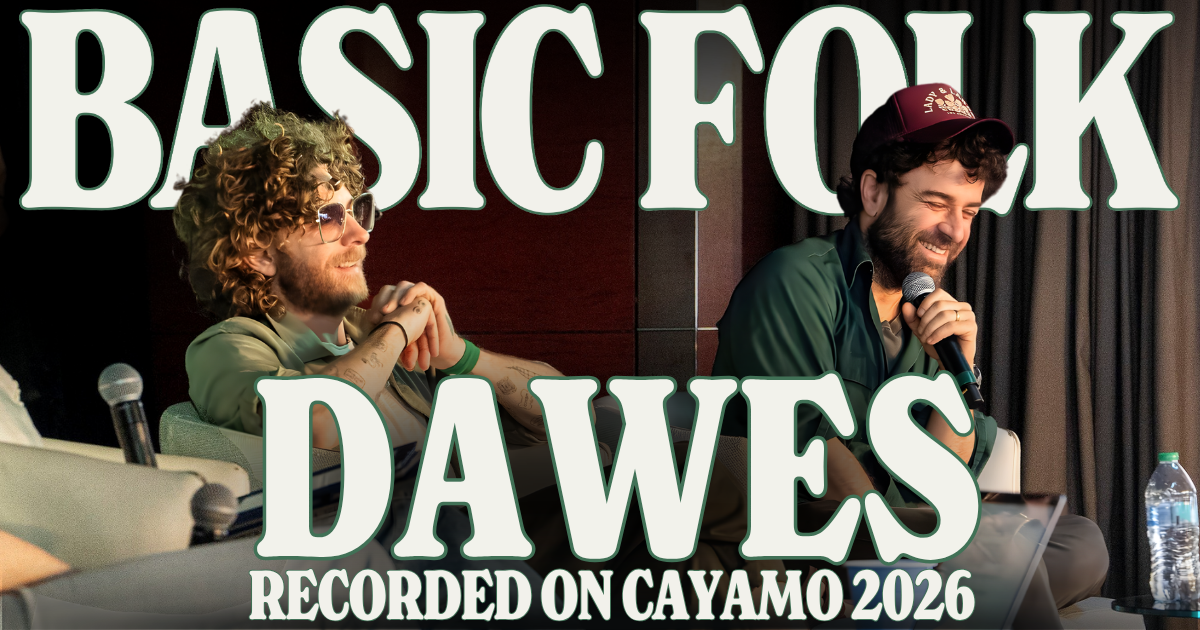
We are so excited to kick off our Interviews at Sea series with DAWES! We had the chance to talk to brothers Taylor and Griffin Goldsmith aboard Cayamo: A Journey Through Song in front of a packed audience during the music cruise’s 18th voyage in March 2026. The guys have been performing as Dawes since 2009, but the band has been a duo since their 2024 album, Oh Brother.
The Goldsmiths have been singing and playing together their whole lives inspired by their musician father, Lenny Goldsmith, who toured as the lead singer of Tower of Power in the 1980s. Taylor was never told it was hard to play guitar or sing, so he just did it. He always knew he wanted to be a professional musician. We talk about the ways his musical career turned out as not quite what he had expected. We also touch on how their singing has evolved over the course of their lives together.
Both Taylor and Griff are fathers, so of course we asked about the freedom that comes with priorities changing in their lives and careers – as well as what toys they may have regretted ever letting their kids have.
One thing following Dawes around for the past year is the aftermath of the January 2025 Eaton Fire in Los Angeles. Both brothers and their parents suffered immense loss due to the flames sweeping through Altadena, California, destroying thousands of homes and causing over 30 deaths. Griffin’s son was born two weeks after the fire, a month early. Dawes became the musical face of the disaster with an emotional performance on Jimmy Kimmel Live! and opening the GRAMMYs with Randy Newman’s “I Love LA” with a veritable supergroup: Sheryl Crow, Brad Paisley, Brittany Howard, St. Vincent, and John Legend. The brothers get into what the experience taught them about healing and reaching a place where this tragedy does not define them. We hear a bit about Taylor’s love of collecting first editions and his fear of the comment section and we wrap up with a fun “Which One?” lightning round. Thanks to Dawes!
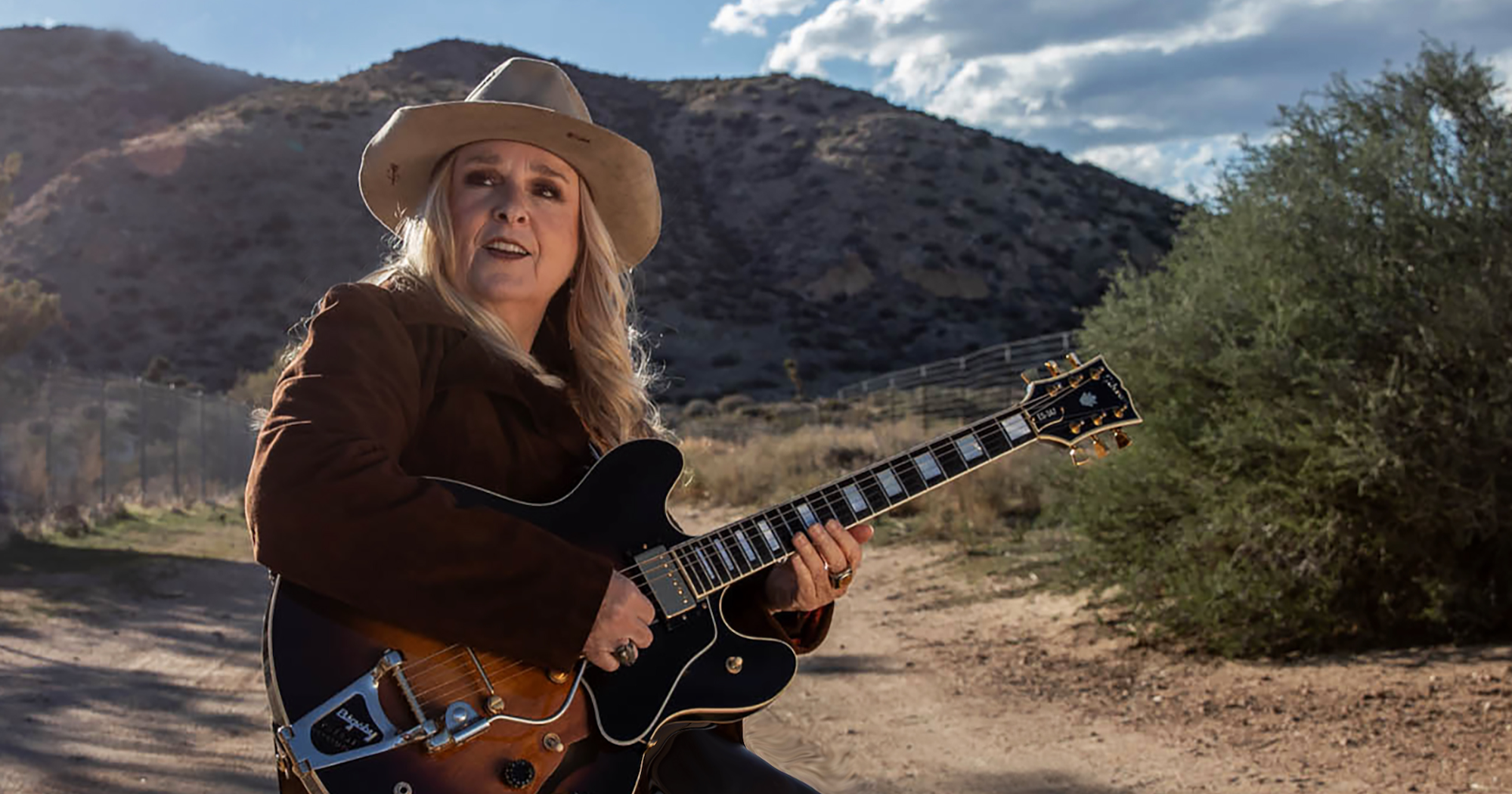
Few people have experienced the highs and lows of the music business to the degree that Melissa Etheridge has. Since releasing her self-titled debut in 1988, she has won two GRAMMYs (and been nominated for many others); been hailed as the second coming of Janis Joplin; won the Gibson Award for Best Female Rock Guitarist; become a mom several times over; been a social activist both for the LGBTQ+ community and for people addicted to opioids; written a memoir; and performed a one woman show on Broadway. Not bad for a kid from Leavenworth, Kansas.
That said, Etheridge has also suffered more than her share of setbacks. She has weathered a couple of high-profile divorces, battled breast cancer – who can forget her duet with Joss Stone at the 2005 GRAMMYs when she took the stage bald after undergoing chemotherapy – and, in 2020, lost her son Beckett to addiction.
The one constant throughout all these ups and downs has been her music, a brand of heartland rock that manages to be personal and universal at the same time. Etheridge is nearly as popular with blue-collar men as she is with lesbians, owing to her raspy vocals, formidable guitar chops, and unpretentious persona. And she’s racked up an impressive list of hits over the years including “Come To My Window,” “If I Wanted To,” “Ain’t It Heavy,” “Similar Features,” “I Want To Come Over,” “Bring Me Some Water,” and “I’m the Only One.”
2026 is shaping up to be a big year for Etheridge. She returned on March 27 with Rise, her first studio album in five years. On the eve of its release, she and her band kicked off a six-week tour in Detroit. And for the first time, Etheridge was nominated for induction into the Rock & Roll Hall of Fame this year.
Rise was recorded in Los Angeles with co-producer Shooter Jennings and includes 11 songs. While they’re diverse musically, the album as a whole feels like a complete statement. It’s a testimony to resilience, to sticking with life through all its ups and downs.
The title track and “Bein’ Alive” (which opens the disc) are both life-affirming rockers. “The Other Side of Blue” is a contemplative duet with Chris Stapleton. The playful “If You Ever Leave Me” puts an Americana spin on Mental As Anything’s ‘80s hit, “If You Leave Me (Can I Come Too).”
The shuffling, midtempo “Matches” was inspired by Johnny Cash’s 1970 concert at the U.S. penitentiary in Etheridge’s hometown. But the two final songs on Rise are also its most personal and poignant. “Call You” is a moving tribute to her son Beckett, while “More Love” was written for her daughter Bailey when she got engaged.
BGS recently had the pleasure of catching up with Melissa Etheridge for a Cover Story interview.
Let’s start with Rise. This is your first new album in five years, which is a significant amount of time. But you’ve been very busy in the last five years; I read your book and saw your show on Broadway. So it’s not like you’ve been sitting around! What do you get out of recording an album that you might not get from doing theater or writing a book?
Melissa Etheridge: Even though I haven’t had an album out in five years, the [last] album I put out, One Way Out, was a previous recording that I’d done seven years before that. So it’s really nine years since I’ve written. And I’ve lived so much of life – from loss to the pandemic to just growth. That’s the part about making a record. I knew that I could create a collection of songs that would make an album.
I love the art form of an album. You know, 45 minutes to be with the listener and take them through an emotional journey. That’s my favorite part; the real crafting of it was the writing. And it was about a year’s worth of pulling things together and then writing [in] December of ’24 and January and February. Then going in the studio [last] March. Going in, it’s so much fun with the road band that I have. It’s like putting on a favorite pair of jeans. Then getting Shooter Jennings to produce it! His studio, Sunset Sound, is so amazing. So it was a pleasure recording there.
It really does flow as an album, but it touches on a lot of different moods. Listening to it as one piece, I felt a sense of renewal and also resilience.
Yeah, that’s something I wanted to get across. There’s so much I experienced through the loss of my son five years ago. That’s about the most devastating thing you can go through. Having gone through that loss, [I] decided that I wasn’t going to drown myself in guilt and shame, I wasn’t going to die – that I was going to experience this, heal with my family, keep loving ourselves, knowing that everyone makes their own choices. I could not save him, he had to make the choices for that. And then making art from that – you know, loving yourself enough to be able to say, “God, I love being alive.”
Writing those songs – especially in this day and age when I find such negativity – if you start believing that, then that’s what you’re gonna see. So I wanted to put [out] positivity without being patronizing or [using] platitudes. You know, lifting people up. Going, “Yeah, you’re gonna fall sometimes. You’re gonna taste the dirt. You’re gonna rise.”
[“Rise”] came after the LA fires. That was something I went through with my family. We had to evacuate. It came right up to our neighborhood. I gotta tell you, LA firefighters are heroes. Every single one of ‘em. They were able to keep it from our neighborhood. But there was a moment, when we were watching the fire reports, where it was like, “Okay. There’s a good possibility that we might lose everything.” I was in a hotel with people who were losing everything. To experience that and then say, “They’re just things. We’ve got our health, our family, our pets.” You know, you’re gonna still rise. There are gonna be these things that knock you down, but man! You’re gonna be stronger and better for it. It’s hard to hear but it’s so true.
I was gonna ask you why “Rise” was the title track but you kind of just told me!
The second to last song on the album is “Call You,” which is really moving and I know you wrote about your son. I don’t have children, but two months ago I lost two of my best friends, one to suicide and one to early onset Alzheimer’s. So I’ve been struggling the last couple of months with a lot of existential stuff and wanting to call my friend Mark – and I can’t. So that song really resonated with me. I guess I wanted to share that with you.
Yeah. Life is full of loss. It really is. You’re not living if you don’t have some loss. And the older you get, the more you’re gonna see it. That’s when the existential stuff [comes in]. I am more than just my body, I am a separate soul here experiencing it. The greater part of me is that non-physical place that I’m connected to – that source that everyone is [connected to].
In “Call You,” I tried to simplify that. Because to me, the times when I miss him the most are the times when it’s like, “I wanna call you!” Even my father who died 30 years ago, you know? When I was nominated for the Rock Hall, I was like “Oh, I just wanna call my dad!”
[“Call You”] was actually the first song I wrote for the album. I knew I had to get that emotional experience down. I had to write that song first.
I also wanted to ask you about “Matches.” When I spoke to you last, you told me about Johnny Cash playing in Kansas when you were just a kid and how one of your thoughts was, “Prisons must be the place where you find entertainers.”
[Melissa laughs]
Tell me more about that and maybe your thoughts about The Man in Black.
Well, growing up in a small town, Leavenworth, we have no places for big artists. Kansas City is 45 minutes away. But our town, in the ‘60s, that just wasn’t a thing. All of a sudden, in 1969, he came to the prison. He came to our town! “Oh my god!” Someone who I’d only seen on his television show or [heard] on the radio and was such a cultural icon – he’s in the same space as me! That really kind of said to me, “Whoa. Maybe I could do that.” It felt close to me. [Cash] always made a big impression on me. I always loved his music, his individuality.
“Matches” was supposed to be a scratch pad song for me. I had just come from the I’m Not Broken [docuseries]. I did a concert in 2023 at the Kansas Women’s Penitentiary. So I was still sort of playing off of that and singing. Scratch songs for me are songs [where] I’m writing for fun and it starts the juices flowing. I kept writing these verses and I played a little bit for my wife, [Linda]. And she said, “You have to put that on! What do you mean that’s a scratch song?”
Can you tell me some wonderful things about Linda?
[Laughs] Yes, I can! That’s easy. For 12 years we’ve been married. We were together four years before that. And before that, we were best friends for 10 years! I married my best friend.
She is… everything I needed or wanted or dreamt about. The only way you really get someone like that in your life is to understand your needs and wants. And to have the love for yourself that you are looking for in other people. The minute I really got in contact with myself and understood what I wanted and loved, I was able to see the best kind of love for me. And she was it.
There’s just a constant partnership that is astounding – a love and desire that never goes away. And it’s because I’m not looking for her to fix me or make everything great. I’m looking for her to be by my side as we both make our choices and walk through this world together.
Tell me a little about “The Other Side of Blue” and what it was like duetting with Chris Stapleton.
Ah! Chris Stapleton is just a national treasure. His soul and his talent and his mind and his heart are so beautiful and so rare. He’s such a unique talent and an incredible man.
I really didn’t know him at all, I just was a big fan. And I didn’t really want to do a duet on this album. But I remember telling my manager, “If I ever did do a duet, I would love it to be with Chris Stapleton. Maybe ask him if he wants to write a song together.” So my manager sent out the request. He said yeah, and that made me so happy. I went down and we wrote the song.
We were writing in RCA Studio A in Nashville, which is where Chet Atkins [recorded]. A massive, huge, historic studio! I just walked in and, “Hello, hello.” We sat down and had guitars in hand. We were just talking and five minutes go by and he asked me about my kids. I said, “Well, I had four but I lost one.” He said, “Oh, I’m sorry.” And I said, “No, no. He was my greatest teacher.” He looked at me and he goes, “You talk in song.”
That was the first line: “Sometimes, I listen when she talks in song.” We were writing within 15 minutes of showing up. It just appeared – every line. It took us maybe an hour and a half to write that song.
You mentioned being nominated for the Rock Hall. Tell me how that feels after all this time.
Well, I was eligible for about 12 years. [Laughs] I was like, “Don’t think about it! It’s not a comment on your music.” I didn’t make my music so that I would be in the Rock & Roll Hall of Fame, that’s not what it’s about. It is lovely and feels really good to be recognized by your peers – by a group of people in the music business who say, “Your contribution to rock and roll has meant something.”
I’ve been on the voting body for exactly 10 years now. Obviously, certain things are subjective, but I thought this year there were a lot of good nominees. More diverse than last year’s group.
Yeah, I love Sade. I love Pink. Lauryn Hill I think is a good one. And then Iron Maiden, come on! It’s time, guys!
I always like to ask you about one older song. My favorite, which I’ve already asked you about, is “Ain’t It Heavy.” Is it okay to ask you about one of the really popular ones? I try not to ask the same things everyone asks. But I am curious about “Bring Me Some Water.”
Oh, that’s good! At least it wasn’t “Come To My Window.” No, “Bring Me Some Water” – that’s fun, that’s an older song.
I’d been playing women’s bars in Los Angeles for five years and a lot of record companies came and turned me down. But Chris Blackwell [finally] comes in and signs me right on the spot, for Island Records. Bam! I’d never made a record and I had no idea [what to do]. So my manager gets this producer, Jim Gaines, from San Francisco. This is 1986. It’s the middle of the ‘80s sound – that sort of Steve Miller, Journey [thing]. We made this record and I play it for Chris Blackwell and he hates it! Because it doesn’t sound like the girl he saw at the bar. It sounds overblown – lots and lots of keyboards and my voice way at the top. He hates it and I’m like, “Oh my God, he hates my album.”
I convinced him to give me four days to try it again in the studio. But in between the time that I finished the first album and went into record again – which became the debut – I wrote “Bring Me Some Water” about this relationship I had with a lovely woman named Kathleen. We lived together and we had this open relationship – which is just a mindfuck! [Laughs] I wouldn’t advise anyone to do that.
This is her being gone and me sitting at home in the middle of September, in Los Angeles. I’m living on Melrose and it’s hot. It’s so hot! So I sit down and I’m like, “Okay. I gotta get back to traditional blues stuff.” I’m just playing [the riff], it’s old Muddy Waters but it’s speeded up. I’m singing about, you know, the foul air. I’m just hot and uncomfortable and I’m mad. So, I wrote this song and Chris Blackwell loved it.
Don’t be fooled by their name, as the Band of Heathens actually give us something to believe in.
Coinciding with their 20th anniversary as a band, their new project Country Sides is equally feel-good and philosophical. The band’s co-founders and songwriters Gordy Quist and Ed Jurdi called in to Good Country from their homes in Austin and Asheville, respectively, to talk through their inspirations for the album, their writing (and rewriting) process, and how banjo fits into their house of music.
Just a few weeks after our visit, Country Sides and the single “Take the Cake” topped the Americana Music Association’s album and singles airplay charts simultaneously, a new feat for the well-established group.
“We have been really fortunate as an independent band,” Quist says. “We’ve never been on a label or been a part of the machine, and we just have a lot of gratitude for the 20 years we’ve had together as a band.
“This record is like a message of gratitude for all that we do have. And as much as we love making records, the live show is certainly my favorite part of this career. That’s what’s special about this band. When we get on stage, I feel lucky to be a part of this thing that really is fun live, so I would encourage people to check out a live show if you haven’t done it.”
As I was listening to the album, I was picking up a lot of messages of encouragement. It feels like a positive record to me. Is that a fair statement, do you think?
Ed Jurdi: Yeah, I think so. It’s like the musical retrospective of the band, in a way, sort of our history as an entity. Maybe in the background, with the realization that we’re making it 20 years at this point, there’s a little bit of a celebratory nature. I don’t know about Gordy, but in my writing process, I tend to almost have the opposite reaction to everything going on around me, outside in the world. If everything’s really negative, and the messaging is really negative, and there’s a lack of hope – maybe it’s a form of escapism for me, but I tend to lean into that [opposite reaction] a little bit more in my messaging.
And insofar as sharing music with people, it’s almost like the internal pep talk that I’m having with myself turns itself into the art and into the lyrics and something to share as a message with other people. We’ve never really been ones for beating people over the head with the message, but things are pretty wild and wooly – and not in a good way out there, in a lot of ways. So, I think some messages of community and togetherness and rallying around a common good – we could certainly use more of that.
Did you have a certain sound in mind as you made this record?
Gordy Quist: I think we talked about trying to make a country soul record. We were listening to some of the early Dobie Gray records and thought, “OK, what if we took a mix of soul music and country music melodies and textured it…” We put more pedal steel on this record than we probably ever have on any record. And that was intentional. From the beginning we knew we wanted to do that. I guess it was intentional to try to make a country soul record. Whether we did that or not, I’m not sure. But that’s how we arrived at whatever we did.
I like the spirit of fellowship in the song “High on Our Own Supply” and there’s a lyric in there about hearing the banjo playing soft and slow, like a stereo. This being the Bluegrass Situation (and Good Country), I’m curious, do you often reach for the banjo?
EJ: I do. I’m a terrible banjo player. You know, my buddy Graham Sharp in Steep Canyon Rangers is an amazing banjo player. So if I need a banjo on a record, I’d probably call him.
I think writing “High on Our Own Supply,” it was almost like we’re building a house of music. You know, if you were to go into any room in that house, there might be this different scene going on. You open the door and there’s someone in there playing the banjo, and it’s so good, it sounds like it’s just coming out of the stereo.
The song “Pleasing People” reminded me of soul music from the ‘70s and I wondered about that soul influence. How does that show up in your music?
GQ: I guess there’s two elements. I think the rhythm section is the foundation of soul music and the groove. That was something on this record we really tried to dig into. The band right now – Clint Simmons on the drums and Nick Jay on bass – are a deep and heavy rhythm section, so that lends itself to a style of American roots music that leans into soul music. But also, simplicity. Lyrics that sound conversational and simple but have some depth to them. It’s hard to do that well. That’s part of what makes soul music great – that it’s simple but it’s good.
It takes skill to make it look easy or sound simple. What’s your editing process and your rewriting process like for you?
EJ: It never really ends. Even after we record these songs, I definitely change lyrics to songs as we play them live. The cool thing about these songs, especially making a recording, it’s a snapshot in time. But songs, I think of all the artistic mediums, they kind of move with you through time in a really special way. What a song means to you at 16 can mean something completely different to you at 40. You’ve piled up life experiences and you view the world in a little bit of a different way. So that’s always fun, but editing is constant.
I would say Gordy and I both are doing a lot of lyrical editing and we’re doing a lot of musical editing, too. When we get together and make records, it looks something like Tuesday morning, 10 o’clock: “Hey, Gordy, what do you got?” You know, Gordy grabs an acoustic guitar, sits in the middle of the room… And I’ve [already] heard these songs we’ve worked on, the two of us, but that’s the first time that Trevor Nealon (our keyboard player) and Nick and Clint have heard the songs.
So it’s like, “Hey, OK, first impressions? Go!” and then we start filling the canvas up, taking stuff away, adding stuff, changing colors, all these different things, until we’re at a point where we feel like we’ve edited something down to a nice, presentable format. So, it’s a work in progress, always. To your point, the more you can tolerate the editing, the better things become. It certainly is the most challenging part of the job, but it can also be the most rewarding.
“Take the Cake” has a great vibe. I’m sort of a workaholic, so it’s a nice message to hear, to hit pause and go do something fun. What were you hoping to convey in that song?
GQ: I think I was playing with the idea of giving versus taking, in life. I’ve been working on that song and editing that song for a couple of years actually. I’ve had it for a while. You know, there’s a weird juxtaposition of giving and taking. If you are always taking, in theory you should have lots of things because you’re receiving them. But in reality, you usually end up empty, whether it be friendships or whatever.
The opposite is true also. If you’re always giving and generosity leads, in theory the fear side of you thinks you’re going to run out of stuff. But the opposite actually is true. And that’s kind of what I was playing with, just the idea of letting go of that consumerism or just the [mentality of] “I need to keep what’s mine.” And being cool with letting go of that and letting generosity be the leading force.
As you mentioned earlier, this album is like a 20th anniversary celebration of the band. Are you enjoying this period of your life? You still have a lot of years ahead, but you’ve got 20 years of experience behind you too.
EJ: Yeah, I think it’s a good vantage point. I’ve heard Gordy describe it as standing at almost the peak of a hill. We’re all dads, so we can look down and look at our kids and remember being their age. Looking the other way on the hill, we see our parents, and we remember our grandparents being that age. So, it’s kind of a trip to be in this middle age of life. We still have the energy of young people. I think the fire is still there. There’s no lack of commitment or of energy or passion to what we’re doing. But we’ve assimilated a little bit more wisdom, and we have a few more tricks up our sleeve, a few more shortcuts. It’s fun exploring those things and trying to share them with people.
GQ: Talking about this phase of life that we’re in, I have this feeling like, when we were young, making our first records, we would put everything into it and the goal always was, “I hope this is good enough that we get to keep making records and make another record.” At the end of every record we’ve made I felt like, “Man, that’s the best thing we’ve ever done and I don’t know how we’re ever going to top that.” Whether it is truly the best thing we’ve ever done or not each time, that’s not for us to decide, but it feels that way to us.
EJ: We’ve always left nothing on the table when we’ve made a record. Now we’re just a little bit more conscious of our surroundings and what our intentions are. Again, I don’t think there’s ever been a lack of effort, but now there’s maybe a realization like, “Hey, every time we get on stage, every time we sing, every time we make a record, it might be the last time we do, so let’s make sure we’re doing it with everything we got. Let’s leave it all out there, because at the end of the day, that’s all you got.” You can feel good about that in the rearview mirror.
Ameripolitan music can be best defined as original music with prominent roots influence, and it has four categories: honky tonk, Western swing, rockabilly, and outlaw. My Mixtape features a song by an artist that represents the roots and then I’ll play a new artist that directly was influenced by them. You can hear the natural growth of country music when you listen to Lefty Frizzell and Merle Haggard or Kitty Wells and Loretta Lynn back to back. (Many of the roots artists had nicknames, I miss that.)
While some may hear an artist’s influence and say they are copying them, I’m of the opinion that John Lennon shared when asked about The Beatles’ influences. He said, and I paraphrase here, “One’s originality comes out in their inability to imitate their influences.” Very well said. – Dale Watson
“Who’s Gonna Take The Garbage Out” – Loretta Lynn, Ernest Tubb
Ernest Tubb had a distinctive voice as you hear on this song he sings with Loretta Lynn. Here’s the Texas Troubadour with the Coal Miner’s Daughter.
“My Wife Thinks You’re Dead” –Junior Brown
And no one is more evidently influenced by him than Junior Brown.
“Undo the Right” – Johnny Bush
Johnny Bush, otherwise known as the “Country Caruso,” was a drummer for Ray Price, the Cherokee Cowboy, before going out on his own. You would definitely hear that influence if you back-to-back Ray Price to Johnny Bush. Both are huge influences to every singer that grew up in Texas.
“Texas Honky Tonk” – Justin Trevino
This young man from Texas is carrying the Bush torch.
“D-I-V-O-R-C-E” – Tammy Wynette
The First Lady of Country Music, Tammy Wynette was married to the Possum, George Jones. She is easily at the top of women that influenced the newer singers.
“Houston Belongs To Me” – Sunny Sweeney
Singing her own divorce song, here’s Sunny Sweeney!
“Big Balls in Cowtown” – Bob Wills & His Texas Playboys
In the Western swing category this is the master, Bob Wills & His Texas Playboys.
“Riding High in Texas” – Asleep at the Wheel, Billy Strings
Though they’ve been around a while, they still burn up the road and proudly wear Bob Wills as their biggest influence. Ian Stewart sings as guest picker Billy Strings shines.
“Here in Frisco” – Merle Haggard
The Hag has influenced generations and even in death he still does. He once told me he forgot he wrote this song and was glad I brought it up so he can add it to his playlist again.
“This Highway” – Zephaniah OHora
Zephaniah OHora is now based in Nashville and he’s got a lot of great original songs. On this song you can hear the Hag in him.
“Bob Wills Is Still the King” – Waylon Jennings
In the outlaw world there is none more influential than Waylon, and in Texas we were all influenced by Bob Wills.
“Long White Line” – Sturgill Simpson
This particular song draws heavily on Waylon’s influence. And I like it.
“Ramblin’ Man” – Hank Williams
Hank Williams’ voice is one of the most recognizable in music. His songs are timeless and still inspire singers and songwriters alike.
“Thunderstorms and Neon Signs” – Wayne Hancock
You can definitely hear Hank in Wayne Hancock, but his own voice is definitely original, too – as well as his great songwriting.
“Guitars, Cadillacs” – Dwight Yoakam
Dwight Yoakam has influenced many a newcomer. Just as he was obviously influenced by Buck Owens. He came along when Nashville needed reminded of its roots.
“Lost in the City Lights” – Johnny Falstaff
Though not well known as of yet, Johnny Falstaff is picking up Dwight’s hat.
“Blue Kentucky Girl” – Loretta Lynn
The Coal Miner’s Daughter definitely left big shoes to fill, but her sassy songs inspired many women artists.
“Don’t You Ever Give Up On Love” – Brennen Leigh
That inspiration can be traced right to Brennen Leigh.
“Good Hearted Woman” – Waylon Jennings, Willie Nelson
Here’s the quintessential outlaw song by the most famously influential artists, the Red Headed Stranger, Willie Nelson, and Waymore, sometimes called Wautawsha, Waylon Jennings.
“Willie Waylon and Whiskey” – Dale Watson
The last song I’ll put in here’s is mine, because with pride I will state, yes, I am heavily influenced by Willie and Waylon. And sometimes whiskey.
When it comes to entirely enjoyable, technically exquisite modern blues, Southern rock, and jam-band soul albums, Tedeschi Trucks Band have a statistically impossible batting average. Their new LP, Future Soul (released March 20 via Fantasy Records), is yet another “no skips” collection from the megalithic 12-person Americana group fronted by husband-and-wife guitarist Derek Trucks and guitarist-vocalist Susan Tedeschi.
On that strength of their catalog – and their ensemble – TTB have amassed hundreds of millions of streams, won eight Blues Music Awards and one GRAMMY, and a handful of their songs have become regarded as modern standards in the Americana and American roots music songbook.
Future Soul simultaneously feels like a surprising departure and familiar, essential territory for the band. With Mike Elizondo producing and songs and creative input sourced from across the group’s lineup, the set ends up sounding and feeling more acoustic than “usual,” while still reaching roaring crescendos and building it all on dank, wide open grooves. Perhaps those acoustic moments are a substantial contributing factor as well, but the cozy, plush pocket of the album is what gives it a laid-back, relaxed, and floating vibe no matter the track’s genre construction.
Screaming slide, no-holds-barred vocals, and wall-of-sound climaxes can all be found herein, as well. But the collection never thrashes or flails, it’s precise and exacting – as Tedeschi and Trucks are both known to be on their instruments, whether guitar or voice – but it’s certainly not sterile or gated or homogenized, either. It’s another remarkable feat for a group so large that you would almost have to assume, live or in studio, musical mud would be an inevitable byproduct.
But no, TTB seem to have no misses, at least not on Future Soul. It’s clear this group works together in harmony not just because of the down-to-earth and collaborative leadership of Tedeschi and Trucks, but because the artistic and musical responsibilities and ownership – of the songs themselves, of the album, of the makings of each, of “success” for the band – are decentralized and distributed throughout the group. The band has a sound, an art, that is consistently collective in the way it’s received by audiences and listeners because, forgive the obviousness, Tedeschi Trucks Band always work as a collective.
In our BGS conversation with Derek Trucks, the magic and unlikelihood of this creative dynamic and the processes by which the band continues to rack up success after success were on full display. We spoke about how they put together Future Soul as a group effort, the many inputs that went into Trucks fashioning his lyrical guitar style, and what bluegrass means to him personally, to Tedeschi, and the band as a whole. It was a joy-filled, passion-led conversation that again reinforced how this wailin’, rockin’, rollin’ band continues to flout and subvert expectations – and thereby has become so beloved.
Something that jumped out at me from the bio about the new album is that you say, “There’s just not a weak spot on this record.” I have to say, I totally agree. I think it’s remarkable that with a 12-person band and such a diverse catalog of recordings and releases, it really doesn’t seem like there’s any “fat” to trim or any duds to cull.
I have to ask, does it feel as magical on the inside of that process as it seems from the outside? It seems unlikely that y’all would work so well together towards a common goal, artistically, and be able to deliver again and again and again. And I don’t just mean commercially, awards-wise, or for audiences alone. Clearly you’re delivering artistically for yourselves and by your own standards, as well. So, does it feel as unlikely on the inside of that process as it maybe does to us on the outside looking in? [Both laugh]
Derek Trucks: That’s awesome. But it does, man! I mean, not every record you do feels the same way. They’re all their own beasts. For I Am The Moon, it was in a time of great uncertainty. We did four records and it was just kind of a heavy, heavy time – and that record feels like that.
This one felt completely different. The band felt much more confident [and] had been touring for two years straight. We had been playing so much together that when we finally got the core of the group up to our farm in Georgia to do some writing, there were a few songs right out of the gate. Like “Future Soul” and “Who Am I,” where immediately, Sue started singing, Gabe [Dixon] started singing these melodies. I got chills and I was like, “Oh, this is gonna be good.”
You’re always kind of worried about running out of ideas, or running out of runway – like a thing in the back of your head. But I feel like we’re incredibly fortunate where, when we’re together, everyone puts everything they have into it. Then, when we’re not on the road together, everyone’s all doing their own things musically. So, when we come back together, there’s a lot to talk about and a lot of music to remember together.
I think it keeps it really fresh and it keeps it moving forward. I feel like everyone’s out honing their craft when they’re away from this. When they come back, there’s a lot of new ground to cover. So far, we’ve been really, really lucky that way. And there’s a handful of just incredible songwriters in the band, so everybody comes in with two or three ideas. You’ve got a pretty strong record right out of the gate. That’s been something that I think me and Sue are just realizing – we’ve known how amazing that is but, you know, Gabe and Mike [Mattison], they show up with some serious ideas.
Then having Mike [Elizondo, the album’s producer] down, just some outside ears – I think that was really important. Sonically, he was trying some different things that I think inspired the band and made everybody play a little differently. That was exciting.
I was struck by the range of styles and the different genre infusions that y’all have put into this collection. What really stuck out to me, listening down to the project in one fell swoop, is there are still those really big energetic moments – and there are still those “wall of sound” moments that y’all are really known for. But I felt like this album is chill and laid-back in a way; it feels deep in the pocket. Can you talk about capturing those seemingly disconnected energies together?
I think one of the things is that with a band or an artist, I think if you’re maturing properly – we learn sometimes slowly – that you don’t have to force the issue all the time. You can trust things around you a little bit more, and sometimes the groove is enough. Sometimes the chord changes are enough, sometimes the melodies are enough. It doesn’t have to be these epic moments at all times. So when they do come, you’re excited about it and wrings you out. Then you lay them back down, and then you go on another little trip.
I think the band, having played together so much, we’re in a different place that way, where we realize that you don’t have to force the issue on every song. You can go to different spaces, different places. And then, again, having some outside ears – Elizondo really helps with that, too. He helps guide you to places that maybe you wouldn’t have gone naturally, so that’s a fun thing. Then you learn things about yourself musically in the band that you didn’t know before. That’s always a good place to be.
One thing that I’ve been obsessed with about your playing, specifically, ever since I discovered you as a teenager, is how lyrical of a guitar player you are. It jumped out at me from the bio, as well, when you’re talking about “I Got You” and how you’re doing a guitar-voice dialogue instead of guitar-guitar. I think of you as one of the most lyrical guitarists out there. You’re so present and so grounded. So I’ve always wanted to ask you how you’ve cultivated that style – as well as being able to have those moments of pure shreddy, lick-y wailing.
Then hearing that you really wanted to make that connection between voice and guitar on this album made so much sense to me, because I’m always thinking about how you’re a lyrical player. And Susan is, too, and you both dialogue with your instruments, and her voice, often.
Pretty early on I had a few musical epiphanies. One was Allen Woody, who played with Gov’t Mule and the Allman Brothers. When we toured with my solo band, opening for a Gov’t Mule in the early days, he would always turn me on to records. He gave me this CD by this guy named Aubrey Ghent, who was a gospel [steel] player. I put on “Amazing Grace” and I was like, “Wow, what an amazing voice.” And then I heard the pick and I realized that it was this guy playing lap steel! But it sounded like a woman singing. I got chills [over] my whole body, and I was like, “That’s it, that’s the thing.”
I had been listening to a lot of Indian classical music – a lot of vocalists and sarod players. Me and our old [Derek Trucks Band] bass player, Todd Smallie, went to Ali Akbar College of Music in San Rafael, [California] and they would let us sit in on classes. I realized he [Ali Akbar Khan] made all the instrumentalists take vocal classes, because his whole thing was that you should be singing through your instrument. So that made it just really obvious.
Those were a few of the things, and then there was a long time where I just stopped listening to any guitar player. It was only singers and horn players. That was kind of the idea [that] musical ideas can come from anywhere, but you really should be singing the thing. There’s time for all of it, but the stuff that moves me the most is, you know – even hearing Duane Allman on “Blue Sky” or something. It sounds like somebody’s singing, like somebody is walking down the road whistling. I think those are probably the touchstones for me.
Maybe I am projecting a little bit, because I’ve been a bluegrass banjo player my whole life – I started playing when I was seven. But when I think of guitarists, especially who end up reaching the pinnacle – whatever that is – or especially in flatpicking and in bluegrass, there tends to be this homogeneity of style. The people who get to the “very top” end up all sounding like each other. Then you have those folks that really stand out, and it tends to be because they’re using space and using air as much as they’re using 16th notes and 32nd notes. I think, being used to really shreddy flatpicking, that hearing steel or slide or blues guitar or jazz or acoustic jazz, anything plays with sustain and plays with space, I just drink it up.
Beautiful, man. I remember the first time I heard the Stanley Brothers, or Ralph Stanley, and I just remember it hit me in that place where those early blues guys hit me. There was just something about it. That kind of cracked that whole world open for me. I mean, I was always a Tony Rice fan. We have the same birthday, so I thought that was cool.
No way, I didn’t know that.
And I remember being at a MerleFest years ago, I think it was one of the last ones that Doc played. I remember seeing this old Oldsmobile or Cadillac – I don’t know, it seemed like an 1980s or ‘90s car – it pulled up to the stage and I see Tony Rice get out, just dressed to the nines. He pops the trunk, gets his guitar, hits the stage, and then right when that set was over, he was back in that car! I was over there thinking, “What a boss.” It was incredible, man. He went up and just annihilated everybody and got back in his car and drove his ass home. Pretty incredible.
So funny.
The last time we talked to you for the site, you were Artist of the Month in 2019 and you talked about Del McCoury and Jerry Douglas. I know you’ve played DelFest a bunch, you’ve collaborated with Billy Strings – oh, and I was super excited to see Molly Tuttle supporting on a couple dates of your TTB tour in April, too.
Yeah, we’re excited for that. That’s gonna be great.
What does bluegrass mean to you? Obviously, there’s Ralph Stanley, Tony Rice – there are pickers and makers in bluegrass that are infused into what you do, but what does the genre mean to you more broadly? And who in the space right now inspires you, or your musical vocabulary, or what you guys are doing in the band?
When I think of American music, I think of blues, I think of bluegrass, and I think of jazz. I think [those are] the things that we’ve really contributed to the world. To me, those are the cornerstones of it.
We’ve become good friends with Sturgill [Simpson] over the years, and he’s dipped into that [bluegrass] place. When I hear him sing it I’m like, “Oh yep, that’s because he’s from there.” He’s from the heart of it, and it makes me feel the way Ralph Stanley does at times. Even guys like Tyler Childers – and Sue’s a big Sierra Ferrell fan. She loves all those records.
That music, even the current guys, it’s always playing around here. I don’t know, it just feels inspiring to hear. People just get on an acoustic instrument and rip one. You’re like, “Oh yeah! There’s still people that know how to do things!” [Laughs]
That’s the big inspiration I take from it. Because [in the music industry] there’s a lot of cutting corners, and that’s a music that there’s no cutting corners. You gotta put your time in and take your licks or you’re just not gonna get on stage. I appreciate not just the dexterity, but the vocabulary and the heart that goes into it.
And there’s just something about seeing a group around one microphone just doing the dance that I think is always inspiring. We’ve done some shows recently with Sam Grisman, we did a benefit [for Camp Winnarainbow] out in San Francisco. Peter Rowan was on it, and me and Sue, and it was all acoustics. I had an old National, and just getting to play with that group – just the way that group felt. Sitting on a stool with a Dobro, and they were coming and going around the microphone. And then, getting to hang after the show with Peter Rowan and him telling these stories, man. It was just incredibly inspiring. Some of the songs that we got to play with them – that dude [David “Dawg” Grisman] has written some incredible music. That was one of the highlights of last year. It was pretty damn incredible.
There’s a lot of acoustics on this new album, too. I did find myself wondering, and maybe I’m biased, but does the world need a 12-piece bluegrass band? It might! It might! [Laughs]
Man, that sounds pretty fun to me. I mean, it would be a lot less gear to carry on the road! Which would make it more plausible.[Laughs]
If you wanted to speedrun pissing off a fan base, this might be the way to do it.
[Laughs] Yes, alright, we will be thinking about this! I’m gonna go talk to Sue.
This next one is kind of for me, so I thank you in advance for humoring me. But I wanted to talk to you about Jack Pearson. When I first moved to town, I just met this guy out jamming on mandolin at these bluegrass jams. I’d be like, “Man, this guy’s so nice.” He’s a great picker. He’s a great singer. I got a lot of practice playing swing with him at jams in town. Then folks started being like, “Hey, do you know who that is?” Oh my god, I did not know who it was. He was just my bluegrass jam pal. Then I worked at the Station Inn for a few years and I got to work a bunch of his trio shows. I’d die for the solo acoustic sets he’d do on the set break.
Incredible.
If I were to list maybe my top 5 favorite guitarists of all time, I feel like you and Jack would both be on that list. So I wanted to have a little nerdy moment to talk about Jack. [Laughs] Can you talk about his playing and your guys’ friendship? Of course, I see so many connections between your musical vocabularies and that lyrical style we were talking about.
Yeah, man I need to check up on him. It’s been a minute. I need to check in on old Jackie P.
He’s a monster, man. He’s one of the few people that can actually go play in a straight-ahead jazz band, in a bluegrass band, and then the Allman Brothers. I mean, maybe the only person that can actually do it.
I totally agree.
I mean, he played with Jimmy Smith. This dude is like, he’s an absolute monster. And a sweet fella! You can’t say enough good things. When I joined the Allman Brothers, Jack was just leaving. So all the tapes I got, like learning the new versions of the tunes, were Jack Pearson tapes. At the time, Bud Snyder was the sound man. He would mix these tapes for me with Jack really boosted in the mix. I could hear exactly what he was doing to learn these things. I got an intimate take on the way Jack was approaching these Allman tunes. It was so unique.
There’s no one [that] plays like him, and [his playing is] about as smooth as it gets. Sometimes, you watch him play – and I know he plays really light strings and he plays low action – and the way his hands move, I’ve never seen anyone play quite like that. Then he busts out a slide and you’re like, “Holy shit! This dude can do anything!” [Laughs]
I know!
He’s one of the unsung heroes. There’s no doubt about it.
He does this thing – and you do this as well – where you’re able to leverage that really gritty, aggressive, absolutely on-the-razor’s-edge style that comes with blues and Southern rock and Americana. Then at the same time, like you’re saying, with light strings and low action, still has such a deft touch. Yet he has such great attack and precision and cleanliness. He is a great lesson in taste. His taste is impeccable.
Yeah, I think that’s exactly it. I think we forget a lot of the time that most of what we love about music is the musician’s taste. I mean, you got to put in the work – and Jack has obviously done that, that dude is a master. But his taste is really as good as anybody.
I think he’s probably a bigger influence on me than I even realized. Probably because of that early Allman Brothers time for me. I was jumping in at 20 years old, 21 years old. And all of a sudden it’s, “Here’s 60 songs to learn, and rehearsal/tryout is in a few weeks. I was like, “Well, give me those dates.”
I’m stressed just hearing about that.
I mean, luckily most of that music I had listened to my whole life, but I had never bothered to learn any of them. I mean, I knew “One Way Out” and “Statesboro [Blues],” that doesn’t take long. It was all the other shit!
Need some new music in your life? You Gotta Hear This!
This time, our weekly roundup is kicked off – pun intended – by mandolinist and singer-songwriter Ashby Frank, who has just released “Stokes County Buck Dancing Man.” Written with Mason Via, the track pays tribute to the tradition of flatfooting and buck dancing at fiddlers conventions, old-time jams, and bluegrass festivals – especially giving homage to Todd “The Bod” Inman of Galax Old Fiddler’s Convention fame. It’s modern bluegrass with plenty of fun, down-home, mountain music infusions. Also in bluegrass, Daniel Grindstaff & the Uptown Troubadours have a brand new self-titled album out today. To celebrate, we’re sharing their cover of “Denver,” a song written by the legendary Larry Gatlin. Whatever the genre, whomever the artist, the song certainly shines; Grindstaff and company do it justice.
Old-time, Cajun, and Americana musician Dirk Powell shares a new lyric video with us today, as well. “Down The Line” captures the musical itinerant lifestyle and career Powell has made for himself, reflecting on the journeys he’s taken from his home in Louisiana to points all over the map – but especially Powell’s beloved Southwest. From West Virginia, singer-songwriter Brad Goodall draws from the river town vibes of his native Huntington for “River Water.” Found at the confluence of clean, manicured soft rock and gritty Americana folk rock, Goodall plays with themes well-placed in roots music: home, belonging, leaving, staying, and – eventually – coming to terms with all of it.
Texan artist, songwriter, and cowgirl Candace Hastings has brought us her new song, “Loving Cowboys,” today as well. It’s a song about being left behind by the person you love, watching the dust kick up from their truck tires as they head off to make their living. Jazzy and swinging, it’s country steeped in the “& western” most of the genre has long since dropped, but Texas keeps well alive for all of us to enjoy. To wrap us up, SUSTO’s acoustic iteration, Susto Stringband, team up with Morgan Wade for “Hard Drugs,” off an upcoming second volume of Susto Stringband. The group wasn’t originally planning to include this song on the project, but were convinced by Wade – to the benefit of each of us.
There’s so much to check out and enjoy below! You Gotta Hear This…
Ashby Frank, “Stokes County Buck Dancing Man”
Artist:Ashby Frank Hometown: Nashville, Tennessee Song: “Stokes County Buck Dancing Man” Release Date: March 20, 2026 Label: Mountain Home Music Company
In Their Words: “I wrote this song with my buddy Mason Via. We both attended fiddlers conventions and bluegrass festivals in North Carolina and Virginia when we were kids and, of course, flatfoot buck dancing and clogging are a big part of these events. There were always so many great musicians and dancers there, as well as some larger-than-life personalities, but Todd ‘The Bod’ Inman from Stokes County, North Carolina, might have been the biggest and brightest character of them all.
“We wrote this song as a tribute to Todd and we were able to send him a work tape version of it before he passed away from cancer in 2024. He loved being the life of the party and the star of the show and he seemed to really get a kick out of our song about him. Galax Old Fiddler’s Convention will never be the same without his iconic dance moves and sense of humor. I was so pleased that Mason agreed to sing harmony with me on this track and I’m so very proud of how it turned out. This one’s for The Bodman!” – Ashby Frank
Track Credits: Ashby Frank – Mandolin, lead vocal Seth Taylor – Acoustic guitar Travis Anderson – Bass Matt Menefee – Banjo Tony Creasman – Drums Mason Via – Harmony vocal Jim VanCleve – Fiddle
Daniel Grindstaff, “Denver”
Artist:Daniel Grindstaff Hometown: Elizabethton, Tennessee Song: “Denver” Album:Daniel Grindstaff & The Uptown Troubadours Release Date: March 20, 2026 (album) Label: Bonfire Music Group
In Their Words: “‘Denver’ lyrically paints a picture and tells a story of heartbreak set against the backdrop of the Rockies. Written more than 40 years ago by legendary songwriter Larry Gatlin, I felt it was the perfect time to introduce ‘Denver’ to a new bluegrass audience. There’s so much about the song that I loved when I first heard it – the melody, the storyline, and the vocal lift in the chorus all grabbed me. Being a huge fan of Larry Gatlin’s songwriting and the music of the the Gatlin Brothers, it’s an honor to put our spin on this great song and show how incredible lyrics and melodies can move through genres and generations and stand the test of time.” – Daniel Grindstaff
Brad Goodall, “River Water”
Artist:Brad Goodall Hometown: Huntington, West Virginia Song: “River Water” Album:Hometown Release Date: March 20, 2026 (single); May 1, 2026 (album)
In Their Words: “Biographical in nature, this song pulled from me a lot of the bittersweet feelings I have regarding my surroundings. ‘You can leave it, it’ll be there when you need it,’ in the hook. West Virginia isn’t going anywhere, and it’s home, but finding my own brand of happiness here took a lot of maturing, because I spent much of my twenties confused, frustrated, and wanting out. As my values changed, my outlook on it brightened.
“This song became more than I imagined in the initial demos. The record version scratches my soft rock itch and even leaves room for a hypothetical live jam in the instrumental bridge section – both of those qualities are pure to me. I was also lucky to have found a defining riff song, which has blossomed again in trending indie and folk songs of today’s landscape. ‘River Water’ is a personal favorite of mine for another reason, it’s malleable. On the road last year and now, I’ve played it as a solo piano ballad, which has brought me close to the tune in inspiring new ways.” – Brad Goodall
Artist:Candace Hastings Hometown: San Marcos, Texas Song: “Loving Cowboys” Release Date: March 26, 2026
In Their Words: “I’ve loved a lot of leavers in my life. ‘Loving Cowboys’ is for all of us who stay home and watch the truck kick up dust on the way out of the gate at sunrise or the ship pull away from the dock for yet another six-month tour. It’s about loving someone with a divided heart, a touchstone for those of us who are left behind – how much are we willing to give up of ourselves to make someone else’s dreams come true? ‘Loving Cowboys’ is a song that gets folks to push back the tables in a crowded bar and dance in the dark. It’s a late-night, jazz-tinted country ballad you can’t help but sway to, a dive bar classic jukebox tune that closes out the night for every lonely heart in the joint. So close the blinds and turn down the lights – it’s time to dance.” – Candace Hastings
Track Credits: Candace Hastings – Vocals, guitar Lloyd Maines – Guitar Glen Fukunaga – Upright bass Chris Gage – Piano Pat Manske – Drums
Dirk Powell, “Down The Line”
Artist:Dirk Powell Hometown: Lafayette, Louisiana (Born in Oberlin, Ohio into a family with deep Kentucky roots.) Song: “Down The Line” Album:Wake Release Date: April 17, 2026 (album) Label: The Last Music Company
In Their Words: “Softly rolling banjos, stark guitars, and distant fiddles paint pictures of journeys from my home in Louisiana through places that have inspired me to lay everything on the line – and given me settings in which to do so. West. South. I’ll take either one, but both at once makes the blood rise in my chest. To feel the moisture of the Gulf give way to chaparral, then to scrubby plains, and finally to the bright desert. Danger and its opposite.” – Dirk Powell
Susto Stringband, “Hard Drugs” Featuring Morgan Wade
Artist:Susto Stringband Hometown: Asheville, North Carolina Song: “Hard Drugs” featuring Morgan Wade Album:Susto Stringband (Volume Two) Release Date: May 29, 2026 (album) Label: Missing Piece Records
In Their Words: “‘Hard Drugs’ was written in the early days of SUSTO, shortly after the release of our self-titled debut. It’s a song about loss, and performing it for years has always taken me back to the moment when it was written. It’s one of the songs from our catalog that people have really latched on to over the years and I’m glad to have been able to revisit it for Susto Stringband (Volume Two). I wasn’t originally planning on including this track for the record, but after chatting with Morgan [Wade] about doing a feature for the album, she requested this one in particular and I’m really glad she did. Morgan’s vocals, along with the string band reimagining of the song, have really breathed new life into it for me and reminded me that songs written from the heart can continue to transcend when presented in new light. I’m so grateful for Morgan adding her voice to this song and the stories it represents, and I’m extra glad to finally share it with the world!” – Justin Osborne
Photo Credit: Dirk Powell by Karen Cox; Daniel Grindstaff courtesy of Bonfire Music Group.
This website uses cookies to improve your experience. We'll assume you're ok with this, but you can opt-out if you wish.AcceptRejectRead More
Privacy & Cookies Policy
Privacy Overview
This website uses cookies to improve your experience while you navigate through the website. Out of these, the cookies that are categorized as necessary are stored on your browser as they are essential for the working of basic functionalities of the website. We also use third-party cookies that help us analyze and understand how you use this website. These cookies will be stored in your browser only with your consent. You also have the option to opt-out of these cookies. But opting out of some of these cookies may affect your browsing experience.
Necessary cookies are absolutely essential for the website to function properly. This category only includes cookies that ensures basic functionalities and security features of the website. These cookies do not store any personal information.
Any cookies that may not be particularly necessary for the website to function and is used specifically to collect user personal data via analytics, ads, other embedded contents are termed as non-necessary cookies. It is mandatory to procure user consent prior to running these cookies on your website.