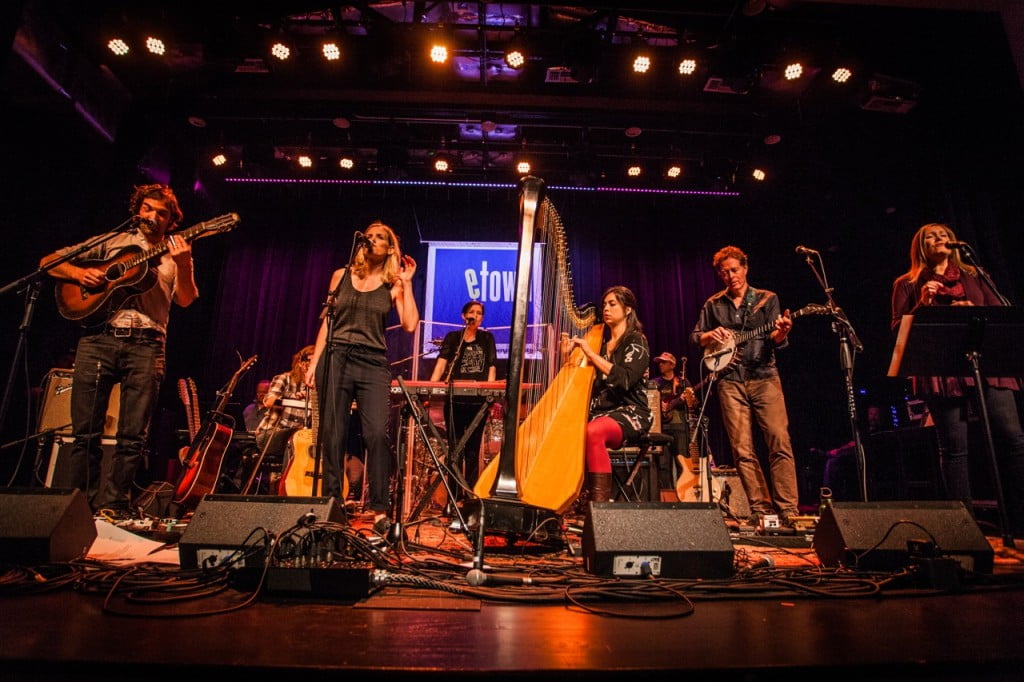
eTown: Come for the Music, Stay for the Message

Wife/husband duo Helen and Nick Forster have experienced first-hand how music can facilitate a connection. Both performers, they met backstage at the Telluride Bluegrass Festival in Colorado 30 years ago. While Helen had served as the co-owner and co-producer of the festival from its inception, Nick was a founding member of the acclaimed bluegrass band Hot Rize, which was on the precipice of a long-term hiatus. The couple bonded over music and shared values — including a concern for the environment. In 1991, they launched eTown, a nationally syndicated, independent, nonprofit radio show integrating conversations with community organizers and researchers along with performances and Q&A sessions with musical guests.

“If you imagine what happens at a bluegrass festival, there’s something very fundamental, which is that everyone comes together from disparate backgrounds and walks of life and there’s no vetting of philosophy or political party or socio-economic alignment or anything like that,” Nick says. “They have a shared experience … [and] a common focus … their hearts are being opened by music, which is a very real and palpable and powerful thing … There is that sense of connectedness which means that, by Sunday night, as things are starting to wrap up and people are thinking about heading home and going back to their jobs the next day, going back to their normal concerns and cares, there’s a wistfulness. There’s a little bit of sadness about, ‘Man I was part of something this weekend.’ I think, to a large extent, a community that’s connected like that is also going to do a couple of other things, including looking out for each other. And they also tend to look out for their space … and so all of those things are a part of the DNA of eTown.”

The program’s tagline defines eTown as a place where people come for the music and stay for the message.

“We wanted to give people a place to go where the music brought people together, where everybody was welcome, where the music would be both the connection point and uplifting, but more importantly, we would also stimulate dialogue in conversation about how do we take better care of each other and the planet,” Nick explains.

eTown is recorded weekly in front of a live studio audience at eTown Hall, a 17,000-square-foot converted performance space in the middle of downtown Boulder, Colorado. Once a church, the building features state-of-the-art recording studios, production rooms, and camera and lighting equipment, allowing Nick and Helen to navigate the shifting media landscape. eTown films the performance portion of each show and posts the videos on their website. When deciding which musicians they will feature each week, Nick and Helen say diversity is key.

“We wanted to have musicians who were soulful. We didn’t necessarily want to have any from a particular style. I think we do tend to focus on vocal singers, you know. We don’t do as much instrumental music, for example, because I don’t think it really fits with our show as well as others,” Nick says. “We’ve always tried to feature one well-known act and one less well-known act, so that people can get excited about hearing the person they know, but then get more excited about the discovery piece … We try to mix it up further, so we have one band, one solo, maybe one male, one female, maybe one from one musical tradition and one from another, because at the end, everybody plays together for the finale and so we want to make sure that the finales are kind of like, ‘Wow that’s a weird combination.’ You’ve got a singer/songwriter and a hip-hop artist, or you’ve got a bluegrass musician and a blues guy, or you’ve got a Cajun band playing with a Latina band from Los Angeles or whatever it is.”

The other segments of the show address social and environmental issues — from homelessness and hunger to air pollution and compromising the oceans. But in 1991, eTown was ahead of the curve when it came to these discussions. Climate change and global warming weren’t even concepts at the forefront of public or political discourse.

“There was a lot of apathy at the time, and people are not apathetic because they’re bad people. It’s usually because things seem overwhelming and you don’t feel like you have any power to do anything,” Helen explains. “So we wanted to bring people in and give them some food for thought. We wanted to inform them and, most of all, we wanted them to be inspired to get involved. We wanted to bring our skills together in order to create something that was really welcoming across the board: Wherever you were, you’re in eTown.”

This idea led to the creation of the eChievement Award, which Helen gives to one winner each week, inviting them to speak about their work on the show. Nominated by other listeners, eChievement honorees are citizens who are actively trying to improve their communities. “We’ve tried to be solutions-oriented,” Nick says. “We’ve tried to highlight the problems but also think about things that are working and things that are positive in the age of Trump and those things are welcome. We hear from listeners that are like, ‘Thank God, there’s something positive out there in media.”

After 26 years, Nick and Helen believe eTown is just getting started.

“The reason for doing eTown, I think, is more important now than ever because we are entering into this time in our nation’s history where politics have become so divisive and so violent, frankly, and the idea that we need to come together particularly around some core issues that are relevant and important for all of us. I mean, it is absolutely critical that we find some common ground,” Nick says. “And we are more committed than ever to making sure that we can use music to bring people together — but not gloss over the details — and talk about what’s important and talk about what we can all do, each of us, to try to address these issues that are absolutely critical for our future. So I’m super pumped about both our history and our legacy, but especially about our future.”
UPDATED: A Call to Action from the Indigo Girls #NoDAPL (Op-ed)

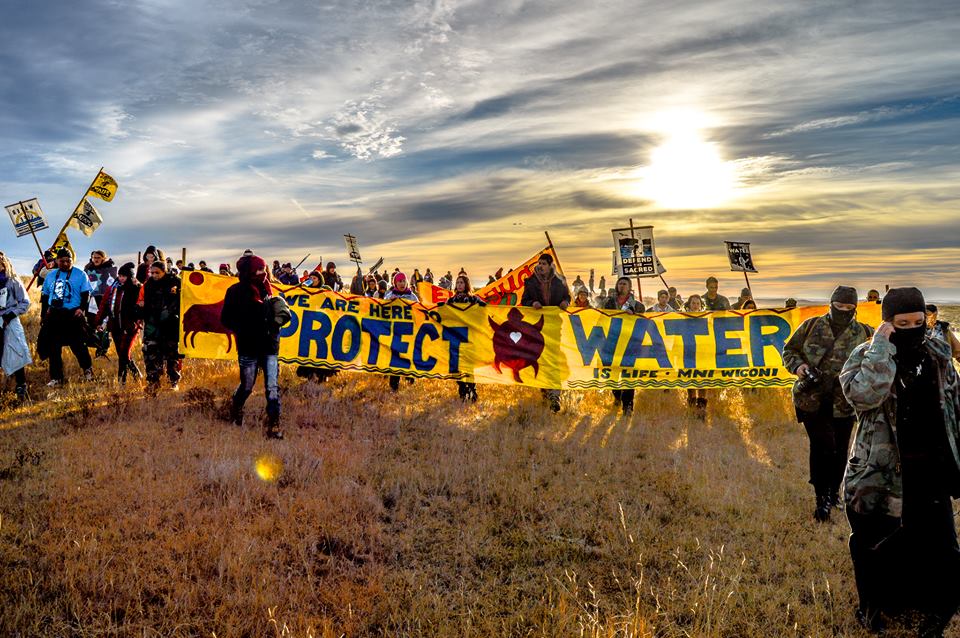
As many of you know, there is a critical battle being fought right now in Standing Rock, North Dakota, between Native Americans, their allies who want to protect sacred land and water, and a huge corporation that wants to build an oil pipeline that threatens the Missouri River with leaks and devastating consequences. The name of the company building the pipeline is Energy Transfer Partners, and its CEO is a man named Kelcy Warren.

Kelcy Warren also happens to be a passionate music lover who owns a festival (Cherokee Creek Music Festival) and a record label (Music Road Records) that, among other things, released a Jackson Browne tribute record. Indigo Girls have played the festival and had a song on the tribute record. When we participated in those events, we had no idea about Kelcy Warren’s connection to big oil and its imminent threat to the Standing Rock Sioux. Now we know.

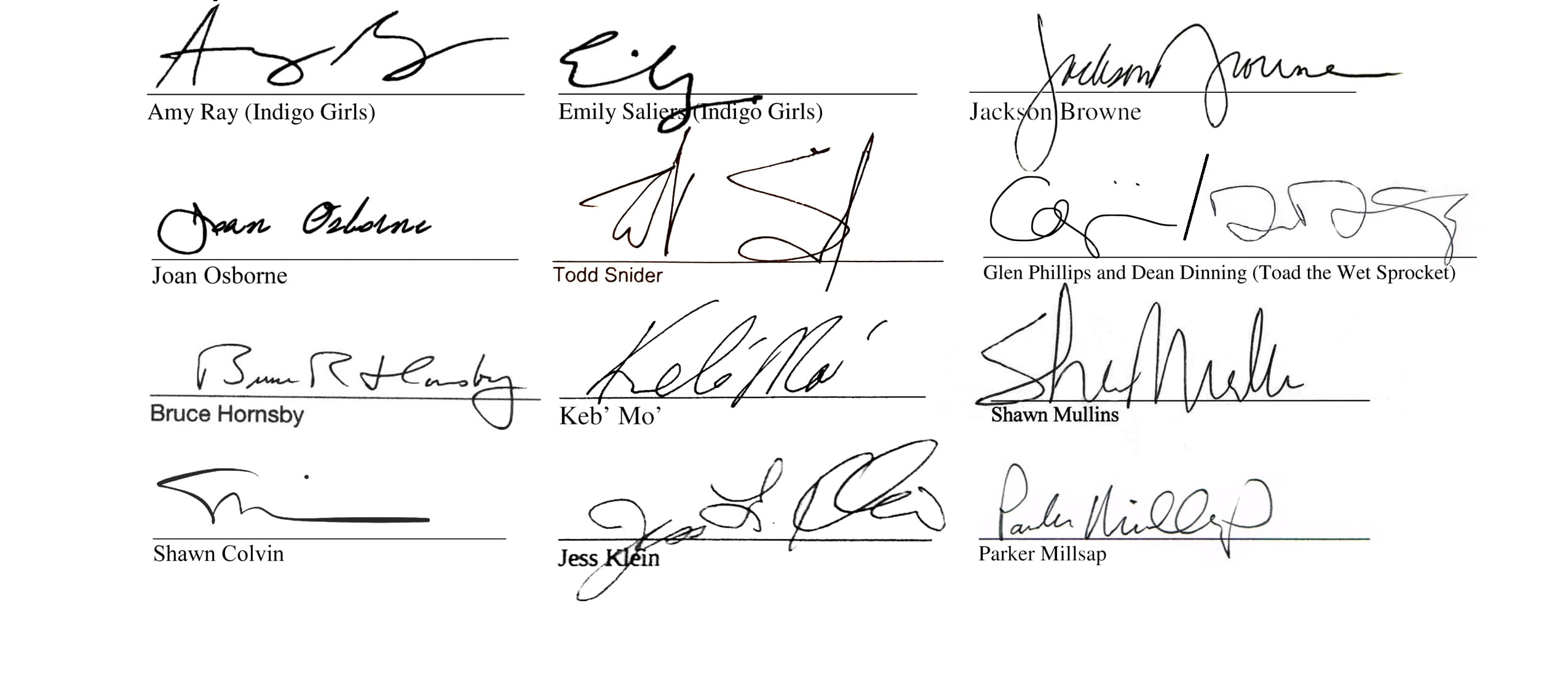
When this connection was brought to our attention, Amy and I wrote a letter to Mr. Warren, voicing our protest over his company’s pipeline (DAPL), and several other artists who had performed at his festival signed the letter in solidarity. We are simply saying that building this pipeline is the wrong thing to do, and its disregard for Native land, water, and rights is in direct conflict with our philosophy as artists and people who care about Indigenous peoples and the environment.

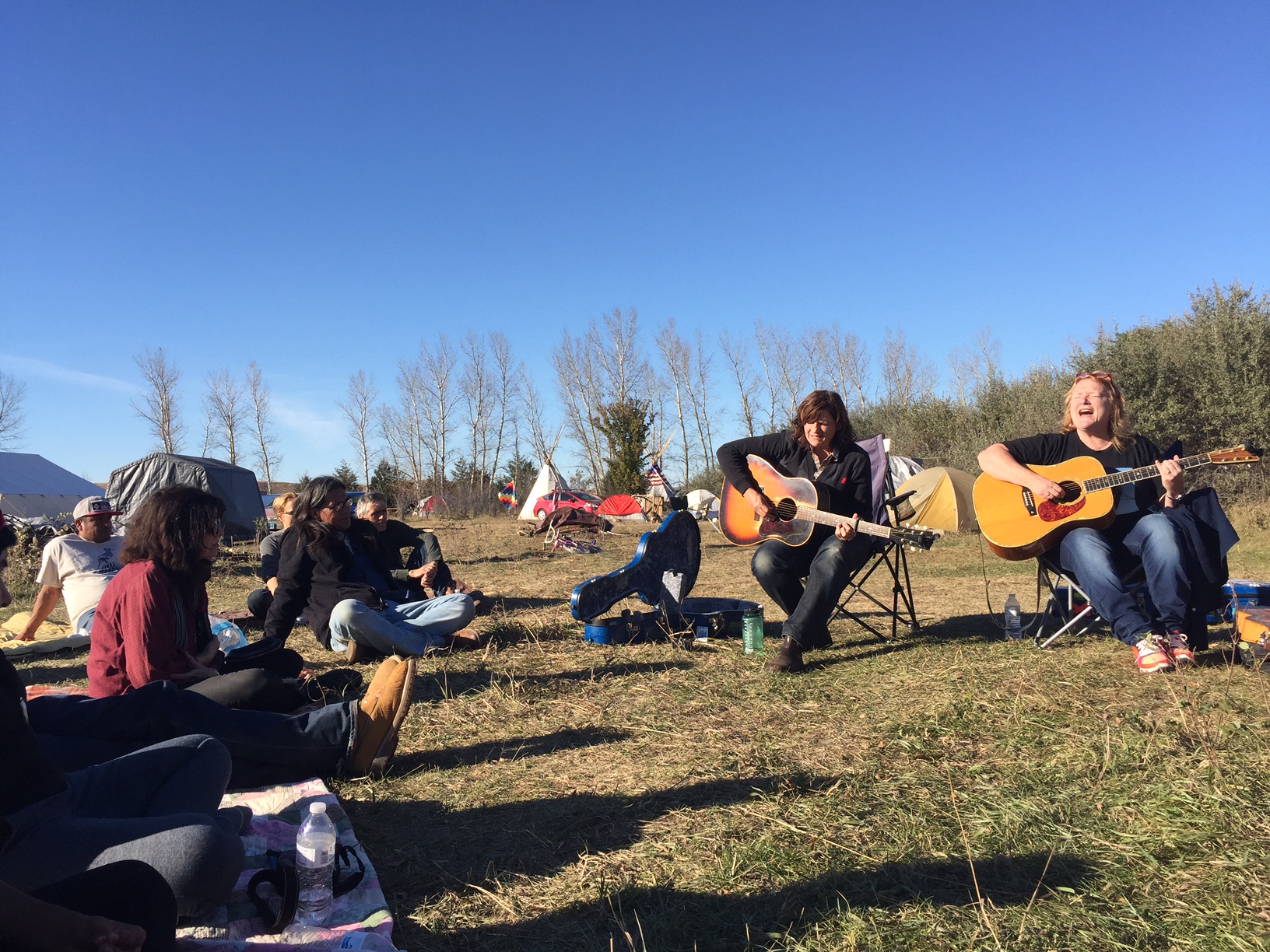
Amy and I, under the guidance of Honor the Earth, have recently been to Standing Rock to play a concert and stand in solidarity with the protectors (not protesters!) there. They are brave, outnumbered by abusive law enforcement, and suffering unfathomable racism, yet they remain firmly committed to opposing this pipeline — not just for themselves, but for all of us.

We wrote to Mr. Warren, asking him to reconsider and stop the pipeline.

Will you join us?

To Email, Call, or Message
Cherokee Creek Music Festival: [email protected] — 214.981.0700 — Facebook
Music Road Records: [email protected] — 512.444.0226 — Facebook

For more information, please visit Honor the Earth.

In gratitude and solidarity with Standing Rock,
Amy Ray and Emily Saliers — Indigo Girls

October 26, 2016

Mr. Kelcy Warren
c/o Cherokee Creek Music Festival
4160 West FM 501
Cherokee, TX 76832

Dear Mr. Warren,

We have played your Cherokee Music Festival and found it to be a compelling gathering of artists and a noble pursuit to help children’s charity organizations across the country. Many of us who have played your festival have invested time and energy into the fight for human rights and environmental justice. For some of us, this mission is the moving force and spiritual foundation of our larger community of musicians, and one of the inspirations to play such rich gatherings as the Cherokee Music Festival. But sadly, we realize that the bucolic setting of your festival and the image it projects is in direct conflict with the proposed Dakota Access Pipeline — a project your company, Energy Transfer Partners, is responsible for spearheading. This pipeline violates the Standing Rock Sioux Nation's treaty rights, endangers the vital Missouri River, and continues the trajectory of genocide against Native Peoples.

Many of us have also participated in projects affiliated with Music Road Records, another company of yours. While this company does a lot to promote incredible music that comes from the roots of our country, many of us, as artists, take offense and are mystified by how someone with such a deep passion for organic and traditional music can own a company that is so blatantly tearing at the heart of the fabric of our American community. The American tradition of music that is so diverse and rich depends on the respect for human rights and that includes environmental justice for Native Peoples that contribute to the great tapestry of this land.

In order to stay true to our music and respect the Native Nations that are united against the Dakota Access Pipeline, we will no longer play your festival or participate in Music Road Records recordings. We implore you to stop the construction of the Dakota Access Pipeline and to reconsider your company’s pursuits with regards to the environment and the communities that depend on its well-being.

We stand with Standing Rock, the Standing Rock Sioux, their friends, and allies in protecting their sacred land and water by stopping the construction of the Dakota Access Pipeline and all pipelines that threaten massive ecosystems.

UPDATE

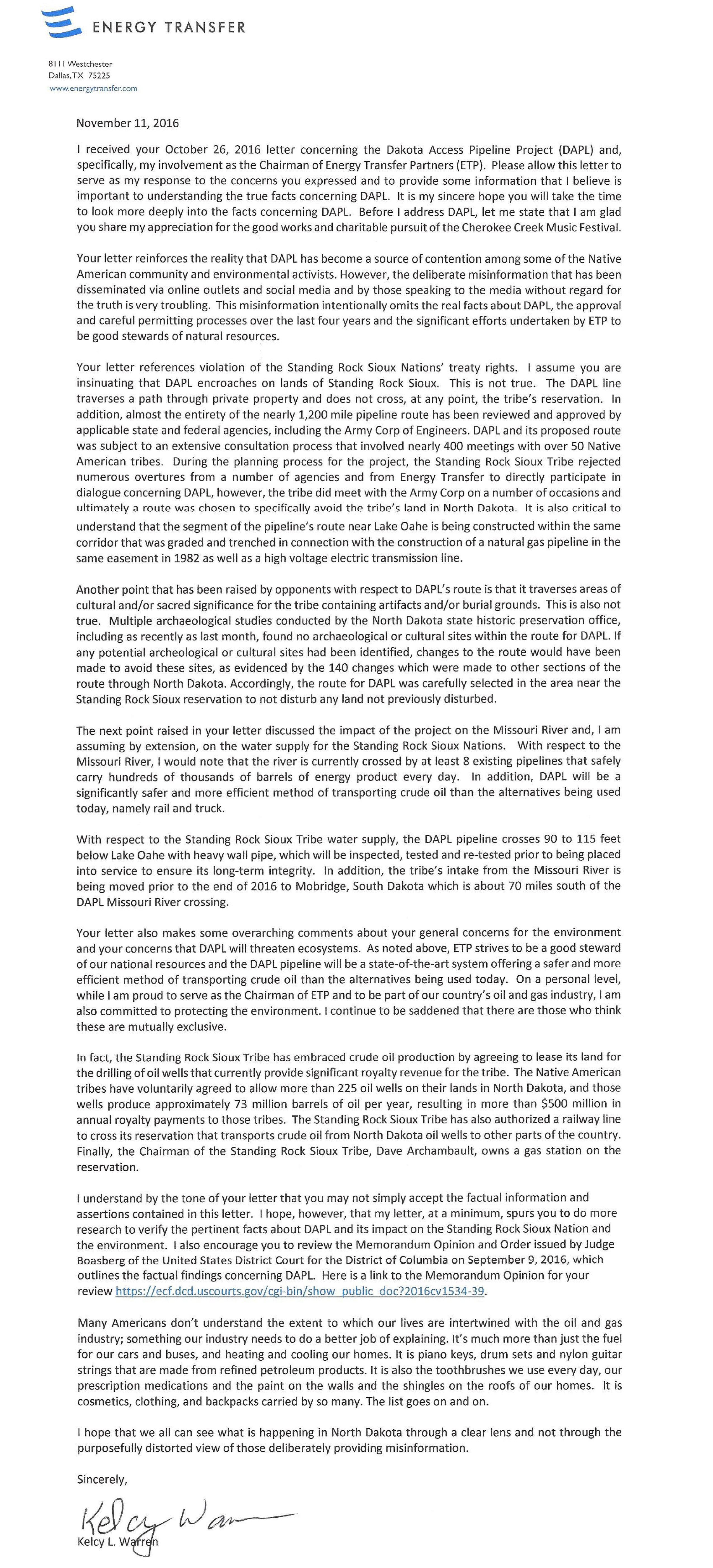
Editor's note: Kelcy Warren responded to the letter by trotting out the usual tone deaf oil industry tropes which are handily rebutted with phrases like "There's a difference between treaty territory and reservation land," "Electricity never polluted anyone's drinking water,"  "It's not hard to imagine why 250 years of broken agreements might lead a Native tribe to be skeptical of negotiating with white men," "Oil barron and environmental steward are, in fact, mutually exclusive titles to hold," and so on. Nevertheless, in the spirit of fairness, we present his letter in full:


Lede image: Water Protectors prayerfully march across the desecrated sacred sites to stop DAPL construction. Photo by Rob Wilson Photography.

Squared Roots: Rhiannon Giddens Studies the Songs of Dolly Parton

Dolly Parton turns 70 in January. And, while that might seem impossible, it takes that span of time to accomplish all that she has over the course of her various careers as a songwriter, a singer, an actress, and a businesswoman.

Rising out of the ashes of unspeakable poverty in east Tennessee, Parton blazed a trail like none other. From her early days with Porter Wagoner through her unrivaled run in the '70s and '80s to her artistic eclecticism of the '90s to today, Parton has composed more than 3,000 songs (by her own admission), charted 42 Top 10 country albums, and garnered more awards than anyone can count. She even has a TV movie of her life, Coat of Many Colors, slated for release in December.

In contrast, Rhiannon Giddens emerged only a decade ago as part of the Carolina Chocolate Drops after studying opera at Oberlin Conservatory. Though the Drops were known for their passion for and handling of old-time music, Giddens has taken a different tack with her solo debut, Tomorrow Is My Turn, and her guest appearance on Lost on the River: The New Basement Tapes. But, with everything she does, Giddens keeps one eye on the past and one eye on the now.

I gotta say … for whatever reason, I thought your pick would be maybe a little less polished — like Hazel and Alice or Ola Belle Reed or somebody like that. So why Dolly?

Well … I'm kind of obsessed with her right now. I guess I've been focused so much on the non-commercial parts of country music and old-time music — you know the Ola Belle Reeds and the Hazel and Alices. I love that so much, but as of now, I'm a more commercial artist. I'm not making CDs while doing something else. It's what I do for a living and I've had a bit of radio play. So I've been really thinking about what Dolly did — and she still does. I mean, she's not writing as much as she was. She definitely had a golden period of songwriting.

The thing that fascinates me about her is how she worked feminism into pop songs. That's kind of what I'm fascinated with right now because, as I look at being a songwriter myself, as I've developed over the last couple of years as a songwriter with definite activist urges, wanting to figure out how to say things while making them effective to as many people as possible … I've been really digging into her early stuff and been kind of amazed at the strength of writing and the really strong feminist themes wrapped up with this sort of smile. I've just been kind of fascinated with it. I've been talking about her every night because I do one of her songs in my show.

So according to the Gospel of Wikipedia, she has written more than 3,000 songs over the span of her career. What does it take to hit a milestone like that?

I mean … what I think is … of course, you'd have to ask her to get the answer. You can't pull all of that … I mean, you can pull all of that from yourself. But I think you'd probably go crazy in the process. I think you have to observe and see what's happening to other people, find things to write about that maybe nobody else ever thought of. If you're really engaged with life, you see that. That's what I think.

Yeah, it seems like the level of empathy that she must have — especially coming from … it's crazy to think of where she came from and where she is now. She's the most honored female country artist in history … and so much more.

Yeah.

I was reading that she got some early words of encouragement from Johnny Cash, then the gig with Porter Wagoner, and off she went. Now here we are 50 years later.

And, still, you think about how she's written that many songs and yet, is she known as a songwriter?

Right!

I know. She's not. And I think part of that's her image. That is sort of the image that she's put out there. I still think people have a hard time seeing a pretty smile and a pretty voice, and they have a hard time connecting that she has a razor-sharp brain … and those songs!

Yeah, you don't get where you are — where she is — by not having the razor-sharp brain.

She is so freaking smart. Oh my God! She's such an inspiration. Just watching what she's done with her career, how she's taken care of her family and people at home … how she's all-successful. Stuff doesn't come up and then collapse, you know? Books for children all over the world? And she does it all without fanfare.

And it's hard to imagine — because she did start as a songwriter with the songs for Bill Phillips and Kitty Wells and stuff — but it's hard to imagine a world where she rested on that, on those songwriting laurels, and didn't pursue being a performer. But what if she had just kept to songwriting? What do you think …

Oh, that would be a sad loss! There are people out there who can write but can hardly sing. But her voice is beautiful. Her phrasing's gorgeous. She's such a great performer and a great actress. She's a real triple threat. There are not many of those out there, really, where each thing is just as great as the other.

She's also — even just within music, taking aside Dollywood and acting — she's had so many different musical lives, as it were. I'm a child of the '70s, so I have to confess to loving 9 to 5 and Best Little Whorehouse in Texas … that was my childhood.

Oh yeah!

But your favorite era is the early stuff? Which cuts?

Right now, I'm obsessed with the early stuff. There's one record that's got a ton of stuff on itwhich isn't really fair because I have a bunch of songs on my iPod, but … "A Little Bit Slow to Catch On," "Just Because I'm a Woman," "I'll Oilwells Love You." I've been writing all the lyrics down, studying how she does this stuff. "The Only Way Out (Is to Walk Over Me)" … just so good! That's the stuff that's not known, in addition to “Jolene” and "Coat of Many Colors" and that kind of stuff … you know, "9 to 5."

I first was introduced to her through her second bluegrass record, Little Sparrow. That was the first time I really … I had seen that stuff growing up, and I knew “9 to 5,” but the first time I really got a sense of Dolly as an artist was Little Sparrow. I loved it. I thought it was beautiful. One of my first introductions to old-time music was actually at the end of "Marry Me" — there's this like little old-time jam that kind of fades off. And I was like, "That sounds so good!" It's funny to think about that, before I knew about old-time or anything.

Everything old is new again, I guess.

You know? The lyrics of "I'm a I'm a little bit slow to catch on, but when I do I'm caught on. I'm a little bit slow to move on, but your baby's a-movin' on" … I mean that early stuff, I'm really into it right now.


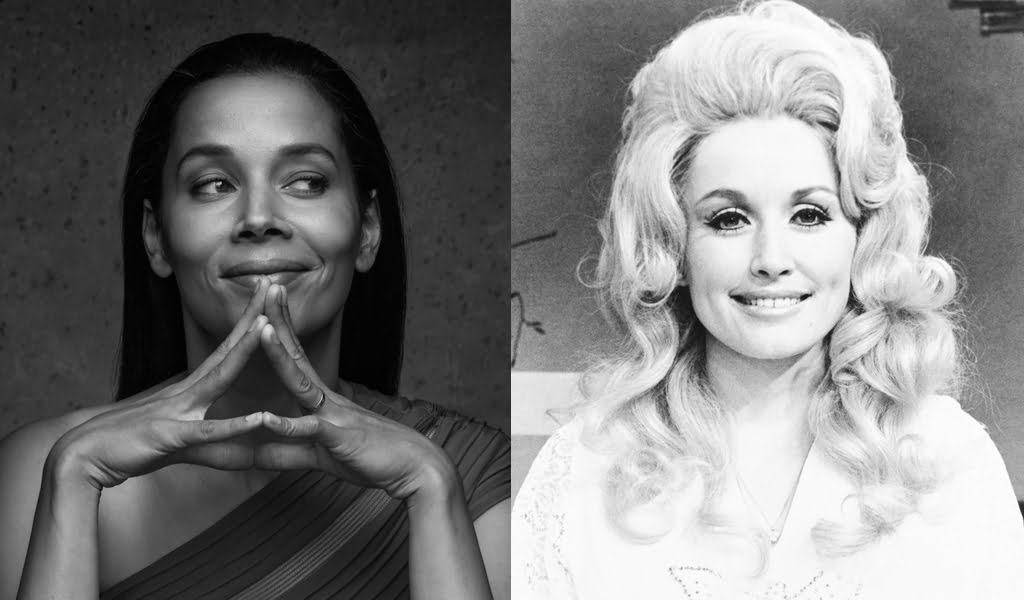
Rhiannon Giddens photo by Dan Winters; Dolly Parton photo courtesy of RCA