Check Out Lucinda’s, a Bustlin’ NYC Honky Tonk

(Editor’s Note: Enjoy our tour of New York City honky-tonk, juke joint, and cocktail lounge Lucinda’s as a special postlogue to our Artist of the Month coverage of Lucinda Williams during March 2026.)

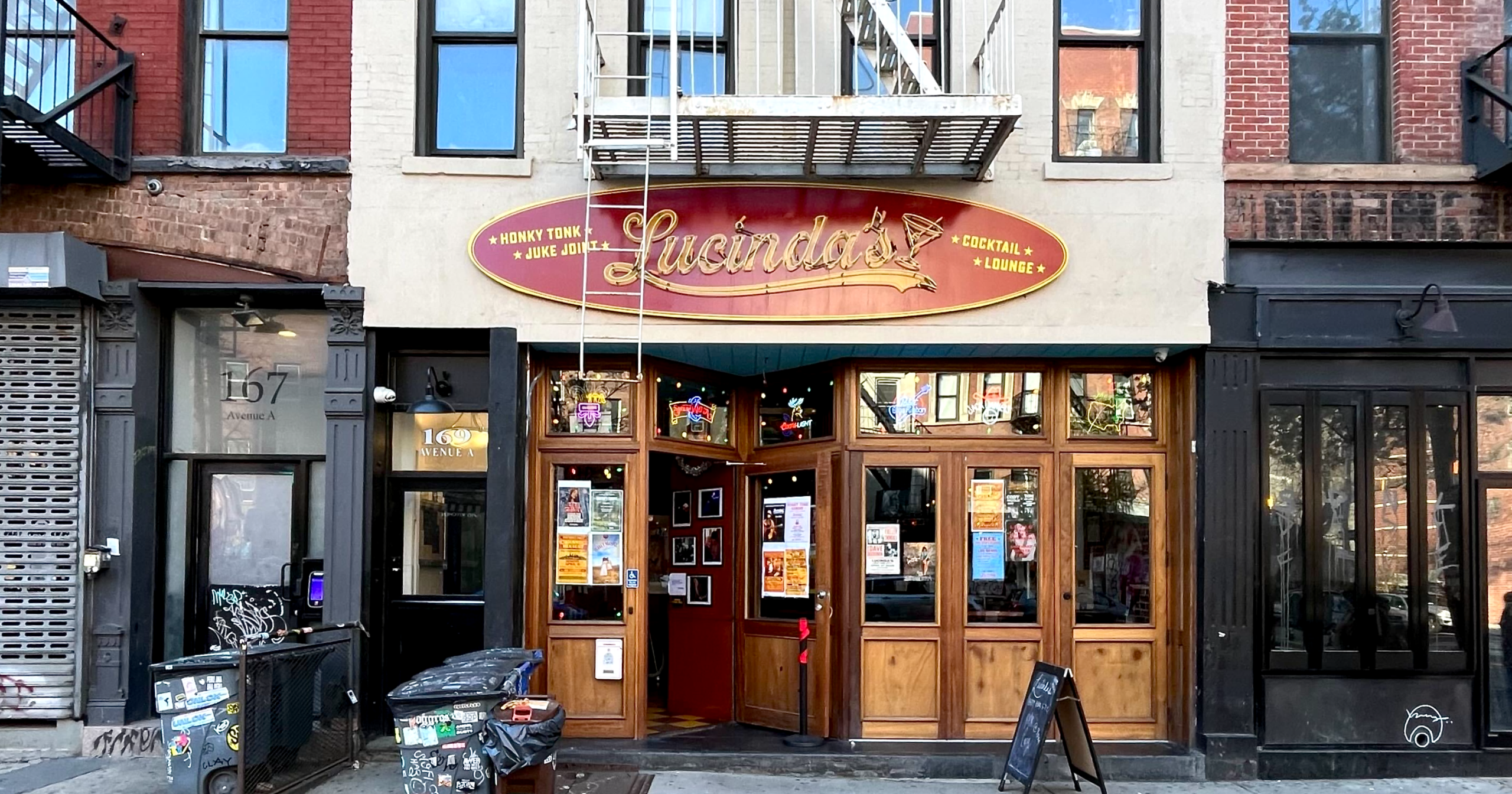
It’s the first springtime Sunday in Manhattan and after a bitter winter, the East Village is humming with human activity. Around the corner from the throng of Tompkins Square Park, where Girl Scouts hawk cookies and roller hockey players clatter their sticks and skates, tumbles of acoustic guitar spill from a storefront, attracting curious passers-by. Some folks pause and lean toward the open windows, and a few cross the threshold to meet wafts of fresh popcorn. Welcome to Lucinda’s.

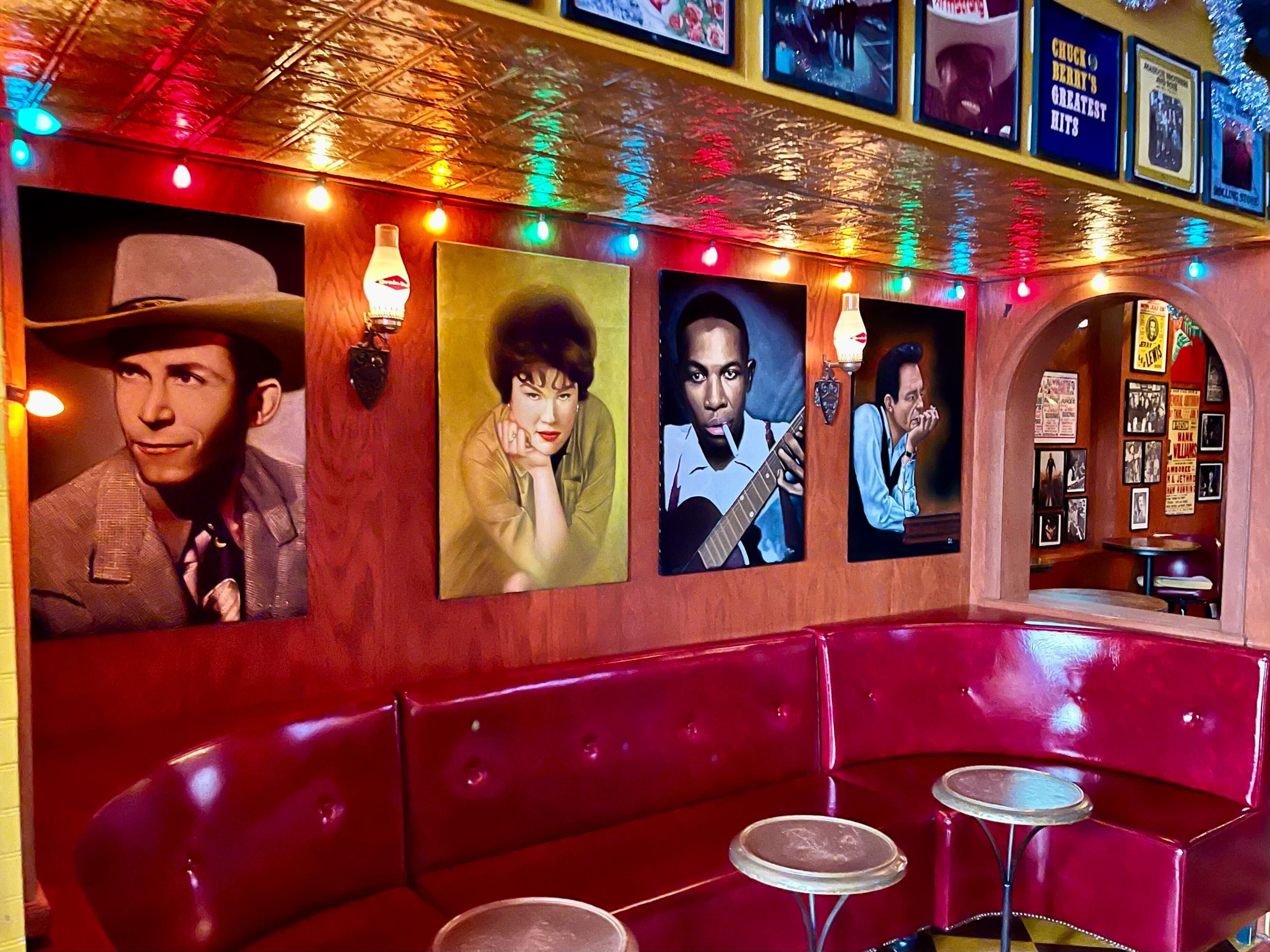
The bar’s tin ceiling interior is catnip to music history aficionados and Americana-kitsch collectors alike, the walls hung with poster prints, vintage memorabilia, and velvet paintings (among them Kitty Wells, Robert Johnson, and Elvis Presley shaking hands with Jesus Christ). There’s a jukebox ready to sling beloved feels-good-to-feel-bad hits, and peanut figurines with Jimmy Carter grinning and holding court over the liquor. These accoutrements all play second fiddle to the spot’s main attraction: live music meant for casual socializing every day of the week.
This robust programming – along with some of the bar’s most prized decorative items – is the work of Kelley Swindall, a musician and New Yorker of 20 years who grew up in Stone Mountain, Georgia. She takes pride in a large round aluminum Coca-Cola sign, an item on “permanent loan” from her family and one of several wall-hung nods to Georgia’s most lucrative liquid export. She’s more proud of filling a void in New York City nightlife. “There’s a lot of Southern people in the city that went to SEC schools that want to have some Southern culture again, like college football, or listening to music that they love and don’t normally hear in New York,” Swindall says.

Though the city has a handful of country-themed, sometimes Western-leaning bars – Williamsburg’s hootin-hollerin Skinny Dennis, the self-explanatory Honky Tonkin’ in Queens, the West Village’s Tex-Mex-y Cowgirl – Swindall wanted to develop a place to celebrate the early country, blues, folk, and other vernacular music that shaped generations of American song. She yearned for the sort of places she knew growing up and got to know as a touring musician, rooms where casual live music fosters socializing instead of hampering it. “That’s what the juke joints and honky-tonks were back in the day – it was live music as the soundtrack of the evening, but you were hanging out, drinking, dancing, and socializing,” Swindall says.
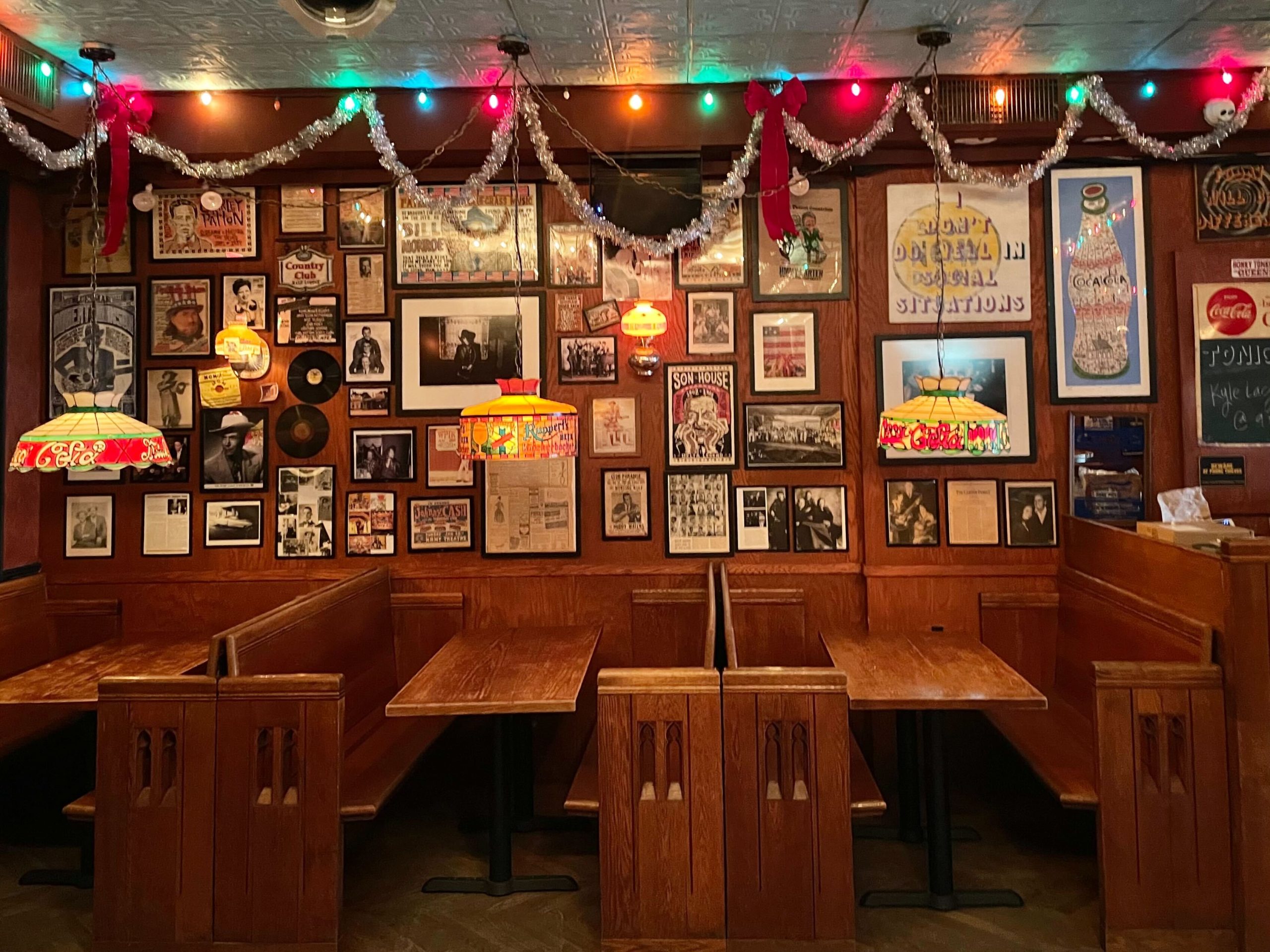
Swindall found a business partner in Laura McCarthy, who has a storied history of her own at 169 Avenue A running prior venues Brownies and Coney Island Baby. The pair found a namesake and patron saint of sorts in Lucinda Williams, with whom they connected through mutual friends. Williams agreed to endorse the place, her multi-stranded artistry anchoring the team’s vision for honoring the deep musical roots of the American South. She christened the stage with a set as part of the bar’s opening-night festivities last July.

On a Saturday night, Lucinda’s is rollicking, packed front to back with revelers before some New Yorkers have even gone to dinner. There’s college basketball on one TV, and The Best Little Whorehouse in Texas on the other. I want to mill around and make conversation, but the bar is thick with boisterous, overlapping shouts converging with mid-1990s Tim McGraw and Shania Twain songs that radiate in my bones.
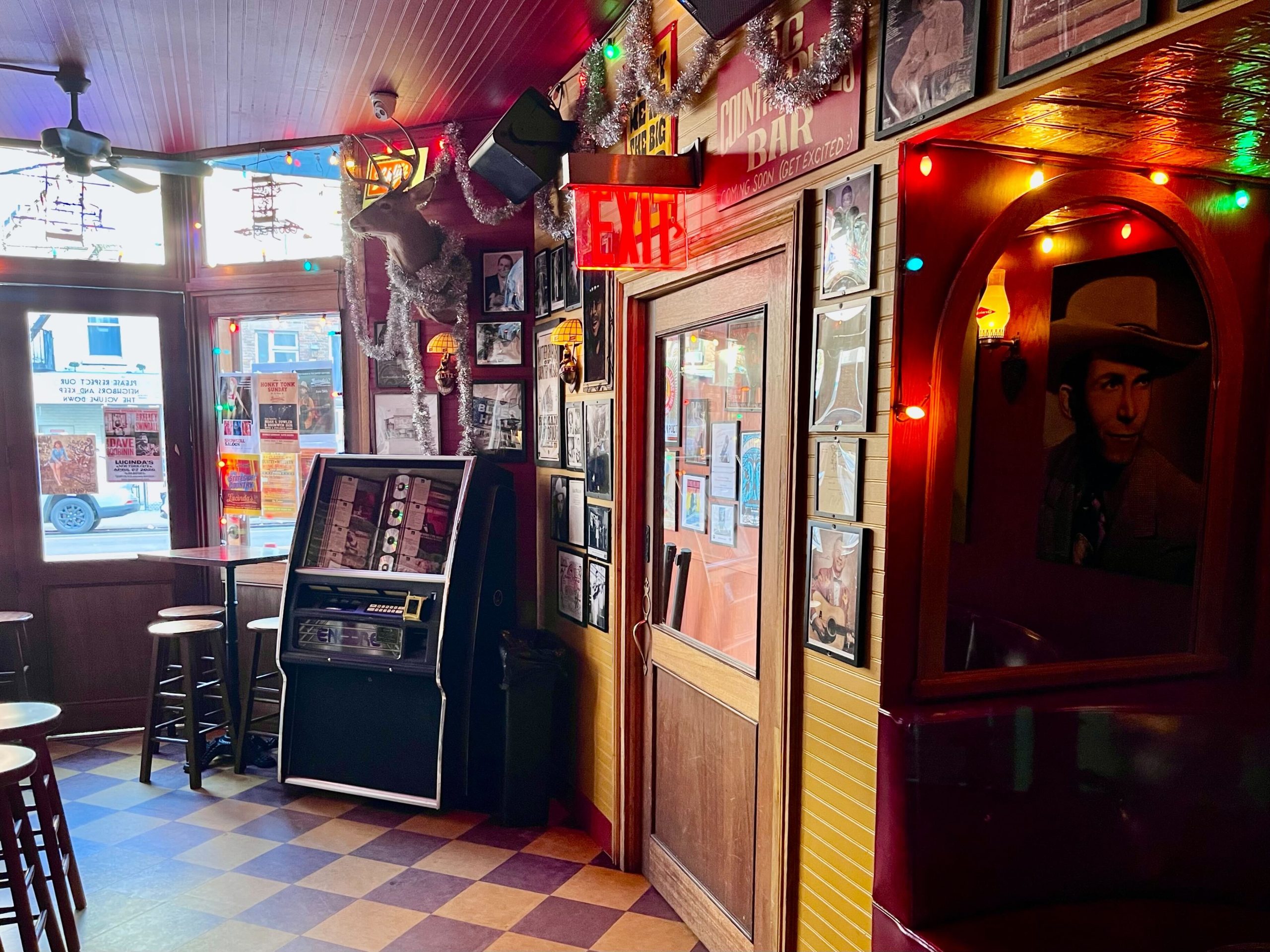
The mission of Lucinda’s is evidently working. With my elbows pinned to my sides, I chat with Emily from Texas and two girls who rolled up for one of several birthday gatherings in progress. After his friend paws at my unattended leftover garlic knots, Gavin, an Irish ex-pat and country music fan, tells me it’s his first time at Lucinda’s after hearing about it on TikTok. “We were in the neighborhood, and we wanted to come in. We already had plans somewhere else, and we made it our business to come back here,” he says, enthralled with the room’s unique decor. I don’t get a chance to ask his thoughts on the Dolly Parton or Johnny Cash bathrooms before he peels off with drinks in each hand.

Spirits are high, but by Lucinda’s standards, the fun has barely started: a few musicians are shouldering their way through to the corner stage. Nightly music programming is a staple at Lucinda’s, which Swindall accomplishes with standing residencies and open mics alongside other ticketed events. There’s a loose structure week to week; weekends are for the big sing-along bands, Sunday evenings are for classic country, and bluegrass and some old-time are on Tuesdays. “I was an artist first, and I still am, so I wanted to focus on the kind of music that I’m into,” Swindall says, adding that Thursday night is for two-stepping.
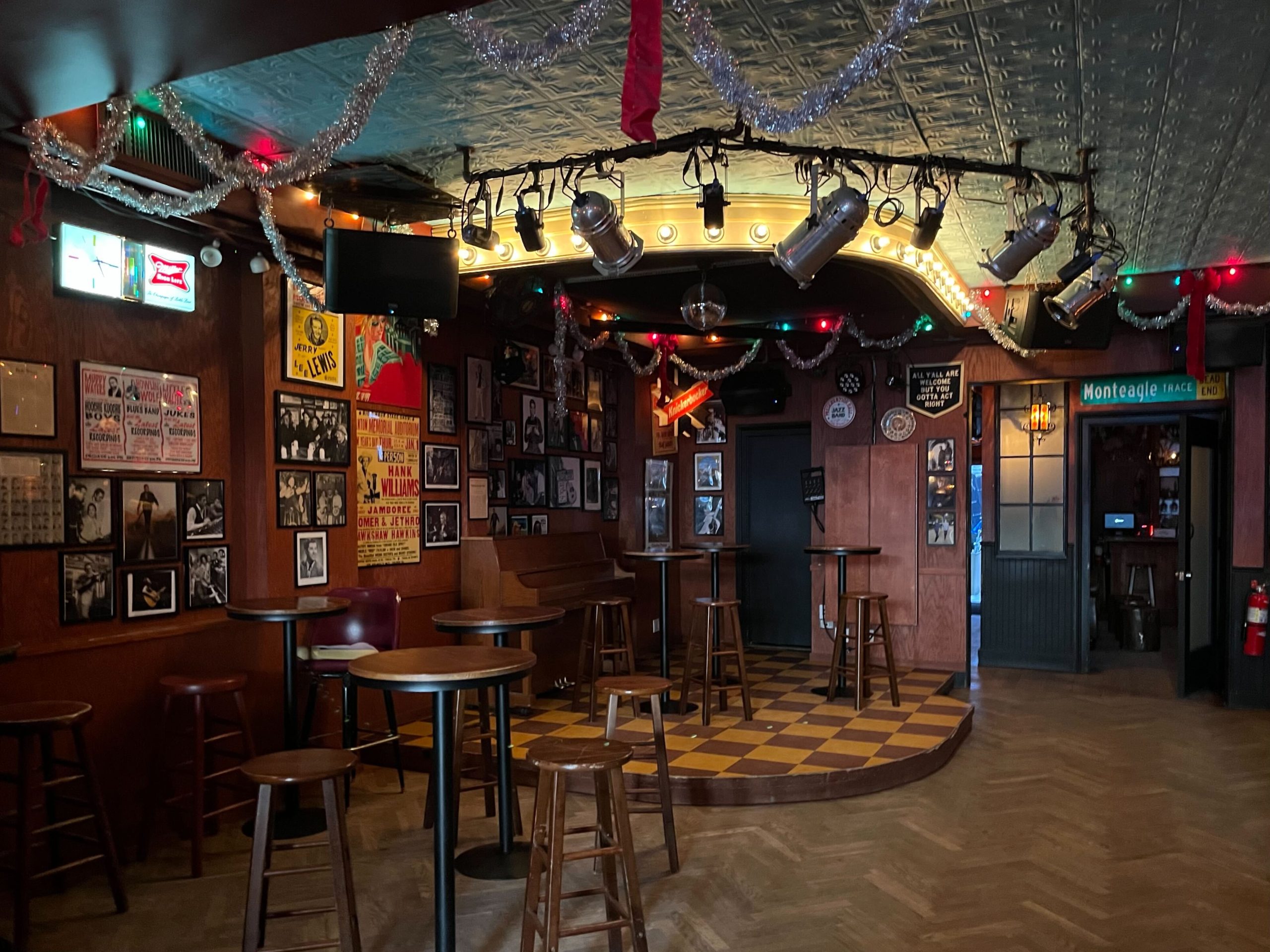
The Sunday open mics are a binding force to Lucinda’s operating concepts. Sign-ups start at 1 p.m. every Sunday, running through the afternoon until another outfit takes the stage for the evening. There are some gentle guidelines (no covers, no backing tracks), aimed toward bringing a pleasant and equitable atmosphere to the gatherings. Swindall prioritizes the artists’ experiences at these weekly forays, remembering open mics as essential to her relationship-building and development as a young musician.

“It’s more important to have people able to come in and play their songs, everyone listen, rather than have a thriving bar culture that day,” she says. Drawing further on her artist’s perspective, Swindall fosters the open mic knowing the challenges of getting a foothold in bigger booking circuits. “A lot of places, they don’t want to book you unless you can bring a crowd or you can show them live footage. It’s really great to give people an avenue to get comfortable on stage and get feedback for their songs,” Swindall says.
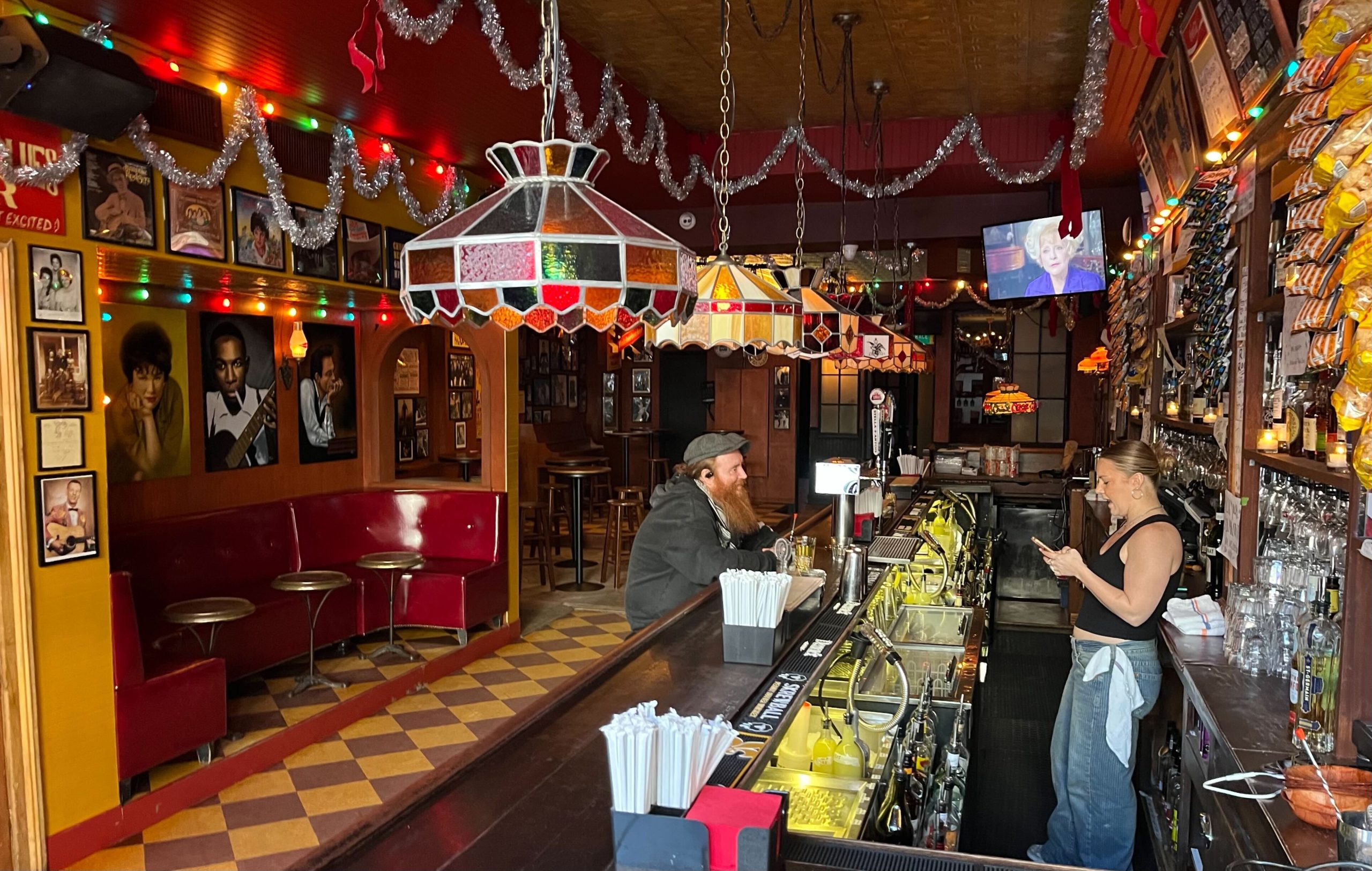
Moreover, the shindigs help Swindall expand her pool for her month-to-month bookings, strengthening the network of relationships that are essential to the arts-forward community that McCarthy and Swindall hope to nourish.

Almost a full year in, Swindall is eyeing a steady growth pattern. She worked her way up to music every night of the week and now sometimes has two shows a night; she’s starting to entertain ideas for a small festival. “From a bar point of view, there’s so much to do,” she says.

The space isn’t zoned for a kitchen, but Swindall wants to figure out some kind of food element; in the meantime, patrons can bring in takeout or ask a bartender nicely for a Moon Pie, a bag of Zapp’s chips, or a bowl of popcorn. Swindall will stay busy as she aims to make Lucinda’s even more of a place for the “all” in “y’all.”

Stop in, sit down, shake loose. Connect with a song, or maybe a stranger.


All photos by BGS Staff.

Explore our Artist of the Month coverage of Lucinda Williams here.
Dale Watson’s Ameripolitan Today Playlist

Ameripolitan music can be best defined as original music with prominent roots influence, and it has four categories: honky tonk, Western swing, rockabilly, and outlaw. My Mixtape features a song by an artist that represents the roots and then I’ll play a new artist that directly was influenced by them. You can hear the natural growth of country music when you listen to Lefty Frizzell and Merle Haggard or Kitty Wells and Loretta Lynn back to back. (Many of the roots artists had nicknames, I miss that.)

While some may hear an artist’s influence and say they are copying them, I’m of the opinion that John Lennon shared when asked about The Beatles’ influences. He said, and I paraphrase here, “One’s originality comes out in their inability to imitate their influences.” Very well said. – Dale Watson

“Who’s Gonna Take The Garbage Out” – Loretta Lynn, Ernest Tubb

Ernest Tubb had a distinctive voice as you hear on this song he sings with Loretta Lynn. Here’s the Texas Troubadour with the Coal Miner’s Daughter.

“My Wife Thinks You’re Dead” – Junior Brown

And no one is more evidently influenced by him than Junior Brown.

“Undo the Right” – Johnny Bush

Johnny Bush, otherwise known as the “Country Caruso,” was a drummer for Ray Price, the Cherokee Cowboy, before going out on his own. You would definitely hear that influence if you back-to-back Ray Price to Johnny Bush. Both are huge influences to every singer that grew up in Texas.

“Texas Honky Tonk” – Justin Trevino

This young man from Texas is carrying the Bush torch.

“D-I-V-O-R-C-E” – Tammy Wynette

The First Lady of Country Music, Tammy Wynette was married to the Possum, George Jones. She is easily at the top of women that influenced the newer singers.

“Houston Belongs To Me” – Sunny Sweeney

Singing her own divorce song, here’s Sunny Sweeney!

“Big Balls in Cowtown” – Bob Wills & His Texas Playboys

In the Western swing category this is the master, Bob Wills & His Texas Playboys.

“Riding High in Texas” – Asleep at the Wheel, Billy Strings

Though they’ve been around a while, they still burn up the road and proudly wear Bob Wills as their biggest influence. Ian Stewart sings as guest picker Billy Strings shines.

“Here in Frisco” – Merle Haggard

The Hag has influenced generations and even in death he still does. He once told me he forgot he wrote this song and was glad I brought it up so he can add it to his playlist again.

“This Highway” – Zephaniah OHora

Zephaniah OHora is now based in Nashville and he’s got a lot of great original songs. On this song you can hear the Hag in him.

“Bob Wills Is Still the King” – Waylon Jennings

In the outlaw world there is none more influential than Waylon, and in Texas we were all influenced by Bob Wills.

“Long White Line” – Sturgill Simpson

This particular song draws heavily on Waylon’s influence. And I like it.

“Ramblin’ Man” – Hank Williams

Hank Williams’ voice is one of the most recognizable in music. His songs are timeless and still inspire singers and songwriters alike.

“Thunderstorms and Neon Signs” – Wayne Hancock

You can definitely hear Hank in Wayne Hancock, but his own voice is definitely original, too – as well as his great songwriting.

“Guitars, Cadillacs” – Dwight Yoakam

Dwight Yoakam has influenced many a newcomer. Just as he was obviously influenced by Buck Owens. He came along when Nashville needed reminded of its roots.

“Lost in the City Lights” – Johnny Falstaff

Though not well known as of yet, Johnny Falstaff is picking up Dwight’s hat.

“Blue Kentucky Girl” – Loretta Lynn

The Coal Miner’s Daughter definitely left big shoes to fill, but her sassy songs inspired many women artists.

“Don’t You Ever Give Up On Love” – Brennen Leigh

That inspiration can be traced right to Brennen Leigh.

“Good Hearted Woman” – Waylon Jennings, Willie Nelson

Here’s the quintessential outlaw song by the most famously influential artists, the Red Headed Stranger, Willie Nelson, and Waymore, sometimes called Wautawsha, Waylon Jennings.

“Willie Waylon and Whiskey” – Dale Watson

The last song I’ll put in here’s is mine, because with pride I will state, yes, I am heavily influenced by Willie and Waylon. And sometimes whiskey.


Photo Credit: Jacob Blinkenstaff

The Latest of Joshua Hedley’s Many Hats

As one of Nashville’s key classic-country connoisseurs, fiddle maestro Joshua Hedley has long been a musician of many hats. In 2018 his first solo album Mr. Jukebox tapped 1960s-style countrypolitan. 2022’s Neon Blue embraced the lush warmth of the ‘90s-era format, and he regularly thrills crowds with cover sets from across time at the famed Nashville honky-tonk, Robert’s Western World. Yet with his new album All Hat, Hedley dons the metaphorical cap he’s long obsessed over – the wide-brimmed stetson of his Western Swing heroes.

A titan of twang and perhaps Broadway’s finest down-home devotee of the traditional arts, All Hat finds the lifelong Bob Wills fan going back to his roots. Produced by Western Swing icon and Asleep at the Wheel founder Ray Benson, the album captures the upbeat joy of an eminently danceable (yet often overlooked) country style, which Hedley has been loving and learning since he was 8 years old.

Over 11 tracks of old-style originals, he celebrates a genre defined by jaunty rhythms and euphoric solos meant to keep a crowd dancing long into the night. With an already-respected resumé, Hedley still calls All Hat his “pièce de resistance,” and feels Western Swing deserves its due in this era of cultural callbacks.

“It’s definitely not seen the renaissance that say bluegrass or the outlaw country sound have,” he laments.

Joshua Hedley spoke with Good Country about the new album, the differences between Western Swing and other country styles, and what it’s like to be produced by one of your heroes. Plus, he explains how “getting stoned and playing country music” is the best cure for creative burnout.

Your new album is called All Hat. But that term is famously used to describe posers – and you don’t fit that bill when it comes to country. So why are you calling it All Hat?

Joshua Hedley: Well some people disagree, man. [Laughs] I don’t know what constitutes “not a poser.” I would think playing country music since you were 8 would take care of that, but apparently not.

Really?

It is what it is. I don’t really give a shit, but it was just kind of poking fun at myself and those criticisms. I just think it’s funny. But honestly, for the album, I was working on a different album. I was writing for something else and I was on the road with Asleep at the Wheel and Brennen Leigh – we were doing a package show tour together – and I was just hanging out with Ray. He was like, “You ought to let me make a record on you.” I’ve been wanting to do another Western Swing album for a long time and I was just like, “This is it.” When Ray Benson wants to make a record on you, you make a fucking Western Swing record.

It came out really great. I’m enjoying it for sure. I wonder, how are you feeling about your craft these days? Like you said you’ve been doing this since… well, your whole life really.

Man, I’m feeling good about it these days. This album in particular has been just a joy all the way around. Writing – it was really fun. Recording – it was really fun. Playing these songs live is super fun, and it’s something I’ve been needing. You get pretty burned out when you do it this much. I come off the road and I go back to playing music just at home. When you play like that, you get burnt out hard – and I was really burnt out. This record is kind of pulling me out of the burnout.

That’s interesting. I’ve been watching you at Robert’s Western World for years and it’s always felt like you had that dialed in. I mean, you’ve earned the respect of everybody in the field, and you could probably be making a more commercial play, but it seems like you’re more inspired to make music with your friends and do small residencies. Is that a more satisfying life?

Definitely. I’ve done a lot of touring and all of that, but when I’m really having fun is when I’m down at Robert’s or Dee’s [Country Cocktail Lounge] or Skinny Dennis. I’ve been playing these solo acoustic shifts at Dee’s, it’s just two hours a week and I just sit there with my guitar and get stoned and play country songs. It’s kind of empty in there, and I get to do whatever I want. I forgot how much fun I have doing that, so I’ve been leaning more towards playing at Robert’s and doing the honky-tonk thing lately, just because at the end of the day, you got to do what makes you happy. If I was going to do something I wasn’t enjoying, then I could get a desk job and probably make a lot more money than I make doing this.

Maybe.

I wonder, do you ever feel like you know a secret that some of your peers are missing? I mean, when you talk about that burnout phase, and being able to sit down and just get stoned and play country music, is that a secret hack of the lifestyle?

I don’t know about a hack or anything like that, but for me, I am having the most fun when I am playing covers and just singing old songs that I really love. You hear a great song on the radio and the feeling that you get from hearing that song? Imagine the feeling you get from singing it. That’s my jam.

You’ve been calling All Hat your “pièce de resistance.” And I cannot speak French, so I can’t say that phrase. But how do you figure?

I love country music in all its forms – well… maybe not all its forms. But most of its forms. Western Swing has always been my very favorite thing to play and sing, and I actually made a tribute to Bob Wills when I was 15 with Buddy Spicher and his band up here in Nashville.

What? Really?

Yeah, it’s all Bob Wills covers, and a lot of ’em, I think probably I learned them from Asleep at the Wheel. … It’s just always been on my mind that I should write one of these instead of just doing Bob Wills songs, and always wanted to do it. And then getting to do it with somebody like Ray and with the players who are on the album – guys I’ve looked up to my whole life. I don’t know, it’s just the vibe was in the room and this record came out better than I could ever imagine.

Tell me a little bit about your songwriting on this one. What do you do differently when you’re writing a Western Swing tune?

Oh yeah. It is actually quite different because a lot of those melodies come out of the pop world. And when I say pop, I mean like ’30s and ’40s pop.

Like the original pop.

The original pop. Big band music and stuff like that. Country’s very structured, at least the classic kind that I do to where you’re verse, chorus, turnaround, chorus, outro, something like that. It’s real regimented and formulaic and it’s a different approach to writing Western Swing. A lot of those songs are just one verse, and then you play a bunch of solos, and then you just repeat that verse and take it home, which is a very jazz standards thing to do.

I guess I never thought of that.

Like on “Fresh Hot Biscuits.” I kind of approached that how Bob and them would approach “Ida Red” or something, which is really just a fiddle tune that he wrote words to. I leaned into borrowing old lines from old blues songs and tried to find some of those old lines. Like in “All Hat” – “I know a gal up over the hill/ She won’t do it, but her sister will.” That line’s as old as time.

Right. So the structure, is that because it’s made for dancing?

Yeah, the vocal is secondary a lot of the time, and the lyrics certainly are. It’s more about dancing and the whole thing evolved out of square dance culture and callers where there weren’t lyrics to the songs. It was just a guy telling you what to do on the dance floor. The lyrics are kind of secondary to the overall vibe, and the musicianship is really a big part of it, too.

I did want to ask you about “Stuck in Texas” because that one’s got Ray on it. It’s got that jumpy beat, and a little bit of yodeling in there, too. Where did that one come from?

I had wrote several songs that had really similar chord progressions at that time. I had written them in a row, and I was trying to get out of that. And I’m also trying to push myself on guitar to write outside of three chords, four chords. I just kind of came up with that. I was thinking about the Sons of the Pioneers when I wrote that song, wanting a real good guy, cowboy-movie cowboy. Thinking about Gene Autry and stuff. Then it was just a no brainer for Ray to step in on. Mr. Texas.

What’s it like to be produced by a guy like Ray Benson? Is it different than playing in his band?

It is different than playing in his band because his band is his brainchild and he knows exactly what he wants it to sound like. I think he recognized that this was my brainchild and we all kind of did it together. Ray, he kind of choreographed a lot of it being like, “We should throw the ensemble part here and twin this,” and “We got to have fiddle on the intro,” that sort of thing. But a lot of it was just a group of guys that play together all the time getting together and playing these songs. And what happened was just natural.

You said somewhere in your bio that you grew up playing fiddle with guys who were in their 50s and 60s, and learning from them. I just wonder, is that what you aspire to be one day?

Yeah, definitely. There’s actually this kid Nash [Grier] that comes down to Robert’s whenever Brazilbilly plays and it’s always a treat. He’s like six or seven years old and he’s a really great fiddle player. He comes up and he sings “Hey, Good Lookin'” and he plays “Orange Blossom Special” behind his back – all the little things I used to do when I was his age. Now that I’m 40 years old, I’m like, “Man, look at that little guy.” It really brings back memories. I was that kid and I love seeing a new generation embracing all this stuff. It’s really special to get to pass it on.

What you hope people take away from this one. I know it’s a labor of love for you and a lot of fun to do, but what do you hope people get from this thing? Do you want to spark a revival?

I don’t know about any revival, but I hope people have fun with it. I hope that they don’t take it too serious. Music can get so heavy these days, and I get it. But I want to remind folks that you can just keep it light and make a great record. Sometimes it’s nice to just dance, to just do some two-stepping, learn how to polka and not be so serious all the time. It’s all fun. That’s why we got into this. So I just want people to remember to enjoy themselves.


Photo Credit: Joshua Black Wilkins

Classic Country
Is Here to Stay

With a new generation boasting unapologetic traditional influence, there’s more classic-sounding country in the mainstream today than in many years before. With his second album, When I Write the Song, Jake Worthington captures one specific aspect of honky-tonk history better than the rest – its sense of humor.

That’s definitely not to say Worthington’s new album is a joke. Far from it. Over 14 songs, the Texas native sinks down into the depths of sorrow and lets his heart believe in miracles all the same. His love of the classic country form is just as authentic as his barrel-chested vocal twang, and with producers Jon Randall and Chuck Ainley joining his team, it gets highlighted with more sincerity than ever. But right from the opening track, Worthington walks in the footsteps of artists like Johnny Paycheck or Jerry Reed; his down-home demeanor is as country as it gets.

Meanwhile, the solo-written title track is almost alarmingly personal and Worthington welcomes Miranda Lambert, Marty Stuart, and Mae Estes as special guests on other tracks. When I Write the Song arrived on September 12 and by touring through the end of the year with both Jon Pardi and Zach Top, Worthington adds even more evidence of an ongoing trad renaissance.

Good Country spoke with Worthington about writing the way he lives and chasing honky-tonk inspiration farther than ever. Plus, he reveals a secret appreciation fans might not suspect.

For fans who don’t necessarily know, you have always been a proud purveyor of the classic country arts. I think that’s pretty fair to say. Are fans going to get more of that on this record or what?

Jake Worthington: Damn right. Yes, sir. I guess that whole narrative don’t ever really change for me. I don’t ever want to make any other kind of music. When somebody listens to a record that I am a part of or put together, I hope they can have a definitive direction to point to and say “That’s what country music sounds like.”

I think that comes across for sure. Now, it’s good timing because there’s kind of a little traditional renaissance going on in the mainstream. Do you agree with that?

Damn right. Absolutely. I’ve never been more inspired in terms of our genre than I am right now. I think a lot of people are writing and singing and recording great country music and I think that folks of all ages are wanting to hear it. Another thing, too, is I don’t think it’s a fad of any sort. I find it interesting – you hear terms like “traditional” or the whole “’90s” deal or whatever. To me, it’s just country music getting made in 2025. I think that’s really exciting, to know that’s the case. It wasn’t like that just a couple years ago.

So you don’t think it’s people cosplaying country?

I know it’s genuine for me. I can’t control what other people do, but hey, if they want to play dress up, that don’t bother me none. I think it’s good for country music. I’m glad that they’re wanting to dress like a grownup.

One thing that I’ve always loved about classic country itself, and something that you do well on this record, is to have a touch of humor. That’s not around as much anymore, but you do that well.

Well, I think it’s funny. I have always struggled with the idea that I never wanted to not be taken serious as a singer or songwriter, but I still like to have fun. I still cut up and it ain’t all rain and storms all the time. I think country music allows room for all of that. There’s definitely a couple songs on this record that is lighthearted, and I guess I was all right with that.

There’s definitely some hardcore heartbreak in here, but the reason I ask is because of the opening track, “It Ain’t the Whiskey.” There are not many songs about getting pulled over and accused of a DUI these days – even fewer that are fun.

Well, some of us write from the research department, I guess. Unfortunately, I was just trying to make light of what was a really shitty situation for me at one point in time in my life. I’ve made some dumb decisions in my adolescence, I guess. That was a good way to look back and laugh at it.

How about “Two First Names”? This one reminds me of a little bit of Joe Diffie and the way he was able to merge classic country and a funny line.

Well, shoot man, thanks. That’s just about a country girl. I’ve got a handful of women I know and love in my life that got two first names and I love that we got away with writing it without ever saying an actual name. … There wasn’t one of us that wrote that song who ain’t from the country, and we’ve all got women we love and know that got two first names. We all love a country girl.

Hell yeah. Now, one thing about this record, you definitely got to work with some big names. You got Jon Randall and Chuck Ainley helping out on production, along with Joey Moi. I wonder with those two guys specifically, Jon and Chuck, did they help you move your sound or your style forward?

Definitely I think. There’s four tracks that I recorded top to bottom with Chuck and Jon … there’s a lot of really awesome things that I got to do through working with Joey. But I think for me, I wasn’t ever totally happy with the way things were ending up sonically. That was my biggest change that I was after, was just kind of where it landed sonically.

Really?

Especially with the vocal. I’m a very imperfect singer. I’m not a perfect singer. I want that to be heard. I don’t want to be masked.

Joey’s amazing, but he definitely comes from a different world sonically, right?

Yeah, and I wanted to work with guys that were making country records that inspired me. But again, I tracked nine of them songs with Joey and man, I love all of it. Chuck wound up mixing the record and Jon come in when we went to track the last four songs and it’s been a dream come true. I get to work with my heroes, man.

You also got to work with Miranda Lambert [plus Marty Stuart and Mae Estes]. Tell me about doing “Hello Shitty Day” with Miranda, it’s a cool broken-hearted waltz. Did you guys get to know each other?

Sure. I mean, I know it sounds a little simple, but she had texted me the song and I asked if I could cut it. She said yes and I said, “Would you sing on it?” And she said, “Hell yes,” so by God, that’s what we did. I don’t know, man. I wasn’t trying to get on the radio with that song. I just thought it was brilliant. I love that song.

One thing I’ve got to ask you, since this is BGS. Do you have any ties to bluegrass, or was that ever a part of what you listened to?

Where I’m from, oddly enough down there in Southeast Texas, we had to go find that stuff. There’s nooks and crannies in East Texas where these cats kinda start out in bluegrass and I think they find it through gospel music and stuff like that. But I wasn’t in the church or nothing – I was baptized in beer and I’m here to testify, you hear me?

Ha!

The great words of Kevin Fowler. But a lot of the stuff I loved the most was coming out of Ohio. When I discovered Dave Evans, that shit knocked me out.

Really?

Oh gosh. There’s something called “99 Years [Is Almost for Life].” One day I’d like to record it, but I understand that bluegrass is just as sacred as country music, so if you’re going to do it, you got to do it right and I think it starts with putting your heart and soul in it.

But I always loved Ralph Stanley. I’ve always loved Flatt & Scruggs and Bill Monroe. I mean, that might sound a little standard, but I love that stuff. Harley Allen’s one of my favorite songwriters and his daddy, Red Allen, I love the records he done. Ronnie Bowman and Lonesome River Band. I like that stuff.

Short answer – yes, sir. Hell yes. I love bluegrass.

That’s amazing. It sounds like you’re deep into it. I mean, maybe it doesn’t show up too much in what you’re doing right now, but maybe one day you ought to do a bluegrass record.

Oh, man. We’ll see, but right now all I want to do is what sounds like country music to me. I think it’s a matter of if you got electrics on it or not. It’s just soul music. It’s gotta come from the heart.

That’s a good segue because I wanted to ask you about the title track, “When I Write the Song,” and writing that solo. You were able to share your pain quite a bit. Where did that come from?

I don’t always wind up writing by myself. I think a lot of us writers sit down and try, and if we could, we would write a lot by ourselves. But that one just kind of fell out. I’d been six, seven years in [to my career] and I don’t know, I think I was a little hurt and kind of angry. I got a whole lot of, “You can’t sing that kind of music. That ain’t never going to work.” Sad songs and waltzes and whatnot. I don’t know why it’s so easy to write about the hard things or the bad things. It seems to be easier than it is to write about the good things sometimes. That’s just kind of where I was at with it.

When I wrote it, I was headed home from some gig and at the time I had been staying at my parents’. They had just got one of them push button door locks to the house with a code on it and I did not remember the damn code. There wasn’t no way I was getting in the house, so I had a guitar and a six pack of beer, a back porch, and plenty of time.

You’re kidding.

That’s what come out of that. I sat on that song for a long time. I was kind of scared of it. I wasn’t sure if it was for anybody. I wasn’t sure if it was any good. But I’m a songwriter and I think that’s just my way of showing it.

That’s real country music to me, so thank you for sharing the story. It’s funny that you got locked out – almost feels meant to be.

I’ve been locked out of a lot of things, hoss.

You’re going to be out on the road with Zach Top and Jon Pardi, right? In their own way, they both definitely inject some classic country into the mainstream, too. Are those tours a good fit for you?

Damn right, man. You tell me anywhere else, you’re going to see three steel guitars and three fiddle players in one stage. … I’m a fan of both of them guys and they know it, and I revere and respect the hell out of them. I’m grateful to get to go work with ‘em. That’s going to be a lot of band, buddy.

All right, Jake, thanks for the time, man. Let me leave you with the big picture. Just tell me what you hope people get from this record.

Well, take away a little piece of my heart while I’m giving it to you. Country music’s here to stay and I don’t think it ever left. I’m just grateful to be a little spoke in the wheels and I hope that when they hear this record, it’s something that they can go to and say, “This is what country music sounds like.”


Photo Credit: Jim Wright

Cheatin’, Betrayal, and Heartbreak

It’s Valentine’s Day again, which means we’re all wading through a saccharine sea of pink-and-red grocery store displays, sentimental commercials for overpriced jewelry, and unsolicited reminders of how dreamy love is supposed to feel. But country doesn’t shy away from the gritty, painful sides of love – and neither do we. So, if you need an escape from the nausea-inducing love parade this year, we’ve got you covered.

From classic pleas like Dolly Parton’s “Jolene” to rage-filled revenge ballads like Miranda Lambert’s “Gunpowder & Lead,” this Good Country playlist is packed full of songs about betrayal, heartbreak, regret, and unfaithful partners. Whether you’re recovering from a recent stab in the back or staving off memories of a long-lost love, these songs will ride with you through the pain and see you to the other side of another gruelling Valentine’s Day season.

Check out a few of our favorites and below you’ll find over four hours of cheatin’ songs on our Good Country playlist on Spotify.

“Does My Ring Hurt Your Finger” – Charley Pride

Jerry Crutchfield and Don Robertson mastered the art of the gentle-yet-cutting callout when they wrote this song for Charley Pride back in 1967. Released on Pride’s third album, The Country Way, “Does My Ring Hurt Your Finger” tells the story of a kind and understanding husband whose wife just can’t seem to keep her wedding ring on when she goes out on the town.

Unlike a lot of cheating songs that devolve (understandably) into anger and spite, this one holds a certain gentleness that we can really appreciate. Pride’s voice is booming and rich, but it’s also tender and emotive as he essentially says, “Hey, not to step on any toes here, but would you mind not pretending you’re single every time you go out? Thanks.”


“Whispering Waltz” – Sierra Ferrell

Sierra Ferrell’s “Whispering Waltz” is an earnest and sorrowful song of surrender. Showcasing the clear, subtle qualities of Ferrell’s voice, this short and sweet waltz holds no anger or contempt – just simple sadness and the acceptance of having been betrayed.

While much of Ferrell’s music highlights her skill as a belter and larger-than-life performer, this tune underlines her talent as a songwriter. But the recent four-time GRAMMY winner is no stranger to writing mic-drop-worthy cheating songs. One of her earliest hits, “Rosemary” (which originally garnered attention as a Gems on VHS field recording on YouTube) tells a time-tested and brutal tale of a woman who murders her disloyal partner’s mistress and buries her under a flower bush.

While of course we absolutely do not condone this kind of unhinged behavior, both “Rosemary” and “Whispering Waltz” are some of the best country songs about cheating and betrayal penned and performed in recent decades. And murder ballads, after all, have been a country tradition since time immemorial.


“Your Cheatin’ Heart” – Hank Williams

It may seem like too obvious a choice, but this list just wouldn’t feel complete without a nod to one of Hank Williams’ most famous songs – and one of the most well-known country cheatin’ songs ever recorded.

Written nearly 75 years ago, “Your Cheatin’ Heart” has been resonating with scorned lovers everywhere since its release in 1952. A great example of Williams’ knack for timeless storytelling and a brilliantly simple song structure, this country classic won’t make your heartbreak go away, but it might make it just a little easier to bear (at least for two minutes and 41 seconds).


“Gaslighter” – The Chicks

This fiery 2020 release from country superstars The Chicks is electrifying from its first belted notes to its last. An extremely personal song written by the band’s longtime frontperson, Natalie Maines, “Gaslighter” is direct, confronting, and does not mince words. We won’t name any names, but we wouldn’t have wanted to be in Maines’s ex-husband’s shoes when this banger first dropped.

For anyone out there who’s ever been cheated on, lied to, or misled by a long-term partner, “Gaslighter” offers an empowering boost of righteous redemption and brutal-yet-necessary honesty. In the words of one anonymous commenter on YouTube, “If you can’t afford therapy, listening to this song about 20 times on repeat works.”


“I’m Gonna Sleep with One Eye Open” – Dolly Parton

Written by Lester Flatt and first recorded by Flatt & Scruggs in 1955, “I’m Gonna Sleep With One Eye Open” is an irresistible bluegrass take on the classic cheatin’ song. Dolly Parton’s version, recorded for her 1999 album, The Grass Is Blue, might help cheer you up if you’re feeling down and out this Valentine’s Day. (Because really, who can be in a bad mood while listening to Dolly Parton?)

Of course, Dolly’s better known for a different song about jealousy and the risk of betrayal – her 1973 megahit, “Jolene,” which is quite possibly the most well-loved and well-known country song to ever hit the airwaves. In 2024, Rolling Stone named “Jolene” the greatest country song of all time, calling it “the ultimate country heartbreak song” – and we won’t dare disagree.


“Fist City” – Loretta Lynn

Before Dolly Parton’s “Jolene” there was Loretta Lynn’s “Fist City.” With both dukes up, Lynn wrote this iconic country diss track in 1968, allegedly inspired by her real-life husband’s habit of cavorting with other women. But while the song quickly reached number one on the Billboard Hot Country Singles chart after its release, it was soon banned by most major radio stations for its controversial theme. (That is, Lynn threatening to beat people up for hitting on her husband).

Lynn went on to have upwards of a dozen songs banned from various radio stations throughout her career, because they often addressed feminist themes (though Lynn herself didn’t identify as a feminist). In fact, some radio stations still won’t play Lynn’s song “The Pill,” a single released in 1975 about birth control and sexual freedom. This Valentine’s Day, we’ll be blasting “Fist City” in honor of Lynn, who passed in 2022, and in honor of everyone else who’s ever been wronged by someone who made promises they weren’t prepared to keep.


Want more Good Country? Sign up on Substack to receive our monthly email newsletter – and much more music! – direct to your inbox.

Lead Image: Audrey & Hank Williams by Henry Schofield (1951), courtesy of the Country Music Hall of Fame.

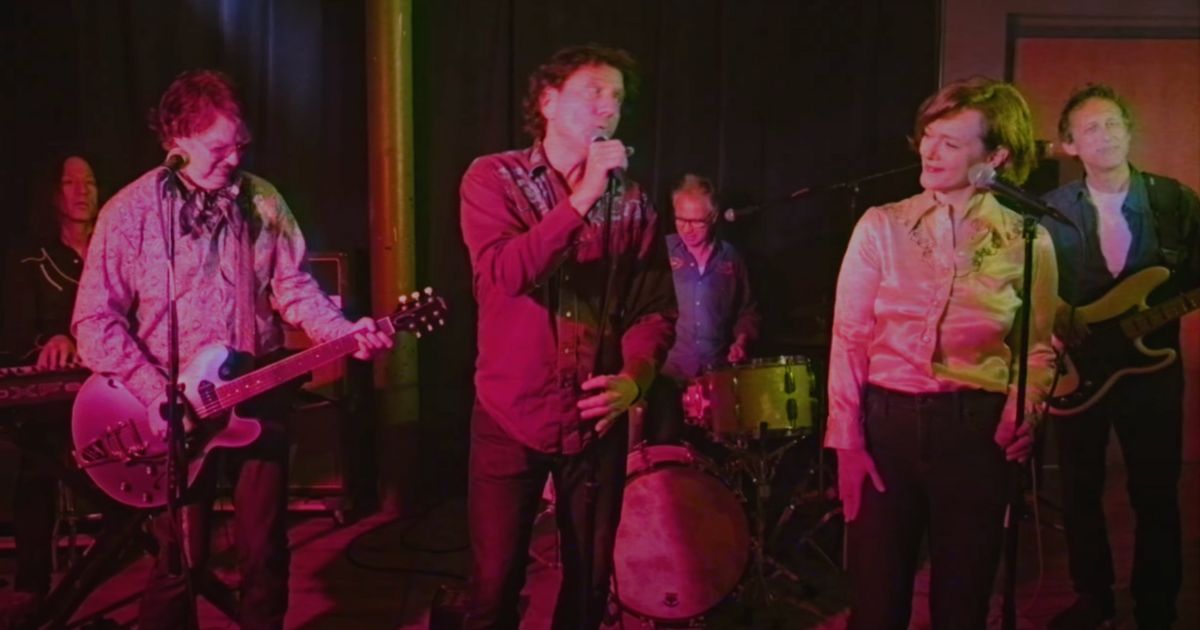
WATCH: Erik Vincent Huey, “That’s What Jukeboxes Are For” (Ft. Laura Cantrell)

Artist: Erik Vincent Huey
Hometown: Morgantown, West Virginia
Song: “That’s What Jukeboxes Are For”
Album: Appalachian Gothic
Release Date: January 20, 2023
Label: Appalachian AF/The Orchard

In Their Words: “Willie Nelson has a quote about jukeboxes: ‘99% of the world’s lovers are not with their first choice. That’s what makes the jukeboxes play.’ This song is an exploration of that sentiment. My grandfather became a bartender after he was injured in the coal mines. I spent my weekends as a young kid in his bar and used all my quarters on the pinball machine and the jukebox. Ever since, I’ve been fascinated with old jukeboxes and their curation — how one machine can hold the entire universe of songs that you can hear in a particular bar. I envisioned it as a George Jones-type ballad but Eric ‘Roscoe’ Ambel — who produced the record — said the song should have an old-fashioned honky-tonk Conway Twitty/Loretta Lynn duet vibe, which you can hear from Roscoe’s opening guitar riff. There are about a dozen classic ’60s and ’70s country songs referenced in the lyrics; I’ve even made a playlist of them. Roscoe thought his friend, the incredible alt-country chanteuse Laura Cantrell, would be perfect, and on this song, Laura sounds like a cross between Kitty Wells and Edith Piaf. You can hear the teardrops splash in the whiskey when she sings.” — Erik Vincent Huey

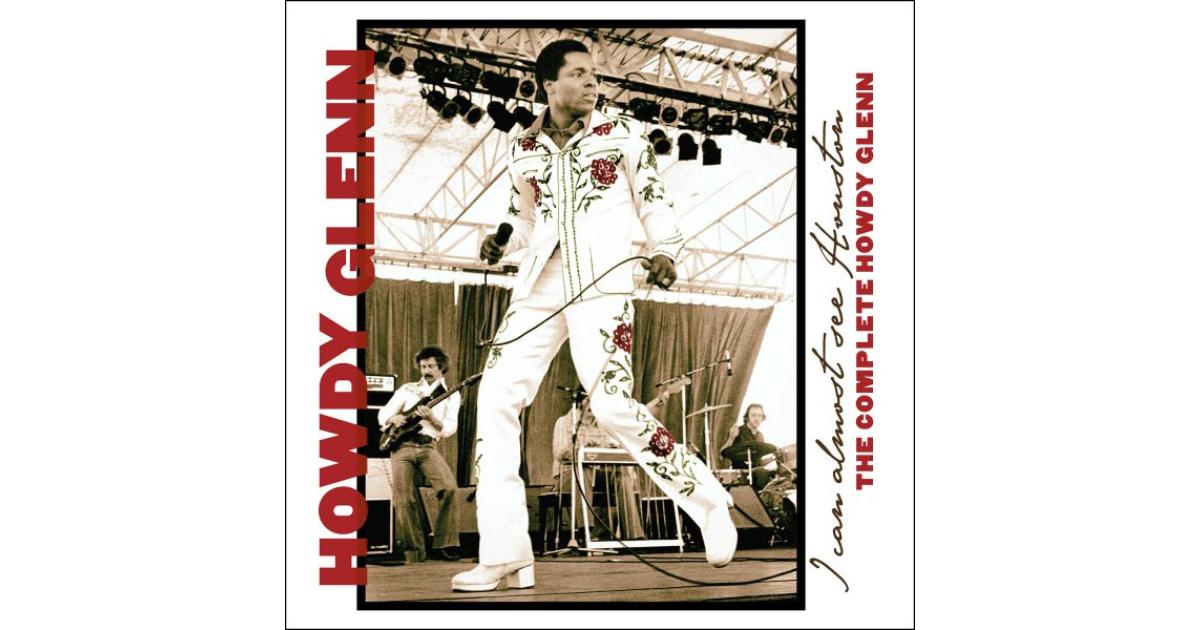
LISTEN: Howdy Glenn, “I Can Almost See Houston”

Artist: Howdy Glenn
Hometown: Inglewood, California
Song: “I Can Almost See Houston”
Album: I Can Almost See Houston: The Complete Howdy Glenn
Release Date: January 20, 2023
Label: Omnivore Recordings

In Their Words: “In 1977, country singer Morris ‘Howdy’ Glenn, a Black performer based in Inglewood, California, spent six weeks on the Billboard Country Singles chart with his recording of Willie Nelson’s ‘Touch Me’ on Warner Bros. Records. That same year, he was nominated for the Top New Male Vocalist award by the Academy of Country Music, alongside Vern Gosdin, Mel McDaniel, and winner Eddie Rabbitt. Despite the high-profile nomination, the release of multiple singles for a major label, and a second Billboard country charter in 1978, he disappeared from the music scene in the early 1980s. Today, virtually no one — even among diehard classic country fans — has even heard of Howdy Glenn.

“Country music, in the popular imagination, has traditionally been regarded as white folks’ music. That was particularly true for the 1970s environment from which Howdy emerged. Fortunately, recent years have seen a proliferation of articles seeking to correct the narrative by highlighting African American contributions to the genre throughout the 20th century. As these stories are re-examined, it’s time for another look at Howdy Glenn, and his historical significance. His recording career began with ‘I Can Almost See Houston,’ an independent recording from 1975. Other than a questionable soprano background vocal on the chorus, ‘Houston’ was a solid record that sounded like something Merle Haggard might have released in that era. By the fall of that year, it was a Top 10 hit in several regional markets, and spent eight weeks in the #1 spot on KENR, a popular country station in Houston, Texas. It was the start of a promising singing career for Glenn that took a number of twists and turns before ending in disappointment. With Omnivore’s release of his complete recordings on CD, accompanied by an in-depth essay on his life and career, Howdy Glenn’s place in the country music story can finally be re-examined.” — Scott B. Bomar, co-producer and liner notes author

WATCH: Nathan Jacques, “Big Iron” (Marty Robbins Cover)

Artist: Nathan Jacques
Hometown: Acton, Massachusetts
Song: “Big Iron” (Marty Robbins cover)
Album: Live Out West EP
Release Date: September 30, 2022
Label: Hidden Mountain Records

In Their Words: “I’m simply a big fan of classic Western music. Marty Robbins, Johnny Cash, Eddy Arnold, Bobby Bare, to name a few are huge influences on me, and I believe it shows in my own music. I crafted this cover of ‘Big Iron’ a long while ago and waited for the right time with the right full band sound to bring it together. The goal of this rendition is to honor the masterful songwriting of Marty Robbins by embellishing the impactful moments of its story. Stripping down the arrangement and building it up to an energetic gallop is my way of breathing new life into the song, which I believe should be the goal of any cover. It’s a song by an artist that everyone should know, and oh man is it a blast to play, so I’m here to happily spread it around.” — Nathan Jacques


Photo Credit: Sam Beasley

Connie Smith Carries a Classic Country Sound to “A Million and One” Video

Grand Ole Opry member Connie Smith is offering a gift to country music purists and enthusiasts: a new album, The Cry of the Heart. It’s Smith’s third endeavor with her husband and producer Marty Stuart, whose acumen and prowess in country and roots music pairs well with the sovereign voice of this Country Music Hall of Fame inductee. Ahead of the album’s release, she released “A Million and One,” paired with a music video filmed in part at Ernest Tubb Record Shop in downtown Nashville. The video starts with a trip down memory lane and an immersion into the lore of that classic country sound as an old clip shows Ernest Tubb himself welcoming Connie Smith to the stage.

Before Smith even sings a note, a new stage is revealed including Marty Stuart’s Fabulous Superlatives dressed in country-chic turquoise and backing her up with a bed of dreamy steel guitar and hypnotic upright bass. When the strings come in, the reanimation of this rendition of Billy Walker’s 1966 classic country hit is complete, showcasing Smith’s timeless brand of country. Smith’s decorations span half a century of incredible music, work that has earned her accolades, awards, and a seat among the highest tier of country music artists. The Cry of the Heart is a celebration of the sound that shaped the genre and, in many ways, American culture. Truly a living legend, Smith says, “People ask me, ‘What is country music?’ I say, ‘To me, country music is the cry of the heart.’ We all have these experiences in our hearts and I’m trying to identify and communicate with people so they know they’re not alone.”


Photo credit: Alysse Gafkjen

LISTEN: K.C. Jones, “Heat Rises”

Artist: K.C. Jones
Hometown: Lafayette, Louisiana
Song: “Heat Rises”
Album: Queen of the In Between
Release Date: June 18, 2021

In Their Words: “‘Heat Rises’ was my songwriting attempt at making the ending of a relationship, any relationship really, relatable through the imagery of one night around a dying campfire. Musically, I wanted the ‘campfire song’ sing-along elements to meet the cosmic psychedelia of the strangeness of the universe somewhere in beautiful harmony. I think it’s definitely one of the ‘twangier’ cuts on the album but it’s kind of thematically the one that brings my love of classic country and singing with friends around a campfire together with the dreamier and more outlandish aspects of the way I write songs and the other genres of music that inspire me.” — K.C Jones


Photo credit: Olivia Perillo