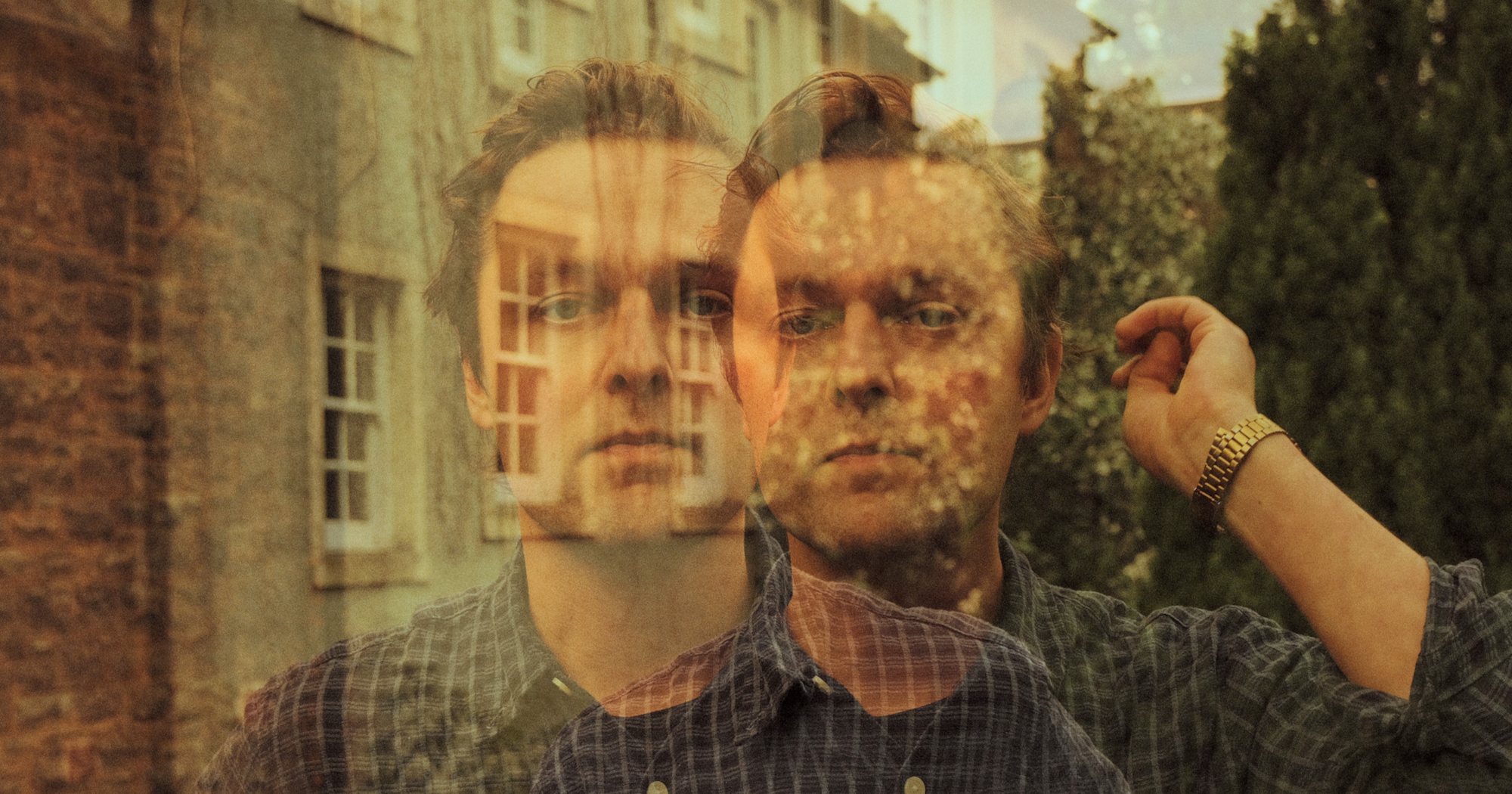
Irish folksinger Joshua Burnside has always shown an affinity for expressing grief, once calling it the reason he began writing songs as a precocious 13-year-old. He’s 36 now, and that sense of grief has never felt as overt as it does on his latest music. Burnside’s It’s Not Going To Be Okay is absolutely shattering, an album that more than lives up to its title. Written and recorded in the wake of the death of Burnside’s best friend Dean Jendoubi, who died of a drug overdose in August of 2024, the album is a bittersweet requiem.
Burnside’s previous albums combined Irish folk with electronic flourishes, worldly rhythms, and elements of sonic collage. His multi-layered experimentation reached a peak with 2025’s Teeth of Time, a record that felt like a major statement and milestone. Barely a year later, It’s Not Going To Be Okay could almost be his Nebraska move – bare-bones stark with minimal embellishment, focused on unadorned voice and guitar in the service of deep, deep mourning.
It’s a state of mind where everything brings back memories of the departed, like the opening of “The Last Armchair”:
Oh, the last armchair you ever sat on
Before you overdosed
Is the one I sit in every morning
To eat my egg and toast…
Ahead of the album’s release on March 20, 2026, we caught up with Burnside for a Zoom interview about his musical past, present and future plans.
It’s Not Going To Be Okay is quite a title. How did that come to be the name of this body of work?
Joshua Burnside: These songs are about the inevitability of pain, suffering, and death, which is what I was dealing with while accepting the loss of my friend. But it was at least a little bit tongue-in-cheek, too, such a ridiculously depressing statement to make. I thought it would be funny in a way. In Northern Ireland, we have a very strong sense of gallows humor. So I was drawing on that a wee bit. I don’t think it’s supposed to be taken literally.
How did you and Dean Jendoubi first meet?
Our paths crossed briefly in school and then we met playing music. Formed a band with a few other people. He and I were maybe 14 and got on immediately. Then there was a trio when we were 16. He played drums, I played guitar, and another friend played bass. We didn’t really gig, just played for the fun of it at his parents’ house. He was a great musician and songwriter himself. His music is amazing and beautiful and weird and dark, like him in many ways. He released a few EPs. The last one is called Skin Hunger and I sing on one of those tracks. Recorded in his mum’s greenhouse, our summer shed 10 years ago.
Since it’s been not much more than a year since Teeth of Time was released, when did you make It’s Not Going To Be Okay?
My sense of time has been so terrible the last few years. It was maybe a few months after Dean passed away in 2024, which is strange to say now. So, end of 2024 is when I started writing and recording and I finished it up autumn of 2025. I was recording it as I was writing it, and the last song I wrote was “It’s Not Going To Be Okay.” It was in the last month of making the record that that one happened.
Is it unusual for you to be working ahead like that, on the next record before the last one was even released?
It’s not typical. It was five years between Teeth of Time and Into the Depths of Hell. That one was a similar dark-humor title, but then COVID hit not long after I’d written those songs. That was some strangely perfect timing. So no, it’s not really normal for me to write and record this quickly. But I just felt an urgency, because one of the main ways I’ve always processed painful feelings is writing and singing about them.
The songs came quickly and easily. I had not planned to focus on just one topic, but most of what came out happened to be that. It felt natural to have them all together like this, almost like a grief journal. That’s the story. A lot of people thought some songs on Teeth of Time had been about Dean’s passing, but they were all written before that. Some of those songs seem resonant with this new record. That seems to happen to me a lot, I’ll write a song and then it seems like life imitates it. If I were not of sound mind, I’d start to worry about ever writing anything tragic or sad.
Was it your intention from the start for this one to be so sonically spare?
Absolutely. I’d been listening to Bill Callahan and Smog, A River Ain’t Too Much To Love. I love how sparse his records are – guitar and cymbal and voice – and they’re still so alive and rich. So sparse, you hang on every word. His voice is so clear. I wanted to do something like that.
Teeth of Time had a lot going on, so I wanted to go with more of a less-is-more principle. See if I could make the songs simpler, almost minimalist, and keep attention with straightforward and very to-the-point lyrics. So I challenged myself. Before that, I was almost hiding behind production and layered instruments. I’d maybe felt a little insecure. But after all these years, I’m feeling more confident.
What has the response been to this record and these songs?
It’s been interesting. I’ve already been playing a lot of these songs live, and so many people come up afterward to say how they lost a friend, dad, uncle, and how much it means to them to connect with my music in a time of grief. That’s powerful, makes me think it’s worthwhile to make music and do this at all. It’s special. I feel a great responsibility not to take this lightly.
I did send the album to Dean’s family, my family, his closest friends, to make sure it’s okay and wouldn’t upset anyone to put this out in the world. My brother and dad knew Dean as well and they told me they couldn’t finish it at first. Just too painful. It took them a while to come around to it. It’s so raw for people who knew him. A bit of an emotional whirlwind in general.
Touring with a record this intimate and personal seems like it would be challenging. Does it feel like you’re delving into difficult feelings every night?
Actors have an ongoing debate about performance technique, whether you should act an emotion or actually feel it. I think it’s similar to performing as a musician. I don’t know what’s more correct or authentic, but the main thing seems to be to stay present in the moment. Playing these songs does make me revisit those feelings a little bit. But I have to be careful with that because I only have so much emotional bandwidth. In performance, I try to remain as present as possible with the feeling of the song, the melody, sound of the words, and craft of the song, as opposed to tapping directly into the original emotion. Sometimes I’ll do that and it’s powerful. But I can’t do that the whole gig or every night, because then touring would be too much.
How many of these It’s Not Going To Be Okay songs will be in your every-show setlist this go-round?
I’ve been toying with the idea of playing all of it start to finish. I was thinking of it that way while writing these songs, how I wanted to play every track and have it hold up even if it was just me. I need to get into the rehearsal room with my bandmates to see if we can crack it. Would be nice to make some different arrangements with electric guitar and cello. We’re a three-piece most of the time.
What were you listening to while growing up?
Lots of heavier stuff, hardcore and post-hardcore, new metal, funk, grunge. Nirvana, Offspring, Fall of Troy. An endless list of screaming, shouting, loud bands, which I still love. But alongside that, I also got a heavy dose of what mom and dad were listening to – Simon & Garfunkel, Fleetwood Mac, Alanis Morissette. Jagged Little Pill was a favorite of my mom’s and I still love that one. Great pop record.
You’ve often cited the experimental duo The Books as a major influence and the source of some of your experimental tendencies.
I saw The Books playing when I was a student in Manchester 15 years ago and they just knocked my socks off. It did not sound like any music I’d ever heard before. All the sampling and found-sound collaging was just eye-opening, a completely different way of making music. I loved the aesthetic, the sound, the folksiness of banjo and cello with all that. It was just inspired.
I would not think about music the way I do without The Books. I still listen to them all the time, and you can hear their influence on loads of my tracks. “Under the Concrete” has city noises I recorded in a park in Belfast, sirens in the distance. I wanted that song to have the feeling of being set in that park in that city. It felt like that’s where it had to take place emotionally.
After two such vastly different records back to back, what’s next for you?
I don’t know yet. I need a bit of time for gestation and recalibrating why I make music and to try to come at it from a different angle. I’m very excited at the prospect of making something new that goes away from what I’ve done before, something a bit more experimental. That’s where my head is at now. Maybe someplace percussive. At the moment all I’ve got are loose imaginary mental soundscapes, but that’s enough to keep me happy for now.
Photo Credit: Tom Johnson