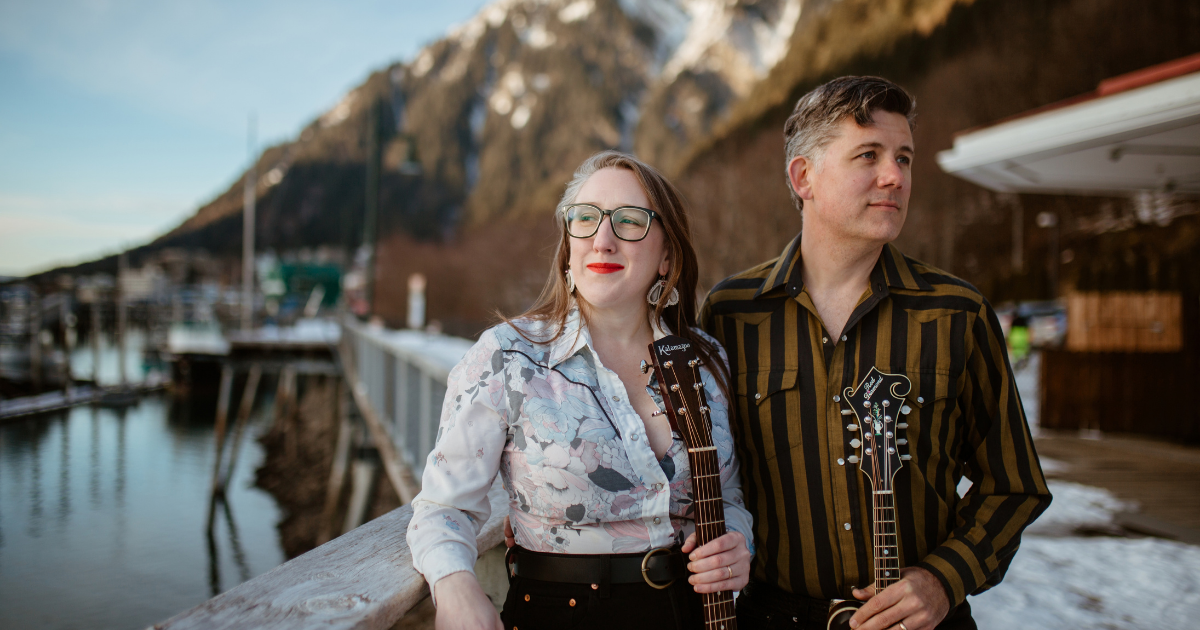
BGS 5+5: The Heists

Artist: The Heists (Andrew and Erin Heist)
Hometown: Juneau, Alaska
New Album: Break & Mend EP

What’s the most difficult creative transformation you’ve ever undertaken?

Coming from a strong background in bluegrass, where you are performing a music that’s rooted in a specific tradition and most often written by someone else, I primarily expressed my individuality through the musical and stylistic choices I would make while improvising solos or singing a harmony part. Transitioning to performing original songs has been an enormous adjustment. There’s immense vulnerability in taking the leap to share songs that are incredibly personal on stage. It’s a completely different ballgame when you’re putting yourself and your songs out there in this way.

Erin apparently coped with the isolation of the pandemic by becoming a crazy prolific songwriter. She was churning out great songs, one after the other, and instantly sharing them with the world. I was like, “Don’t you need to fret over it and overanalyze it and then be overcome with crushing self-doubt and hide it away in obscurity?” Nope. It was so inspiring to see her fearlessness as she worked out what being a songwriter meant to her. Around this time we were beginning to collaborate with and be inspired by Josh Fortenbery and Taylor Vidic, two mega-talented Juneau neighbor-musicians who were also writing and performing their own songs. The incredibly supportive environment that formed there really helped me get out of my own head and begin to share my own songs. It has been the most important and challenging musical moment for me since I started playing. — Andrew

I didn’t start playing guitar or singing until I was in my mid-20s. And as someone who has had a big issue with drawing attention to myself, the whole process of becoming a performing musician coincided with transforming from primarily an introvert to primarily an extrovert. The first time I sang in front of Andrew, I kind of whisper-sang a Cat Power song. Which now, thinking back, it is WILD that I thought that’s how I sang. Our voices are so deeply personal and I imagine that I’ll spend the rest of my life learning about my voice and finding new ways to sing. — Erin

What rituals do you have, either in the studio or before a show?

For the studio, I think the big goal is to be at the right level of ready. Part of what I really love about the recording process are the little twists and turns and surprises that happen along the way. When you have the right people in the room, like we did for Break & Mend, the result feels magical. There’s a conversation that happens in the moment. Patrick M’Gonigle has been a longtime pal, but this was the first time we’ve worked with him as a producer. Patrick is just a monster musician and a great hang, and with his immense experience, knowledge, and innate feel for the kind of music we play, he really helped us double down on those impossible-to-define moments that can only happen between musicians that are live in the room together. — Erin

This has evolved over the years. When I was in my twenties, getting ready for a show meant soundcheck at 5 while having a couple beers. Head out to another place to grab another drink or three, grab dinner somewhere with a couple glasses of wine then show up at 10 p.m. for a four-hour bar gig. It was a (somewhat lengthy) moment in time and it was a lot of fun, but not sustainable.

Thankfully now, things are different. We get to play shows where people are coming to really listen to the music and I want to fully show up for them. Being rushed is one of my least favorite feelings and really takes me out of the frame of mind I want to be in to perform. I like to do all of the boring drudgery of gathering gear early in the day to free up time later to leisurely run a few songs and feel warmed up. I’m definitely not someone who leans toward over-rehearsing, but over the years I’ve felt the sting of being unprepared on stage enough times that I want to avoid it at all costs. Having the setlist done ahead of time and knowing that we’re rehearsed and ready gives me a foundation of calmness to start from. It actually makes me more inclined to make a few in-the-moment changes during the performance that can be really fun. That base of preparation for me actually frees up my ability to be spontaneous on stage and some really magical moments have come out of it. — Andrew

What is a genre, album, artist, musician, or song that you adore that would surprise people?

In Alaska I’m probably best known from lots of years playing hard-driving mandolin and singing in several iterations of a traditional bluegrass band. Recently that has expanded to performing our own songs with The Heists as well as backing up a variety of musical pals, most of which lands in the folk, country, acoustic Americana vein. I think people might be surprised to learn that when left to my own devices I very, very often listen to jazz and hard bop from the mid-twentieth century. Miles Davis, Bill Evans, Bird & Diz, Coltrane, Horace Silver, Dave Brubeck, Mingus, Monk.

I grew up listening to the grunge and punk of the mid-’90s and then drifted into the Grateful Dead universe, and right before I left Philadelphia I started going to a club called Ortlieb’s to see live jazz several nights a week. When I went out west to college I was able to borrow dozens of jazz CDs from the library and burn my own personal jazz collection. I love lyrics in music, but there’s something really important to me in just listening to pure music without words. The improvisation in jazz is just magic to me. To this day, any time I have a decent chunk of time at home by myself I always carve out a night to listen to Keith Jarrett’s fully improvised The Köln Concert in its entirety. — Andrew

I absolutely love going to punk shows. I don’t actually listen to any recorded punk, but man, when I get to go to a show, especially a small show in a local scene, that is the best. Last year one of my favorite shows I went to was in Tokyo with my brother and we ended up in a tiny black basement punk show with non-stop crowdsurfing and a goofy mosh pit. — Erin

If you didn’t work in music, what would you do instead?

I’m a big foraging nerd and I love food. Which means that in an alternate life I used to write a column for our local paper and had a foraging food blog. I love spending a quiet few hours poking around the woods. If I’m mushroom hunting I have to set a timer for a few hours because otherwise I could spend from dawn to dusk looking for “just a few more.” Part of what I love about writing recipes for foraged food is that there are always new puzzles to solve, new textures and tastes to pair. I’m a lazy cook and forager, so I only want to pick delicious things that are relatively easy to pick and clean. And then to figure out a new recipe, share it with folks, and help people get out onto the land, I love that. Foraging means that you pay attention to the way that a season moves through your home, how the light moves through the forest, the texture of the earth. If I wasn’t giving my creative energy to music I would finish that cookbook I’ve got started and probably start a series of wood walks and cooking classes. — Erin

This might be a bit of a cop out, but I’d work with musical instruments. Repairing, restoring, making them. From the time I started playing guitar in middle school, I’ve been captivated by the instruments that make the music possible. It probably started by looking at the ads in my Guitar World magazines and then I got a book called The Guitar Handbook (Ralph Denyer) that was full of pictures of all kinds of guitars throughout the prior 100+ years and I was hooked. I ended up on the paper mailing lists for Mandolin Brothers in Staten Island and Gruhn Guitars in Nashville. I would read these photocopied newsletters, with hundreds of descriptions and grainy, black-and-white pictures of guitars and other instruments cover to cover, over and over again, even though I couldn’t afford to buy a single one.

When I was 18 I bought a Roger Siminoff book and a very inexpensive tabletop band saw and attempted to build an F-style mandolin in the basement of my childhood home. While that attempt never reached completion, I became intimately familiar with the inner workings of acoustic stringed instruments and have tinkered with them to varying degrees ever since. — Andrew

What has been the best advice you’ve received in your career so far?

Throughout my life I have been very fortunate to be surrounded by dozens of successful, amazing artists from all kinds of disciplines who have been role models in some way or another. I’m not sure it specifically counts as ‘advice’ but I have continually been awed at the amount of work and determination that all of these people have put towards their art. While many of them were decidedly some of the most un-serious people I have ever known, when it came to their art they gave it absolutely everything. I’ve tried to instill a bit of this in myself when it comes to working on my own playing and writing. — Andrew

Growing up we had a very close family friend who was a stride piano player and a helicopter pilot. He’d come up to Juneau and live with us for a month while he was flying for one of the big lumber outfits. Michael was the first person in my life who I ever saw improvise music. He was a bit of a wild man, a Vietnam vet who had traveled the world and had a wicked sense of humor and a giant heart. I had started to learn how to play piano and desperately wanted to travel around the globe. Michael told me that learning to play music was one of the best things I could do because if I could play music, then I’d always have a way to thank people. I think about that lesson almost every time I play. That playing music for folks is a form of giving a gift, of thanking them for their presence, connection, silly jokes, amazing dance moves, and joy. — Erin


Photo Credit: Sydney Akagi

Survival of the Heart and Survival in Alaska

During the Klondike Gold Rush, the Red Onion Saloon in Skagway, Alaska, operated as a thriving brothel and a rare (sometimes) source of autonomy for the women who worked there. More than a century later, Juneau-based singer-songwriter Taylor Dallas Vidic found empowerment at the old bordello too, by offering feminist tours in character as Madam Anya Johnson. Innuendos loosened up tour groups, forging a connection that made them receptive to some serious history lessons – alongside dick jokes.

“What working at the Red Onion did for me was make me feel really comfortable about being a human in front of other humans, and to talk about things that often feel taboo or uncomfortable, and to normalize them,” Vidic says. “It’s translating from making sex jokes to feeling comfortable standing in front of a lot of people and saying, ‘Hey, here’s what it felt like when I broke my heart or when someone else broke my heart.’”

Vidic’s songwriting is warm and vulnerable. She’s equally capable of belting above sultry and coy jazzy tracks, carrying intricate, stripped-down folksongs on her magnanimous voice alone, and building grand theatrical numbers, as well. She does all of it on her debut album, Cat & Mouse, a collection of 13 (mostly) love songs that deliver an expansive, playful representation of what is perhaps humanity’s most perplexing and intoxicating experience. And it’s all rooted in the same multifaceted understanding of shared humanity that Vidic used to bond with strangers on those summer stints in Skagway.

Beyond an exceptional, arresting voice and range, Vidic’s songwriting conveys an acuity of emotion which pushes what is superficially an album of love songs well beyond predictable tropes. “They tell you it takes time, you’ll see/ To remember who you use to be/ Remember how to sit in the quiet/ On your own,” she sings on the album’s opening track, “Falling Out of Love,” which lays out in minute, closely felt detail the experience of returning to self after a breakup:

I’ve learned to fill the space that
I’d kept for only you, dear
I smile at all the faces
Walk past all the places
We used to go
Each breath a little deeper
Each song a little sweeter
Now that the scent of you doesn’t linger on my pillow
Anymore

Heartbreak might be age-old song fodder, but Vidic extends it far beyond breakups to many kinds of aches (loss, longing, unbearable certainty) with an alluring immediacy. In her hands, the simple mechanics of falling in and out of love – or wishing to fall in love, even if just for the evening – become a comforting exercise in self-discovery and relatable human experience.

There’s “In a Song,” about a crush that’s missed its moment. “High,” which yearns for the good parts of a past entanglement. And “In Your Arms,” a cinematic, self-aware disquisition on a relationship’s irreconcilable differences: “I said it’s a big ole world/ The place we could go, the people we’ll see/ Just imagine the strangers we could meet,” Vidic sings, adding: “He said/ My corner’s just fine with me.” By song’s end, Vidic is off on the grand adventures she dreamed for them both, solo.

Part of Vidic’s remarkably evolved approach to love songs derives from practical necessity. Juneau, Alaska – population 32,000 – is small and isolated both from the rest of the country and even the state, by geography; with no roads out of town and flanked by impenetrable mountains, ice fields, and the Gastineau channel, it’s accessible only by boat or plane. Living within those few square miles, it’s impossible to avoid running into an ex regularly. In the same way that Vidic’s ethos accepts humanity’s many facets, so too she’s maintained love and respect for her exes. Indeed, most of them were invited to – and attended – her album release show.

“Finding ways to actively reframe relationships when they have run their course is a matter of survival of the heart. And it would be such a loss to not get to continue to care for the people that I have loved, that have loved me,” Vidic says. “I don’t know if I’m just lucky in that I’ve found people that are willing to do that – even though it is messy and hard at times and a little confusing at times, too, and uncomfortable; we spend so much time with people that we choose to love and we share so much…I really like holding onto those moments.”

Juneau’s geographical limitations and eccentricities crop up on the album in other ways, as well. “I let those mystery boys get me every time/ When the stakes are low I’m better at not losing my mind/ An hour is too far when an airplane is in play,” Vidic sings on “Muse.” Nothing quite as bittersweet as unrequited love, specifically one that’s unwanted.

“Twice a Day,” the album’s opening foray into its folk/Americana B-side, is the only song that doesn’t overtly take place in Alaska, written during a few months in New York City. On it, Vidic, a consummate observer of the world around her, contemplates the near-infinite possibility for human interaction in a big city surrounded by so many more souls than in her hometown: “Maybe I would make you laugh each day/ Maybe when it ended I’d be begging you to stay/ Maybe we’d grow old and see, we’re as happy as we’d ought to be/ But we’re always a platform away.”

First albums are always special. Often, they represent the culmination of years’ worth of a musician’s best and hardest fought work – John Prine’s eponymous debut, Emmylou Harris’ Pieces of the Sky, Guy Clark’s Old No. 1 – and Cat & Mouse is no exception. Written over more than a decade (Vidic penned its oldest song, “Muse,” at 21), the album is, for Vidic, a scrapbook of her life and formative early adulthood.

“I think most people can agree that songs take us back to moments in our lives, be it a playlist that was on the radio a lot when we were in middle school, or that particular song that helped you get over a breakup or a song that makes you think about your parent,” she says. “And these songs do that for me, but they are snapshots of my existence and of the people that I’ve come across.”

From her delivery on stage to the studio production of Cat & Mouse, Vidic also brings the banter and cheek of her madam tour guide gig, as well as the showmanship she’s cultivated as part of burlesque troupe, The Nude & Rude Revue, and through many community arts events she’s helped organize. Leaning into her life’s dualities, Vidic made the album with two distinct sides; Cat, the album’s A-side, is jazzy with a big band sound; Mouse is a stripped-down, folksy, and sparsely-instrumented B-side. It’s a concept that easily could have been sonically incongruous, but both sides flow together through the power of Vidic’s voice, aided by the album’s title track, which she rendered in both styles and delivered at the end of each side, respectively.

Juneau’s geographic isolation can be a mighty impediment for musicians, but it’s also a blessing that breeds collaboration and allows musicians a certain freedom to grow and flourish without the pressures of bigger music cities in the U.S., says Juneau-based musician Andrew Heist. Heist has played in a myriad of bluegrass bands in Alaska over the last 20 years, and lends his scintillating mandolin to “Falling Out of Love.” He also shares stages with Vidic as part of their songwriting group, the Muskeg Collective.

“Without the pressure to get a product out there to build her name in a competitive scene, there’s this community familiarity that is so rare and amazing in Juneau,” Heist says. “It’s sort of like the old soul version of hearing somebody sing, there’s a depth to the way that she brings her music forward.”

Most of Vidic’s songs are exceedingly personal, yet she manages to spin the exquisite pain of heartbreak into something universally relatable, and she’s equally vivid when singing about someone else. Vidic wrote “Wet Tennis Shoes” in part thinking about a friend whose father left when she was too young to remember him. The song effuses not just ache, but a crushing loss of innocence, as well: “Boats made of paper float on the pond/ A little girl playing wonders where you have gone/ You took all the sunshine and made her skies grey.” And though the paper boats do not actually dissolve, the song’s omnipresent drizzle – “Rain on her window/ Rain on her head/ Rain on the rooftop as she lies in bed” – evokes the dissolution even more effectively.

After spending most of the album exploring feelings’ small intricacies, Vidic’s final track before the “Cat & Mouse” reprise is “Stockades,” a showy, declarative pop number about the enormity of falling head over heels. “The Stockades fell/ When he touched my hips/ And he kissed my lips in ways they’ve never been kissed,” she cries before continuing: “Lord knows it took one night to tear this empire down/ The walls we built, they’re falling faster than Jericho to the ground.” Still, kingdoms fall and so do powerful loves; and again by the end of the song, Vidic is reminding herself how to get back up and stand on her own two feet. Now, and always, too.

The strength of Alaskan songwriters’ connections extends beyond helping each other and into the community at large as well. As part of her album crowdfunding (Cat & Mouse was also partially funded by a prestigious local grant), Vidic asked for funds to bring music into the state’s network of nursing homes, a goal inspired by visiting her mother in a long-term care facility and a few concerts she’s already given.

Memorably, Vidic recalls how at a Christmastime performance she stepped offstage to sing among the audience to bring herself into focus for them. Next to a man she’d noticed never uttered a word on previous visits, Vidic sang “Silver Bells.” Part way in, the man joined her, singing along with words he’d learned long ago.

Nursing homes are often undesirable performance locations; they’re sterile, poorly lit, and underfunded, their residents not the most attentive or engaging audience members – yet, Vidic observes, those people deserve live music, joy, and respect, as much as anyone. She plans to rework her stage performance into a version with which to bring music to those spaces where it’s rarely heard, and sorely needed.

“That again brings me back to my time at the Red Onion and finding that shared humanity with strangers, and just feeling like we’re all just human beings doing our best, sharing spaces and trying to find joy and make moments worth living,” Vidic says. “What’s the point without it?”


Photo Credit: Sydney Akagi