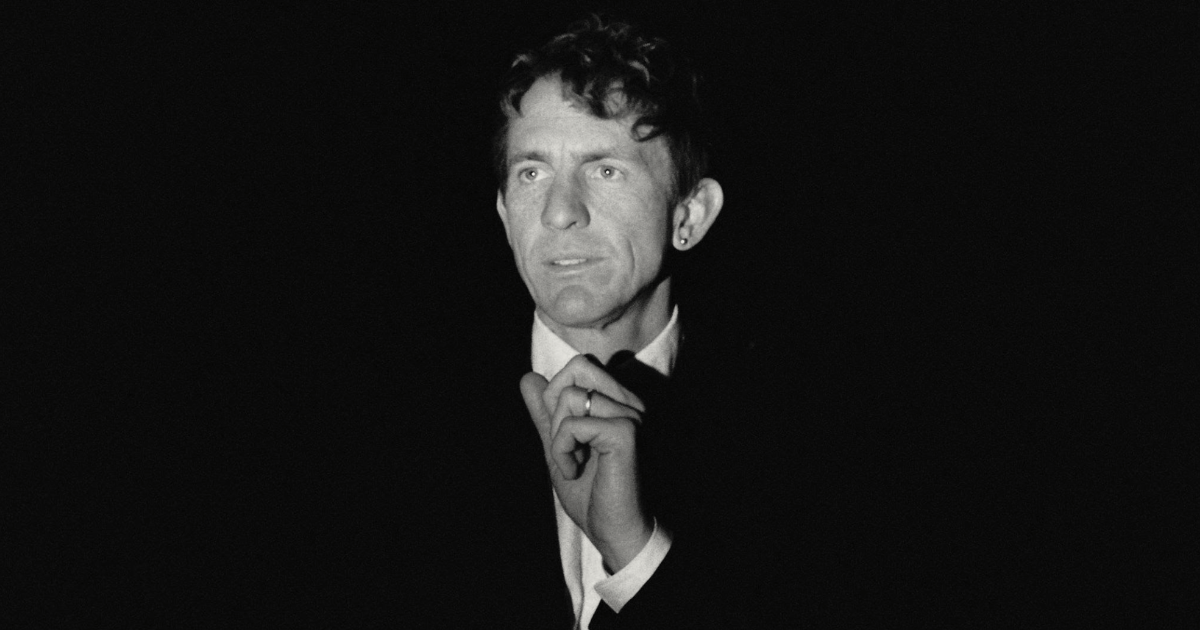
Buck Meek doesn’t give the whole game away. It’s not guaranteed he’ll tell you exactly what his songs are about. However, he will expound, in detail no less, on how he gets himself in alignment to write them and what the mechanics of his songwriting process look and feel like. After six albums with Big Thief and four solo albums, most recently The Mirror, he has more than earned the right to hold back in some ways while sharing deeply in others.
Born and raised in Wimberley, Texas, Meek grew up playing guitar, singing, and writing songs surrounded by a community of old-guard outlaw songwriters, western swing players, and barrelhouse blues musicians who took him under their wing at a young age, taught him how to play it how he felt it, and gave him his first gigs around the Texas Hill Country. At the same time, annual trips to the nearby Kerrville Folk Festival introduced him to the rich traditions of Texan folk music.
As the grandson of scholars who studied the two Williams – Shakespeare and Faulkner – and the son of a child psychologist and a glass sculptor, it’s easy to surmise he was never short on literature and art. His depth of influence and fluency come through in how he speaks about his musical practice and his commitment to it.
When he was 17, Meek left Texas for Boston, where he studied jazz at Berklee College of Music before finding community with a generation of young musicians who wanted to write their own songs and play sweaty rock shows in basements. Later, he moved to New York, where he began performing with Adrianne Lenker. The two musicians lived in a van, singing their songs across the country before forming Big Thief. Fourteen years later, the East Coast’s long-standing punk and rock traditions are as much a part of his musical DNA as the Americana, country, folk, and blues he was raised on. The eureka moment came when he let his two worlds collide musically.
Produced by Big Thief drummer James Krivchenia, The Mirror features a stunning cast of family and friends turned collaborators, including his brother Dylan, Lenker, the hauntological harpist Mary Lattimore, Adam Brisbane, Germaine Dunes, Staci Foster, and the Avant-Americana icon and former BGS advice columnist Jolie Holland.
Opening with the range-roving rhythms and bittersweetly sung melodies of “Gasoline,” Meek digs into the intricacies of relationships and communication throughout the album, rendering them in a traditionalist alt-country and western style, underpinned by modular synthesis and subtle electronic textures from Krivchenia and engineer Adrian Olsen.
On “Can I Mend It,” he describes a deeply regrettable moment where raw emotions crystallize, before shattering into a million potentially irreparable fragments. As he laments on the chorus, “Can I mend it?/ Can I make it whole?/ Now that you’ve seen into the dark side of my soul.” Later, when Meek looks in the mirror on “Demon,” Olsen’s modular synthesis briefly overpowers the band with a not-so-subtle squelch. As with all parts of the album, there’s a reason for this.
By the time The Mirror closes with the summery, sunset shuffle of “Outta Body,” we’ve lived with Meek for a spell. Although, as he argues in this interview, we never really fully know anyone else, or even ourselves for that matter. Sometimes, when you look at someone from that right angle, or let our communication move beyond words, we achieve brief but precious moments of understanding.
On a Wednesday morning in early March, Meek spoke with Good Country by video call about all of the above and more.
How are you doing? What do your days look like at the moment?
Buck Meek: I just moved to Los Angeles. I got this big old yard, but the fence is kind of patchy. My little dog keeps running away. I’ve just been chasing my dog around every day. She keeps escaping and there are peacocks everywhere in my neighborhood. So my dog is just chasing peacocks all day long. I’ve also been trying to learn how to garden a little bit, planting some plants, and doing lots of interviews.
It’s one thing to be in a band that succeeds, but it’s a whole other thing to be able to have a solo career as well. What’s the difference between how things have played out for you and the future you imagined when you were younger?
I grew up playing blues, ragtime, and jazz manouche with some local cats, Django Porter and Brandon Gist, and playing in icehouses around the Texas Hill Country. I felt really happy when I played the guitar, and that was enough. I didn’t really have any idea what it even meant to be a musician in the world. When you’re a kid, you don’t know how any of that works. Of course, I idolized Jimmy Page and the like, but that felt completely out of reach.
Do you think what you’re describing was a common experience for musicians your age growing up in Texas?
I think the bar bands of the world are the modern folk musicians. Really, the people who are keeping the songs alive are the ones who have never made an album, or nobody’s ever heard of. The people who play in bars around the world in small towns. They’re the ones who keep the spirit of music alive. There is this incredible relationship between the elders at the bars and the little kids coming up as guitar students. Inevitably, the star kid, the kid who works the hardest, gets taken under the wing by the old-timer as their protege. There are these beautiful relationships that pass down knowledge. I think you find that pretty much everywhere.
I’ve gone on to have bands with names and travel around the world, but when I’m on stage playing guitar, it still feels the same as it did back then. It’s just me and my guitar. It’s a very simple form of happiness. It’s very fulfilling, whether people show up or not. There’s a life cycle to attention, but as long as I have my guitar, I don’t care.
At the heart of it, it’s about your relationship with your instruments and the musicians you play with, right?
Totally. In the words of Tom Sachs, the reward for good work is more work. As long as I get to do it again the next day, I’m good.
When you think about your career in Big Thief and as a solo artist, do you feel like you’ve mostly been able to do it on your own terms?
Yes, for the most part, but we’ve done it collectively. Everyone in Big Thief is very uncompromising in our own ways, but we all have blind spots. Because we’re a group of people, we’re able to call each other out on our blind spots, maintain our collective lack of compromise, and never sell out, never sell our souls. I’ve been lucky to be surrounded by people who have a perspective on that. We’ve done it on our own terms. I’ve definitely learned the power of that over the years.
Do you ever feel like you were born in the wrong era?
No, I don’t feel that way. I’m stoked.
What do you think the era you emerged within has afforded you that a previous era might not have?
Of course, it’s a two-headed monster, but access to communication, for example, how we’re talking now, helps so much. Not being beholden to a record label giving you a budget, and being able to record your own music at home is huge as well. Now, people are able to hear that music on Bandcamp or the like, which allows you to go and play shows around the world. That’s a very new phenomenon. It’s been a huge part of building my career.
When we started booking tours, we recorded our first album at our friend’s house. We were burning copies to CD-R, putting them in brown paper bags, and passing them out to anyone we could think of. We basically asked all our friends in Brooklyn if they had friends in other towns and got their email addresses. We’d email them our record and ask if we could play a show in the town where they lived. We just kind of pieced this tour together around the country.
We used the internet as a tool to get started, but we’d drive to these towns, meet these people, shake their hands, and become friends. Eventually, we moved out of our apartments, bought a crappy van, hit the road, and played a lot of shows: parties, basements, whatever. Getting in a room with people was essential.
How do you feel about going on the road by yourself?
Lately, I really enjoy traveling with a band. I’ve had some really good solo tours, especially down in the desert and around the Southwest. My friend Tony Presley, who runs the label Keeled Scales, released my first two solo records. He’s an Austin kid. He’s a booking agent as well, but he primarily books small towns and DIY venues. He booked a few tours for me around the Southwest. Taos in New Mexico, out in the desert, El Paso and Santa Fe. Little towns in Arizona, and out in the Hill Country of Texas, stuff like that. That’s always a lot of fun.
How much impact do you think the people you meet through these experiences have had on your music?
I think they’ve made me who I am, which has a big impact on my music. I mostly think of songwriting as the time I spend away from my guitar and my songs. I really try to put it down and just go out into the world and live my life. That’s the real work, living your life as a person in the world.
How close do you think we can get to truly knowing another person?
We never fully get there. I think the closest we can often get is by looking at them sideways or trying to find oblique solutions to communication. I think language is really powerful, but it’s limited. The space between words and conversations, and unspoken communication, often adds up to more of an understanding. The truth is, we never fully know ourselves either. So how can we know someone else? Often, I feel like it’s easier to understand someone else than to understand yourself. I think it’s just shifting constantly. There are moments of understanding, but there’s never any kind of permanence.
Tell me about the conditions under which your new album came together.
I spent a couple of years just living my life. I was living in a log cabin in Topanga and booked a recording date with my band about six months in advance. I sat on the porch every day for eight hours and wrote these songs. I’m blessed to have the resources to do that thanks to my label, 4AD. I put in the time to write the tunes, and then I brought the band together in the cabin.
We set up the big living room with the drums. I stood on the front porch and recorded the vocals outside with a big window into the living room. So there was enough isolation for the drums. Our producer, James Krivchenia, had this setup of electronic instruments and modular synths in the control room with our engineer, Adrian Olsen. They were using the live band as triggers for modular synths and some electronic synthesis feedback in the mix. The album was made live with my band. We moved pretty quickly. There was about a week and a half of tracking.
The other thing I’m the proudest of is how much fun we had making it. It was a great group of people. We had a blast cooking good meals, playing cards, and running around the woods. The music was just a small part of it. I’m glad I can share it as an artifact, but the experience was really the best part.
I thought it was interesting how subtle the use of modular synthesis was.
The entry point for the idea was to be pretty bold, but in practice, the band held a lot of space for the songs. James wanted to focus on the songs as the primary force. There were certain moments where the modular synth took the lead. At one point in the song “Demon,” it kind of takes over and swallows the band for a second. There’s this battle between the two worlds.
For the most part, it’s pretty subtle. For me, it represents the subconscious. The band is the conscious world – a structured, acoustic-instrument world. The electronic elements represent the subconscious. I speak about this in the lyrics of these songs, this kind of play between the conscious and subconscious, intention and intuition, and all these things. It’s subtle, but if you were to remove the electronics, the impact would be great.
It’s like Ernest Hemingway’s iceberg theory. You only ever see the 20% of the iceberg that floats above the surface.
I think having a nod to this limitless space, this ambient world where there’s no grid, no structure, not as much transient energy, this textural, abstract, liquid aspect of the album, opens up the subconscious a little bit in the listening experience.
While listening to The Mirror, I thought about how no one has a monopoly on interiority. Just because someone doesn’t say much in a conversation doesn’t mean they don’t have a lot going on upstairs.
I like playing with that in songwriting. I feel this pressure to be precise and create a very clear map and logic for people to follow. My ideas have to be very concrete, but that’s a rule I’ve imposed on myself. It’s exciting to be able to, to some degree, reveal an abstract inner world amid structure and logic.
I know that pressure is self-imposed or has been projected onto me by society at large. It’s something I try to push back against, while still honoring the medium. There’s a reason that people want some form of relativity or underlying structure. There is always a need for a starting point in communication, but I think we must know when to depart from that structure to express the full spectrum of our ideas and truth. There’s a balance. It’s important to honor it, because otherwise you’re just isolating yourself.
When did you start thinking about songwriting in the sort of terms you’ve just articulated?
I started writing songs in high school as a confession to my high school crush. I just wrote a love song for love’s sake. It was no more complicated than that. I think that’s really the heart of a song. Ideally, for me, a song has a reason to be. It comes from some form of compulsion, or a need to articulate something or to create an artifact, to be able to pull something out of your body and observe it as some form of catharsis. To me, those are the best songs, but there are no rules for the context.
How did you develop your approach to it all?
As I started writing, my self-education was mining the world for songs that, for lack of a better term, felt good. I was trying to find songs that really moved me. Intuitively, I started trying to understand why a song makes me feel something. I’d unpack every word and learn the song and the melody while trying to understand the relationship between them. I wanted to understand how the melody sanctified the lyric and what the rhythm had to do with it.
Let’s talk about taste. There’s a constructed taste you can use as a tool to help people understand where you are. Then, there are those songs that you might not even think you like, but they make the hairs stand up on your neck.
The older I get, the more willing I am to accept those things for myself and really listen to that intuition. As a young kid, I was obsessed with pop country. In my teenage years, I rejected it. When I listen now, it still hits me in the same way it did when I was six. I’ve learned to embrace that. Sometimes, you’ve got to be able to come home. I think with this album, I was thinking about moments when my body wanted to say something, but my mind would kick in and say, “Oh, the critics won’t think that is cool, hip, or smart enough.” I had to lean into those lines and say them twice, say them louder. If you can do that, no one can touch you.
Have you ever thought about how lakes and streams were the original mirrors?
Yeah, ponds and lakes and puddles and things. Good point. They’re still enough to provide a reflection, but also fluid enough that you can throw a rock in and diffuse them. There’s still a relativity to it, which is more true to what a reflection really is. There’s some form of objectivity, but to some degree, it’s just a construct.
Photo Credit: Germaine van der Sanden