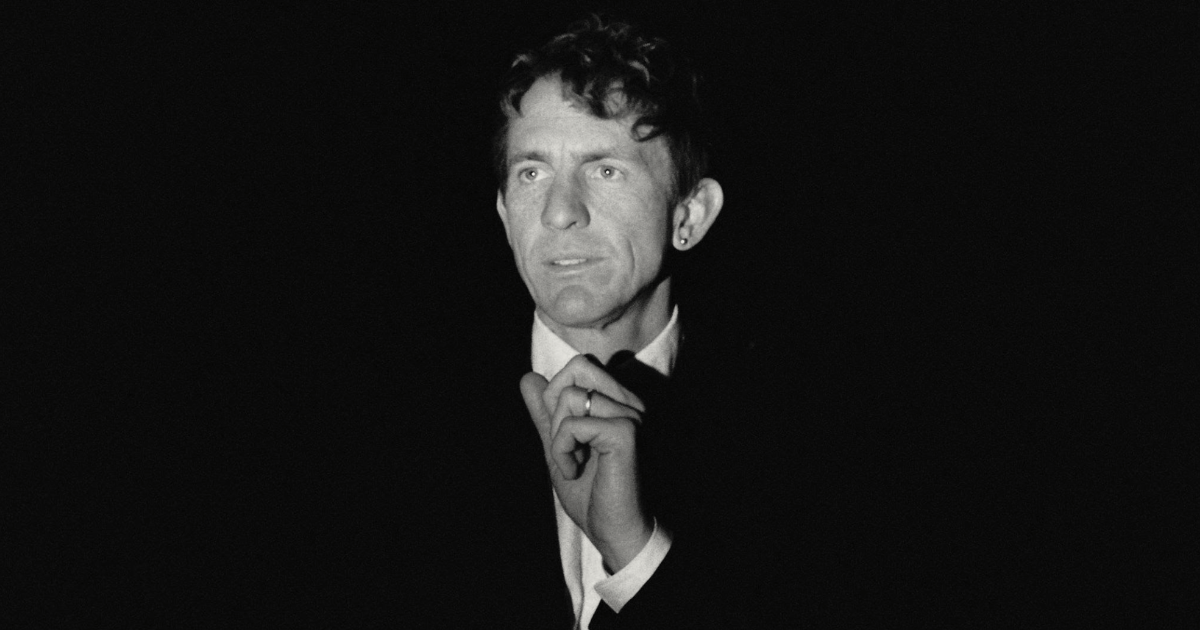
Buck Meek’s Musical Worlds Collide

Buck Meek doesn’t give the whole game away. It’s not guaranteed he’ll tell you exactly what his songs are about. However, he will expound, in detail no less, on how he gets himself in alignment to write them and what the mechanics of his songwriting process look and feel like. After six albums with Big Thief and four solo albums, most recently The Mirror, he has more than earned the right to hold back in some ways while sharing deeply in others.

Born and raised in Wimberley, Texas, Meek grew up playing guitar, singing, and writing songs surrounded by a community of old-guard outlaw songwriters, western swing players, and barrelhouse blues musicians who took him under their wing at a young age, taught him how to play it how he felt it, and gave him his first gigs around the Texas Hill Country. At the same time, annual trips to the nearby Kerrville Folk Festival introduced him to the rich traditions of Texan folk music.

As the grandson of scholars who studied the two Williams – Shakespeare and Faulkner – and the son of a child psychologist and a glass sculptor, it’s easy to surmise he was never short on literature and art. His depth of influence and fluency come through in how he speaks about his musical practice and his commitment to it.

When he was 17, Meek left Texas for Boston, where he studied jazz at Berklee College of Music before finding community with a generation of young musicians who wanted to write their own songs and play sweaty rock shows in basements. Later, he moved to New York, where he began performing with Adrianne Lenker. The two musicians lived in a van, singing their songs across the country before forming Big Thief. Fourteen years later, the East Coast’s long-standing punk and rock traditions are as much a part of his musical DNA as the Americana, country, folk, and blues he was raised on. The eureka moment came when he let his two worlds collide musically.

Produced by Big Thief drummer James Krivchenia, The Mirror features a stunning cast of family and friends turned collaborators, including his brother Dylan, Lenker, the hauntological harpist Mary Lattimore, Adam Brisbane, Germaine Dunes, Staci Foster, and the Avant-Americana icon and former BGS advice columnist Jolie Holland.

Opening with the range-roving rhythms and bittersweetly sung melodies of “Gasoline,” Meek digs into the intricacies of relationships and communication throughout the album, rendering them in a traditionalist alt-country and western style, underpinned by modular synthesis and subtle electronic textures from Krivchenia and engineer Adrian Olsen.

On “Can I Mend It,” he describes a deeply regrettable moment where raw emotions crystallize, before shattering into a million potentially irreparable fragments. As he laments on the chorus, “Can I mend it?/ Can I make it whole?/ Now that you’ve seen into the dark side of my soul.” Later, when Meek looks in the mirror on “Demon,” Olsen’s modular synthesis briefly overpowers the band with a not-so-subtle squelch. As with all parts of the album, there’s a reason for this.

By the time The Mirror closes with the summery, sunset shuffle of “Outta Body,” we’ve lived with Meek for a spell. Although, as he argues in this interview, we never really fully know anyone else, or even ourselves for that matter. Sometimes, when you look at someone from that right angle, or let our communication move beyond words, we achieve brief but precious moments of understanding.

On a Wednesday morning in early March, Meek spoke with Good Country by video call about all of the above and more.

How are you doing? What do your days look like at the moment?

Buck Meek: I just moved to Los Angeles. I got this big old yard, but the fence is kind of patchy. My little dog keeps running away. I’ve just been chasing my dog around every day. She keeps escaping and there are peacocks everywhere in my neighborhood. So my dog is just chasing peacocks all day long. I’ve also been trying to learn how to garden a little bit, planting some plants, and doing lots of interviews.

It’s one thing to be in a band that succeeds, but it’s a whole other thing to be able to have a solo career as well. What’s the difference between how things have played out for you and the future you imagined when you were younger?

I grew up playing blues, ragtime, and jazz manouche with some local cats, Django Porter and Brandon Gist, and playing in icehouses around the Texas Hill Country. I felt really happy when I played the guitar, and that was enough. I didn’t really have any idea what it even meant to be a musician in the world. When you’re a kid, you don’t know how any of that works. Of course, I idolized Jimmy Page and the like, but that felt completely out of reach.

Do you think what you’re describing was a common experience for musicians your age growing up in Texas?

I think the bar bands of the world are the modern folk musicians. Really, the people who are keeping the songs alive are the ones who have never made an album, or nobody’s ever heard of. The people who play in bars around the world in small towns. They’re the ones who keep the spirit of music alive. There is this incredible relationship between the elders at the bars and the little kids coming up as guitar students. Inevitably, the star kid, the kid who works the hardest, gets taken under the wing by the old-timer as their protege. There are these beautiful relationships that pass down knowledge. I think you find that pretty much everywhere.

I’ve gone on to have bands with names and travel around the world, but when I’m on stage playing guitar, it still feels the same as it did back then. It’s just me and my guitar. It’s a very simple form of happiness. It’s very fulfilling, whether people show up or not. There’s a life cycle to attention, but as long as I have my guitar, I don’t care.

At the heart of it, it’s about your relationship with your instruments and the musicians you play with, right?

Totally. In the words of Tom Sachs, the reward for good work is more work. As long as I get to do it again the next day, I’m good.

When you think about your career in Big Thief and as a solo artist, do you feel like you’ve mostly been able to do it on your own terms?

Yes, for the most part, but we’ve done it collectively. Everyone in Big Thief is very uncompromising in our own ways, but we all have blind spots. Because we’re a group of people, we’re able to call each other out on our blind spots, maintain our collective lack of compromise, and never sell out, never sell our souls. I’ve been lucky to be surrounded by people who have a perspective on that. We’ve done it on our own terms. I’ve definitely learned the power of that over the years.

Do you ever feel like you were born in the wrong era?

No, I don’t feel that way. I’m stoked.

What do you think the era you emerged within has afforded you that a previous era might not have?

Of course, it’s a two-headed monster, but access to communication, for example, how we’re talking now, helps so much. Not being beholden to a record label giving you a budget, and being able to record your own music at home is huge as well. Now, people are able to hear that music on Bandcamp or the like, which allows you to go and play shows around the world. That’s a very new phenomenon. It’s been a huge part of building my career.

When we started booking tours, we recorded our first album at our friend’s house. We were burning copies to CD-R, putting them in brown paper bags, and passing them out to anyone we could think of. We basically asked all our friends in Brooklyn if they had friends in other towns and got their email addresses. We’d email them our record and ask if we could play a show in the town where they lived. We just kind of pieced this tour together around the country.

We used the internet as a tool to get started, but we’d drive to these towns, meet these people, shake their hands, and become friends. Eventually, we moved out of our apartments, bought a crappy van, hit the road, and played a lot of shows: parties, basements, whatever. Getting in a room with people was essential.

How do you feel about going on the road by yourself?

Lately, I really enjoy traveling with a band. I’ve had some really good solo tours, especially down in the desert and around the Southwest. My friend Tony Presley, who runs the label Keeled Scales, released my first two solo records. He’s an Austin kid. He’s a booking agent as well, but he primarily books small towns and DIY venues. He booked a few tours for me around the Southwest. Taos in New Mexico, out in the desert, El Paso and Santa Fe. Little towns in Arizona, and out in the Hill Country of Texas, stuff like that. That’s always a lot of fun.

How much impact do you think the people you meet through these experiences have had on your music?

I think they’ve made me who I am, which has a big impact on my music. I mostly think of songwriting as the time I spend away from my guitar and my songs. I really try to put it down and just go out into the world and live my life. That’s the real work, living your life as a person in the world.

How close do you think we can get to truly knowing another person?

We never fully get there. I think the closest we can often get is by looking at them sideways or trying to find oblique solutions to communication. I think language is really powerful, but it’s limited. The space between words and conversations, and unspoken communication, often adds up to more of an understanding. The truth is, we never fully know ourselves either. So how can we know someone else? Often, I feel like it’s easier to understand someone else than to understand yourself. I think it’s just shifting constantly. There are moments of understanding, but there’s never any kind of permanence.

Tell me about the conditions under which your new album came together.

I spent a couple of years just living my life. I was living in a log cabin in Topanga and booked a recording date with my band about six months in advance. I sat on the porch every day for eight hours and wrote these songs. I’m blessed to have the resources to do that thanks to my label, 4AD. I put in the time to write the tunes, and then I brought the band together in the cabin.

We set up the big living room with the drums. I stood on the front porch and recorded the vocals outside with a big window into the living room. So there was enough isolation for the drums. Our producer, James Krivchenia, had this setup of electronic instruments and modular synths in the control room with our engineer, Adrian Olsen. They were using the live band as triggers for modular synths and some electronic synthesis feedback in the mix. The album was made live with my band. We moved pretty quickly. There was about a week and a half of tracking.

The other thing I’m the proudest of is how much fun we had making it. It was a great group of people. We had a blast cooking good meals, playing cards, and running around the woods. The music was just a small part of it. I’m glad I can share it as an artifact, but the experience was really the best part.

I thought it was interesting how subtle the use of modular synthesis was.

The entry point for the idea was to be pretty bold, but in practice, the band held a lot of space for the songs. James wanted to focus on the songs as the primary force. There were certain moments where the modular synth took the lead. At one point in the song “Demon,” it kind of takes over and swallows the band for a second. There’s this battle between the two worlds.

For the most part, it’s pretty subtle. For me, it represents the subconscious. The band is the conscious world – a structured, acoustic-instrument world. The electronic elements represent the subconscious. I speak about this in the lyrics of these songs, this kind of play between the conscious and subconscious, intention and intuition, and all these things. It’s subtle, but if you were to remove the electronics, the impact would be great.

It’s like Ernest Hemingway’s iceberg theory. You only ever see the 20% of the iceberg that floats above the surface.

I think having a nod to this limitless space, this ambient world where there’s no grid, no structure, not as much transient energy, this textural, abstract, liquid aspect of the album, opens up the subconscious a little bit in the listening experience.

While listening to The Mirror, I thought about how no one has a monopoly on interiority. Just because someone doesn’t say much in a conversation doesn’t mean they don’t have a lot going on upstairs.

I like playing with that in songwriting. I feel this pressure to be precise and create a very clear map and logic for people to follow. My ideas have to be very concrete, but that’s a rule I’ve imposed on myself. It’s exciting to be able to, to some degree, reveal an abstract inner world amid structure and logic.

I know that pressure is self-imposed or has been projected onto me by society at large. It’s something I try to push back against, while still honoring the medium. There’s a reason that people want some form of relativity or underlying structure. There is always a need for a starting point in communication, but I think we must know when to depart from that structure to express the full spectrum of our ideas and truth. There’s a balance. It’s important to honor it, because otherwise you’re just isolating yourself.

When did you start thinking about songwriting in the sort of terms you’ve just articulated?

I started writing songs in high school as a confession to my high school crush. I just wrote a love song for love’s sake. It was no more complicated than that. I think that’s really the heart of a song. Ideally, for me, a song has a reason to be. It comes from some form of compulsion, or a need to articulate something or to create an artifact, to be able to pull something out of your body and observe it as some form of catharsis. To me, those are the best songs, but there are no rules for the context.

How did you develop your approach to it all?

As I started writing, my self-education was mining the world for songs that, for lack of a better term, felt good. I was trying to find songs that really moved me. Intuitively, I started trying to understand why a song makes me feel something. I’d unpack every word and learn the song and the melody while trying to understand the relationship between them. I wanted to understand how the melody sanctified the lyric and what the rhythm had to do with it.

Let’s talk about taste. There’s a constructed taste you can use as a tool to help people understand where you are. Then, there are those songs that you might not even think you like, but they make the hairs stand up on your neck.

The older I get, the more willing I am to accept those things for myself and really listen to that intuition. As a young kid, I was obsessed with pop country. In my teenage years, I rejected it. When I listen now, it still hits me in the same way it did when I was six. I’ve learned to embrace that. Sometimes, you’ve got to be able to come home. I think with this album, I was thinking about moments when my body wanted to say something, but my mind would kick in and say, “Oh, the critics won’t think that is cool, hip, or smart enough.” I had to lean into those lines and say them twice, say them louder. If you can do that, no one can touch you.

Have you ever thought about how lakes and streams were the original mirrors?

Yeah, ponds and lakes and puddles and things. Good point. They’re still enough to provide a reflection, but also fluid enough that you can throw a rock in and diffuse them. There’s still a relativity to it, which is more true to what a reflection really is. There’s some form of objectivity, but to some degree, it’s just a construct.


Photo Credit: Germaine van der Sanden
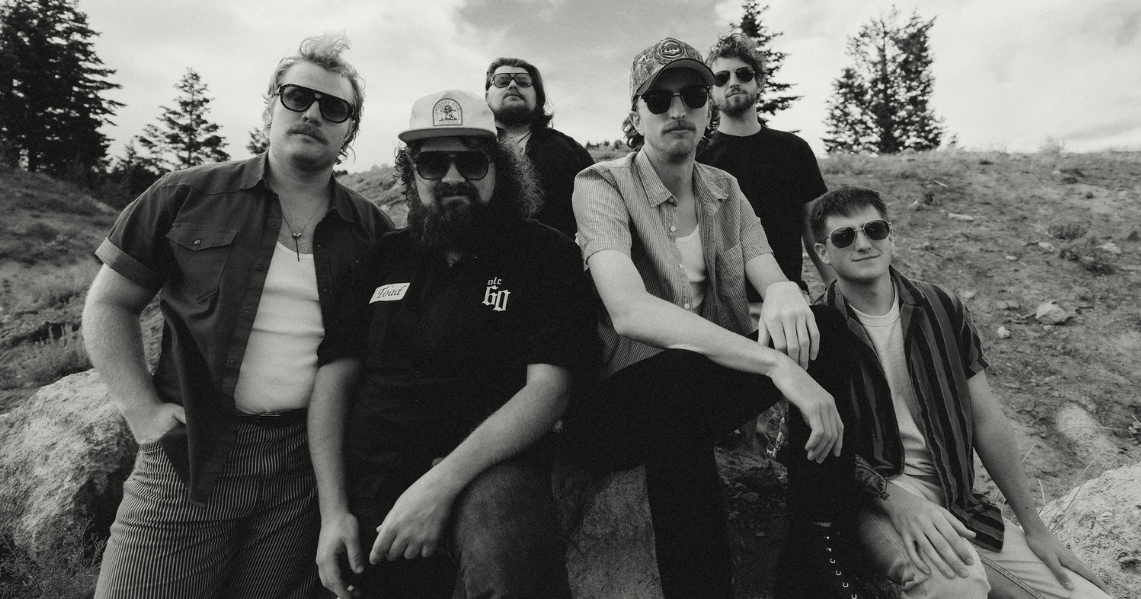
Ole 60 Bring Their Smokestack Town to the World

Pairing the slouchy charm of indie grunge with roots-rocking, small-town punk energy, Ole 60 spent 2025 becoming one of the most intriguing new acts in Americana.

With their debut album Smokestack Town – plus some fun-loving video content, huge opening-act performances with Zach Bryan, and first-time trips to Lollapalooza, the Ryman, the Grand Ole Opry, and more – the six-piece band came a long way from their blue-collar hometown of Hawesville, Kentucky. They even finished off the year with their biggest show yet, selling out their first-ever arena gig with an Owensboro homecoming. But there’s still more to do.

Inspired by a world of shift work and shitty luck, and powered by a rusty Toyota rolling on four bald tires, frontman and primary songwriter Jacob Ty Young fills his songs with vividly conflicted characters. Soaring garage-pop singalongs stand alongside sucker-punch ballads of screwing up and flaming out, each one struggling with the urge to get the hell out while still loving where you’re from. It’s a feeling anyone nursing big dreams in a small town will recognize, and Ole 60 shares it with a fresh voice.

In late January, Young told Good Country about the band’s quick rise and biggest year yet, while looking ahead to what comes next. There’s already a level-up tour underway and new music in the works. But Young pledges not to forget where they got their start – a pizza shop game room in a Smokestack Town.

In 2025, Ole 60 was out on tour, did big shows with Zach Bryan, made an Opry debut and released your first album. What’s it been like processing all that in the last month or so?

Jacob Ty Young: You try to take it in as it’s happening, but it’s a lot easier once you have some time to think. … I think it was definitely the best year we’ve had and now that we’ve had some time off, I’m eager to get back out and start touring again.

And I’ve been writing a lot. After putting out that first record, it was something that we’d never really done before. It was our first time making an album and we learned a lot of things and I think that everybody’s in the headspace that this next one’s going to be even better, so we’re working hard.

What was the common bond that brought you all together musically? You blend influences all the way from Smashing Pumpkins and Metallica to John Prine, right?

Five of the six of us are all from the same little small town in Kentucky, or bordering towns within about 30 minutes of each other. I kind of knew everybody before we started the band. We just got together and started jamming. I’m a huge Smashing Pumpkins fan. Most of the guys are big metalheads. They love Metallica, Black Sabbath, Primus, all that stuff. I think everybody bonded over just our love for rock music. There is obviously some country influence, but I never really considered it that. We were just a garage band, and it’s hard to not bond when you’re sitting there in a garage playing cover songs. The Pumpkins, Stone Temple Pilots, Black Crowes. It was that kind of grunge stuff that really glued us all together.

You can hear that still, and then there’s a rootsy folk side to it, too. When did you start writing songs?

I’ve been writing songs my whole life, but nothing ever really serious. I would write funny songs when I was in high school and I wrote a song about our basketball team one time, just as a parody thing. And I always really enjoyed playing guitar and being creative. I was into visual art and graphic design for a while. Then I kind of went through some stuff in my personal life and decided I wanted to sit down and write some songs about it. That ended up being the first EP [three twenty four]. That would’ve been 2023, I think. I always loved guys like John Prine and Bob Dylan and even Billy Corgan of the Pumpkins, just the uniqueness of the songwriting. I think for lyrics, I look to those guys, and then for the music we kind of look all over the place.

I hear there’s a pizza shop in there somewhere, right? We keep seeing pizza references in the socials and songs. Is the shop like an easter egg for you?

Yeah, I think so. I worked at a pizza restaurant in Hawesville, Kentucky, for about four years when I would come home from school. And then there’s another guy in the band, Ryan, his brother owned the pizza restaurant, so he worked there as well for years. When we first started practicing, rehearsing, and getting ready to go around playing bar gigs, we would rehearse in the back of Galaxy Pizza after close. We’d set up all our equipment back in the arcade section and jam until one in the morning. And then we got our bass player, Colby, and he had a garage, so we moved to his garage. But yeah, I grew up right next to Galaxy and it’s kind of a staple in our hometown, so we just try to let that side of us show through our content and all the visual side of stuff.

Tell me about putting the album together. Smokestack Town was one of my favorites of the year, so congratulations on how it came out. What did you want? I mean, creating a debut album is a pretty big moment. It might seem like an overwhelming task, so what were you going for?

We didn’t have a hardcore plan. I was just writing songs and I got six of ’em that I was really proud of. We went recorded and I was like, “Okay, I think this could be an album.” So I was writing as we were recording the album, and then the last song that I wrote was “Smokestack Town.” I was like, “That seems like a good name.”

I just wanted to push ourselves and try to do something different sonically than we had before. We got together with Jacquire King who produced it, and he’s one of the best of the best. He took my vision and ran with it and we’re very happy. We just wanted to put ourselves out there and let people in, see what kind of music we listen to.

That’s interesting, because it’s been presented as a concept album. But it sounds like you were building the concept as you went.

If it’s a concept album, it’s more so on the visual content side of things, because we’ve been putting out these little short videos of character acting. Taking the lead from the Foo Fighters.

Totally!

But there were just a lot of overarching themes in the record about home. Missing home, being homesick, being young. Plus that idea of small town, kind of dystopian … but not really.

Right, you wrote all these characters who are definitely small town people, with small town stories. But the thing I appreciate was they’re not stereotypical tailgate anthems or “I’m so country.” Nothing like that. Where were you coming from?

After I left Galaxy, I worked in an aluminum mill for a year and a half, and my dad works at the paper mill. Hawesville is a very industry-driven town. I think it’s different from your typical country town because it’s so labor-driven and everybody’s proud to be union and blue-collar. It’s less sitting on tailgates and drinking beer and more going to work a 16-hour shift and coming home and sleeping.

I wanted that to come through, because in country music it is a lot of sitting out in the boonies, drinking beer, and sitting on a tailgate. But I wanted to write my experience growing up in my little country town. There’s nothing to do, so we just ran around all the time and went to all these different places and got into trouble there. I wanted to write about that side of stuff, and less about the country stuff.

Being a new band coming into the indie and roots music scene, did it feel like there’s a lot of opportunity and energy out there?

Everything’s been so great. We kind of blew up on social media and I don’t know if any of us were ready for that to happen, but it did. I think that the reception’s been great. We went out and started headlining shows fairly early and we were selling them out. That’s a great feeling, because when you do blow up like that on social media, it’s hard to really put a gauge on what that means – until you go out and play a headline show and you see the crowd and they’re singing, and you go play a festival with all these big names and it’s your first time out there, and the crowd’s into it. And that’s kind of how it was.

True, and you finished last year with a huge statement in Owensboro, right? Hometown show, New Year’s Eve. Your first arena show and you sold it out. What was the feeling like on stage?

It was weird because it was both the most nervous I’ve ever been and the most comfortable I’ve ever been. You look out in the crowd, you see people you know, and you don’t get that a whole lot when you’re touring. It was just super cool. I got to sleep at the house I grew up in. The whole day just felt good. It was nice to be home and have family coming in and out and friends. Just the perfect way to end the year.

Y’all cleaned up nicely in the tuxedos. Did you put some extra polish on the performance, too?

Yeah, I thought it was New Year’s, we might as well get some tuxedos. I thought everybody looked nice. I want to do it more often. I dunno how the other guys feel about it. We’ll see.

@ole60music🗣️ said it don’t hurt and I called your bluff♬ original sound – Ole 60

You’re getting back on the road for the Smokestack Town Tour this winter. What’s everybody looking forward to? What’s the vibe?

The new year feels like a fresh start to change the show and really put a lot of thought into what we want to do with it. We’ve got some new production stuff, new lighting, and I’m really excited for everybody to see it. I think everybody just wants to go out there and every night needs to be the best show we’ve ever played. We’re playing bigger shows this year and we’re super excited, super grateful.

Earlier you said you’ve been writing, can you give us a hint about what’s been inspiring lately?

Yeah, I’ve been listening to a lot to indie rock, and what I listen to comes through in what I write. So definitely it sounds like Ole 60, but it’s new, and I’m still kind of figuring it out. But I’m really excited that the direction everything’s headed. I don’t have any idea about timelines for new music, but I have been writing a lot and I’m really excited about all of it.

Jacob, thank you for the time. I’ll leave you with the big picture – I always ask people what they hope listeners take away from their work. So what’s that look like to you?

I just hope that our story can be inspiring to others through the fact that we came from a town where after you graduate, you either go to college, you go to the military, or work in a factory, and that’s your options. And there’s always other options out there. You just got to put your head down, work hard and good things will come.


Photo Credit: Wales Toney

BGS 5+5: The Naked Sun

Artist: The Naked Sun
Hometown: Philadelphia, Pennsylvania
Latest Album: Mirror in the Hallway (set for release January 30, 2026)
Personal nicknames (or rejected band names): “Fully Clothed Moon”; “Naked! Son.”; “The Naked Sons”

(Editor’s Note: Responses provided by The Naked Sun guitarist and singer-songwriter Drew Harris.)

What was the first moment that you knew you wanted to be a musician?

I have a very vivid memory from when I was maybe four years old. My mom wasn’t home from work yet, so I was being watched at someone’s house – some kid I barely knew. I was only there once in my life, a strange one-off moment that almost feels like fate. They had one of those old Casio-style keyboards with preset drum loops and out of pure boredom I started messing with it.

To this day, I can remember the feeling of a sort of flow state and being sucked into the music I was making. It’s really that exact feeling that keeps me coming back to the profound play that is making music. Something clicked. When my mom came to pick me up, I didn’t want to let the keyboard go. Something in her must’ve recognized that spark, because not long after we were driving around to strangers’ houses looking for a used piano that we could afford. I started lessons soon after and kept at them for the next six or seven years.

Which elements of nature do you spend the most time with and how do they impact your work?

We all spend a lot of time in nature. Tom, Dylan, and I are pretty avid cyclists. We have some incredible trails in and around Philadelphia that we spend a lot of time riding. Tim’s a trail runner and very recently took up bow hunting. James loves hiking the Wissahickon.

For me, the place that shapes my writing the most is the Delaware Bay. I walk those beaches for hours – staring at the tide, the sky, the sand shifting beneath me. I started doing it out of boredom, stuck at the shore when everyone else was gone, needing some way to fill the time. (Turns out: boredom = creativity.)

One night I walked all the way toward the Cape May–Lewes Ferry and watched a storm crawl across the bay – lightning slowly getting closer. It was beautiful and terrifying and overwhelming. I think that was the first moment I felt truly connected to nature, and something inside me clicked open. I’ve been returning to that shoreline ever since.

I think the ever-changing shoreline informs my music in a deep way. The beach is never the same twice – shaped daily by tides, wind, and waves, scattered with shells, rocks, horseshoe crabs, footprints, and whatever people leave behind. Every sunset lands at a slightly different angle, filtered through a new cloud formation or dropping into a clear sky without interruption.

Change.

Like the shore, our lives are constantly shifting – subtle in some seasons, dramatic in others. Music is how I process that movement. It lets me catalog who I was and who I’m becoming. When change feels heavy or uncertain, music is the valve that releases that pressure. Because the music will always be there, I know I can change.

How often do you hide behind a character in a song or use “you” when it’s actually “me”?

This is a really interesting question, because I think that, at least in my music, every song is about me in some way, shape, or form. Even when I’m writing from someone else’s perspective, when I pull the thread it always comes back to me. Even if it’s years and years after I’ve written a song I’ll look again with a fresh set of eyes and be like, “I thought that was about my mother, but damn, that was really about me.”

I remember writing in a journal years ago that all of my songs are really just letters to myself. And how could they not be? Even when I think I’m writing about someone else, I usually circle back later and realize it was me the whole time. It’s not that I’m hiding behind “you” – it’s that sometimes I don’t yet recognize the reflection I’m writing from.

But I’m increasingly drawn to exploring the true “you” in a song. The songwriters I admire most are shapeshifters – they step into other lives completely, almost like actors. They embody characters, perspectives, flaws, desires. They can disappear into someone else and still reveal something human and true.

That kind of writing fascinates me. It’s difficult – maybe the hardest thing to do, honestly – but I feel like it’s where I’m headed next. If writing has been a mirror, maybe now it becomes a window too.

What is a genre, album, artist, musician, or song that you adore that would surprise people?

Most people don’t expect this, but my all-time favorite band is the Canadian punk group Propagandhi. I first heard them at 14 or 15, walking into a head shop on the Wildwood boardwalk. It was angrier, smarter, sharper than anything I’d heard – political, passionate, direct. Perfect for a rebellious Catholic school kid

I’ve been listening to Propagandhi since their very first record. I’ve even been up to Canada to see them play and met Chris, Todd, and Jord. This style of music is so different from the music I make. I tried, believe me, I tried to write fast punk-metal riffs, I just wasn’t very good at it. (Propagandhi shreds.) I found Bob Dylan at the right age, taught myself how to play guitar and harmonica at the same time, and adopted a more folky sound.

But I think Propagandhi and folk share a similar ethos: anti-corporate, pro-people. I like to think that I’ve combined the two genres at times in my own abstract and artistic way.

Since food and music go so well together, what is your dream pairing of a meal and a musician?

I love to cook and have spent time working in kitchens as a line chef, and I even taught cooking for several years, so cooking, food, and of course music are always paired together. I have a little tradition when I go down the shore in the summer; the first summer meal that I prepare, which is almost always shrimp, scallops, and Jersey corn, I turn on “Mississippi” by Bob Dylan off of The Bootleg Series, Vol. 8: Tell Tale Signs. I just absolutely love this version of this song and it transports me back to making meals at my Mom Mom’s house down the shore.

Sorry, Bob, but since this is a dream meal, my dream meal is with Bob’s friend, Tom. My dream meal would be picking blue crabs, sipping beers (and probably a couple joints), listening to music, and chatting with Tom Petty. Tom’s a southern guy, so I think he’d appreciate some blue crab, corn, shrimp, potatoes, and of course a joint or two.

We’d sit outside down at the Jersey Shore and I’d let Tom control the aux and just shoot the shit while we imbibed. A crab feast is always really long, too, so I’d get some extra time to spend with my hero. Not sure I’d ask Tom any specific questions, I’d just want to listen to his tunes and listen to him tell me why he chose them, what he liked about them, what they remind him of, etc., while we sweat out light beer and fill up on blue crab.


Photo Credit: Bob Sweeney

311’s Nick Hexum Trades Hard Rock for Bluegrass and Country

Normally, when singer-guitarist Nick Hexum plays a gig, it’s fronting legendary hard rock band 311, performing for massive audiences in huge venues around the globe. But, on a recent evening in Knoxville, Tennessee, he was backed by Americana/bluegrass act Water Tower in front of a small crowd at the Open Chord, a cozy space on the west side of the city along Kingston Pike.

“I’ve always been drawn to music that has energy, and there’s so much energy in flatpicking, the banjo, the tremolo picking of the mandolin,” Hexum tells BGS backstage. “This stuff has rock and roll energy that predates rock and roll.”

For Hexum, this deep dive into bluegrass, country, and Americana of late has become something of an intrinsic mission from within. It’s the current soundtrack of a 55-year-old rock star carefully aiming to dig up and examine the melodic roots of his past – these existential anchor points needed to move forward.

“This whole experience is just bringing it really full circle, like a home,” Hexum says. “My mom is from Nashville, so this is me getting in touch with [memories of] when we used to go to visit my great aunt Margaret in Gatlinburg and she’d play the autoharp.”

Retracing old routes, both geographically and sonically, was no more apparent for Hexum than when he and Water Tower appeared at Americanafest in Nashville. The stop in Music City was part of a larger tour throughout the Southeast in an attempt for Hexum to not only reconnect with his past, but also create an opportunity to break new ground for his craft – especially outside of the hard rock juggernaut that is 311.

“I’m just grateful that fans are showing up and are open to seeing me do something completely different,” he says.

During the intimate set in Knoxville, Hexum and Water Tower crowded around a single microphone, weaving in, out, and around each other in a whirlwind of acoustic instruments and Hexum’s signature vocals. The show ran a gamut of material, whether it be classic 311 numbers or selections from Hexum’s latest solo record, Phases of Hope and Hollow.

“The intimacy [of the show], it’s wonderful to be so up close. It’s totally different [for me] from a technical situation – it takes silence,” Hexum reflects.

This project is the brainchild of Hexum and Water Tower’s Kenny Feinstein. Water Tower is a rising ensemble from Los Angeles, one which initially started as an old-time/punk group, only to lean further into becoming a high-energy string band. They raised more than a few eyebrows when they performed at the recent Telluride Bluegrass Festival in Colorado.

“We’re walking into another side of Nick,” Feinstein says. “311 is all about bringing people together through unity and different styles of music, so this is another slice of Nick’s personality.”

For Feinstein, working with Hexum has been this surreal experience, personally and professionally. As a millennial growing up in the late 1990s and early 2000s, Feinstein was a huge 311 fan, so much so he vividly remembers their video for the smash hit “Amber” and seeing 311 guitarist Tim Mahoney sporting a mohawk haircut.

“My friend and I saw the video and [decided] we needed mohawks,” Feinstein reminisces with a laugh. “So, all three of us went to a party [that night] and got our heads shaved into a mohawk.”

This latest musical chapter for Hexum and Water Tower happened serendipitously through the sober community both Hexum and Feinstein are part of in Los Angeles. Leading up to their crossing paths, Hexum had been heading down the rabbit hole of an Apple Music playlist that featured singer-songwriter Faye Webster. His ear perked up.

“I really like her songs, the pedal steel [sound], and the beautiful arrangements,” Hexum says of Webster. “And then, I reached out to Drew Vandenberg, who produces her music. We started talking about working together and one of the things I wanted to do was learn some of those instruments. So, I bought a pedal steel and took some lessons.”

Making space in his studio for the pedal steel, Hexum wanted to add a few more instruments into his creative arsenal, including the mandolin. Cue Feinstein. Meeting him through the sober community, Hexum asked Feinstein if he would teach him how to play the mandolin.

“I had [Kenny] over and I was like, ‘Let’s do something that sounds like [Faye Webster],’” Hexum says. “And he was just a cornucopia of ideas.”

At that juncture in his career, Hexum “mostly had played six-string guitar,” with these other instruments “a new world” for the artist. And yet, even though he was just learning how to play them, he was already well-versed in the sounds of bluegrass and country.

“Nick saw a dulcimer on my wall and I was really impressed that he knew what that was,” Feinstein recalls. “He told me about his heritage and [growing up] in Omaha and how he loved country and bluegrass. Then I said, ‘We should jam sometime.’”

That initial jam session between Hexum and Feinstein resulted in the duo writing five songs right out of the gate. Soon, Feinstein brought in Water Tower banjoist Tommy Drinkard and wrote several more.

“And now we’re on tour. It’s so special to see the humility that [Nick] carries, the gratitude and appreciation for all of his fans after so many years of doing it,” Feinstein says. “It just inspires us to have gratitude for where we’re at now, and to know the journey we’re on is about continuing to lessen the suffering [of others through music].”

“There’s so many people out there in the crowd crying, really taking it in,” Drinkard adds. “These are very intense subjects and Nick does a good job of explaining where he’s coming from with the songs he’s writing.”

For Hexum, this recent journey into the bluegrass realm has become this incredibly cathartic experience. He found himself not only dissecting his past and that of his parents, but also that of his ancestors going back generations.

“My mom is from Tennessee and my grandpa was a Southern Baptist minister,” Hexum notes. “Half of my family does have these southern roots, so when I hear bluegrass, it just feels like part of my DNA.”

Beyond the new music itself, Hexum views this ever-evolving project as part of his ongoing quest to find himself through this vibrant kaleidoscope of sound and purpose. It’s about stripping everything down, focusing on the essence of a particular melody, and always being aware of the beauty of the sacred platform that is live performance. Turn off the amps, pick up the acoustic guitar and huddle around a lone microphone, together.

“It has gotten to a point where I’m like, ‘All right, time is limited here, and I want to make the most of the time that I have now,’” Hexum says humbly. “I mean, when you see your kids get older and get their driver’s license and stuff like that, you just feel this passing of an era. And so, for me, it’s getting into a different mode of songwriting – really focusing on sincerity and simplicity.”


Photo Credit: Gentle Giant Digital

Outlaw Country That’ll Make You Smile

Holding the attention of a roomful of moderately smashed bar-goers is no small feat, let alone with a traditional Irish folksong. But last May, country singer-songwriter Dylan Earl ended his set at Brooklyn’s Skinny Dennis standing on top of the bar and singing an a cappella version of “Wild Mountain Thyme.”

“Will you go, lassie go/ And we’ll all go together/ To pull wild mountain thyme/ All around the blooming heather,” Earl implored in his warm baritone, towering above the room in worn jeans, boots, and a sleeves-cut-off T-shirt from his Arkansas-based label, Gar Hole Records. In spite of all the alcohol collectively consumed by the listeners who packed the venue to its beer-tinged walls that evening, the room was just about as quiet as a divey honky-tonk can be.

By ending his set with the kind of folk song which, passed down through generations, comprises one major lineage of country music – indeed, “Wild Mountain Thyme” is based in a much older Scottish folk song – Earl invoked a deep vernacular tradition and history often left out of modern country. Earl’s music attracts labels like “old-school” and “classic country,” and his voice certainly lends itself to those comparisons, but his own compositions convey a whole lot more. Rejecting the banality of tired Southern stereotypes, Earl writes punk-hearted, poetic music rooted in a love of people and place; music which is both socially and class-conscious and captures wide-ranging cultural unease and indignation with nuance and wit.

On his fourth studio album, Level-Headed Even Smile (released September 19), Earl makes clear that his is not a return to a bygone era so much as a carrying on of a long tradition of speaking truth to power and of imbuing dimension and worth into the lives of overlooked characters and issues too easily reduced to absolutes.

“I’d rather be an outlaw than in with the law/ All this authority worship is the strangest thing I ever saw,” he sings in “Outlaw Country,” a thesis statement of sorts for the album and Earl himself. Earl wrote “Outlaw Country” out of frustration at how many people made assumptions about his beliefs and morals because of his appearance – and because he plays country music with a whole lot of Southern twang. Earl wanted to make it clear where he stands.

“I finished high school in a very rural part of Arkansas; I identify with the Deep South, but I don’t identify with its most prevalent fucking right-wing rhetoric… I still want to remain approachable to those people I completely disagree with, because I think that’s an important part of making art, is creating discourse,” he says. “I want to try to approach these people and try to have that conversation. Be like, ‘Listen here, brother, I’m just like you, but you don’t have to be a racist piece of shit. It’s way more fun in life to be happy and be inclusive. Your soul will be happier because of that.’”

Lately, outlaw country morphed from its subversive roots into a shorthand for wicked good independent country or a slightly more specific alternative to Americana. While both wicked good and independent, Earl’s version also rekindles contempt for the establishment that fueled the original outlaw country movement:

I’d rather be a bootlegger than a bootlicker
A side stepper than a homewrecker
And I don’t get a pick me up
From putting other people down

It’s clear to see by the air I breathe
Working class solidarity
Is the only way
We’re gonna stamp that fascist out

Sardonic and irreverent, “Outlaw Country” is an anthem for anyone who ever believed in love and community over corruption and power. But rather than a callback, Earl’s music is of and for the next generation of ne’er-do-wells and dreamers living on the fringes, hoping for something better.

Earl grew up in Lake Charles, Louisiana, where he split his time between separated parents. Chafing at the craven habits of money and influence that he witnessed from his father, a powerful local lawyer, Earl preferred the warmth and love he felt in the house his mother shared with his grandmother. (Despite a rocky childhood, Earl’s now building a relationship with his dad.)

“I was living in poverty on one side and then I was living in opulence on the other side, and the poverty side is where I wanted to be, because that’s where all the love was,” Earl says. “I’m so lucky to have that, to be able to have identified where love was at a young age and identify where my soul felt good.”

Earl’s mother showed him how to seek joy and adventure, filling life with road trips and camping weekends. When he was just five years old, Earl’s mother plopped a map in his lap and taught him to navigate. Perpetually tight on money and resources and mired in an enduring custody battle with his father, she nonetheless taught him how to get away from it all, instilling in him a curiosity about the world. On the road, they stopped to check out historical markers, explored parks and rivers and the Gulf Coast, and watched giant boats come in while picnicking along the Intracoastal Waterway.

“That developed a sense of wonder and being like, ‘I don’t fucking need money to feel this type of happiness, to feel this sense of joy and adventure and love of life, just life in its purest form,” Earl says, choking up. (He firmly believes more men should cry, and that it helps him be more humane.)

“Her sense of adventure, her true passion for living, it’s amazing to me; it still is amazing to me.”

The album’s title and thematic heart – level-headed even smile – are derived from that approach to living life fully. For Earl, it’s an essential mechanism of coping and connecting. Remain engaged in the world and aware of all its horrors and tragedies, he says, but then, when it gets to be too much, know when and how to take a break:

Some nights I’m crying on the backroads
Rolling my smoke backwards
Trying to keep a level-headed even smile
Don’t you know I might take a while to get there
Just hoping I get anywhere
Trying to keep a little level-headed even smile

“At some point we’ve got to unplug from the fucking screen and just go explore things that are fucking real, like the trees around us, or the grass, or the water, or the sun or the moon, and try to get in touch with that more primal sense of ourselves,” Earl says. “That is where we can really most quickly and most efficiently achieve happiness, it’s getting in touch with the simplest form of ourselves.”

Beside the love from his mother, Earl describes himself as a depressed kid who struggled in school and wanted desperately to escape his hometown and father and stepmother. At 15, he convinced his father to send him to boarding school which, in part because of Hurricane Katrina’s devastation of Louisiana, ended up being in rural Arkansas. At the Subiaco Abbey and Academy, Earl studied with monks who’d taken a vow of poverty and offered rigorous, benevolent study, kindness, and care. Though he’s an atheist, Earl counts the monks, whom he visits regularly, as mentors, connecting with them still through shared spirituality.

“We all fucking showed up pissed off as hell. And we found love and we found love amongst each other; we found love from those monks and found nature,” Earl says, reverently, of his time at Subiaco. “It saved my fucking life. The whole thing; I found joy and happiness for the first time in my life.”

Level-Headed Even Smile is dedicated to Earl’s late friend, William, who was the first to befriend him at Subiaco. “He helped me clear my heart,” Earl says. As he sings of those halcyon days on “Two Kinds of Loner,” “We were two kinds of loner/ A misfit and a wayward son…”

Armed with the sense of wonder his mom taught him, liberated by the fallow morals of youth, and subsumed by the ready escapism afforded by their surroundings, Earl and William learned every back road. They’d steal beer from the back of William’s dad’s Crossroads Tavern and drive for hours exploring the backwoods and levees along the Arkansas River.

“William was the first to show me the country air. Hanging out with him, something about getting in that truck after class, taking off down Lile Ridge Road, cracking a beer, putting on whatever weird music he was listening to at the time, that was the first sense of fucking true freedom I ever had in my life,” Earl says.

Stopping just shy of wistful, “Two Kinds of Loner” is a bittersweet, intimate portrait of the desperately important work of becoming oneself as a teenager – and of the raw beauty in forming kinship through human connection rather than blood relation:

Down where the kudzu meets the bodark
And the darkness first let go of me
High in a cab of a buddy I had
He showed me the county air
I used to not care about nothing
Because no one seemed to care for me

After high school, Earl attended Hendrix College, a liberal arts school which lived up to its name situated in Conway, Arkansas. A few years earlier, Earl borrowed his father’s old guitar – a Yamaha FG 180 Red Tag, which he still plays today – and learned enough chords to make himself useful around a bonfire and impress the local girls. Encouraged by one of the monks at Subiaco, who noticed him straying from lesson plans, Earl started writing his own music.

When he got to college, he landed feet first in a robust DIY music scene. Together with a group of friends – including Gar Hole Records cofounder and label manager Kurt DeLashmet – Earl played a circuit of local house venues: White House, Blue House, Brick House, and occasionally Shit Mansion, where both also lived for a time. To this day, their two-day, 28-band Butt Ranger music festival thrown by friends at the White House remains one of Earl’s favorite shows.

“We were drunk off our fucking asses on plastic bottle whiskey and snorting Adderall and fucking ripping cigs and shit like that. It was fucked up. It was so awesome. It was just blood and piss everywhere,” Earl says. He recalls the floor at White House buckling so deeply that by the end of the night all his gear, including his oversized amp, wound up in a pile in the middle of the floor. Volume was of primary concern, tone and other nuances distinctly secondary. “What a fucking beautiful, carnal, amazing culture to be a part of,” he says.

Two songs on Even Smile come from those early days playing music first in college and, afterwards, in Little Rock, where Earl and his band Swampbird moved. (Earl lived in Little Rock for a few years then moved to Fayetteville, where he still lives.) Both songs are paeans to the chaotic moil of early adulthood rendered heady and hazy by too much booze and too little grounding: “Broken Parts,” which he first recorded with Swampbird, and “Little Rock Bottom,” about his time in Arkansas’ capital city.

“I don’t really quite realize it until I am talking about it, how much of my life and my story is wound up into that album,” Earl, who’s now in his mid-30s, admits. The album feels like a fitting way to process and close that chapter of life. “I do feel like I’ve left it on the table and I’ve left it all out on the field, so to speak.”

In total, Even Smile is a loving, layered depiction of both Arkansas specifically and the south in general. Among his many influences, Earl includes Arkansas gonzo poet Frank Stanford (who also attended Subiaco and whose burial there Lucinda Williams memorialized in her song, “Pineola”). Stanford’s realism and wild abandon creep into Earl’s songwriting sensibilities; they share a love of the South and its complexities and a reverence for and dedication to illuminating those stories.

Alongside a few cheeky disquisitions on life on the fringes – including road dog ode “Get In The Truck” – throughout the album Earl relishes the beauty of his home territory. Perhaps nowhere more so than on “High On The Ouachitas,” an extended soliloquy on the wild beauty of the mountain range, his chosen retreat for a reset and solace:

When I’m high on Ouachita
High as I ever saw the Arkansas
With goldenrod and reindeer lichen
Twist flowers in bloom
There’s just no place
I’d rather waste my afternoons
Than high on Ouachita

“I love it so fucking much, because I know all of the nuance and I know all the beauty that’s deep underneath all of the stereotypes. And just how fascinatingly complex our communities are,” Earl says. “It’s fucking beautiful. You have two and a half million acres of national forest. So we have the cleanest drinking water in America; we have endless amounts of outdoor recreation; the food is fucking kick ass; the people are the sweetest ever.”

Earl rounded out Level-Headed Even Smile with two very on-theme cover songs: beloved Arkansas folksinger Jimmy Driftwood’s “White River Valley,” a love letter to Arkansas’s pastoral beauty, and Utah Phillips’ peripatetic wanderer’s lament, “Rock Me to Sleep,” which concludes the album. Together they bracket the glib “Lawn Chair,” written with Cameron Duddy and Jonathan Terrell.

Earl jokes when playing the song live that it might be the worst song he’s ever written. And superficially it sounds like the kind of redneck anthem that might confirm the uneducated listener’s worst stereotypes about uncouth Arkansans: “It’s a whipass life just being me/ It don’t cost much to be the free/ I got my lawn chair/ And I’m sitting on top of the world.” Yet the song is also a sly rebuke against taking everything too seriously. Convivial in its roughness, it’s a gleeful, carefree reminder of the many ways to keep a level-headed even smile.

“If I’m feeling bogged down and feeling depressed, oftentimes it has nothing to do with the task at hand, it’s just that I’ve been absorbing how terrible the fucking world is and it makes me incapable of interacting and interfacing with my immediate world, because I’m so fucking caught up in that goddamn bullshit… and it is not allowing you to reach your full potential as a biological piece of anatomy that is somehow living on this planet,” Earl says.

“[A level-headed even smile is] an attempt to focus on your humanness and try to reattach yourself to the earth and detach from the problems of the earth; and just go out and find your smile. Go find your joy amongst all the fucking evil.”


Photo Credit: Justin Cook

Cody Jinks:
“You Never Stop Coming of Age”

For Texas country star Cody Jinks, his latest album – the fiery and rough-around-the-edges, yet poignant and sorrowful In My Blood – is a liberation of sorts. Not of sound or scope, but of self.

It comes from the eternal quest to find balance within the body, mind, heart, and soul of a singer-songwriter, one trying to understand just what it means to be human in the modern, chaotic world – which is why “Better Than the Bottle” was purposely placed as the opening track on the record.

“Been layin’ things down one habit at a time/ Never thought we’d get old…” Jinks rumbles through the melancholic number. “Now we’re damn sure tryin’/ And makin’ the most of the time that we have left.”

With his sobriety in recent years, Jinks has been taking a hard look at what he sees in the mirror. It’s not about having regrets or cringing at one’s past. Instead, it’s taking personal accountability and professional inventory of the wisdom gained from your existence in real time, all while the calendar on the wall seemingly changes faster and faster each year.

Now 44, Jinks is more focused on what’s just around the corner than continually looking back over his shoulder at the ups and downs along his life’s journey. It’s about a clear head, a keen focus on what matters most – family, friends, fellowship, the freedom to create and perform.

It sounds like you’re in a really good place right now.

Cody Jinks: Yeah. Well, whenever you’re a late bloomer like me, it takes you [til] later in life to figure things out. It’s a practice. I mean, obviously the last couple years I’ve been trying to work on myself, work on my family. I think it’s helped a lot creatively, as well. None of it’s been easy. It’s not like anything’s ever peaches and cream or roses or whatever. The music business is tough, and if it was easy, everybody would do it. I spent much of my marriage while I was on the road. Having been off the road the last four or five years, [not touring] as much as I used to be, I’ve learned that being a great husband and father is even harder than being in the music business.

And it all ties into everything though, because that creative side is also a big balancing act, where you need that outlet in your life.

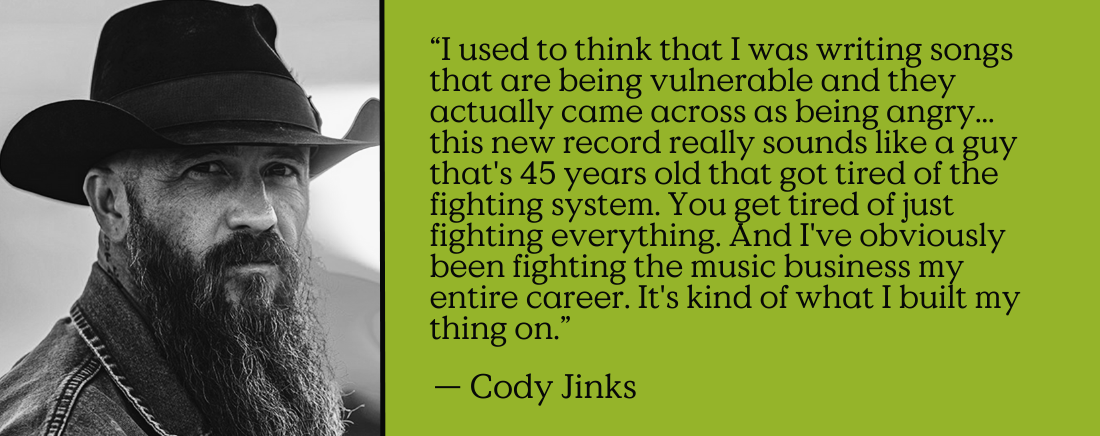
Well, not only the creative outlet, it’s that I used to think that I was writing songs that are being vulnerable and they actually came across as being angry. There was an edge to [the older songs], where this new record really sounds like a guy that’s 45 years old that got tired of the fighting system. You get tired of just fighting everything. And I’ve obviously been fighting the music business my entire career. It’s kind of what I built my thing on.

And, at the same time, I had started bringing the guy in the music business home – that’s who my wife and kids had to live with, as well. So, we’ve been correcting some stuff like that. I’ve been getting some really vulnerable songs out of it. You never stop coming of age. No matter how old you get – when you’re in your teenage years, when you get in your forties – life is a continual movement, man. And if you are not moving forward, you’re going backwards. So, vulnerability is a strength to an extent.

How does that play into the album? I would surmise that the opening track [“Better Than the Bottle”] was purposely placed there.

I was actually going to speak to that track specifically, because that was the second-to-last song written for this record. I wrote it with a friend, Tom McElvain. We both quit smoking cigarettes. We quit doing recreational drugs. We’ve written together a lot over the years. I’ve got several songs with his name on it, but [“Better Than the Bottle”] was a real conversation.

He came over one morning, and in 20-plus years of friendship, it was the first time we had ever been around each other stone cold sober. We were talking about how we used to live versus how we’re trying to do things now and who we’re trying to be now for ourselves and for the people that we love, the friends that we lost along the way that didn’t pull out of it. We’re old enough to have friends that have died from it now. That song made its way to the first slot because it was everywhere – that song’s true. Tom was over here that morning in January and you talk about two grown men in their 40s and 50s just laying all out, teary eyes. Dude, we fucked a bunch of shit up in our lives and there’s a lot. At this point, we’re trying to atone for a lot of things.

That’s one of the beauties about getting older – perspective. There’s this kind of weird intrinsic value to hitting this age, where you still have mobility and your wits about you, but you also got some road miles on the tread.

[Laughs]. Yeah. At 40, I tell people the “check engine” light comes on. It’s not usually that serious, but you gotta change some things. It might be time to trade in the Lamborghini and get an F-150, slow down a little bit.

You have a family, as well, with these personal responsibilities and people that want you around for a long time.

That was really the big player. I quit smoking for my kids. I’d still probably be smoking cigarettes if it weren’t for my kids. I quit drinking for myself and for everybody around me. But, the cigarettes, I finally got that licked about five, six years ago. That was the one my doctor said, “Your kids are gonna thank you.”

This year also marks the 10th anniversary of your breakout album [Adobe Sessions]. I don’t know if you’ve been thinking a lot about the last 10 years, who that person was when you broke into the national scene and then who you are right now.

[I’m] a lot more patient [these days]. It’s been 10 years, [and back then] we’d been [playing for] 10 years by the time that breakout record came out. [I] still have hunger in this business, I just put in a smarter, more calculated manner these days.

I also found it interesting that you’ve mentioned Ray Bradbury as an inspiration for In My Blood. Can you speak to why that is and what he represents for you?

Yeah, absolutely. The focal point of the record, it’s a travel life, right? That’s where the record takes you, on this up-and-down journey of life. And, in that life, in everyone’s life, every fork you come to in the road, you take one way or the other, which leads you to another fork in the road. By the time you’re done, you’ve taken a bunch of forks, you’ve taken a bunch of different roads, and hopefully you took more good forks than you did the bad.

We planted a Ray Bradbury-inspired song (“Something Wicked This Way Comes”) right smack dab in the middle of this damn record, because it was the perfect frickin’ spot for it. It’s the only song that was snuck in the record that wasn’t really based on my life. If you’ve read the [Bradbury] book Something Wicked This Way Comes, it’s part of a series called the Green Town Trilogy. They’re all really good [books], but that one stands out. It’s my favorite. It’s a brilliant book. It’s good and evil.

We all have the same wants, needs, desires. What’s good for us? What’s not good for us? Is it good for me if I try to do this to obtain this or achieve this or to be this or to look like this? And those are the decisions that we make every single day. I had just read the book and I came up with this really badass little blues riff. It feels like a carnival ride.

That also plays into one of the things about getting older, which is that you choose to keep moving forward. When you’re younger, you might feel the pressure. And as you get older you realize there’s a lot of things you don’t need to worry about.

Yes. My parents had told me, “Don’t sweat the small stuff.” And then, when you’re at the age we’re at, the big stuff you thought when you were 20, 25 years old, you’re [now] like, “Well, that’s small stuff.” And then, by the time you get to our parents’ age, they’re looking at stuff we’re worried about in our 40s and they’re thinking, “Oh, that’s small stuff.” We’re gonna get to the point, hopefully, where we’re looking at [things] going, “Ah, man, why was I worried about that?”

Case in point, the other night we had a very mild water leak in the upstairs [of our house]. My daughter came downstairs at two o’clock in the morning and there was dripping on a custom turntable in our living room. This was nobody’s fault. And I got upset about it. We stopped the leak. We dried the water up. I woke up the next morning and there’s flooding in Central Texas and there’s like a hundred families who have lost their children. Let’s not sweat the small stuff, man. Some people got real problems.

There’s probably a lot of weight that’s come off your shoulders in the last couple years, whether it’s personal or professional. Obviously life’s a continued journey. Whether you want to participate in it or not, that’s up to everybody on their own. But, it feels like you’re kind of leaning into life in a really good way right now.

Yeah, I’m living it more, as opposed to getting up and butting heads with [life] every day.

How do you square that with the outlaw image that the media puts on you? Because there’s stereotypes that get equated into that. At your core, you’re a singer-songwriter, you’re a country musician.

You know, my whole career, they’ve been calling me [an “outlaw”]. Look, I know they need an “outlaw,” whatever. I’ve never called myself an outlaw. That was something the media called me, and I just agreed. I’ve kind of gone with it. It’s okay. It’s easy to call me that. I’m not an outlaw, dude. I’m a punk.

And underneath all of that is still your punk rock and metal blood.

Yeah. It’s too big a piece of me. It’s just who I am. It’s the way I run my organization. It’s a family. It’s us against the world. We don’t belong with anybody, so we belong to everybody.


Photo courtesy of The Oriel.

BGS 5+5: Grain Thief

Artist: Grain Thief
Hometown: Boston, Massachusetts
Latest Album: House of the Dog (out August 1, 2025)

Genre is dead (long live genre!), but how would you describe the genres and styles your music inhabits?

We’ve sort of faced the “genre-bending” thing throughout our career, so by now you’d think we’d have a good idea of how to summarize ourselves and our music. The beauty is, though, that we don’t really have to put ourselves down for a genre for anything more than maybe a drop-down menu or an intake form.

We’re from Boston, Massachusetts, an area that’s not typically known for its bluegrass scene (think Aerosmith, Dropkick Murphys, and Marky Mark). But through playing together in the early stages, we landed on this instrumentation that would be typical for a bluegrass band. So, does that make us a bluegrass band? Not really.

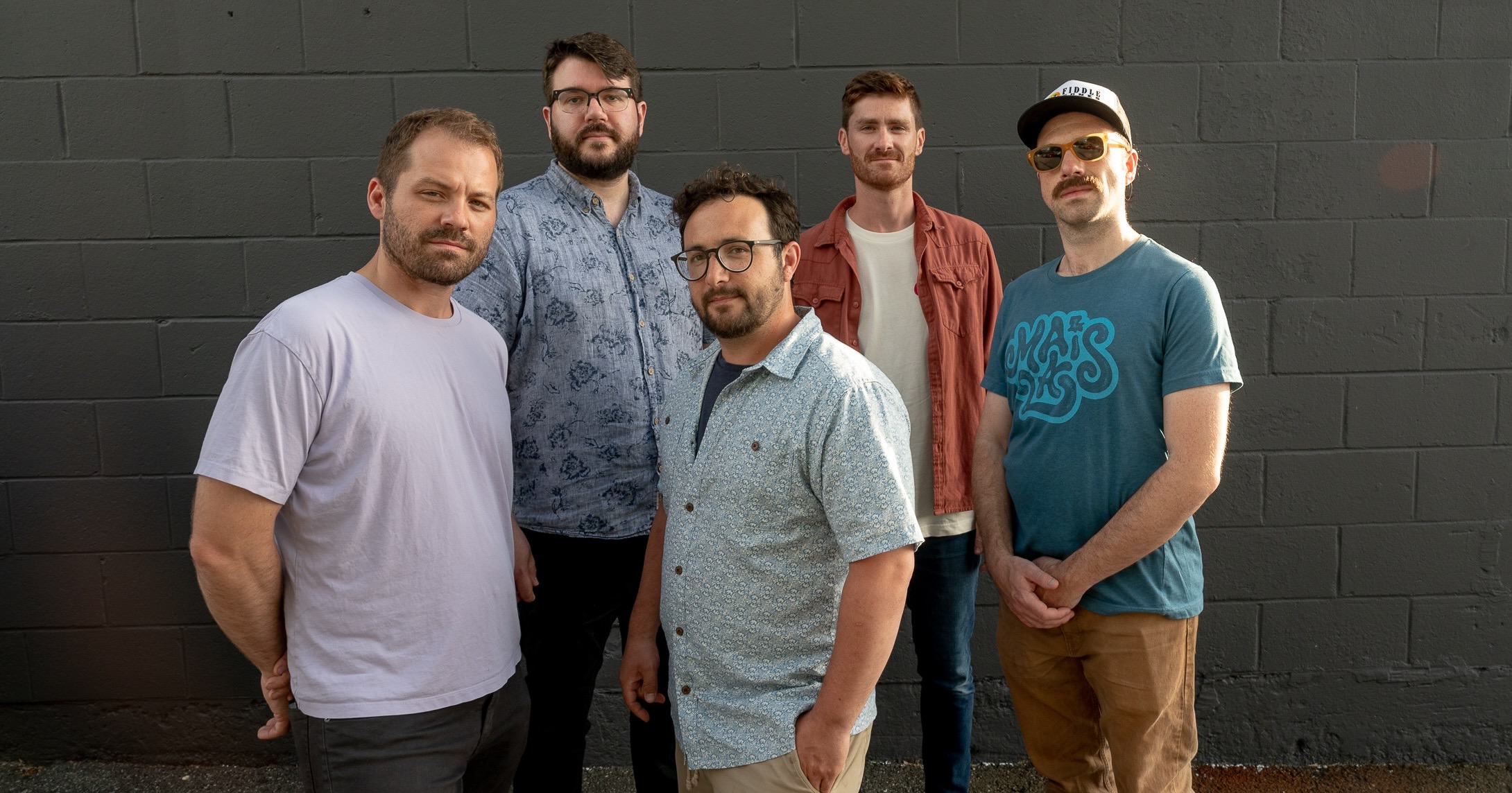
We welcome our individual musical backgrounds into our collective creative process. Alex (fiddle) went to school for classical music while Mike (bass) played drums in a punk band. Zach (mandolin) grew up in the PNW old-time scene while Patrick (guitar) studied English and developed a knack for songwriting. Tom (resonator) is a hell of an electric guitar player and is ready at the drop of a hat to play any iconic lead guitar riff that you might’ve just made reference to. We’re a mess. Sometimes, it’s a beautiful one.

What this all translates to is that we have a wide range of musicality within our crew and we allow all of that into our creative process and see what we come up with. Sometimes that could be called bluegrass or maybe even derivative of classical. Sometimes it’s lyrically poignant while other times it’s an angsty punky notion. Sometimes it’s, “This bridge kind of sounds like Weezer!” Thankfully this process has allowed us to grow a wide audience and allows for opportunities that are inside and outside of the bluegrass genre.

What other art forms – literature, film, dance, painting, etc. – inform your music?

We’re a group of friends who are all just about the same age, so we’ve all grown up along the same cultural timeline – regardless of the fact that we all first met in our 20s. When we’re making any kind of cultural references together, whether satirically or literally, things generally land with the other band members. We all watch similar series and movies and someone might make a reference from childhood that’s stood the test of time. Other times we’re in the van looking for things to talk about and someone asks, “Hey have you seen Dune 2 yet?” while the odd-man-out immediately goes straight to “earmuffs” mode.

We’ve got hobbyist photographers and not-so-hobbyist visual artists within the group, so we share our work and inspirations with each other which leads to art direction brainstorming for band projects (album art, merch, etc). Many of us enjoy literature and some of us can barely read music. Not bad! While we haven’t necessarily organized the thought before, we certainly draw inspiration from other art forms and that spills into our music and our relationships together as bandmates.

What rituals do you have, either in the studio or before a show?

Prior to making a record we generally go away for a few days (as much as time allows for) while we are on a break from playing shows to take a creative writing retreat. This has taken place now before our albums Gasoline (2020) and House of the Dog (2025), which are the two from our catalog of the past few years that are complete original compositions. This time together allows us to get away from the outside world and work distraction-free and it allows a significant amount of time for creative collaboration or to bring works to the group for arranging. This time together also acts as an opportunity to share meals together, check in, strengthen friendships, and generally just appreciate the role that we collectively play in each others’ lives.

If you didn’t work in music, what would you do instead?

Sadly we all have other jobs, too. Yay music industry life of 2025! Among us are skilled computer programmers, web developers, carpenters, general contractors, bartenders, sound engineers, CAD engineers, teachers, and more. Is anybody hiring for those positions? It’s literally no rest for the wicked. Yet here we are and we are grateful that there is still a place for being a professional musician in our lives at all.

We try to really make it count when we get to do this, and it has never felt like something that we have to do.

Since food and music go so well together, what is your dream pairing of a meal and a musician?

We’ve all got excellent taste in both food and music, so it’s going to be hard to pick a single pairing that would apply for all of us. Sometimes we can’t all even decide on the same place to eat on the road. But, I’ve got two words that are abundantly clear with this one: “Jerry” and “Dogs.” So, probably a night of grilling hot dogs to the soundtrack of Grateful Dead bootlegs.


Photo Credit: Lead image by Toan Trinh; alternate image courtesy of the artist.

Vandoliers Find Liberation
in Life Behind Bars

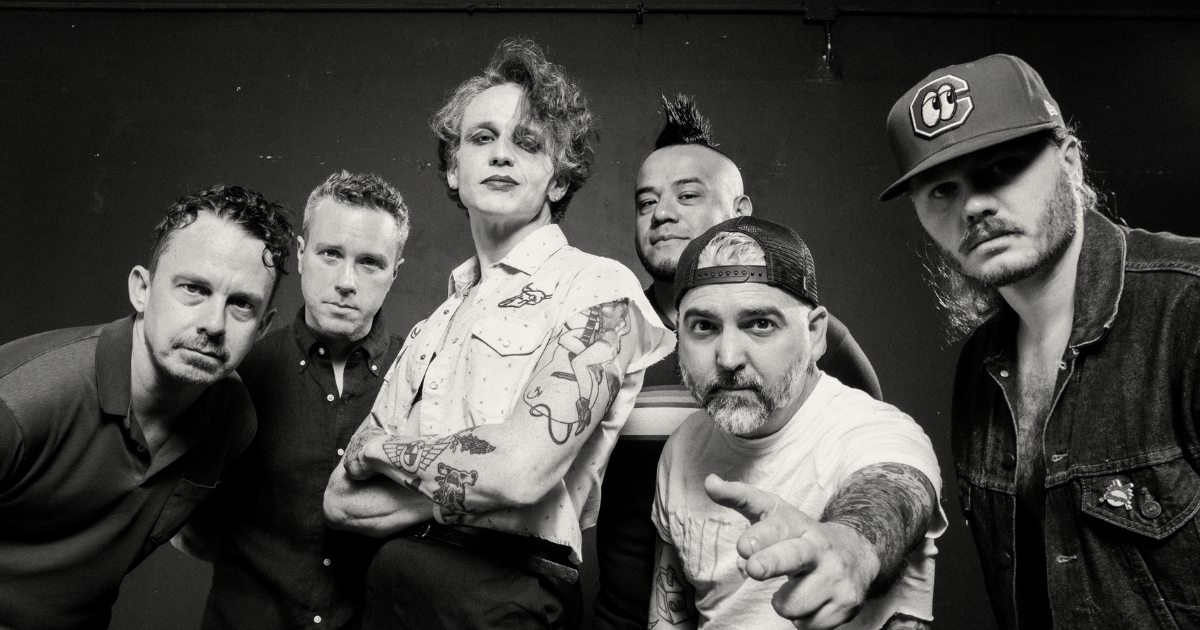
Vandoliers are doing their part to keep the spirit of alt-country alive with their raucous blend of punk, country, and mariachi. In other words, they’re the quintessential Texas dive bar band.

They’ve long been outspoken supporters of the queer community, going viral for protesting the Tennessee Drag Band by performing in dresses as a protest; that was when lead singer Jenni Rose realized that she may be a member of the LGBTQIA+ community herself. And so, the band’s fifth and newest album, Life Behind Bars (released June 27), finds the Vandoliers exploring the wild desert landscape of the heart: sobriety, grief, gender dysphoria — and joy in liberation.

Good Country spoke with group members Rose and multi-instrumentalist Cory Graves in early June about collaborating as a six-piece band, working with producer Ted Hutt to push the band to ever-more lyrical honesty and musical proficiency, and the profound impact Jenni’s sobriety and coming out has had on the band.

The album’s title track, “Life Behind Bars,” deals in part with frustrations of life on the road – but Vandoliers are known for bringing the party. How do you balance these two realities?

Jenni Rose: I couldn’t be a lead singer of this band unless I got sober. I tried really hard to be the party person and be the lead singer and be able to do this hundreds of times a year. I just couldn’t do everything. Put the party down for a little bit, and that brought up so much in my life. It made the shows exponentially better. It made me a better singer. On this record, you’re really hearing me processing this new identity, this new life unfolding. It starts with the question, “Why can’t I get sober?” and then it’s like – “Oh my God, I’m in the wrong body.”

I was dealing with a lot. Cory was dealing with a lot, the whole band was dealing with a lot. We have made four records of us asking, “Where am I at in my life? What am I going through?” We’ve been able to conquer the humorous and the serious, so we weren’t really out of our comfort zone by talking about big feelings, but they’re in this album for sure.

The song has four co-writers: you two, Joshua Ray Walker, and John Pedigo – Texas royalty for sure. While it’s common for pop country songs to have many writers, it’s a bit unusual in the Americana world. How did you all even find yourselves in one place together?

JR: Josh Walker and I are really close. I was with him a lot during his cancer diagnosis. We were catching up and we were about to go to Sonic Ranch to record. I suggested we just go write a song and call up John, who used to produce our records. He pretty much has a co-write on every Vandoliers record except for the last one. We love writing together.

Josh Walker brought up the frustrations with touring and we were talking about how we can keep doing it. Then we thought, “Let’s say we didn’t do it. What else are we gonna do? What kind of jobs are hiring 40-year-olds for entry-level positions?” Cory and Josh had been talking about this line “life behind bars” as a double entendre for years. We all related to it and everybody just started throwing out lines. And then by the end of it, we were all screaming the hook and we had a song.

When you began working with producer, Ted Hutt, he said your songs were “superficial” and pushed you to go deeper. How was it to hear that feedback?

JR: It was wonderful. That conversation was like a year before we got to the studio. So I came in with like 40 tunes. Cory came in with like six or seven. Ted really took the time to listen to our writing and pick the songs that were right for the record. He pushed me so hard with my lyric writing and my vocal performance.

I was writing and rewriting things, clarifying, digging deeper into what I was trying to say and that opened me up to a lot of emotions. I knew I was gonna hit gender dysphoria, but I didn’t know I was gonna hit it there. Then [the] Pandora’s Box was completely opened.

Cory Graves: We’ve always craved a producer that would come in and be like a seventh voice in the room, like a tiebreaker voice or someone who could come in with other ideas. We’ve gotten that a little bit here and there in the past, but never as much as I think some of us wanted. He was heavy-handed, like suggesting we change a song from a punk song to a country song or changing the key.

We all knew that we wanted that. Going in, we all agreed that if Ted wanted to try something, everyone would just be happy about it and try it. That’s exactly what happened. It always worked out for the better.

What lessons do you think you’ll bring with you from this process?

JR: I’m already better at being fully vulnerable when I write. Life Behind Bars is me opening up, whereas some of my writing right now is pretty brutal. I’m excited about moving forward being fully aware and shameless in my writing now.

The band itself is so collaborative, by nature of the kinds of sounds you make. How does the band work together?

CG: We all have so many different influences. None of the songs ended up sounding like the demos. They ended up sounding like a piece of everyone. My song, “Thoughts and Prayers,” was more of a punk song, but ended up as a rockabilly song. “Life Behind Bars” started as an emo song while “Bible Belt” was kind of like a Green Day song. Now it’s like The Cars meets, like – I don’t know. So many different things. There’s a twang to it, but also ’80s rock, because Dustin [Fleming], our guitar player, was in a Cars cover band. So he’s got that in his blood.

There are different things that we each bring out from our past into the tunes.

Jenni, it sounds like for a while you isolated yourself socially from the band a bit. How do you both feel things have changed since you’ve come out?

JR: When I was trying to quit drinking, I changed all of my habits just to make sure that I could. It would have jeopardized my career if I kept going the way that I was going. I didn’t wanna do that, ’cause it’s not just my career, it’s everybody’s career. So I started going to the gym after the shows and then journaling during the day, having a ten-minute free write, word-vomit of poetry that I would send to Ted. I would do this every day and that would take me three hours – most of the van ride. So I’d be in my headphones, dead silent with everybody, and I was cocooning. I was going through a lot and I was trying to heal while in motion.

So everybody got to live with a hermit, essentially, for three years. I know it wasn’t cool, but I had to do it. I’m writing these songs. I’m reading every fucking self-help book I can possibly grab to figure out why I’m an addict. The dysphoria is starting to pick up and ramp up, because I’m starting to understand my emotions instead of dull them and ignore them. I am becoming more in tune with my body at the gym and noticing the dysphoria there and starting to understand myself better and better and better. While all of this is happening, I’m on fucking tour all over the world with six other people.

They’re watching somebody change the way that they eat. They’re watching somebody change what they do during the day. They’re watching my social life become pretty much non-existent. … Everybody becomes [at] arm’s-length on the road for a couple years. And then at a Taco Bell, I tell everybody I’m a trans girl and it’s like I’m right back to the party, I can like hang out again, I can go out after the show, or I can skip the gym. … I’m existing as my highest self after years of searching.

It sounds like your coming out has been a fairly positive experience so far.

JR: I saw immediately how quickly my relationships have been healing since coming out. Each person I told – before coming out publicly – it was great. Now I just get to be in a band with my friends again and they get to know me fully without me being scared of rejection.

I can’t manipulate anybody into accepting me. I can’t control how they feel about me. There’s nothing I can say that would make them either love me or not love me. You just kind of get to figure out who’s with you or not. I am so blessed that the people that are around me are at such a high quality. I think it’s a testament to just my exquisite taste in humans. I’ve been so blessed.

Everybody around me loves me and wants me to keep going and wants to keep being in my life, which is not what I thought that they would do. I assumed that I would be abandoned by everybody, because that’s the narrative that we’re all used to, but it’s been really beautiful. I’m really glad I did it.

Your coming out process has been very public. Your band went viral for protesting the Tennessee drag ban the day it was passed by wearing dresses on stage. And now, you’ve come out in Rolling Stone. So, how are you doing?

JR: Wearing the dresses was Cory’s idea. I have worn so many dresses behind closed doors. No one knew this side of me. When we went shopping for dresses, we all were having fun. When I put it on I was so nervous, but I was also really comfortable. And then we went out and played and I twirled. I had a great time. I thought only like 80 people were gonna see this, that I’d wear a dress for this one show and that would be it. Then everybody saw it.

That was kind of when I realized I had this aspect of me. It was the first time anybody had seen it and everybody kind of saw it at once. It made me wanna drink again, ’cause I didn’t want this to keep multiplying because I was scared. It wasn’t the first time I’d worn a dress and I knew that that wasn’t the first time that I felt comfortable doing so. I didn’t know if I wanted to accept that, or think that it was anything more than a kink or whatever. But I was sober and I did have to deal with it, and I did have to talk about it with my family and my wife.

If anybody’s reading this and they’re questioning if they should come out, you should. It’s good for you.

What are you each most excited about getting the album out in the world and touring it?

CG: I’m excited that people are gonna hear a little bit of a different side of us and to see what they think of it. I think more people are gonna be aware of us than ever, and I’m excited to see how people react to that.

Also, I’ve been doing music for, I don’t know, 20-something years. I’m 41 years old. I’ve never sung a lead vocal on any record in my entire life. I’m just excited for that [“Thoughts and Prayers”] to be in the world. That’s a big accomplishment for me, personally.

JR: I’m glad you sang it. You sang it much better than I was singing it!

I am most excited to be seen as 100% me on the road and to see what that does. So far, it’s been really magical. I think it’s been really positive. As I’m out and I’m playing, these bars or venues or theaters or little music series or festivals, they’re gonna see a trans person in a band, maybe at a country festival, maybe in a small town, maybe at a place that they wouldn’t usually see a queer person, and they’re gonna have to figure out how they feel about that.

I think the thing that I’m most excited about is posing that question to people and giving them a chance to react. I have faith in our fans, but I also have faith in our country, too. I don’t think hate has as much of a stronghold as we might think. It’s there for sure, but I think there’s a lot of love too.


Photo Credit: Vincent Monsaint

Ed’s Picks – Country to Love

Editor’s Note: Each issue of Good Country, our co-founder Ed Helms will share a handful of good country artists, albums, and songs direct from his own earphones in Ed’s Picks.

Sabrina Carpenter

Stop everything!! Sabrina Carpenter’s deluxe edition of Short n’ Sweet released today, featuring Dolly Parton herself on a new version of “Please Please Please” – and, thank you!


Olivia Ellen Lloyd

An honest, down to earth country singer-songwriter from West Virginia, the self-sufficient Olivia Ellen Lloyd will release her lovely new honky-tonkin’ album, Do It Myself, in March.


Kacey Musgraves

“The Architect” as Best Country Song? Another one the GRAMMYs got right this year. Even if you never stopped listening, it’s the perfect time to return to this Good Country track.

Find more Kacey Musgraves on Good Country here.


TopHouse

Indie folk with string band bones from Montana (via Nashville), we’re excited for TopHouse’s new EP, Practice – and that they’ll play our stage at Bourbon & Beyond later this year.


Cristina Vane

Hundreds of thousands of fans adore the blues, bluegrass, Americana, and country combinations of Cristina Vane and her slide guitar. Her latest, Hear My Call, is out next week.


Sunny War

Our BGS Artist of the Month, Sunny War brings together fingerpicking, blues, punk – and so much more. Her newest, Armageddon in a Summer Dress, is timely, fierce, and excellent.

Dive into our Artist of the Month coverage on BGS.


Want more Good Country? Sign up on Substack to receive our monthly email newsletter – and much more music! – direct to your inbox.

Photo Credits: Sabrina Carpenter, Short n’ Sweet; Olivia Ellen Lloyd by Aaron May; Kacey Musgraves by Kelly Christine Sutton; TopHouse courtesy of the artist; Cristina Vane courtesy of the artist; Sunny War by Joshua Black Wilkins.

The Subtle Danger of Guitarist Sunny War and ‘Armageddon in a Summer Dress’

In 2022, punk-blues innovator Sunny War moved into her late father’s house in Chattanooga, Tennessee, and began making repairs. There was no heat that first winter and the house needed a full electrical rewiring. By winter 2023, she had the money to heat the place, but as the temperature rose each night, Sunny felt a strange impulse to patrol the house in the dark, swinging her grandfather’s machete at the ghosts inhabiting the top floor.

At the start of our Zoom call interview in January, Sunny recounts the bizarre magical realism of the weeks she spent living with an undiscovered gas leak. I ask enough follow-up questions to be reassured that my friend is not still being fumigated in her own home before I allow myself to belly laugh. “I have to fix everything,” she sighs.

Sunny goes on to explain that by the time the city discovered and fixed the problem, the mood had already been set for her forthcoming album, Armageddon in a Summer Dress. I would describe the results as psychedelic and subtly dangerous.

My friend Sunny can be a little hard to read, a fact which she mentions at one point during our call. We first met at Americanafest in 2019. It was my second year traveling from New York to Tennessee for the annual roots music conference and festival. That summer I had made up my mind to bring Black artists together during the festival for our own unofficial day party. I booked Dee’s Country Cocktail Lounge, cross-referenced names on the festival poster with Google image searches, and sent out a few invitations. Sunny agreed to perform, as did Tré Burt and Milwaukee folk duo Nickel & Rose (featuring Carl Nichols, the artist soon to become Buffalo Nichols). One after another we played our songs then stepped out onto the Madison, Tennessee, porch, most of us meeting for the first time. It was the greatest number of Black people I had ever been around in a professional space since releasing my debut album in 2017.

It was clear to me even then that Sunny was a star. Carl, Tré, and I were on ascendant career arcs of our own, but Sunny was out ahead somehow. She was already well known in songwriter circles for her inimitable movements on the guitar and for her punk rock roots, but it was the intensity of her stage presence that stood out to me most on that first meeting. I watched her suck in the air and light around her as she sang, quietly commanding the audience’s attention. Songs like “Drugs Are Bad” and “Shell” became spells when sung in War’s almost-effortless, warmly breathy style. She appeared peaceful in her own creative world amidst the restless energy of the festival.

2019 was also the year that Sunny founded the downtown Los Angeles chapter of Food Not Bombs, a national network of community groups addressing hunger. In interviews about the movement she was candid about having experienced houselessness herself and how she noticed the disproportionate presence of veterans on the street. She organized weekly meetups in which volunteers made meals and shared them, potluck-style, with their unhoused neighbors on skid row. When COVID hit they switched to burritos and sack lunches. On “Deployed and Destroyed,” one of the outstanding tracks from Sunny’s 2021 album, Simple Syrup, she invites her listener to spend three minutes and 54 seconds in the shoes of a 26-year-old unhoused veteran experiencing PTSD. When I listen to her sing “I still love you/ We’re still friends” I feel like I am sitting beside her. This is what Aristotle and contemporary Marxists call “praxis.”

Sunny is fearless on stage. Six years into our friendship I remain awed by the way in which she commands attention without ever seeming contained by it. Her presence has a kinetic power that you can more easily get lost in than describe. We met up in Chicago on a winter night in early 2023 when Sunny was on tour and I was in between tours. Both of us were depressed, I think. Wide, wet snowflakes were beginning to fall outside while we caught up over drinks. We bribed the DJ into letting us jump the line for karaoke and then launched into a formally unconventional performance of Destiny’s Child’s “Jumpin’ Jumpin’.” The mostly-white crowd of beer-drinking twenty-somethings were amused at first and then bored. I gave up. Sunny stayed the course, winning the audience over with mischief in her eyes.

Later that year Sunny released Anarchist Gospel on New West Records to well-deserved, unanimous acclaim. The album featured Americana heavy hitters Allison Russell, Dave Rawlings, and Chris Pierce. She also toured with Mitski, broadening her fandom to include more indie listeners. I cheered my friend from afar, mostly on Instagram, as her star continued to rise.

When I ask about her memories of that album cycle, Sunny enthusiastically recalls the younger audiences who discovered her music. She expresses gratitude that a 14-year-old at a Mitski concert, someone who “actually is into music for the first time in their life, in the way that you are when you hate your parents and all you have is music” would become a fan. A lot of journalists described her as an “emerging” artist or a songwriter soon to be one of the most beloved in Americana. But for those of us on the fringes of the format, Sunny had been the best around for a minute and the momentum of her career spoke for itself.

Sunny’s latest album, Armageddon In A Summer Dress, comes out on February 21. I ask her to describe the new record in her own words. “Silly,” she responds. I ask if there is a genre descriptor for her music in general. She says, “No.”  I am going to follow the artist’s lead and not do her album the disservice of describing it too much. I will say that Armageddon In A Summer Dress is her seventh full-length effort and contains her most inspired vocal performances yet – and some of her finest lyrics.

There is a haze hovering in the top layers of some of these tunes. The winding guitar melodies often weave themselves into the vocal lines, but sometimes they go their own way. I ask her if audiences are reacting to the Black anarchist content of her songs differently than they did the last time she released a folk album with transparently leftist politics. “I don’t feel like people pay that much attention to my lyrics,” she responds. Her primary musical concern, she reflects, is playing the guitar. And in any case, the best way to metabolize these songs is by listening to them repeatedly.

Sunny, Carl, Tré, and I have remained loosely intertwined in the years since that first Americana kickback. We have toured together. We run into each other at festivals and in thrift shops. Tré and Sunny were roommates for a time and in the summertime can be seen riding bikes like cousins in Sunny’s recent music video for “Scornful Heart.” I interview my friends periodically.

We all continue to embody aspects of the blues tradition while resisting categorization. Sunny continues moving patiently through her own cycles of living, transforming, creating in darkness, and then telling the story. She leaps unexpectedly from now to the future and then doubles back to sample tradition, inviting you to keep up. Her lyrics are disarmingly empathetic. Like all great artists, Sunny moves in her own time, less concerned with debating the canon than she is with creating the future. She looks back on the nights she hunted ghosts with her grandfather’s machete joking, “That wasn’t me!”

There is great integrity in Sunny’s storytelling, which means that no matter how long it has been since we last spoke, she will catch me up quickly when we meet again. I ask her who the narrator of “No One Calls Me Baby” is, trying to signal that I am a feminist who recognizes women writers as authors beyond the world of autobiography. But she quickly tells me that the narrator is her and fills me in on the past few months of her life. She has been single for over a year, and has been learning to enjoy the alone time in a house she owns. We commiserate about being single, but we are both leaned back by this point, looking down on loneliness together. “No one calls me baby anymore/ I hold my own hand now…”

One of my favorite things about Sunny is that whether she’s playing a dive bar or a sold-out theater, everyone walks away dazzled. She is just as warm and entertaining sitting across from you in her home. She accompanies herself.


Find more Sunny War Artist of the Month coverage here.

Photo Credit: Joshua Black Wilkins