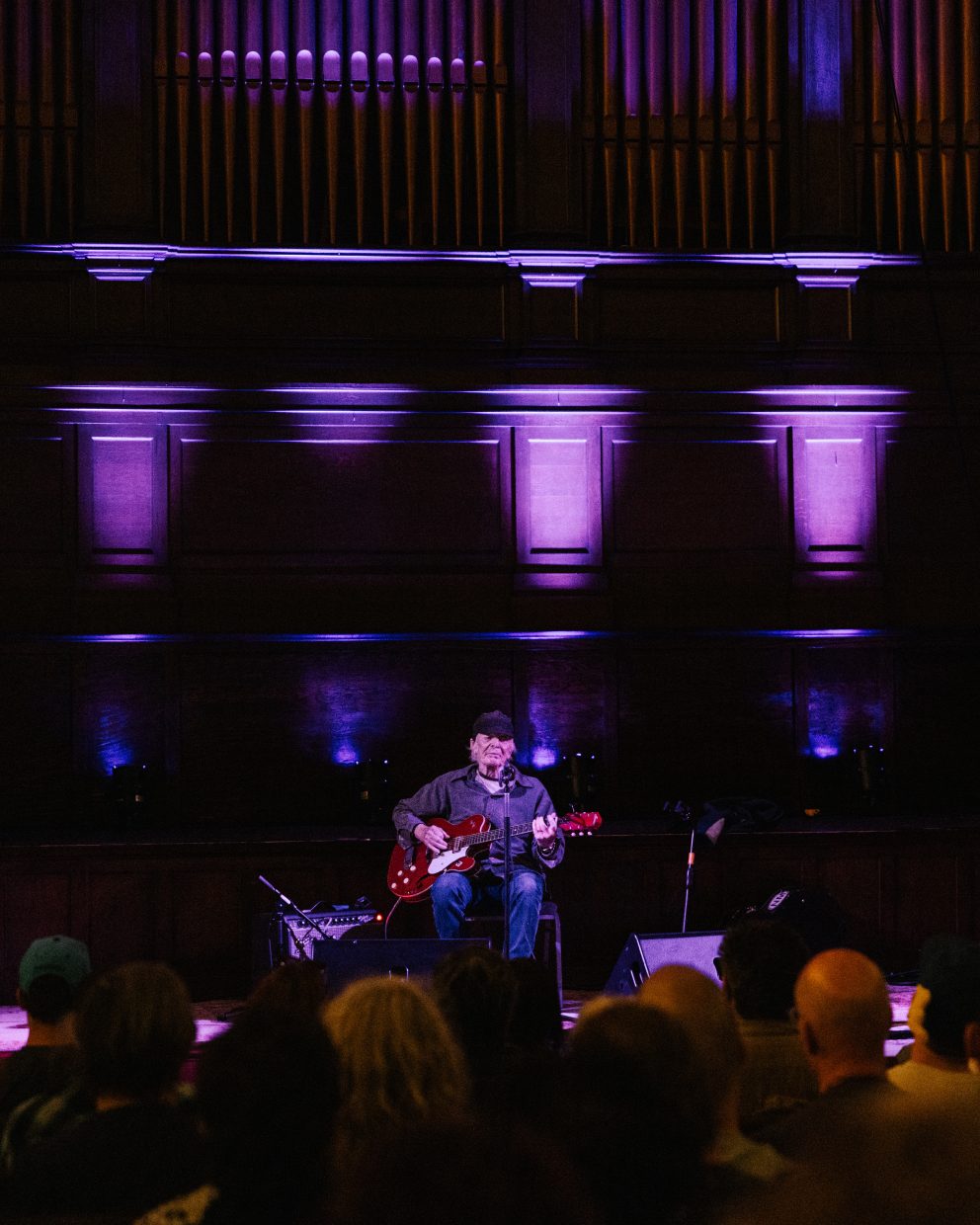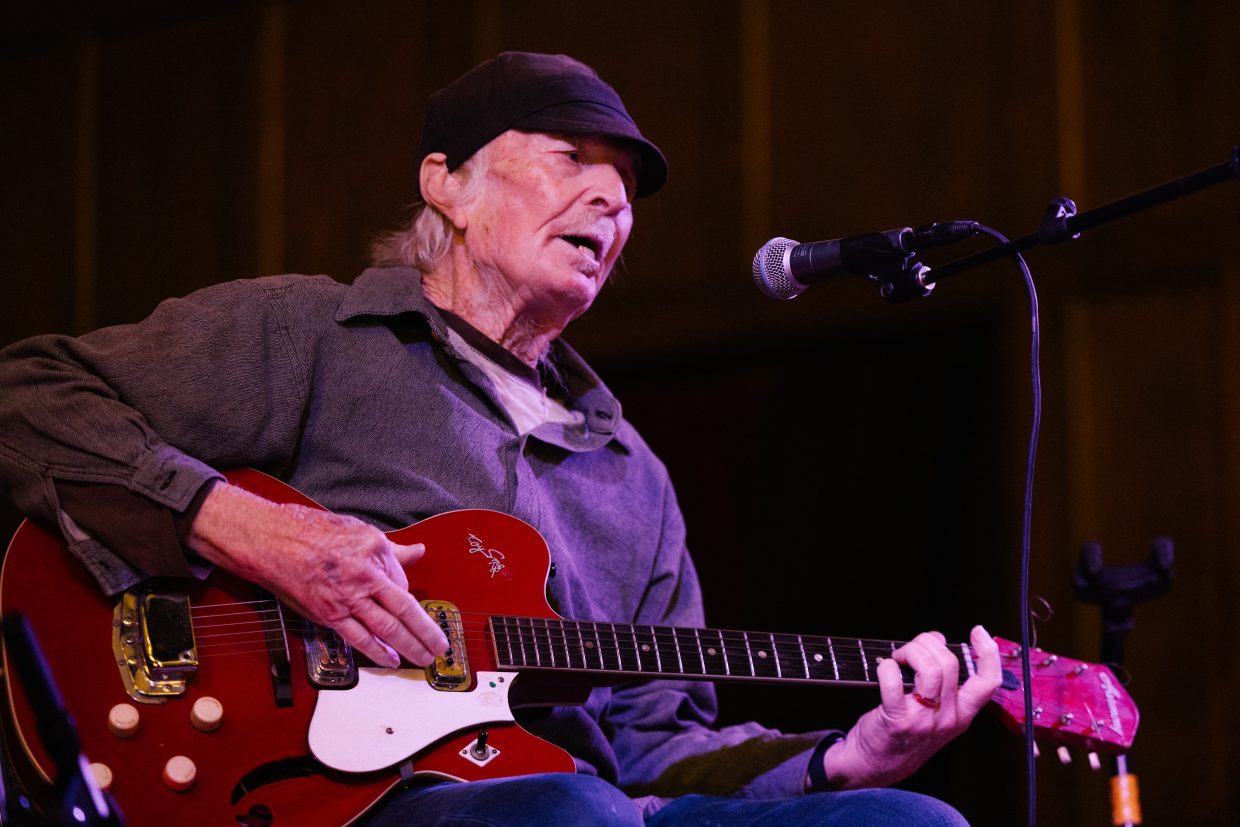
Buck Meek’s Musical Worlds Collide

Buck Meek doesn’t give the whole game away. It’s not guaranteed he’ll tell you exactly what his songs are about. However, he will expound, in detail no less, on how he gets himself in alignment to write them and what the mechanics of his songwriting process look and feel like. After six albums with Big Thief and four solo albums, most recently The Mirror, he has more than earned the right to hold back in some ways while sharing deeply in others.

Born and raised in Wimberley, Texas, Meek grew up playing guitar, singing, and writing songs surrounded by a community of old-guard outlaw songwriters, western swing players, and barrelhouse blues musicians who took him under their wing at a young age, taught him how to play it how he felt it, and gave him his first gigs around the Texas Hill Country. At the same time, annual trips to the nearby Kerrville Folk Festival introduced him to the rich traditions of Texan folk music.

As the grandson of scholars who studied the two Williams – Shakespeare and Faulkner – and the son of a child psychologist and a glass sculptor, it’s easy to surmise he was never short on literature and art. His depth of influence and fluency come through in how he speaks about his musical practice and his commitment to it.

When he was 17, Meek left Texas for Boston, where he studied jazz at Berklee College of Music before finding community with a generation of young musicians who wanted to write their own songs and play sweaty rock shows in basements. Later, he moved to New York, where he began performing with Adrianne Lenker. The two musicians lived in a van, singing their songs across the country before forming Big Thief. Fourteen years later, the East Coast’s long-standing punk and rock traditions are as much a part of his musical DNA as the Americana, country, folk, and blues he was raised on. The eureka moment came when he let his two worlds collide musically.

Produced by Big Thief drummer James Krivchenia, The Mirror features a stunning cast of family and friends turned collaborators, including his brother Dylan, Lenker, the hauntological harpist Mary Lattimore, Adam Brisbane, Germaine Dunes, Staci Foster, and the Avant-Americana icon and former BGS advice columnist Jolie Holland.

Opening with the range-roving rhythms and bittersweetly sung melodies of “Gasoline,” Meek digs into the intricacies of relationships and communication throughout the album, rendering them in a traditionalist alt-country and western style, underpinned by modular synthesis and subtle electronic textures from Krivchenia and engineer Adrian Olsen.

On “Can I Mend It,” he describes a deeply regrettable moment where raw emotions crystallize, before shattering into a million potentially irreparable fragments. As he laments on the chorus, “Can I mend it?/ Can I make it whole?/ Now that you’ve seen into the dark side of my soul.” Later, when Meek looks in the mirror on “Demon,” Olsen’s modular synthesis briefly overpowers the band with a not-so-subtle squelch. As with all parts of the album, there’s a reason for this.

By the time The Mirror closes with the summery, sunset shuffle of “Outta Body,” we’ve lived with Meek for a spell. Although, as he argues in this interview, we never really fully know anyone else, or even ourselves for that matter. Sometimes, when you look at someone from that right angle, or let our communication move beyond words, we achieve brief but precious moments of understanding.

On a Wednesday morning in early March, Meek spoke with Good Country by video call about all of the above and more.

How are you doing? What do your days look like at the moment?

Buck Meek: I just moved to Los Angeles. I got this big old yard, but the fence is kind of patchy. My little dog keeps running away. I’ve just been chasing my dog around every day. She keeps escaping and there are peacocks everywhere in my neighborhood. So my dog is just chasing peacocks all day long. I’ve also been trying to learn how to garden a little bit, planting some plants, and doing lots of interviews.

It’s one thing to be in a band that succeeds, but it’s a whole other thing to be able to have a solo career as well. What’s the difference between how things have played out for you and the future you imagined when you were younger?

I grew up playing blues, ragtime, and jazz manouche with some local cats, Django Porter and Brandon Gist, and playing in icehouses around the Texas Hill Country. I felt really happy when I played the guitar, and that was enough. I didn’t really have any idea what it even meant to be a musician in the world. When you’re a kid, you don’t know how any of that works. Of course, I idolized Jimmy Page and the like, but that felt completely out of reach.

Do you think what you’re describing was a common experience for musicians your age growing up in Texas?

I think the bar bands of the world are the modern folk musicians. Really, the people who are keeping the songs alive are the ones who have never made an album, or nobody’s ever heard of. The people who play in bars around the world in small towns. They’re the ones who keep the spirit of music alive. There is this incredible relationship between the elders at the bars and the little kids coming up as guitar students. Inevitably, the star kid, the kid who works the hardest, gets taken under the wing by the old-timer as their protege. There are these beautiful relationships that pass down knowledge. I think you find that pretty much everywhere.

I’ve gone on to have bands with names and travel around the world, but when I’m on stage playing guitar, it still feels the same as it did back then. It’s just me and my guitar. It’s a very simple form of happiness. It’s very fulfilling, whether people show up or not. There’s a life cycle to attention, but as long as I have my guitar, I don’t care.

At the heart of it, it’s about your relationship with your instruments and the musicians you play with, right?

Totally. In the words of Tom Sachs, the reward for good work is more work. As long as I get to do it again the next day, I’m good.

When you think about your career in Big Thief and as a solo artist, do you feel like you’ve mostly been able to do it on your own terms?

Yes, for the most part, but we’ve done it collectively. Everyone in Big Thief is very uncompromising in our own ways, but we all have blind spots. Because we’re a group of people, we’re able to call each other out on our blind spots, maintain our collective lack of compromise, and never sell out, never sell our souls. I’ve been lucky to be surrounded by people who have a perspective on that. We’ve done it on our own terms. I’ve definitely learned the power of that over the years.

Do you ever feel like you were born in the wrong era?

No, I don’t feel that way. I’m stoked.

What do you think the era you emerged within has afforded you that a previous era might not have?

Of course, it’s a two-headed monster, but access to communication, for example, how we’re talking now, helps so much. Not being beholden to a record label giving you a budget, and being able to record your own music at home is huge as well. Now, people are able to hear that music on Bandcamp or the like, which allows you to go and play shows around the world. That’s a very new phenomenon. It’s been a huge part of building my career.

When we started booking tours, we recorded our first album at our friend’s house. We were burning copies to CD-R, putting them in brown paper bags, and passing them out to anyone we could think of. We basically asked all our friends in Brooklyn if they had friends in other towns and got their email addresses. We’d email them our record and ask if we could play a show in the town where they lived. We just kind of pieced this tour together around the country.

We used the internet as a tool to get started, but we’d drive to these towns, meet these people, shake their hands, and become friends. Eventually, we moved out of our apartments, bought a crappy van, hit the road, and played a lot of shows: parties, basements, whatever. Getting in a room with people was essential.

How do you feel about going on the road by yourself?

Lately, I really enjoy traveling with a band. I’ve had some really good solo tours, especially down in the desert and around the Southwest. My friend Tony Presley, who runs the label Keeled Scales, released my first two solo records. He’s an Austin kid. He’s a booking agent as well, but he primarily books small towns and DIY venues. He booked a few tours for me around the Southwest. Taos in New Mexico, out in the desert, El Paso and Santa Fe. Little towns in Arizona, and out in the Hill Country of Texas, stuff like that. That’s always a lot of fun.

How much impact do you think the people you meet through these experiences have had on your music?

I think they’ve made me who I am, which has a big impact on my music. I mostly think of songwriting as the time I spend away from my guitar and my songs. I really try to put it down and just go out into the world and live my life. That’s the real work, living your life as a person in the world.

How close do you think we can get to truly knowing another person?

We never fully get there. I think the closest we can often get is by looking at them sideways or trying to find oblique solutions to communication. I think language is really powerful, but it’s limited. The space between words and conversations, and unspoken communication, often adds up to more of an understanding. The truth is, we never fully know ourselves either. So how can we know someone else? Often, I feel like it’s easier to understand someone else than to understand yourself. I think it’s just shifting constantly. There are moments of understanding, but there’s never any kind of permanence.

Tell me about the conditions under which your new album came together.

I spent a couple of years just living my life. I was living in a log cabin in Topanga and booked a recording date with my band about six months in advance. I sat on the porch every day for eight hours and wrote these songs. I’m blessed to have the resources to do that thanks to my label, 4AD. I put in the time to write the tunes, and then I brought the band together in the cabin.

We set up the big living room with the drums. I stood on the front porch and recorded the vocals outside with a big window into the living room. So there was enough isolation for the drums. Our producer, James Krivchenia, had this setup of electronic instruments and modular synths in the control room with our engineer, Adrian Olsen. They were using the live band as triggers for modular synths and some electronic synthesis feedback in the mix. The album was made live with my band. We moved pretty quickly. There was about a week and a half of tracking.

The other thing I’m the proudest of is how much fun we had making it. It was a great group of people. We had a blast cooking good meals, playing cards, and running around the woods. The music was just a small part of it. I’m glad I can share it as an artifact, but the experience was really the best part.

I thought it was interesting how subtle the use of modular synthesis was.

The entry point for the idea was to be pretty bold, but in practice, the band held a lot of space for the songs. James wanted to focus on the songs as the primary force. There were certain moments where the modular synth took the lead. At one point in the song “Demon,” it kind of takes over and swallows the band for a second. There’s this battle between the two worlds.

For the most part, it’s pretty subtle. For me, it represents the subconscious. The band is the conscious world – a structured, acoustic-instrument world. The electronic elements represent the subconscious. I speak about this in the lyrics of these songs, this kind of play between the conscious and subconscious, intention and intuition, and all these things. It’s subtle, but if you were to remove the electronics, the impact would be great.

It’s like Ernest Hemingway’s iceberg theory. You only ever see the 20% of the iceberg that floats above the surface.

I think having a nod to this limitless space, this ambient world where there’s no grid, no structure, not as much transient energy, this textural, abstract, liquid aspect of the album, opens up the subconscious a little bit in the listening experience.

While listening to The Mirror, I thought about how no one has a monopoly on interiority. Just because someone doesn’t say much in a conversation doesn’t mean they don’t have a lot going on upstairs.

I like playing with that in songwriting. I feel this pressure to be precise and create a very clear map and logic for people to follow. My ideas have to be very concrete, but that’s a rule I’ve imposed on myself. It’s exciting to be able to, to some degree, reveal an abstract inner world amid structure and logic.

I know that pressure is self-imposed or has been projected onto me by society at large. It’s something I try to push back against, while still honoring the medium. There’s a reason that people want some form of relativity or underlying structure. There is always a need for a starting point in communication, but I think we must know when to depart from that structure to express the full spectrum of our ideas and truth. There’s a balance. It’s important to honor it, because otherwise you’re just isolating yourself.

When did you start thinking about songwriting in the sort of terms you’ve just articulated?

I started writing songs in high school as a confession to my high school crush. I just wrote a love song for love’s sake. It was no more complicated than that. I think that’s really the heart of a song. Ideally, for me, a song has a reason to be. It comes from some form of compulsion, or a need to articulate something or to create an artifact, to be able to pull something out of your body and observe it as some form of catharsis. To me, those are the best songs, but there are no rules for the context.

How did you develop your approach to it all?

As I started writing, my self-education was mining the world for songs that, for lack of a better term, felt good. I was trying to find songs that really moved me. Intuitively, I started trying to understand why a song makes me feel something. I’d unpack every word and learn the song and the melody while trying to understand the relationship between them. I wanted to understand how the melody sanctified the lyric and what the rhythm had to do with it.

Let’s talk about taste. There’s a constructed taste you can use as a tool to help people understand where you are. Then, there are those songs that you might not even think you like, but they make the hairs stand up on your neck.

The older I get, the more willing I am to accept those things for myself and really listen to that intuition. As a young kid, I was obsessed with pop country. In my teenage years, I rejected it. When I listen now, it still hits me in the same way it did when I was six. I’ve learned to embrace that. Sometimes, you’ve got to be able to come home. I think with this album, I was thinking about moments when my body wanted to say something, but my mind would kick in and say, “Oh, the critics won’t think that is cool, hip, or smart enough.” I had to lean into those lines and say them twice, say them louder. If you can do that, no one can touch you.

Have you ever thought about how lakes and streams were the original mirrors?

Yeah, ponds and lakes and puddles and things. Good point. They’re still enough to provide a reflection, but also fluid enough that you can throw a rock in and diffuse them. There’s still a relativity to it, which is more true to what a reflection really is. There’s some form of objectivity, but to some degree, it’s just a construct.


Photo Credit: Germaine van der Sanden
The Steel Wheels’ Songs for Humans, by Humans

It’s common these days to wring hands over the many ways powerful tech companies have meddled, without permission, in how we discover and listen to music (among other things). It’s just as common to fearfully declare that music’s good old days are past and gone. But after 20 years as a working band, we know that the strength of community through music is much more enduring; and we see it all the time.

There is no greater force than a group of people who are ready to share a joyful experience. It doesn’t matter if they’re gathering to jam, attend a concert, or anything else. People in community can create strong connections in a heartbeat, under almost any circumstances, and music is a powerful vehicle for it. Some days it feels harder than others to find that spark, but it’s always there if we come together and dig for it. Every day the pressure grows to strip the things we all have made and love for parts, but collectively we can raise our voices and push back. As a band, we’re choosing to resist that force and to keep building things. Together.

This playlist features artists that we feel musical and professional kinship with, bands that have been around and are well into their careers. The songs we chose come from albums that are worth spending time with over and over again. These folks have played lots and lots of gigs and revel in the energy of a great show as much as we do. You’ll also find some music from our 9th studio album, The Steel Wheels, too. Music that we made together in a room. – The Steel Wheels

“Easy” – The Steel Wheels

A breezy song with a swirling fiddle intro and a big question at its heart. We live in the future now, with the entire world available to us on the other side of our screens. So why are we lonelier than ever? If everything is supposed to be easy, why does it all feel so hard?

“Talk Is Cheap” – Dr. Dog

Because they inspired me with one incredible Bristol Rhythm & Roots Reunion set probably 15 years ago. Their old amps, their confident trailblazing of their sound that was clearly referential and respectful – but not chasing what a lot of other bands were chasing.

“Los Angeles” – Big Thief

An artist’s job is to remain open and soft to the world and to distill all that pain and joy into work that transmits emotion across space and time. Somehow, Big Thief seems to only become less jaded with time, maintaining curiosity and exploration as part of their creative process.

“Go Back” – The Steel Wheels

All deep relationships come with joy and with pain. To be rid of one you would also lose the other. It’s part of lived experience, this is a reminder to embrace all of it. True connection is worth it.

“Waiting For The Sun” – The Jayhawks

The Jayhawks are a band that prove you can continue to forge your own way and make it through the highs and lows. I was still really just a kid when I discovered them through some older cats I was playing with at the time. Son Volt and Wilco were very much in the alt-country scene and the Jayhawks just had something a bit different going on.

“Worried About The Weather” – Greensky Bluegrass

I love the way this song pivots between the anxiety of pushing forward through uncertainty and the breezy delight of taking a moment to enjoy the journey. There’s momentum to both things and “Weather” has tons of it.

“Keep On Dancing” – The Steel Wheels

Let’s take a break from responsibilities to just see ourselves and each other. Don’t forget to breathe and to appreciate the unadorned peace that can fill the spaces between us.

“I And Love And You” – The Avett Brothers

Even a track like this, one full of solitary stillness, shows the Avetts’ songs are packed with other people. They always remind me that I’m not as alone as I often feel. You can sense the presence of old partners and family throughout this song even though the speaker is alone in their car.

“Valerie” – The Brothers Comatose

These guys are everybody’s friends. Maybe the acoustic Dawes? I don’t know. We’ve known them a long time and they keep bringing joy and fun with warmth and grounded songs that don’t rely too heavily on bluegrass tropes.

“Sway / Endless Highway (Pt. 2)” – Watchhouse

Watchhouse invest deep thought into every lyric and intention into every note without ever seeming to overthink their process or get held back by previous work. “Sway / Endless Highway (Pt. 2)” demonstrates how the band is constantly in conversation, transitioning between tempos and driving down into a deep groove with a breeziness that belies the technical mastery of their acoustic instruments. At a Watchhouse show, the crowd will hang on every note and every silence, sharing a reverence for the song with the band.

“Slow Rise (to the middle)” – The Wood Brothers

Oliver, Chris, and Jano seem to be propelled forward by some groove force that penetrates everything they do and they invite listeners to join in on the funky joy. Their track “Slow Rise (to the middle)” tips a hat to their musical journey. To be in an audience is to get lost in the moment, only to occasionally remind yourself how wild it is that all the sounds coming from the stage emanate from just three musicians.

“Way Down Yonder ” – Chatham County Line

I first heard Chatham County Line when I opened for them at The Livery in Benton Harbor, Michigan, with a jamgrass band I was in, probably 20 years ago. They were tight and had their act together. I was blown away by their professionalism and it made a big impact on me. I will never forget that moment and I’m still inspired by their creativity and longevity as a band.


Photo Credit: Monik Geisel

Photos & Memories: Remembering Roots Music Troubadour-Poet, Michael Hurley

(Editor’s Note: Thanks to our friends at Big Ears Festival, held at the end of March in Knoxville, Tennessee, we’re able to share these photos of revered folk icon Michael Hurley taken during what the world would later realize were two of his final performances, captured shortly before he passed on April 1, 2025. 

To honor Hurley’s incredible legacy and his indelible impact on roots music, we’ve paired the photographs from Big Ears with a heartfelt remembrance by longtime Hurley acolyte and BGS contributor Dana Yewbank.

Our hearts go out to Michael Hurley’s friends, family, loved ones, and collaborators as we all grieve this humble-yet-towering figure in our corner of the music world; our gratitude goes out to Big Ears for sharing these intimate and lovely time capsule photographs.)

I first encountered Michael Hurley – the influential singer-songwriter who recently passed at the age of 83 – in a room painted like a 1960s rendering of a time machine. Big black-and-white spirals looped around the floor of the stage, awash in a moody, pink glow.

The show was at the Woodland Theater in Seattle, Washington, in 2018. I was there with friends – a ragtag group of fellow musicians who’d all been inspired by Hurley’s music in one way or another. My friend Bobby wore a shirt from Oakland’s Burger Boogaloo festival, which rings like the name of a Michael Hurley song that never was.

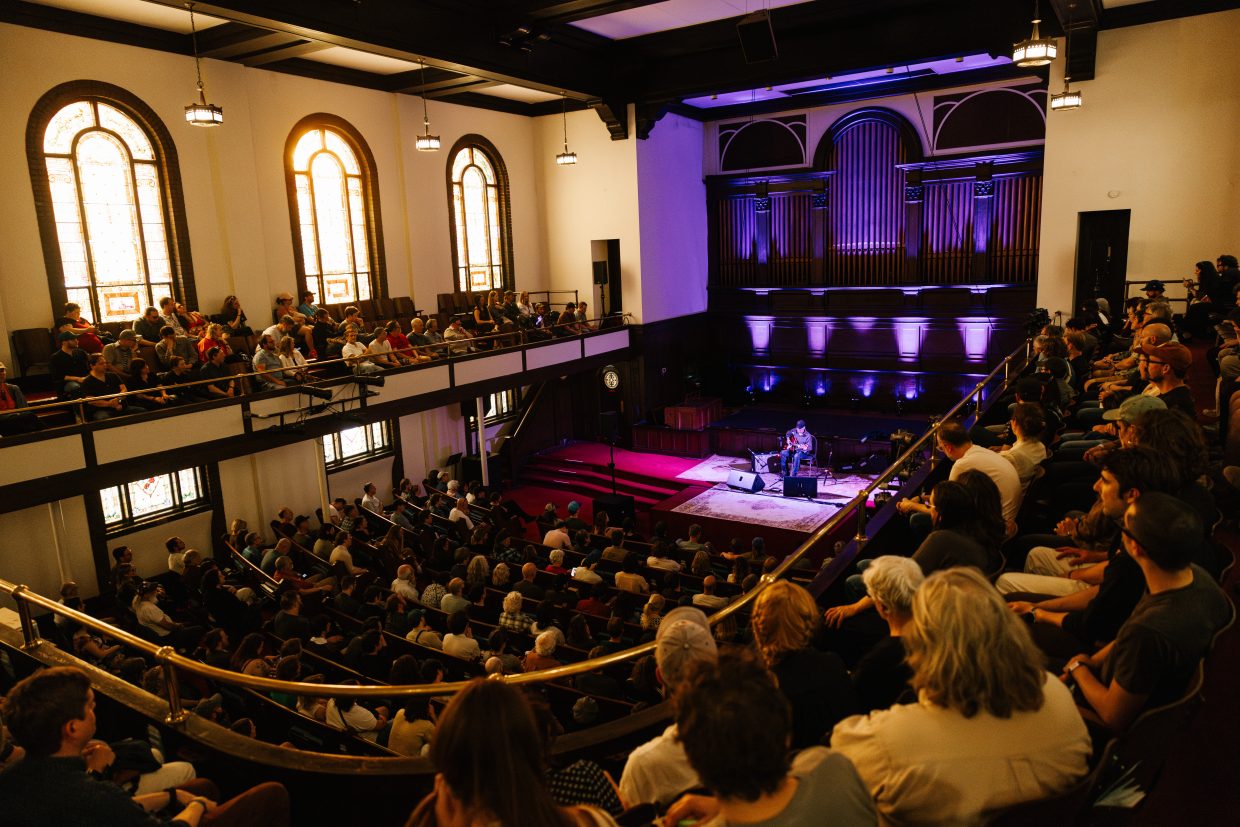
Michael Hurley performs for his official Big Ears appearance to a packed house at the Point in Knoxville, TN. Photo by Andy Feliu.

We got there early. In a performance space the size of a small café, Hurley was sitting in the corner next to the stage, quietly playing a worn piano. My friends and I exchanged looks of mild wonder, realizing we had walked in on something unexpectedly intimate. Quietly finding seats among the folding chairs, we soaked in the scene as the room filled up. Throughout the night, we interacted with Hurley in passing as if we were all just milling about someone’s living room. He attentively watched all the opening sets. Bobby showed him where the bathroom was. Hurley never acted like a living Americana legend, even though he was one.

Raised in Bucks County, Pennsylvania, and an eventual cultural fixture of Astoria, Oregon, Michael Hurley wrote and recorded surreal, folk-esque blues and Americana songs across seven decades. He also made comics, self-published several art zines, and made an unspeakable impression on the broad world of American folk music. He continued to perform up until his death, which came suddenly the day after his final performance. Michael Hurley spent his last evening on earth playing his timeless, effervescent songs at the AyurPrana Listening Room in Asheville, North Carolina.

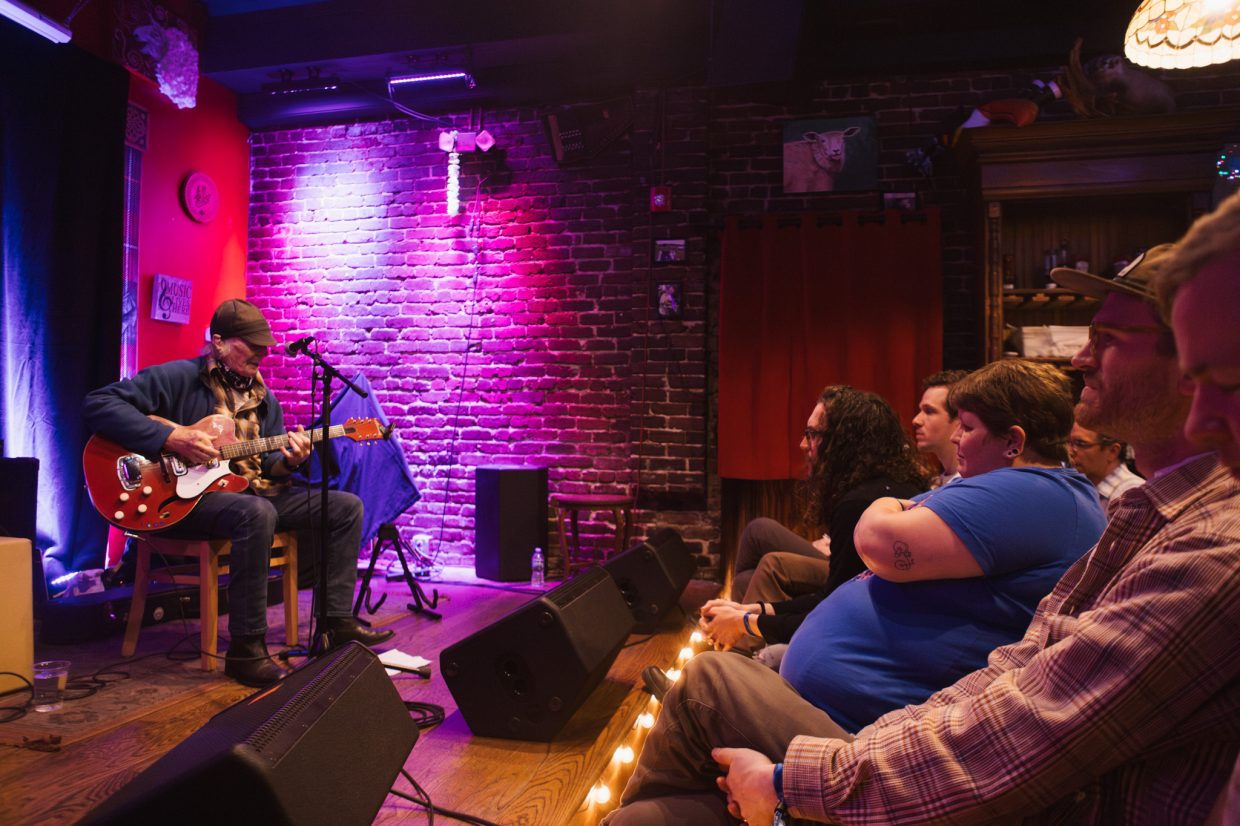
Michael Hurley also wowed a small audience at a surprise Big Ears performance at Boyd’s Jig & Reel, a small Celtic pub. Photo by Joeleen Hubbard.

My doorway into the world of Michael Hurley was First Songs, a lo-fi collection of recordings published by Folkways in 1963. The songs on that album have a subtle, somber quality that’s harder to find on Hurley’s later, more jovial records. Listening, it feels like taking a long, slow walk through a deep forest at dusk. Less sunshine and laughter than Have Moicy! or Long Journey, but as a sad, confused 20-something, the mist and mystery of First Songs drew me in. “Animal Song” will always be the sound of being 24, reluctantly living back in my small Northwestern hometown, not far from the place Hurley would eventually call home.

But melancholia is far from what Michael Hurley became known for. Instead, his music is beloved for its surrealism, lightheartedness, and humor. Hurley sang about aliens, ghosts, werewolves, and potatoes. His songs abound with clever turns of phrase and humble imperfection, offering a sort of unselfconscious freedom to listener and musician alike.

That night at the show in Seattle, a 76-year-old Hurley played for an impressive two-and-a-half hours, never seeming to lose steam. He must have played through at least 50 songs by the end of the night, which doesn’t even touch the several hundred he wrote and recorded throughout his life.

The magical Michael Hurley, mid-surprise appearance at Boyd’s Jig & Reel. Photo by Joeleen Hubbard.

Despite being called the “godfather of freak folk,” Michael Hurley never fancied himself a folk musician. Most of his influences fit squarely in the world of jazz and blues: Lead Belly, Lightning Hopkins, Fats Waller. He even cited country songwriters like Hank Williams, but rarely any notable folk artists. His eclectic influences make sense: Hurley’s songs have an unpredictable liveliness to them. They jump and wander, following a path seemingly guided by Hurley’s creative intuition alone.

But when it came to how he approached his life and career, Hurley lived fully into the folk tradition. He made his own album art, released some of his own records, and toured with zero frills. He also had a salt-of-the-earth political ethos and didn’t shy away from using music as activism. In 2014, Hurley assembled a compilation of “anti-Monsanto songs” and released them for free on Bandcamp.

Michael Hurley performs at the Point at Big Ears Festival. Photo by Andy Feliu.

Hurley (or Elwood Snock, as he liked being called) was a musician of the people, only ever taking himself just seriously enough, unafraid of welcoming play and spontaneity into his work. His legacy has a lot to teach us about just how essential these qualities are to the creative process — because if making art isn’t a form of play, then what is it?

That unbridled, unbothered element makes Hurley’s music deeply comforting and grounding. It roils and pops like a low fire you can warm yourself by. It’s trustworthy and safe, emerging from the endless present moment, bubbling up like a fountain from which we can all drink.

Michael Hurley by Andy Feliu.

Honey, honey, honey,
have you ever blowed bubbles
underwater when you’re feeling bad?
You let your lips begin a-buzzin’
the bubbles rush up like mad.
Right there you’ve got somethin’
to help you out
when you ain’t got nothin’
to brag about.

– from “Driving Wheel,” Sweet Moicy! (1976)

Hurley frequently collaborated with other artists – from his Unholy Modal Rounders to Marisa Anderson and Kassi Valazza – and he continued to make new connections well into his final years. Adrianne Lenker, who counted Hurley as a friend, recently credited him as one of the reasons Big Thief became a band, in a post memorializing Hurley on Instagram.

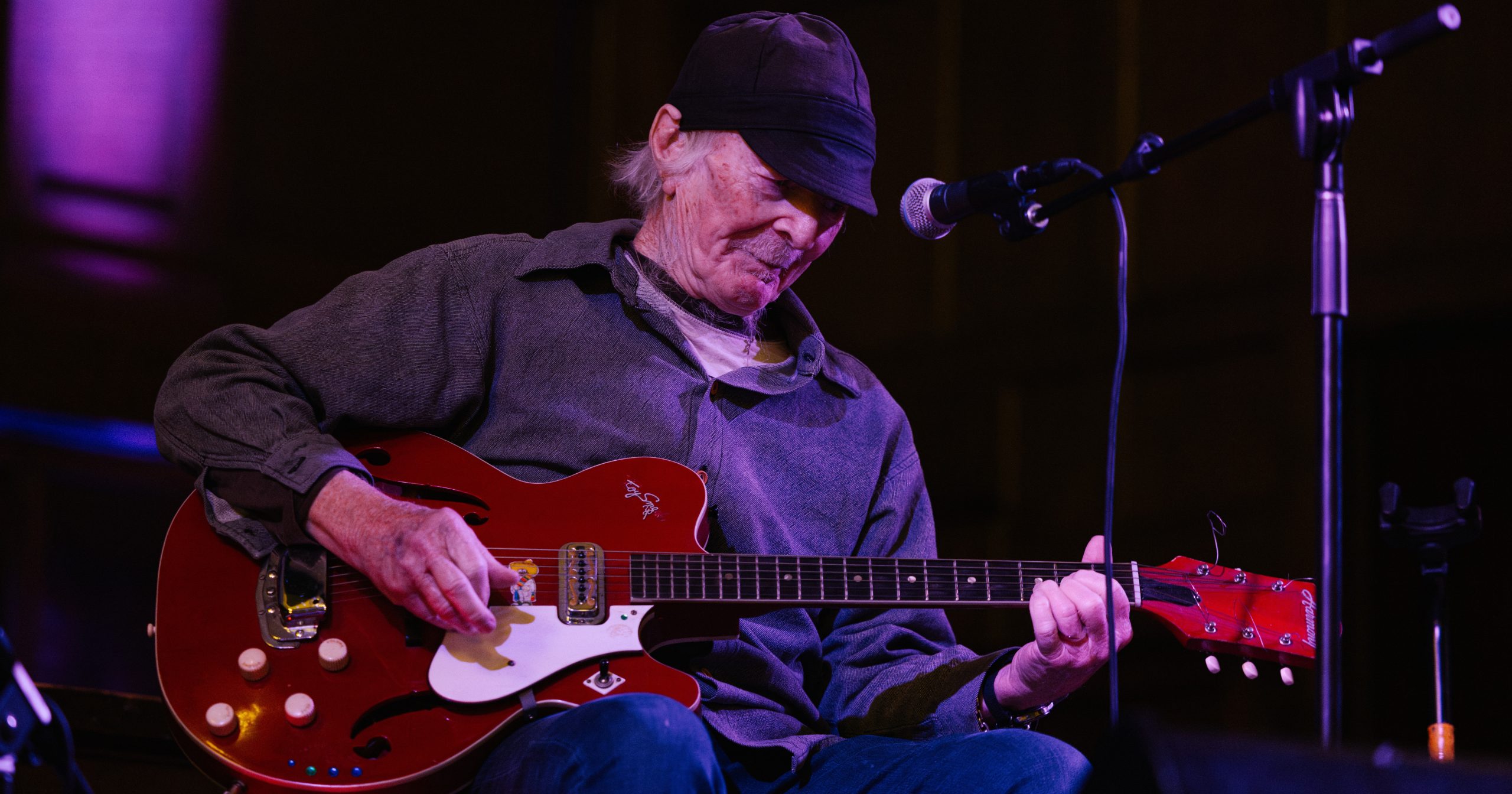
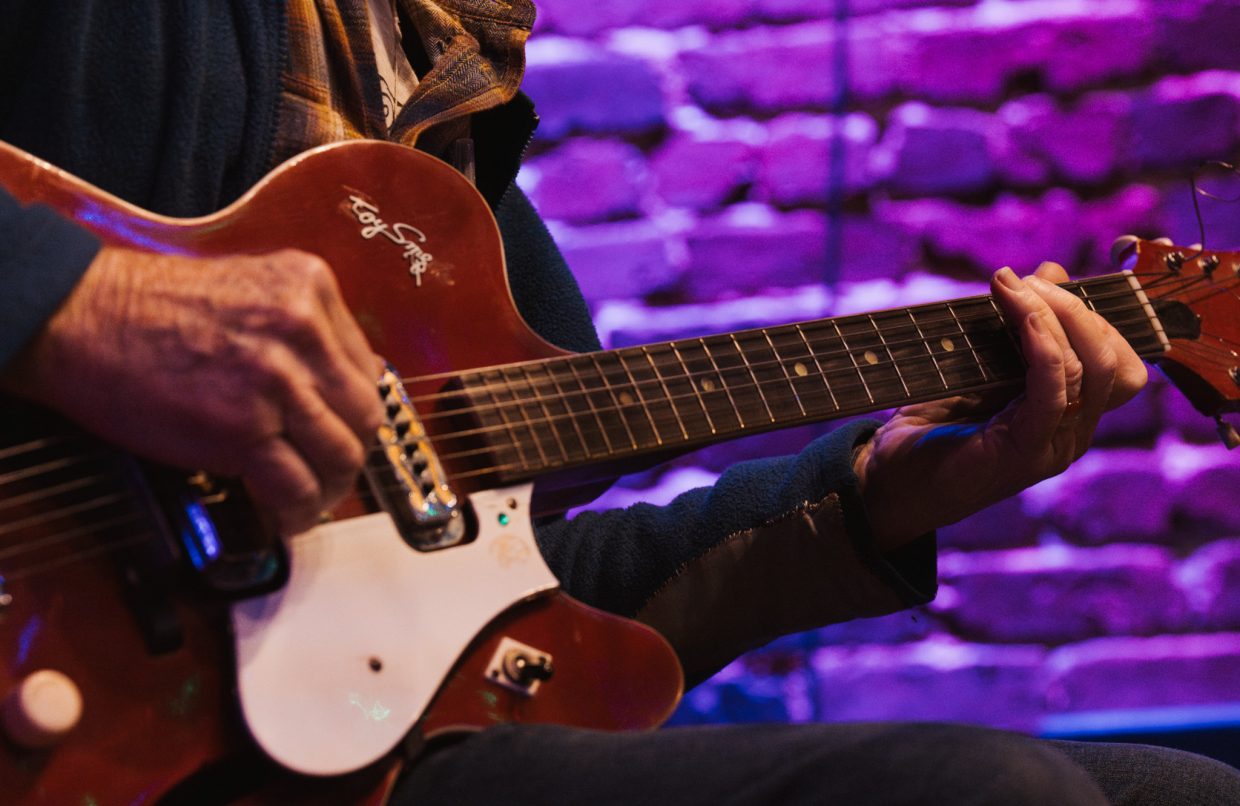
Michael Hurley’s red Harmony Roy Smeck guitar. Photo by Joeleen Hubbard.

Infinite rivulets flow out from Snock’s work, watering seeds of creativity wherever they go, rippling and rolling over the landscape much like Hurley did – from Jersey City to Vermont to Astoria.

Michael Hurley passed on April Fool’s Day, which is painfully fitting. He loved a good joke, taking things that might otherwise feel heavy and heartbreaking and peppering them with levity and brightness. Now, in his absence, we can let his songs buoy us through dark times, of which there are too many, and laugh alongside us in the light.


All photos courtesy of Big Ears, shot by Joeleen Hubbard and Andy Feliu as credited. Lead Image: Andy Feliu. 

MIXTAPE: Melanie MacLaren’s Love & Loss Playlist

Welcome to my Mixtape of loss and love! I hope you don’t need it right now, but if you do, it’s here to bring you a little comfort. When I was making it, I started out trying to make the most devastating playlist I could make, but then halfway through I decided to make something I’d actually enjoy listening to. Something that mimics the way we process loss and love– yes, there’s a lot of time spent in really dark places, but there’s also so much humor in the face of everything and a lot of reluctant joy, showing its light despite our best efforts to draw the curtains and hide.

That dialogue between loss and joy is at the heart of my EP, Bloodlust, which just came out on October 24. I wrote this project coming out of a period of life that was marred by grief, death, and illness, so naturally I had a lot of heavy stuff on my mind, but I felt this overwhelming need to write some of the most upbeat and energetic songs I’ve ever written.

Sometimes it helps to grieve and sulk and sometimes you want to just roll down the windows and feel your pain casually, communally, and maybe even with the last laugh. I think there’s room on this Mixtape to do both. – Melanie MacLaren

“Wayside/Back in Time” – Gillian Welch

We like to think of a loss as these finite events, but sometimes it’s a long, steady process, the passing of time and dissolution of relationships, a slow decline of health. Loss can sometimes simply be the progression of time, and Gillian Welch’s writing is so timeless, too, that it strengthens that feeling – she could be singing from any time about any time, as long as it’s gone.

“Change” – Big Thief

Thinking of loss as simply “change” is really difficult, but at its core that’s what it is.

“Flirted With You All My Life” – Vic Chesnutt

This song is wild. I remember the first time someone played this for me on a road trip, I was smiling thinking, “Oh man, he really likes me,” and then that guitar comes in and the lyrics change tone completely and you realize the whole song is about death. It’s a funny phenomenon. You can feel the sky darkening at that moment. But then you listen to the song again with all that in mind and you still feel happy in the first half of the song. I think that’s part of the beauty of it too– knowing the ending and still being receptive to joy.

“beachball” – Dan Reeder

This is a 90-second song about a beachball that makes me bawl my eyes out. I love Dan Reeder.

“Buffalo” – Hurray for the Riff Raff

I have a soft spot for songs that talk about animals (I guess that’s why I wrote a song about Laika for my EP). I think we can talk about them in a way that we’re afraid to talk about ourselves. Their fear is our fear, but it’s hard for us to think of it that way. Asking if the love we share with each other as humans will last forever or if it will go extinct the way that some animals have, at our hands, feels really bold.

“Bloodlust” – Melanie MacLaren

This is the title track off my new EP. This whole project is me trying to make peace with the constant cycles of loss and love we all inevitably experience in our lives. They’re natural like the seasons, but they still feel so overwhelming and unnatural. It was also my attempt to experience moments of joy while not shutting out my grief and anger.

“Random Rules” – Silver Jews

Love and loss are so incredibly random that it would be funny if it didn’t matter so much to us. I always laugh a little at the first line and feel really nonchalant in a dumb way. It sounds like wearing sunglasses inside to me. But then, by the second verse, I’m fully feeling my feelings and replaying every little thing that’s gone wrong between me and every person I’ve ever cared about.

“New Partner” – Palace Music

I like to listen to this song when I’m driving alone and see who I picture in the passenger seat beside me. It changes a lot. That’s probably a good thing.

“I’ve Got a Darkness” – Mick Flannery

Mick Flannery writes the best songs. This song is such a devastating portrait of generational pain and an ode to the fact that we can feel the effects of loss and love that we’ve never experienced in our own lifetime. We carry so much with us that we’re not even aware of.

“Lake Charles” – Lucinda Williams

I love how the verses are just memories, snapshots of life, and all questions and talk of death is reserved for the chorus. It’s such a beautiful homage that way, letting someone still be alive in the song and just describing things as they were, but then still asking those bigger questions because you can’t help but ask when you’ve lost someone you love. You just hope they’re ok.

“The Arrangements” – Willi Carlisle

I love the line, “It’s still sad when bad love dies.” Amazing album with lots of songs about animals.

“Whatever Happened to Us” – Loudon Wainwright III

I love how blunt this song is and how it relies on humor in the face of loss. I heard it for the first time this summer, after I had recorded my song “Get It Back.” I immediately resonated with its matter-of-fact nature. I also love the wordplay in it; I think having fun with language is a way we as humans maintain a little bit of control of the narrative of things we don’t really have much actual agency over.

“Donut Seam” – Adrianne Lenker

There’s so much off this album that could be on this playlist. I almost went with “Sadness as a Gift,” but I really loved the way this song intertwines a dying love with the feeling that the world is dying. Even if that isn’t literal, it often feels literal. The harmony on “what it means to walk that line” makes me feel human.

“Days of the Years” – The Felice Brothers

I love how loss is naturally integrated with the mundane and the beautiful: “These are the days, of the years, of my life.” What else is there?

“Don’t Let Us Get Sick” Solo Acoustic – Warren Zevon

The simplicity of this song is so overwhelming, especially from a writer who can obviously complicate things lyrically and musically when he wants to. He just stays in this sort of The Muppet Christmas Carol arena (compliment!) and it’s so effective, because what he’s asking for is so simple. It sounds like a child’s prayer.


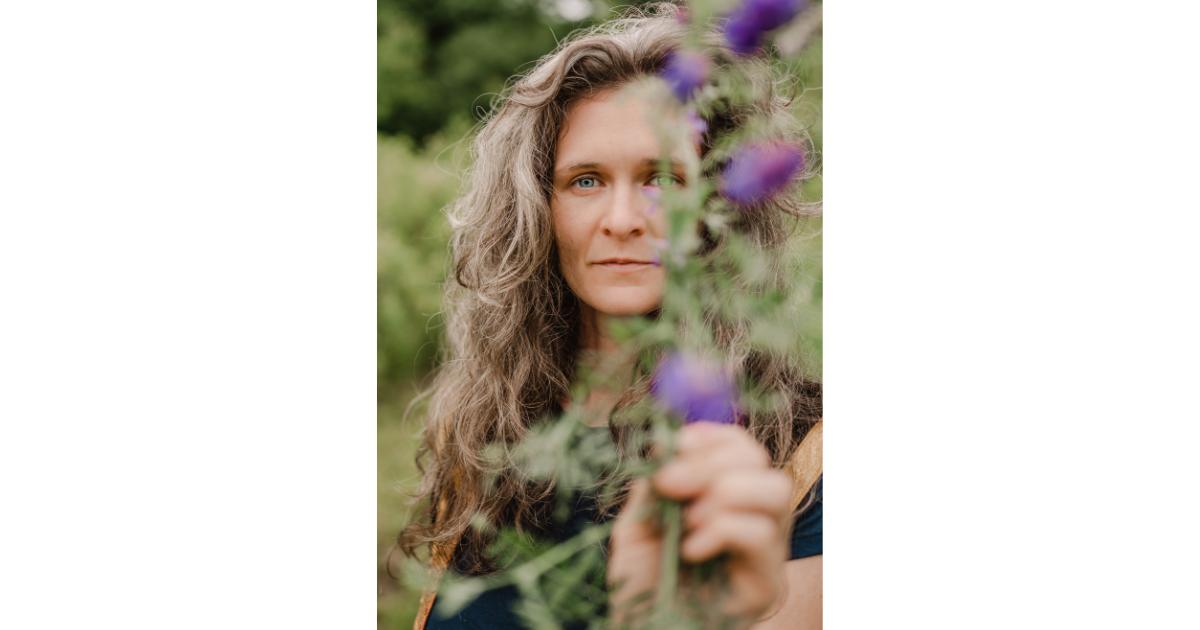
Photo Credit: Blaire Beamer

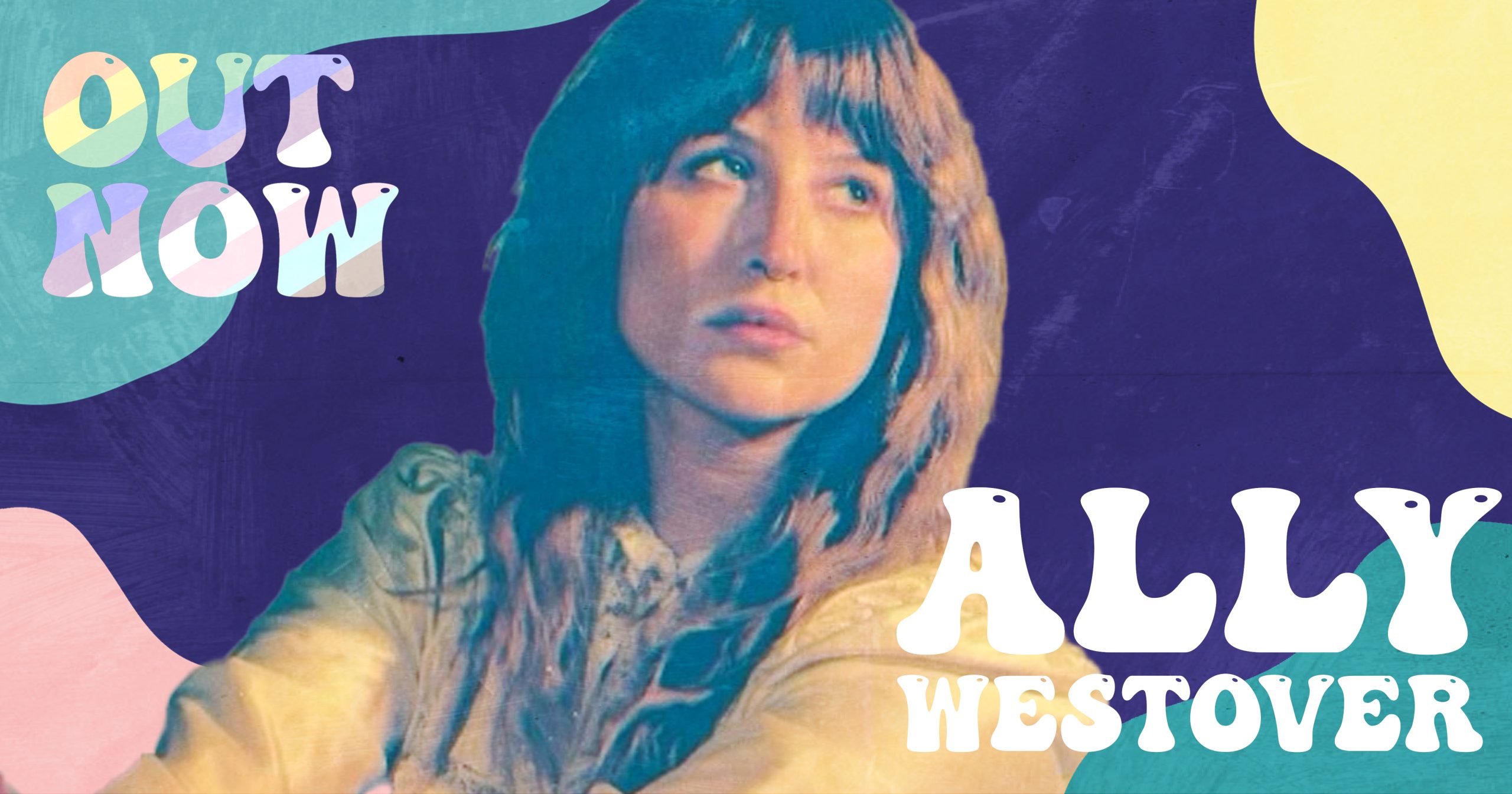
Out Now: Ally Westover

Ally Westover is a Nashville-based artist known for a blend of lullaby-like sounds and groovy indie-folk tunes, stitched together with warmth, imagery, and honesty. Her new single, “Rotten Milk” (available September 6), is an exploration of queer identity. The lyrics circle relatable themes like love gone sour and compulsory heterosexuality – a term coined by Adrienne Rich to describe societal expectations queer women face around conforming to heterosexual norms. The concept resonates with many queer women who struggle to navigate their identities.

It’s exciting to feature an artist who is opening a discussion around these ideas. Ally’s EP, Changing Room, dives further into these themes and is to be released in January 2025. In our Out Now interview, she shares her current state of mind, what it means to her to be an LGBTQ+ artist, and how she balances the business and creative aspects of being an artist.

You are releasing an EP in 2025 titled Changing Room. What was the process of creating this project? And, what do you hope listeners will take away from this collection of songs?

I created this project with my friend and musical mentor, Oliver Hopkins. He is one of the people that inspires me most in this world and to make a record with him is an absolute dream come true. I came to him with a few songs that I loved and believed in, but wanted him to help me make them sound more focussed and sonically interesting.

We wrote “Rotten Milk” in his backyard in the height of the summer heat after I had just gotten out of a relationship with a man that felt like a stranger. The track that follows is “Waterbug,” which is my absolute favorite. It encompasses queer desire and yearning. The last song is called “Digital Body” and it’s all about decompressing and slowing things down. I hope that listeners enjoy the songs and feel maybe a little more understood in their own lives. More than anything I am just happy to have the songs in the world!

Why do you create music? What’s more satisfying to you, the process or the outcome?

Songwriting itself is pure magic. The energy present during the process is what propels me to dig for more songs. I create music because I have to! It is the way that I work through my emotions and thoughts and fears. It is the time capsule for my life. It is the way that I cope with being human.

Do you create music primarily for yourself or for others?

Initially, I create music for myself. And when it is done, I look forward to sharing the songs with other people so that they may feel less alone as I believe we all have similar struggles. It’s my hope that through sharing music, we all feel more connected to each other at a soul level.

Who are your favorite LGBTQ+ artists and bands?

Courtney Barnett, MUNA, Big Thief, Chappell Roan, Katy Kirby, Arlo Parks, Tash Sultana, Cassidy Maude, Ab Lag, Molly Martin, Erin Rae, Liv Greene, Purser, Jobi Riccio, and Saltwater Baby are some of my favorites. Wow! There are so many! I am so grateful for queer visibility!

For anyone reading this who might not be out of the closet, were there any specific people, musicians, or resources that helped you find yourself as a queer individual?

The band MUNA saved me! Chanting songs about being gay and worthy of love really helped me feel empowered. I have an incredible sister, friends, and therapist who have stood by me through the hardest moments. The queer community in Nashville is amazing. Shout out to Jonda, the owner of Lipstick Lounge, for creating a safe haven for queer people. It was only when I realized that it is not my job to make other people comfortable, was I set free.

What does it mean to you to be an LGBTQ+ musician?

I would not be openly making music as a queer person had it not been for the Black lesbians and trans people of color that fought back during Stonewall riots. Thank you to Marsha P. Johnson, Sylvia Rivera, and Stormé DeLarverie for fighting for my right to exist and to love who I love. Being an LGBTQ+ musician means that “no one is free until everyone is free.” It means liberation, justice and resistance.

We’ve had a conversation before about how you left the music industry for a few years and decided you needed to return. What was that like for you? Could you share what drew you back and the importance of creating and sharing your music?

In the time that I was away from music, it was still plaguing my every thought. I tried to study fashion to explore a different creative outlet and that brought me to sustainability, as I learned about the horrors of the fast fashion industry. Because of this, I make all of my merch on thrifted clothes in hopes to be as eco-conscious as possible. Sustainability led me to an existential crisis so I switched majors to philosophy, which only dug me a deeper hole. It was during my philosophy class that I realized I must pursue my bliss – music! Coming back to music as my career focus felt like coming home.

What’s your ideal vision for your future?

When I think of “future me” I imagine myself traveling and playing shows with a small band, throwing killer dinner parties, and tending to a sprawling garden. The ideal vision of my future has much to do with “present me” leaning deeper into the things that I already do.

What is your greatest fear?

I have realized that I am the person who will ultimately affect the outcome of my life – so I would say that I am most afraid of the part of myself that harbors doubt.

What is your current state of mind?

My current state of mind is a collage of gratitude and helplessness; of joy and sorrow; of yearning and grieving. I grieve the genocide in Palestine amongst the many other humanitarian crises in the Congo, Sudan, and in the United States. I find it really challenging some days to be hopeful, but I try to find joy in the small moments and do everything I can to uplift marginalized voices.

I am hopeful about creating and sharing the project that I have been working on for over a year now. Entering into the fall season, I am looking forward to slowing down, going inward, and continuing to lean into my cozy home and my community.

How do you balance being on social media, promoting your music, playing shows, and looking after your mental health?

I tell myself that I want to do this for the rest of my life, so if it takes the rest of my life to do it then so be it. I remind myself that the long game is what matters and that slowly chipping away making good art is what counts. I lean on my community and try my best. I’ve also been trying to intentionally rest without guilt and to say yes to fun experiences that do not center around music. I have found that I create the best and most interesting art when I am living my life for myself. My partner is very organized and business focussed and they gave me some killer advice. They said, “Why don’t you focus strictly on music business for 2 hours a day, in the morning, so that you don’t have to spiral about it for the next 22 hours?” They created the term “Ally’s Office Hours” and it has helped tremendously.

What would a “perfect day” look like for you?

Soft sunlight and fresh air seep through my window. I indulge in light roast pour over coffee and fresh fruit for breakfast. I sit at the kitchen table with my journal and my mini Yamaha as ideas for songs flood my mind like a heavy summer rain. Once the rain has cleared, I walk to the grocery store and grab some fresh seafood, sharp cheeses, and Castelvetrano olives. The rest of the dinner setup will be a harvest from my garden. I pop by the local wine shop for a floral Spanish white wine and perhaps a juicy beaujolais. Friends will arrive at golden hour to a home full of fresh flowers and candle light. We eat and drink and enjoy rich conversation over a delicious meal. I fall asleep beside my lover as we count our blessings.

What’s the best advice you’ve ever gotten?

“If it is urgent, then it is not God.” I can be so impulsive about my decision making, and when a friend told me this, it blew my mind. A sense of urgency is likely never a good sign that something is right.

What are your release and touring plans for the next year?

I am releasing my second EP, Changing Room, in January and could not be more excited. The first single, “Rotten Milk,” comes out today, September 6!

Changing Room encapsulates self exploration, and more specifically queer exploration. The project begins with “Rotten Milk.” It’s about the last man that I ever dated. We were together for a few short months in the summer and much like the milk at the restaurant, the love, too, had gone sour. It was as if I was playing dress up. I couldn’t get access to my true self until I freed myself of compulsory heterosexuality.

I am opening for Louisa Stancioff, Molly Parden, and Eliza Edens in Portland, Maine on October 4 and again in Washtington, D.C. on October 15. The plan is to go on a sweet little tour in early spring to share the songs on Changing Room and then get back to creating more tunes.


Photo courtesy of the artist.

LISTEN: Mary Elizabeth Remington, “Dresser Hill”

Artist: Mary Elizabeth Remington
Hometown: Moose Brook, Hardwick, Massachusetts
Song: “Dresser Hill”
Album: In Embudo
Release Date: February 10, 2023
Label: Loose Music

Editor’s Note: Mary Elizabeth Remington recorded her new album in a small house in Embudo, New Mexico, with her friends Adrianne Lenker and James Krivchenia of Big Thief and Mat Davidson of Twain.

In Their Words: “A song can take me a few days to write and other times a song will emerge gradually over years. Starting with a melody, lyrics take form as circumstances unfold, sometimes changing over time. It is so cool to start a song in the beginning of a difficult situation, and over a few months of growth and change, find the last words. The song becomes a jewel mined from struggle, where the pain is dissipated within the sacredness of the lesson. This is very much how ‘Dresser Hill’ was written. Mat, James, Adrianne and I each have a unique journey as musicians and all of us making the time for this album, I am forever grateful for.” — Mary Elizabeth Remington


Photo Credit: Lindsay Leslie

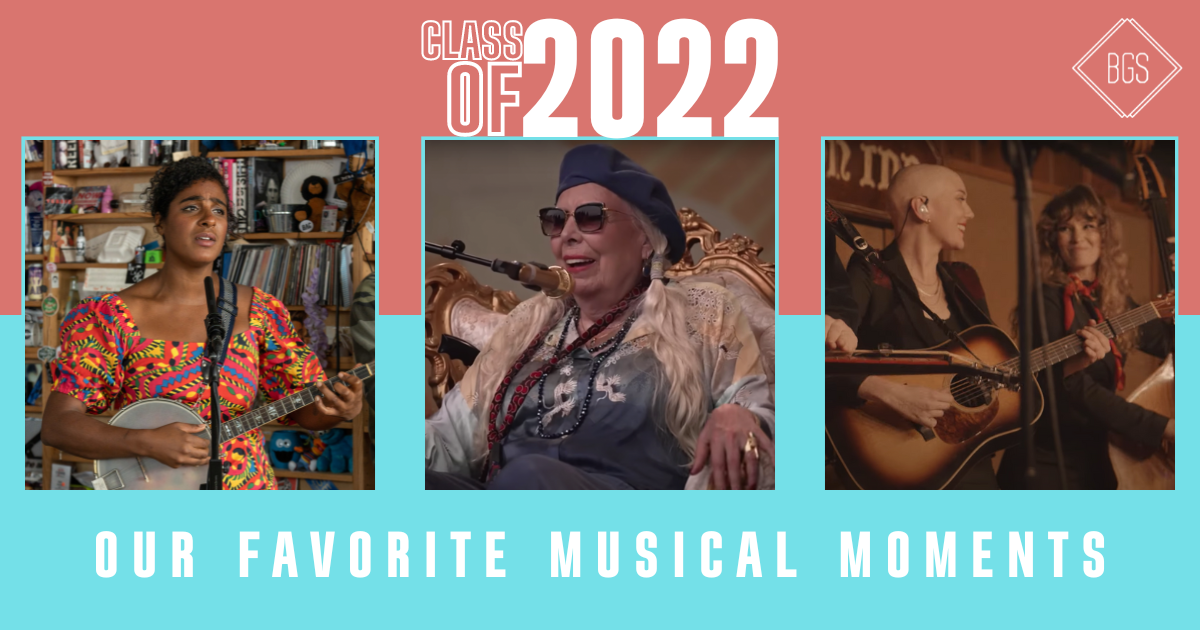
BGS Class of 2022: Musical Moments from Joni Mitchell, Molly Tuttle, and More

Whether you’ve been following the Bluegrass Situation for 10 years or 10 days, you’ve likely noticed that we cover more than bluegrass. That’s especially evident in our BGS Class of 2022, a retrospective written by our contributors that includes numerous familiar faces, a couple of superstars, and even a few surprises. (And you can probably tell that we’re fans of live music.) Here are our favorite moments of 2022, listed alphabetically and enthusiastically.

Banjos, Banjos, and More Banjos

For banjo lovers, 2022 offered an array of styles and inspirations. Jake Blount explored Afrofuturism on The New Faith, while Caamp’s Evan Westfall channeled his Ralph Stanley influences into the Americana-leaning album Lavender Days. Pharis & Jason Romero embraced a folk sound in “Cannot Change It All,” Tray Wellington indulged his interest in jazz on Black Banjo, and Leyla McCalla related her Haitian heritage in songs like “Fort Dimanche.” Could banjos be the great unifier? — Craig Shelburne


Big Thief, “Spud Infinity”

With its bounding cartoon mouth harp and Adrienne Lenker’s hound dog howl, this standout on Big Thief’s double album, is a goof on Americana tropes, a funny embrace of the kookier sides of early Dylan or maybe Country Joe & the Fish. The song’s odd climax is the bemused realization that you can’t kiss your own elbows: “They’re on their own!” Lenker declares. How the band manages to pivot from such silliness to a genuinely moving existential query is a cosmic bit of choreography. — Stephen Deusner


Black Artists in Country Music

Forty years ago I wrote a review of Big Al Downing’s LP on the Team label for the Bridgeport Post-Telegram (today the Connecticut Post). I got two letters — one from (I presume) a white man saying, “N-words don’t sing country music. Why did they print your crap?” The other came from a Black guy saying, “You’re a great writer. Write about OUR MUSIC.” I know he’d be thrilled at the presence of so many Blacks in country today, and at videos like Jimmie Allen’s poignant ‘Down Home.’ It’s about life, love, country things and every bit as much about Black life as any ghetto saga or rap chronicle. Seeing it always makes me happy and seeing him and other Black stars excel in country reaffirms it is AMERICAN music, period. — Ron Wynn


Kate Bush’s Second Run and Sam Bush’s Radio John

If this year gave us one thing to be especially grateful for, it was the return of Kate Bush, whose 1986 earworm “Running Up That Hill” was inescapable following its prominent inclusion in Season 4 of Stranger Things. Suddenly Kate was almost everywhere (though to some of us she never really went anywhere but I digress…). Even my 16-year-old niece suddenly knew about “Cloudbusting” and “Wuthering Heights,” to my great joy. But Kate wasn’t the only Bush to make an impact in 2022. A more familiar face to BGS fans, the Sam variety of Bush released a beautifully personal tribute, titled Radio John, for his friend and musical icon John Hartford. While the Bushes’ music couldn’t be more diametrically opposed, the “Bushaissance” was a welcome reminder that some of our most legendary artists continue to be as prolific and relevant as ever. — Amy Reitnouer Jacobs


Mike Campbell & The Dirty Knobs at Brooklyn Bowl Nashville

This March 15 show began as a statement of where Mike Campbell is going and ended with a celebration of where he’s been. It was a cathartic night of mourning Tom Petty’s death and celebrating that his brand of literate rock lives on through Campbell’s music vision. It was exhilaratingly joyful. Bonus: Margo Price bashing away on drums behind husband and opening act, melodic songwriter Jeremy Ivey. — Jim Patterson


Cimafunk at Austin City Limits

When Cimafunk taped his Austin City Limits debut in May, it was like watching the spirits of James Brown and Prince explode into an Afro-Cuban soul-funk supernova. The moves, the grooves, the seductive way rhythms rippled through his body … the language barrier simply melted away, replaced by pure, infectious energy. From gorgeous balladry to syncopated deliciousness, Cimafunk & the Tribe, his eight-piece, jazz-influenced band, left me crushing hard — and dancing out the door. — Lynne Margolis


JazzFest Returns

The first second line parade… the first blaring brass band … the first Cajun waltz… the first bite of a cochon de lait po’ boy… New Orleans’ JazzFest was back after three looooong years! The “headliners”? Who cares? The stuff you can’t get anywhere else was what we missed. DahkaBrakha from war-torn Ukraine, their traditional towering hats against a backdrop of the words “Won’t Bow Down,” the defiant credo of New Orleans’ Black Masking Indians? Yeah you right. — Steve Hochman


Kentucky Rising Raises $3 Million

After flash flooding decimated Eastern Kentucky in early August, Chris Stapleton organized a relief concert at Lexington’s Rupp Arena on Oct. 11 that included Kentucky all-stars Tyler Childers and Dwight Yoakam. The show’s highlight came during a star-studded finale that saw Eastern Kentucky musical paragons Ricky Skaggs and Patty Loveless join others for a rendition of John Prine’s “Paradise.” The surprise moment was a powerful reminder of how, even in the darkest of times, music has the power to lift spirits. — Matt Wickstrom


Joni Mitchell at Newport Folk Festival

After a 2015 aneurysm left Joni Mitchell having to relearn how to walk and sing, her performing days seemed over. But she had a comeback for the ages at this past July’s Newport Folk Festival, with help from Brandi Carlile and friends. Mitchell’s first full set in 23 years was an unequivocal triumph, especially the penultimate “Both Sides Now” – which had everyone there openly weeping. The moment of redemptive healing we didn’t know we needed. — David Menconi


Plains, I Walked With You a Ways

Waxahatchee’s Katie Crutchfield and Jess Williamson teamed up to form Plains this year, and Williamson may have written the perfect millennial country song for the project (though, as country music tends to do, it’ll resonate with any generation.) “Abilene” reluctantly talks of dreams that once were — now abandoned, for one reason or another. With white picket fences being harder than ever to reach these days, “Abilene” might leave my fellow millennials crying into their avocado toast, but immediately swept back up by this wholly incredible and refreshing album. — Shelby Williamson


Caitlin Rose, CAZIMI

Before November, Caitlin Rose hadn’t released an album since 2013 — and still managed to be a “top-played” artist for me every year. CAZIMI perfectly encapsulates why: Her hummable melodies, expertly balanced instrumental twang, and smart lyrical candor make every song feel like a confessional with your wittiest friend. From the forward-looking harmonies of “Getting It Right” to the vulnerable, clear-voiced “Blameless,” CAZIMI is yet another Rose stunner I’ll be spinning for decades to come. — Dacey Orr Sivewright


Sam Shackleton on Gems on VHS

A top musical moment for me this year was watching Scottish musician and folklorist Sam Shackleton on GemsOnVHS’ YouTube channel, performing the classic song “House Carpenter” from Arthur’s Seat which overlooks his hometown of Edinburgh. I love how Shackleton’s spirited busker style puts him at ease anywhere, solo or in a crowded pub jam. His richly accented singing voice and his unpretentious banjo style shine through in this video. — Lindsey Terrell


Sister Sadie, “Diane”

So, how’s this for a storyline? The singer finds out not only that her boyfriend is a two-timing creep, but also that he’s married to her friend Diane. And in this female take on the cheating story, knowing she has betrayed a friend is what hurts most. After a sweet acapella intro, a banjo backup tells you to strap in — the bluegrass is about to take off. Great story, great vocals, great drive. – Claire Levine


Chris Stapleton & Patty Loveless at the CMA Awards

For my musical moment of 2022, I didn’t have to go too far back. At this year’s CMA Awards, Chris Stapleton and Patty Loveless joined forces on a Darrell Scott classic, a gut-wrenching song about the hardship of living in the coal country of Eastern Kentucky. I performed this song a few times in my day and it still makes me shiver when I hear the hook: “You’ll Never Leave Harlan Alive.” — Jonny Therrien

https://www.youtube.com/watch?v=pZ2ZgQ1AP2c


Town Mountain, “Lines in the Levee”

With its first album on New West Records, Lines in the Levee, Town Mountain has broken into a new, exciting level. Based in Asheville, North Carolina, this Americana/bluegrass act is a high-octane, live-wire presence on stage. And, with this latest record, the group dug deep into its lyrical wellspring, commenting on the state of affairs in America — a melodic voice of reason amid uncertain times. In truth, after 17 years together, the band is only getting more raucous and riled up. “Lines in the Levee” has already become a staple in the concert realm. — Garret K. Woodward


Molly Tuttle & Golden Highway, “Crooked Tree”

Molly Tuttle’s “Crooked Tree” is a testament to finding strength in otherness. It’s a track that leans into traditional aesthetics while oozing Tuttle’s personality, worldview, and musical ethos — which remind of second-generation bluegrass trail blazers like Laurie Lewis and Lynn Morris. The confidence, vigor, and panache Tuttle has built with Golden Highway and on Crooked Tree are striking and widely resonant; in November, she received two Grammy nominations: Best New Artist and Best Bluegrass Album. — Justin Hiltner


Watkins Family Hour, Vol. II

I cheered about everything that went into Watkins Family Hour’s Vol. II. Not to downplay the 20-year milestone of Sean and Sara Watkins’ collaborative project but their third LP being devoted to just that, collaboration, felt like a burst of sunshine against lockdown’s darkness. Each song sounds so full of human individuality — of life. Rather than listening to a recording, I feel like I’ve walked into Largo for Watkins Family Hour’s next live show. — Kira Grunenberg


Photo Credit: NPR (Leyla McCalla); Newport Folk Festival (Joni Mitchell); Nonesuch Records (Molly Tuttle)

BGS 5+5: The Lowest Pair

Artist: The Lowest Pair
Hometown: Olympia, Washington
Latest Album: Horse Camp
Rejected Band Name: The Goodle Days

Answers by Palmer T. Lee

How often do you hide behind a character in a song or use “you” when it’s actually “me”?

Oh, this is very common practice in both directions. Sometimes a writer will take on a character as well, using “me” when its actually someone else. And that character could be a real person or quite frequently an amalgamation of people and experiences both real or concocted. Sometimes topics can feel a little too personal while they also feel relevant and powerful to write about and share so a new character is born of necessity. And of course, sometimes the most potent way to express this seems to be to keep it personal and use “me” when I mean “me” and yet the situation may not be 100% literal or accurate to the source. I mean, don’t let the truth get in the way of a good story, eh? The most important thing is to find what best serves the song, how the intention of the piece will be conveyed most effectively.

What other art forms — literature, film, dance, painting, etc. — inform your music?

I think it’s fair to say literature is the largest non-music art form that influences our music. While we have both always pursued musicianship, developing our technique and skill set, learning bluegrass and old time fiddle tunes, etc., we are songwriters first and musicianship is largely part of that toolbox. If someone were to deep dive into our lyricism they would likely find a lot of sampling and referencing of whoever we were reading or moved by at the time. And further, our styles are pretty influenced by writers as well. The playful word and phrase bending of e.e. cummings, the literary landscape paintings of Steinbeck, the psychospiritual paradigm twisting of Thich Nhat Hanh, to name a few.

If you had to write a mission statement for your career, what would it be?

It’s truly a blessing to find good work, to do something that feels important to both yourself and for others. On a personal level, we get to create these little tools that we can return to over time. Little devices we can process things through, both intellectually and emotionally. If a song doesn’t seem to be serving us (we’re not feeling it) it tends to gradually slink out of the set list. If it’s a song that has spent a lot of time with us there is probably a reason for that and these songs will likely return to rotation later with a whole new set of meanings and associations. The great bonus of this craft is that other people get to use them as well. Listening to a record can transport you to somewhere you didn’t know you needed to go, somewhere you forgot was there, somewhere you’ve been trying to figure out how to access. And in a live performance we all get to do that together, everyone on their own trip but also sharing the space and time with each other (a wonderful social experience for introverts! Ha!).

What rituals do you have, either in the studio or before a show?

Whenever possible I love to wash my hands before playing instruments, especially before a concert. There is something resetting and care-taking about it.

Which elements of nature do you spend the most time with and how do those impact your work?

A significant part of being a writer is spending time not writing, or at least not making anything, maybe thinking about writing, maybe not at all, maybe not even identifying as a writer for a while, maybe collecting notes from an overheard conversation or trying to describe the wind just for fun, or maybe just being quiet for a few days.

Kendl spends a lot of time hiking the Cascade and Olympic mountains and running through the densely forested parks of Olympia. I seem to frequently find myself living in the woods or an otherwise rough-and-tumble environment where you might need to walk fifty yards to do your business or cook and it’s quiet and the elements have a say in the flow of your day.

I think these influences can be both heard and intuited in our music. Place names will find their way into our stories, critters and plants, a sense of awe or isolation or reverence or a passing conversation with the colors and smells of a quiet dawn.


Photo Credit: Molley Gillispie

MIXTAPE: Lowland Hum’s Songs for Dusk

We’ve put together a group of songs that feel related to dusk: the transition moments between day and night. Included in our thinking about dusk are the days in between each season.. winter to spring, spring to summer, summer to fall and fall to winter days. We all need help in our times of transition, as we are being stretched, strained, or pressed between what was and what is to come. The songs that assist us in these travels seem to have an unplaceable quality, both disorienting and comforting like a sweet, warm drink with salt scattered on its surface.

The unique combination of anticipation and farewell allows these songs to occupy paradoxical thematic and sonic space. We need songs like these so we can bring more of ourselves into the present. So, we humbly offer this grouping of songs to accompany you in transitions of all kinds, whether they be literal dusks, the days between seasons, or simply moments where this particular tone may be soothing, cathartic, comforting or augmenting. To paraphrase something we read on The Milk Carton Kids’ Mixtape… “we include our songs aspirationally and for self-promotion here.” — Lowland Hum 

Aldous Harding – “Zoo Eyes”

We love Aldous Harding’s ability to shapeshift, morph, and play in her music while remaining vulnerable and human. It reminds us that those are all options we can choose as well when creating. Her most recent album, Designer, is delicious.

Bob Dylan – “He Was a Friend of Mine”

This song has always stood out to us as a deeply compassionate and humanizing song that packs so much into its few and deceptively simple words. It reminds me of the wordlessness that comes with deep grief. At the anniversary of George Floyd’s death I think of the great losses our nation has experienced this year and the way all words felt clumsy and insufficiently small in the face of such dumbfounding, dark and evil things.

Big Thief – “Open Desert”

We’re having a hard time finding what’s not to like about anything and everything coming from Adrianne Lenker (and her band) these days.

The Beatles – “Julia”

This melody is so wistful, dreamlike, sad, and lovely. “When I cannot sing my heart I can only speak my mind, Julia, sleeping sand, silent cloud, touch me so I sing a song of love, Julia.”

Radiohead – “You and Whose Army?”

The beginning of this song makes us feel like we are suspended in shimmering stardust thick enough to hold a person’s weight. The arrangement blooms so patiently until you suddenly tumble down a flight of stairs. That a recording can do that is one of the main reasons we organize our life around music.

Antonio Carlos Jobim – “Look to the Sky”

I mean, are you not slow dancing by yourself on a terra cotta tile patio, barefoot, with a cocktail in hand when you hear this?

Labi Siffre – “Cannock Chase”

The combination of this picked guitar and gently shuffling percussion sounds like being in the car at dusk with the windows down, scenery flying by.

The Zombies – “Beechwood Park”

We’ve listened to this album so much in the past few years, but somehow only really noticed this song and its magnificence in the past week. Now we are obsessed.

Nick Drake – “Free Ride”

To us Nick Drake always sounds like sunlight filtering through the leaves of trees. Although this one carries a bit more urgency and pep than some of his other songs, this one is no exception.

Myriam Gendron – “Solace”

This song comes from an album of Dorothy Parker poems put to music by Myriam Gendron. The whole album is like a friend sitting silently beside you when you’re feeling a lot. You probably need it in your life.

Keur Mossa – “Quand le fils de l’homme viendra”

This song comes from an album that has been an immense comfort to us in times of transition. When far from home, while working on building our studio in early morning light, while in labor with our first child… It’s a beautiful treasure of humanity reaching toward divinity.

Tiny Ruins – “One Million Flowers (solo)”

This album is all solo guitar and voice versions of Tiny Ruins’ full-band album Olympic Girls. Hearing these songs stripped to their skeletons showcases how strong her songwriting and voice are. Though we were fans of the full-band album first, we prefer these versions hands down. We aspire to make songs that can stand on their own naked or dressed up.

Lowland Hum –”We Do What We’re Told (Milgram’s 37)”

This is our cover of Peter Gabriel’s “We Do What We’re Told (Milgram’s 37)” from his album, So. We covered that album in its entirety, calling our version So Low. Our version came out on the 35th anniversary of the original’s release.

Lou Reed – “Perfect Day”

This song is a cocktail of equal parts bummed-out and triumphant. How he does it we don’t know, but we love it.

Frank Sinatra – “Mood Indigo”

The strings and reeds in this song are like sitting on a fire escape in the warm balmy breeze of a summer evening. Sinatra’s delivery is so subtle and masterful. You can’t go wrong with any song on In the Wee Small Hours.

The Weather Station – “Trust”

We have long been fans of Tamara Lindeman. Her songwriting is like a window into the unspoken dialogue of real relationships.

Arthur Russell – “Close My Eyes”

This song is so visual to me (Lauren). It reads in the mind like a bedtime story complete with dark oil pastel illustrations. I dare you to close your eyes and not see it all.

Gold Connections –”Confession”

Will Marsh of Gold Connections is a dear friend of ours but we promise we aren’t biased. They just released this single and we can’t get enough of it. This song has it all: city and desert; neon signage and the kind of starry sky that can only be seen when you are far from civilization.

Bruce Springsteen – “Nebraska”

Tragic, startling, beautiful. Daniel always says he believes in this album because it gave him compassion for a mass murderer. That’s some power right there.

Paul Simon – “Night Game”

What a stunning and mournful number. Who knew a song about baseball could feel so mystical? Hold out for the otherworldly harmonica solo by Jean-Baptiste Frédéric Isidor. This one has comforted us on many a late-night drive.

Adrianne Lenker – “forwards beckon rebound”

This whole album is a treasure. This song has such a great momentum while remaining quiet.

Martin Denny – “Trade Winds”

This exotica album is a staple in our household during our newborn son’s bathtimes. But we find it perfectly appropriate for listeners of all ages and stages. It is perfectly campy and yet transportive.

Lowland Hum – “Waite”

We felt that we needed to include at least one original Lowland Hum song, so here’s our duskiest. This song was written while on tour in Europe in 2017. We were playing a house concert in a landscape painter’s home studio and gallery (Andy Waite is the name of the painter and now friend) and the guitar part mysteriously came to Daniel while we were setting up in the space. Something about being in a home so steeped in one person’s creative life and flow was magical. There was a very real substance in the air that mysteriously found its way into Daniel’s fingertips as he was messing around on guitar.


Photo credit: Tristan Williams

Gig Bag: Big Thief

Welcome to Gig Bag, a BGS feature that peeks into the touring essentials of some of our favorite artists. This time around, we look at what Big Thief's Adrianne Lenker has to have handy when she's out on the road.

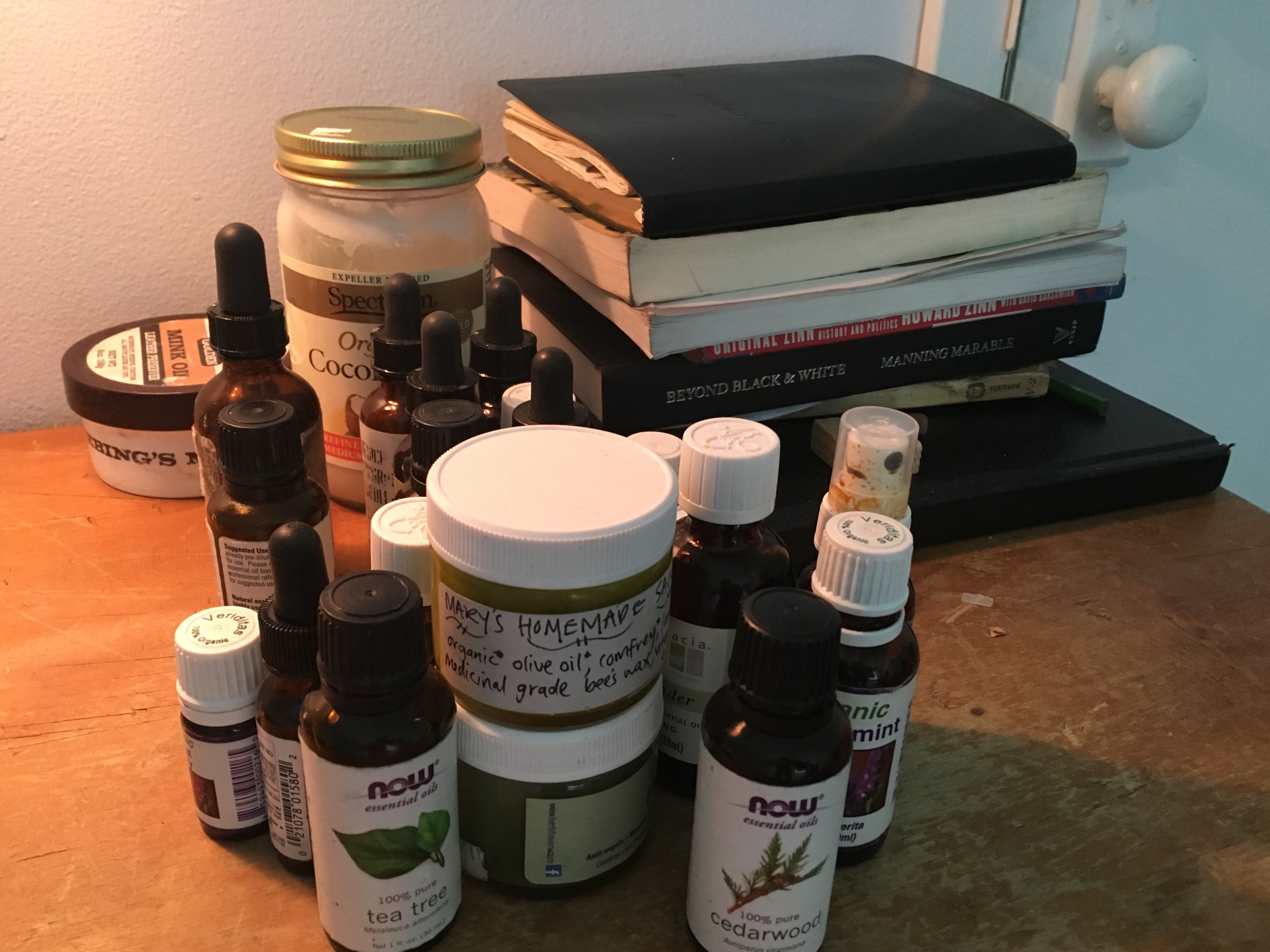
Essential oils: I keep lavender, frankincense, peppermint, titri, cedar wood, coconut, and my friend Mary Remington's handmade beeswax and comfrey vitamin lavender Olivia oil salve. They are medicinal and healing, and help me control my personal environment in the constantly changing paradigms of touring. 

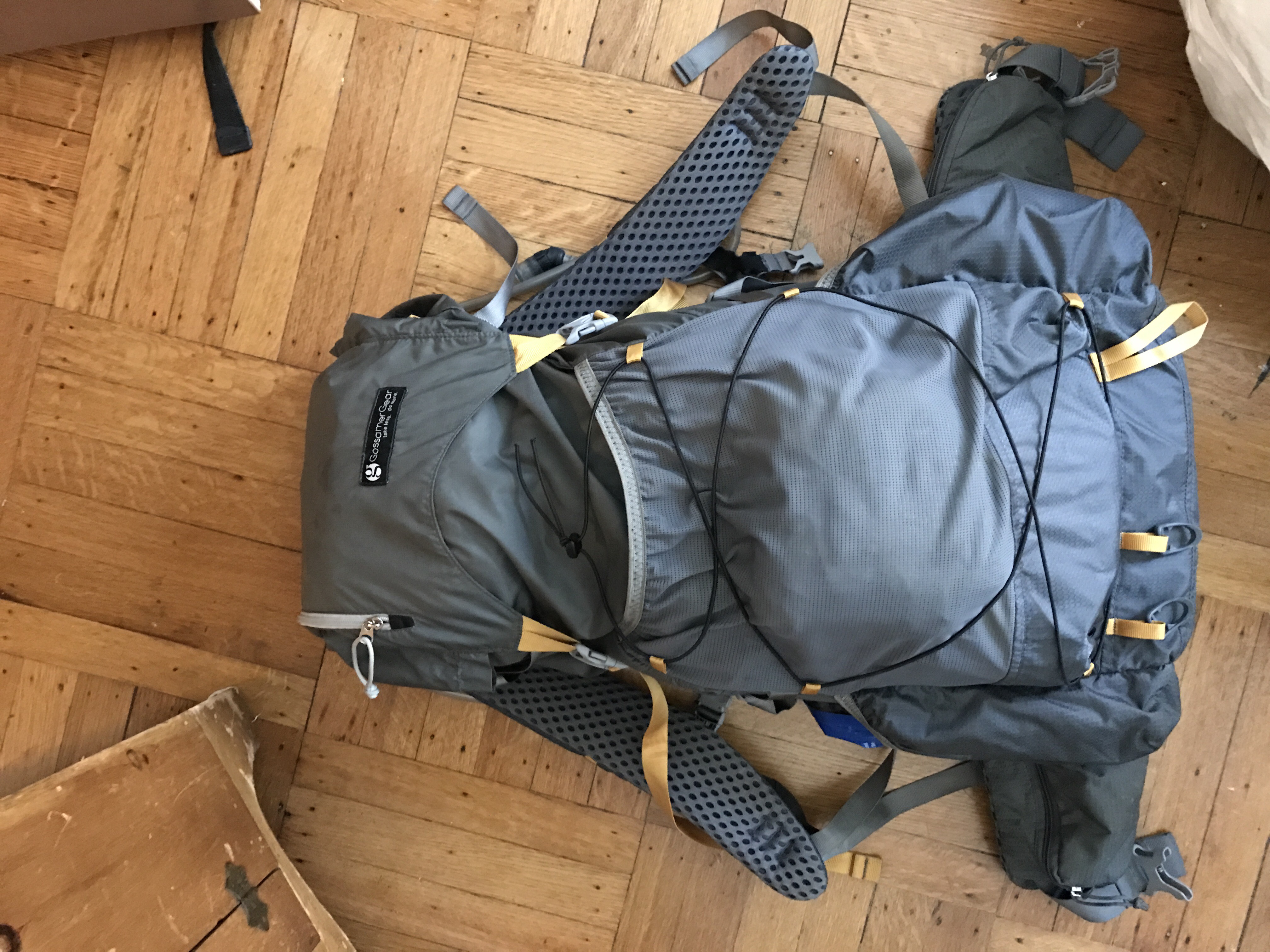
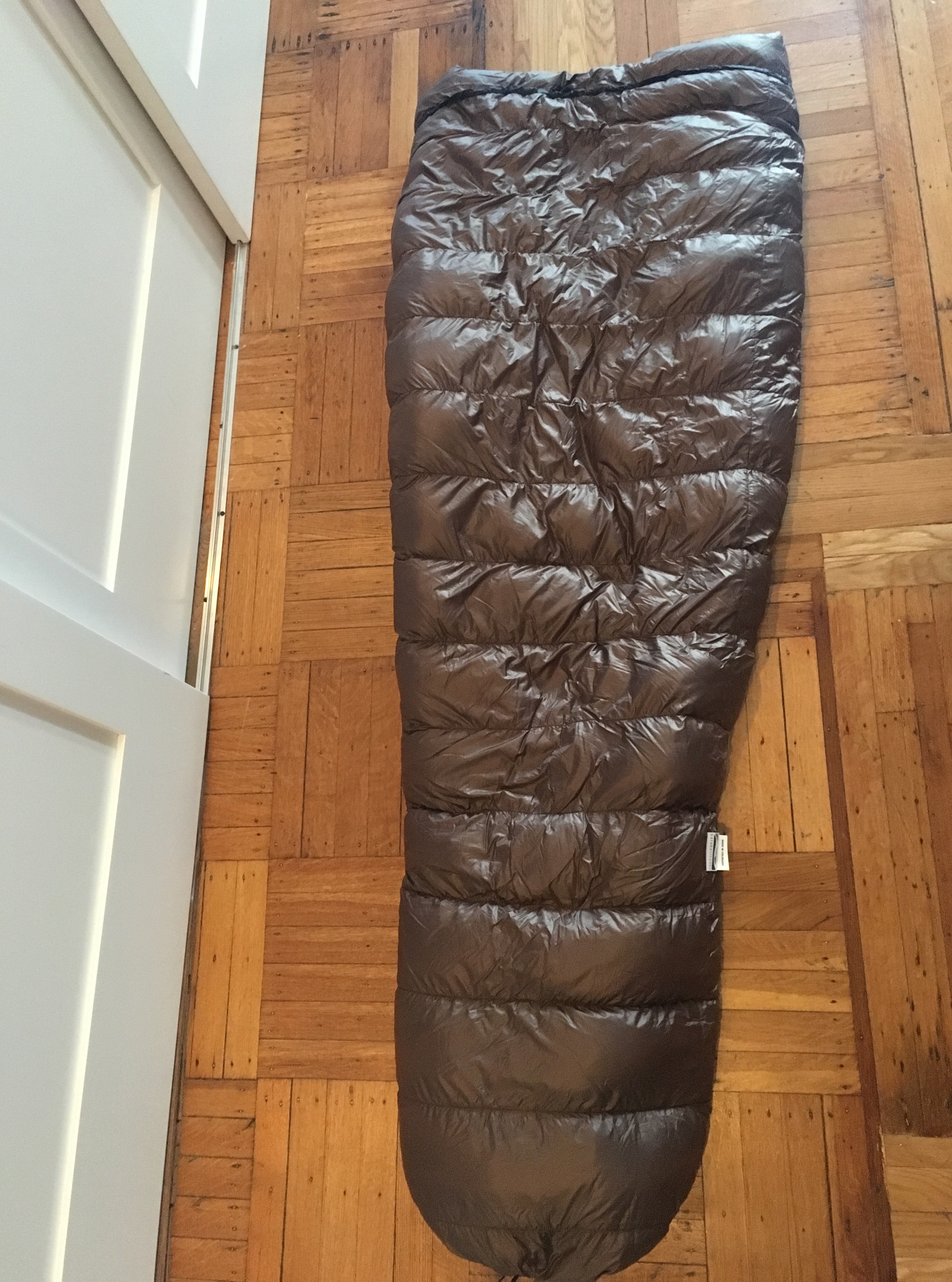
Camping gear: I always take a full rig of camping gear on tour in case there's a chance to sleep outside or hike. I use a Gossamer Gear backpack which is super light, a down sleeping bag, a water purifier, butane stove, ZPacks Duplex tent, air pad, waterproof jacket, warm wool layers, and a knife. 


Down sleeping bag: In addition to camping, this comes in handy for crashing on couches or in the van. 


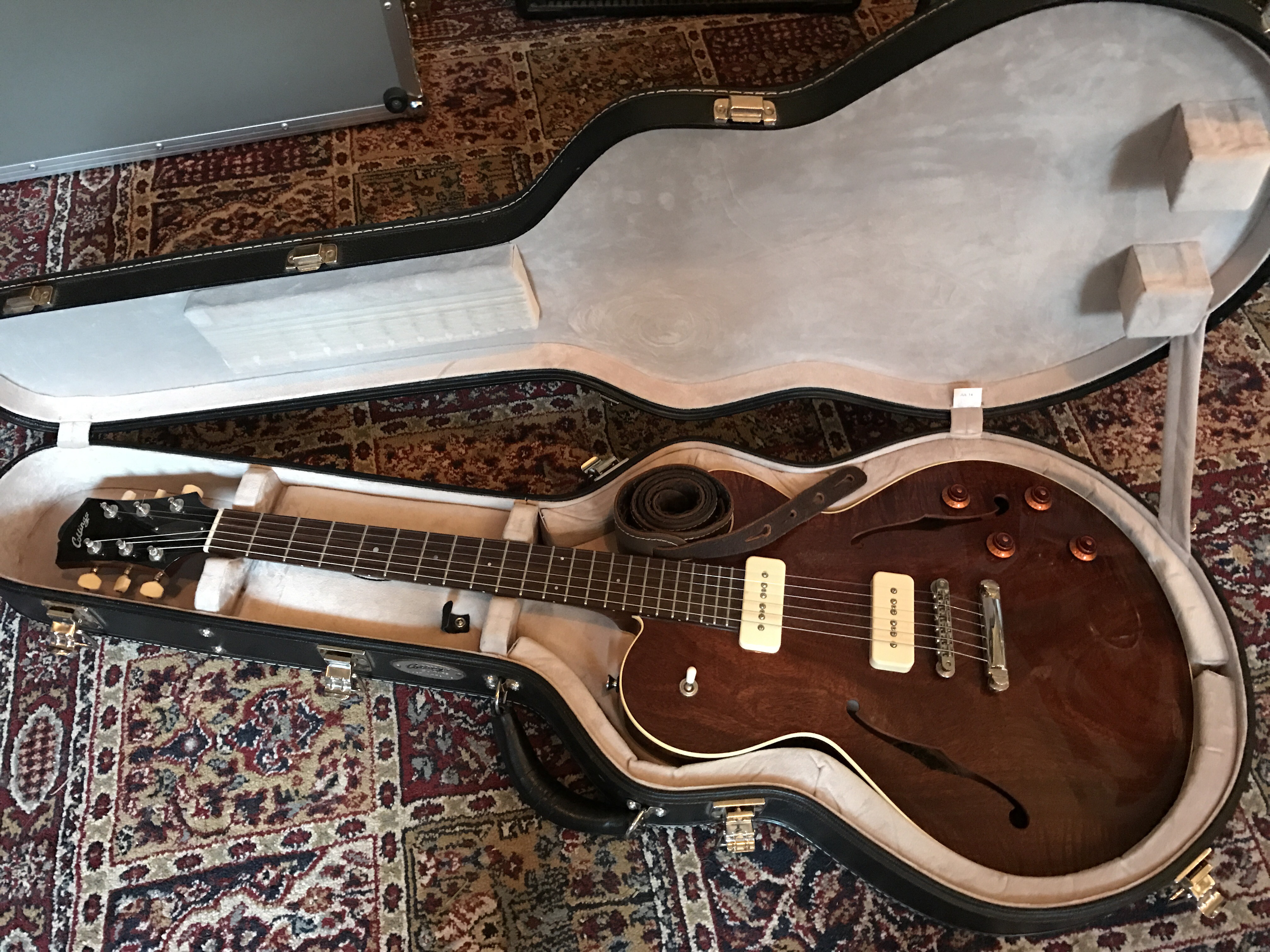
Collings SoCo guitar: I keep one photograph, a pen, a whittled necklace from my Texan friend, a piece of Labradorite from my brother, an extra set of strings, a guitar strap my dad gave me when I was six, a capo, a dollar bill I made busking when I was 14, a rattlesnake rattle, and thumb picks.


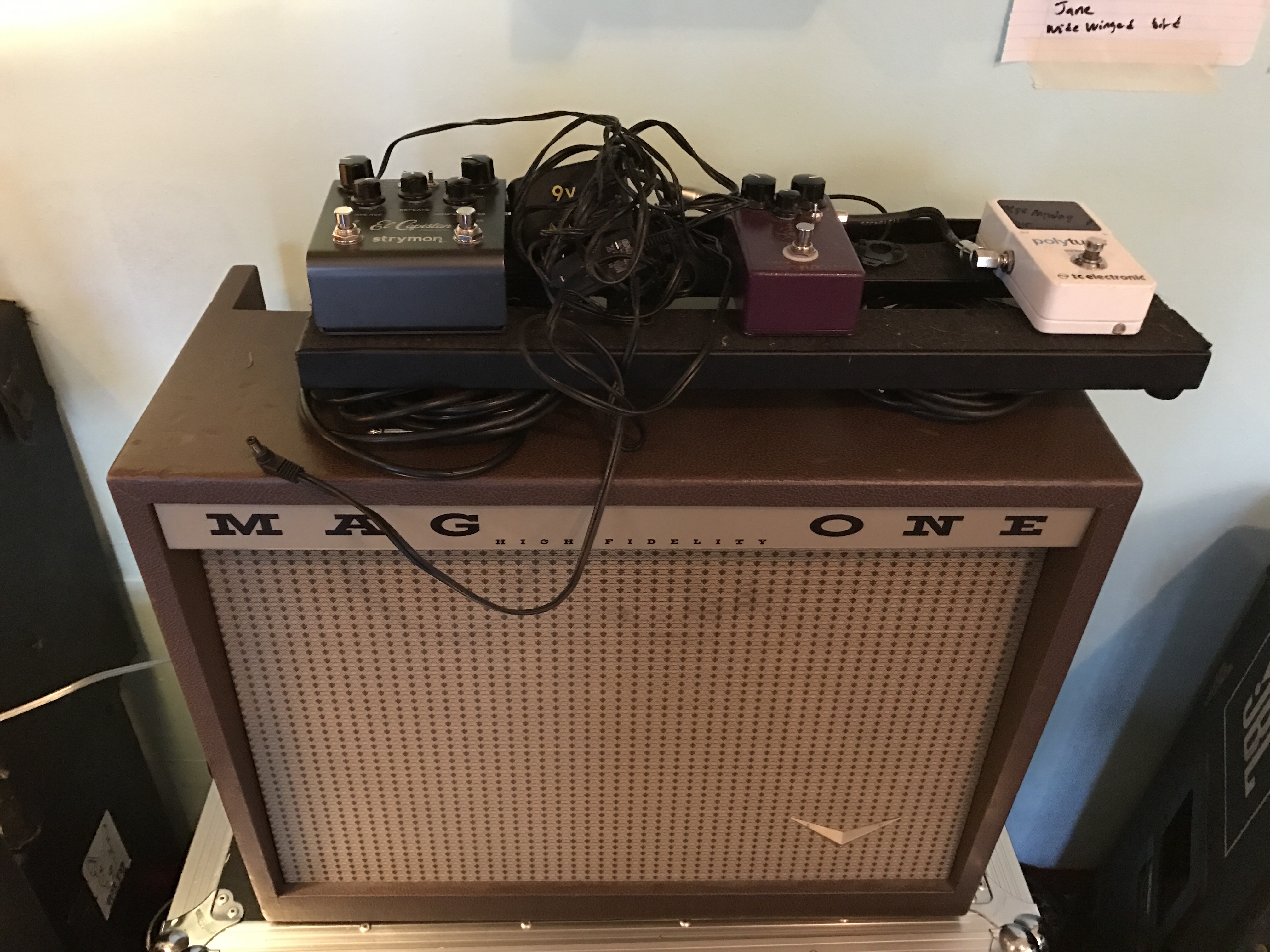
Magnatone Twilighter amp and my pedalboard: I think this is the best amp in the world. I use a Strymon Capistan tape echo pedal, an Analogman Prince of Tone, and a tuner. 


Lede photo by Mikey Buishas. All other photos by Adrianne Lenker.

SaveSave